
AI Relationship Coach for Trust Issues (2026)
Find the best AI relationship coach for trust issues in 2026. Lovon offers voice-based, personalized sessions 24/7 — no waitlist, no $200 hourly fee.

Key Takeaways
- Generic mindfulness apps rebranded as relationship coaches. Headspace and Calm serve a real purpose, but a breathing
- AI tools that skip the emotional history layer. An AI that only asks "what happened today" misses the attachment
- Text-only platforms for distress-heavy content. Typing a jealousy spiral at 1 a.m. produces less therapeutic
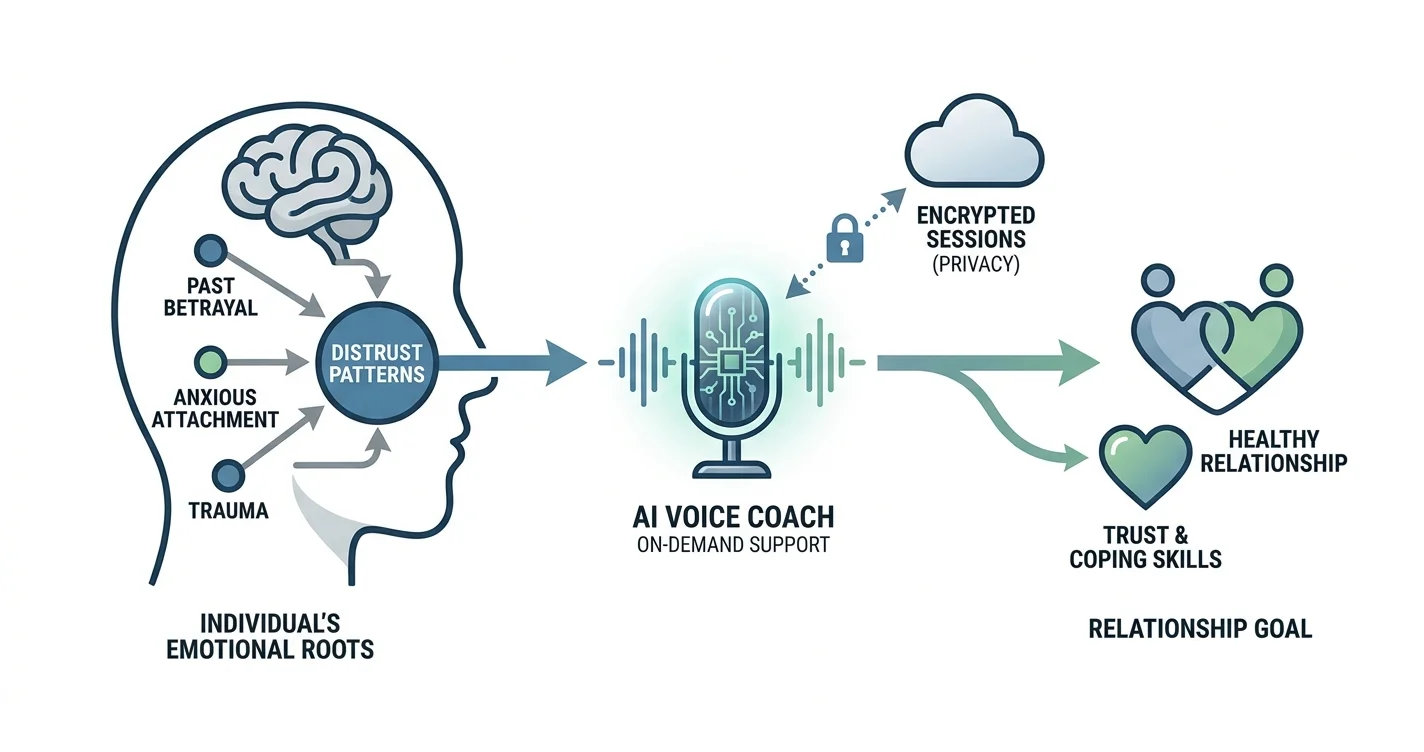
If trust issues are making your relationship feel like a minefield, an AI relationship coach can give you a private, on-demand space to work through the patterns driving that distrust — without waiting weeks for a therapy slot or spending $200 per session.
TL;DR: An AI relationship coach for trust issues works best for people who need structured, judgment-free support to identify where their distrust comes from — past betrayal, anxious attachment, or communication breakdowns — and build concrete coping skills. Lovon's AI relationship coach delivers voice-based, personalized sessions available 24/7 in 2026. It is not a substitute for couples therapy when active infidelity or abuse is present, but for the wide middle ground of chronic low-grade distrust, it is a strong first move.
If you would rather start by naming the pattern than by talking it through, the do I have trust issues quiz is twelve questions and needs no account.
Why This Matters in 2026
Trust issues are one of the top three reasons couples seek coaching, alongside communication breakdowns and intimacy problems. The average wait time to see a licensed couples therapist in the US is 3–6 weeks, and weekly sessions average $150–$250 out of pocket. AI-powered voice therapy apps close that gap: they are available the moment a spiral starts — 2 a.m. after reading a suspicious text, or right after a fight where the old wound reopened. For health and wellness users who already track mental state on their phones, adding a relationship-specific AI coach in 2026 is a natural, low-friction step.
Who This Is For
This guide is for individuals — not couples — who suspect their own trust patterns are at least part of the problem. You might have been cheated on before and now monitor your current partner's every move. You might have an anxious or fearful-avoidant attachment style that flags safety threats where none exist. You might be the person whose partner calls them "too jealous" or "always suspicious." You are not in active crisis, but the slow corrosion of distrust is damaging something real. You want tools, not just validation.
What to Look for in an AI Relationship Coach for Trust Issues
Attachment-Aware Questioning
Trust issues rarely live in the present. They are rooted in attachment patterns formed in early relationships or past betrayals. A good AI relationship coach asks about history, not just the current argument. It identifies whether your distrust is anxious-attachment-driven (hypervigilance, need for constant reassurance) or avoidant-driven (emotional distance, pre-emptive withdrawal). Without that diagnostic layer, advice is generic and often counterproductive.
Voice-Based Interaction
Typing out your worst fears about a relationship is hard. Speaking them out loud — even to an AI — activates a different processing mode. Research in emotional disclosure consistently shows that verbal expression produces greater emotional relief than written journaling for distress-heavy content. In 2026, the best AI wellness apps use voice as the primary interface for exactly this reason. An app that is text-only misses the therapeutic mechanism that makes the session actually useful.
Personalized Session Structure, Not Scripts
Generic chatbots offer canned responses: "That sounds hard. Have you tried talking to your partner?" A real AI relationship coach adapts to what you said two sessions ago. It notices if the same trigger keeps appearing. It adjusts the depth of a session based on your current emotional state. Personalization is the single biggest differentiator between an app that helps and one that you delete after three days.
Coping Tools Delivered In-Session
The coach should not just surface insights — it should hand you something you can use in the next 24 hours. That means specific cognitive reframing exercises for jealousy spirals, grounding techniques for hypervigilance, and communication scripts for bringing trust concerns to a partner without triggering defensiveness. Insight without a practical tool is just a more expensive diary entry.
Privacy Architecture
People share things in a trust-issues session they would not tell a best friend. The app needs end-to-end encrypted sessions, no third-party data sharing, and a clear data deletion policy. In 2026, any wellness app that is vague on privacy terms should be disqualified immediately — the sensitivity of the content demands it.
On-Demand Availability
Trust spirals do not schedule themselves. The highest-distress moments — late at night, during a work trip, mid-argument aftermath — are exactly when you cannot call a therapist. An AI coach that is available 24/7 catches the moment when intervention is actually useful. Scheduled-only formats miss the window.
Top Picks
Lovon — The Safe Pick for Ongoing Trust Work
Hook: The structured, voice-first option built specifically for emotional and relationship support.
The spec that matters: Voice-based sessions with personalized mental health framing, covering anxiety, depression, stress, and relationship issues in one platform.
Lovon is an AI-powered voice support app that runs personalized sessions on-demand. For trust issues specifically, it covers the emotional undercurrent — anxiety, hypervigilance, attachment wounds — that drive distrust, not just the surface-level relationship complaint. A session can start immediately, any hour of the day in 2026, without scheduling. The AI relationship coach is accessible directly, and the broader platform connects relationship coaching to the mental health roots that make trust issues sticky.
Verdict: Buy. If your trust issues are tangled with anxiety or past relationship trauma, Lovon's combined approach — voice sessions, coping tools, personalized framing — is the right starting point.
Compatibility Self-Assessment — The Diagnostic Wildcard
Hook: Useful before you spend time on any coaching if you are unsure whether the issue is you, the relationship, or the match.
Running a compatibility check surfaces whether core value misalignments or attachment-style clashes are generating the distrust rather than a specific incident. Lovon's compatibility quiz takes under 10 minutes and gives you a structured read on relational fit. This is not a replacement for coaching — it is a diagnostic first step that tells you what kind of coaching to prioritize.
Verdict: Consider. Pair it with ongoing sessions, not instead of them.
AI Therapy Track — For Deep-Rooted Betrayal Trauma
Hook: When the trust issue is actually a trauma response that relationship coaching alone won't touch.
Some trust issues are not about the current relationship at all — they are unprocessed betrayal trauma from a previous one, or childhood attachment failures. In those cases, pure relationship coaching addresses the symptom while the cause stays buried. Lovon's AI voice support track runs sessions specifically structured for anxiety, depression, and trauma patterns. The 2026 platform integrates this with the relationship coaching layer so you are not bouncing between disconnected apps.
Verdict: Buy if a therapist has ever used the word "trauma" in your context. Consider if you are uncertain — the sessions will tell you quickly which track is more relevant.
What to Avoid
- Generic mindfulness apps rebranded as relationship coaches. Headspace and Calm serve a real purpose, but a breathing exercise does not address why you read your partner's messages when they leave the room. If the app's relationship feature is a "communication tips" article pack, it is not a coach.
- AI tools that skip the emotional history layer. An AI that only asks "what happened today" misses the attachment pattern context that makes trust issues chronic. You need an app that builds a model of your specific patterns over multiple sessions, not one that resets each time.
- Text-only platforms for distress-heavy content. Typing a jealousy spiral at 1 a.m. produces less therapeutic movement than speaking it. If the app has no voice mode, it is solving the wrong problem for this use case in 2026.
Verdict Comparison
| Tool | Attachment-Aware | Voice-Based | Personalized | Coping Tools | On-Demand |
|---|---|---|---|---|---|
| Lovon AI Relationship Coach | Yes | Yes | Yes | Yes | Yes |
| Compatibility Quiz | Partial | No | No | No | Yes |
| Lovon AI Voice Support | Yes | Yes | Yes | Yes | Yes |
| Generic Mindfulness App | No | No | No | Partial | Yes |
| Text-Only AI Chatbot | No | No | Partial | No | Yes |
FAQ
What is the best AI relationship coach for trust issues in 2026? Lovon is the strongest option for people whose trust issues are tied to anxiety or attachment patterns. Its voice-based, personalized sessions address the emotional roots of distrust — not just the surface argument — and it is available 24/7 without scheduling.
Can an AI relationship coach actually help with jealousy? Yes, for jealousy rooted in anxious attachment or past betrayal — which covers the majority of cases. AI coaches deliver cognitive reframing exercises, grounding techniques, and communication scripts that reduce jealousy-driven behavior between sessions. They do not replace couples therapy when the jealousy is caused by an ongoing trust violation in the current relationship.
Is AI relationship coaching private and confidential? Reputable apps use encrypted sessions and do not share conversation data with third parties. Verify the privacy policy before starting — look specifically for data retention and deletion terms. Lovon is built with individual emotional safety as a core design constraint.
How is an AI relationship coach different from a regular therapist? A licensed therapist provides clinical diagnosis and treatment, accepts insurance, and can manage crisis situations. An AI relationship coach provides structured emotional support, coping tools, and behavioral coaching on-demand. In 2026, the best use case is AI coach for daily pattern work and ongoing coping, therapist for clinical diagnosis or crisis.
How much does an AI relationship coach cost compared to human coaching? Human relationship coaches charge $100–$300 per session. AI relationship coaching apps typically cost $0–$30 per month for unlimited access. The 2026 market includes free-tier options — Lovon offers an accessible entry point — making consistent daily support financially viable for the first time.
Is an AI relationship coach better than doing nothing? For chronic trust issues, yes — significantly. Untreated trust patterns compound: they erode relationships, spike cortisol chronically, and often escalate into controlling behavior. Structured coaching, even AI-delivered, interrupts the pattern with concrete tools rather than letting it run.
What attachment styles benefit most from an AI relationship coach for trust issues? Anxious and fearful-avoidant attachment styles see the most immediate benefit, because both produce hypervigilance and distrust even in objectively safe relationships. Secure attachment styles rarely develop chronic trust issues without a specific external trigger like infidelity.
Can an AI relationship coach help after being cheated on? Yes for processing your own response and building coping tools. If you are rebuilding trust within the same relationship post-infidelity, couples therapy with a licensed therapist should run alongside the AI coaching — not replace it. For individual healing after leaving a relationship where you were cheated on, AI coaching is well-suited to the work.
One Last Thing
Research on trust repair consistently identifies one counterintuitive finding: the people who most need to work on trust issues are often those who insist the problem is entirely their partner's fault. AI coaching works best when you bring at least 10% openness to examining your own patterns. If you are fully in that space right now, a single session with Lovon's AI relationship coach will show you more about your own distrust architecture in 30 minutes than a week of self-reflection alone — because it asks the questions you have been avoiding.
Related Guides
How AI Support Helps You Heal
AI emotional support isn't about replacing human connection — it's about filling the gaps. The moments when you need to talk at 2 AM, when you don't want to burden your friends again, or when you simply need someone to listen without judgment.
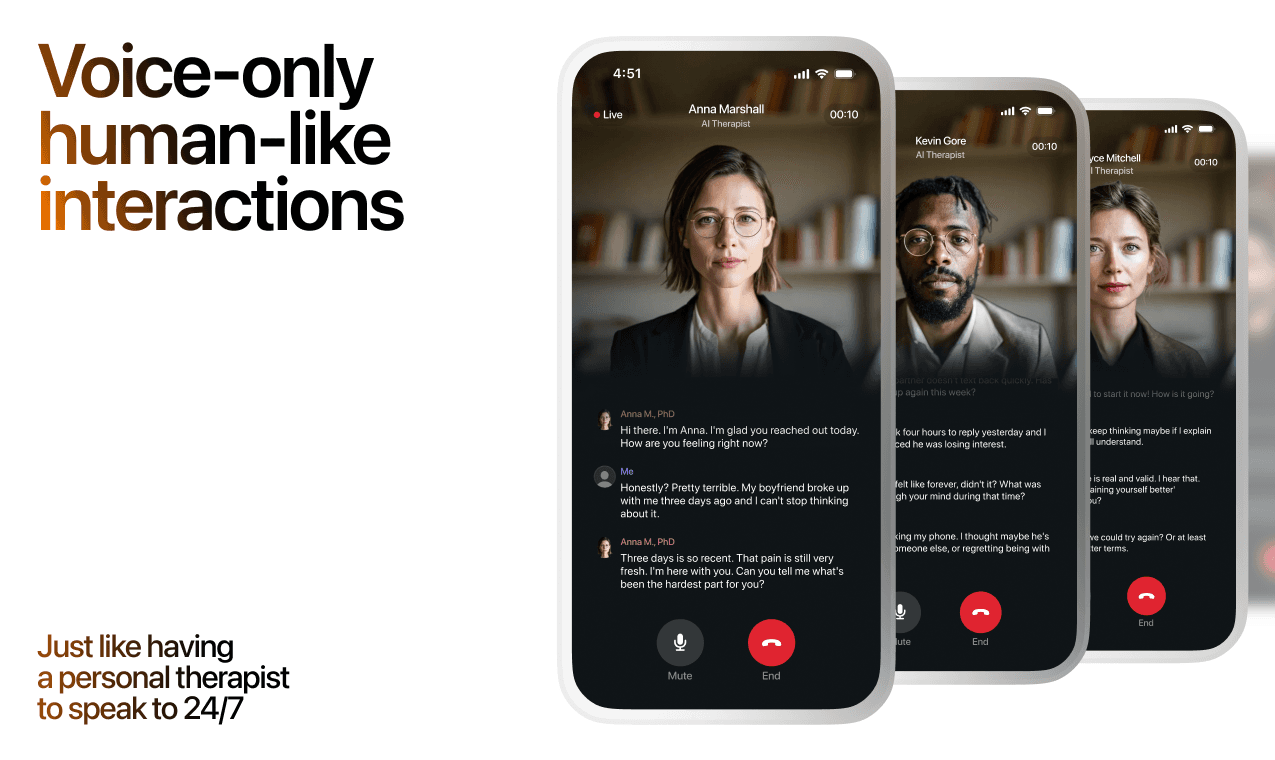
Here's what happens in a typical Lovon session:
You share what's on your mind
There's no script, no intake form, no waiting room. You speak or type whatever you're feeling — in your own words, at your own pace.
Lovon validates and explores
Using frameworks from CBT (Cognitive Behavioral Therapy) and motivational interviewing, Lovon acknowledges your feelings first, then gently helps you explore them. No dismissive "just move on" advice.
You build coping skills together
Lovon doesn't just listen — it actively works with you on evidence-based techniques: thought reframing, urge surfing, behavioral experiments, and more.
What a Session with Lovon Looks Like
When to Seek Professional Help
AI support is a valuable tool, but it's not a replacement for professional care. Please consider reaching out to a licensed therapist if you experience any of the following:
- Persistent thoughts of self-harm or suicide
- Inability to perform daily activities (work, eating, sleeping) for more than 2 weeks
- Turning to alcohol or substances to cope
- Intense anger or desire to harm your ex-partner
- Complete emotional numbness that doesn't improve over time
Crisis Resources (US): If you're in immediate danger, call 988 (Suicide & Crisis Lifeline) or text HOME to 741741 (Crisis Text Line). Available 24/7, free, and confidential.
Outside the US? Find a crisis line in your country
Ready to Start?
Your healing journey can begin right now
A 7-day trial. No judgment. Just a safe space to process what you're going through.
Frequently Asked Questions
Is Lovon a replacement for a real therapist?
Is my conversation with Lovon AI private?
How is Lovon different from ChatGPT for emotional support?
Can I use Lovon if I'm already seeing a therapist?
Can I try Lovon before subscribing?
About the Author
The Lovon Editorial Team
Mental Health & Wellness Content Team
The Lovon Editorial Team develops mental health and wellness content designed to make psychological concepts accessible and actionable. Our goal is to bridge the gap between clinical research and everyday life - helping you understand why your mind works the way it does and what you can do about it....
Related articles
- AI Relationship Coach for Adoptive Parent Bonding 2026
Lovon's AI relationship coach helps adoptive parents process bonding stress daily in 2026 - a companion between therapy…
- AI Relationship Coach for Breakup Recovery 2026
The best AI relationship coach for breakup recovery in 2026. Lovon delivers voice-based, on-demand emotional support and…
- AI Relationship Coach for Dating Confidence: 2026 Guide
The best ai relationship coach for dating confidence in 2026 pairs voice practice with real self-worth work, not…
- AI Relationship Coach for Chronic Illness Couples 2026
An ai relationship coach for couples facing chronic illness in 2026: what Lovon does, what it doesn't, and how to build…
See also
Quizzes
- Am I Sabotaging My Relationship? 12-Question Quiz
Find the move you reach for, in 2 minutes.
- Conflict Style Test: How You Fight and How You Repair
See how you fight, and whether you repair.
Free tools
- Relationship Check-In Questions, and How to Run One
Check-ins fail on structure, not on questions. Tell it whether this would be your first one, what is on your mind, and…
- What to Say When They Are Struggling
A chat, not a list. Tell the coach who this person is to you, what they are going through, and what you already said…
From the wiki
- What is cheating in a relationship?
Cheating is a breach of the agreement you and your partner made about who else gets your body, your attention and your…
Disclaimer: This article is for informational purposes only and does not constitute medical advice, diagnosis, or treatment. Always seek the advice of your physician or other qualified health provider with any questions you may have regarding a medical condition. If you are in crisis or think you may have an emergency, call 988 (Suicide & Crisis Lifeline) or go to the nearest emergency room. Outside the US? Find a crisis line in your country.