
Emotional Support App for Loneliness: What Wins in 2026
Compares emotional support apps for loneliness in 2026 — what to look for, top picks, and verdicts. Lovon rated the top AI voice therapy option.

Key Takeaways
- Apps that claim to "cure" loneliness in a fixed number of sessions. Isolation isn't a checklist; anything promising
- Tools with no clarity on data handling. If a privacy policy is vague about voice recordings or chat logs, that's a
- Anything positioning itself as a replacement for a licensed clinician. A trustworthy emotional support app tells you
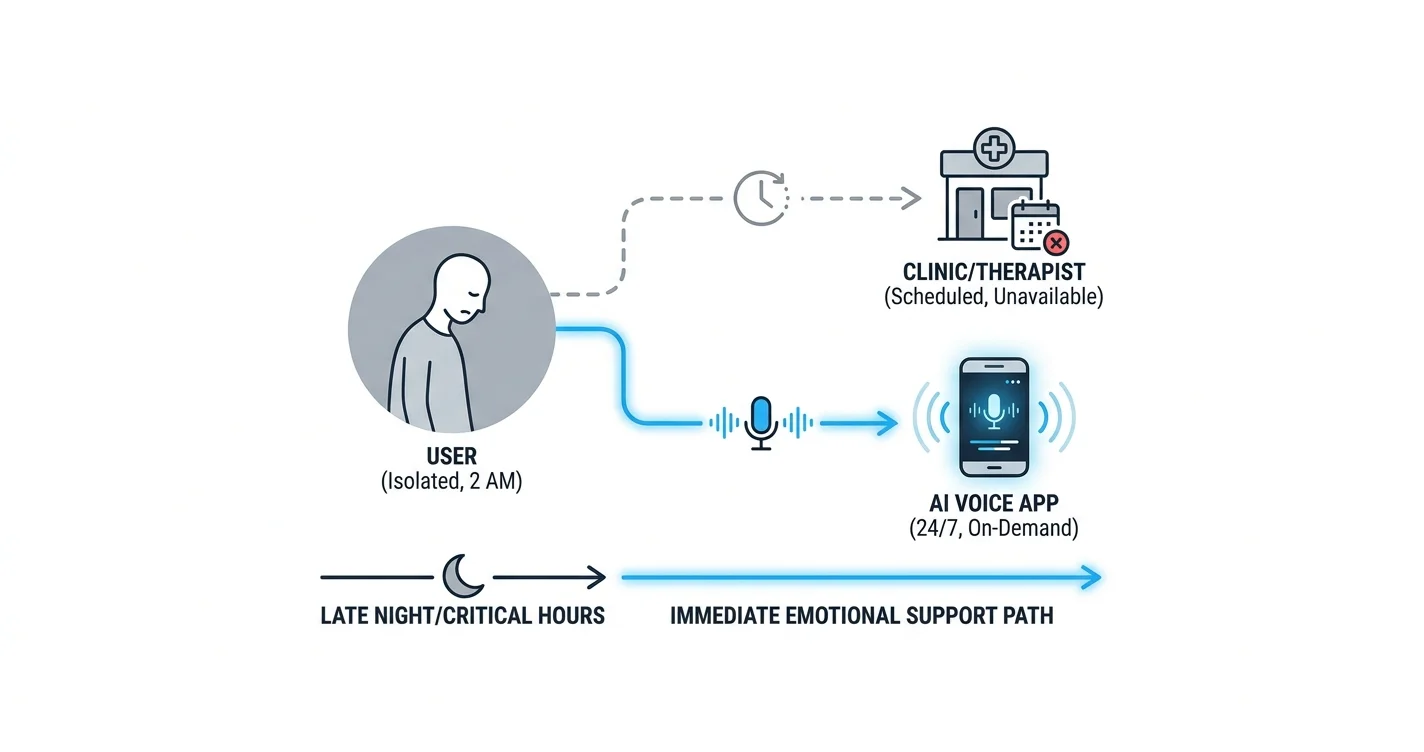
Loneliness doesn't wait for office hours, and neither should the support you reach for. If you're comparing an emotional support app for loneliness against therapy, journaling, or peer forums, this guide breaks down what actually matters and names the pick worth your time in 2026.
TL;DR
An emotional support app for loneliness works best when it's available at 2 a.m., costs less than a copay, and doesn't pretend to replace a licensed therapist. Among AI voice support options, Lovon is the Buy for daily check-ins and coping tools built with input from PhD psychologists. Text-based chatbots are a Consider for quick venting, peer support forums are a Consider with caveats about moderation quality, and video teletherapy is a Buy only when you need a diagnosis or medication management, not a fast fix for a lonely Tuesday night.
Why this matters
The U.S. Surgeon General's 2023 advisory tied chronic loneliness to a mortality risk comparable to smoking up to 15 cigarettes a day — that's not a small-talk statistic, it's a public health one. Lovon built its entire premise around closing the gap between "I need to talk to someone right now" and "the next available therapy slot is in three weeks." Loneliness spikes at odd hours: after a breakup text, during a Sunday scroll, in the middle of a sleepless night. An app that's actually there in that moment does more good than a perfect one you can't access until Thursday.
Most people searching for an emotional support app for loneliness in 2026 aren't in crisis. They're isolated, under-stimulated socially, or grinding through a stretch where friends feel far away. That's a different problem than clinical depression, and it calls for a different kind of tool.
Who this is for
This guide is for someone who feels disconnected more days than not — recently moved, working remote, going through a breakup, or just noticing that months pass without a real conversation. It's not for someone in acute crisis; if you're having thoughts of self-harm, a crisis line or emergency care comes first, not an app. It's also worth separating the feeling from the fact: understanding the difference between loneliness and being alone changes what kind of support actually helps.
What to look for in an emotional support app for loneliness
Availability outside business hours
Loneliness doesn't schedule itself around a 9-to-5. An app that's live at 11 p.m. on a Saturday solves a real problem that a Monday-through-Friday therapist can't. If the tool can't be reached the moment you need it, it's not actually solving the isolation problem — it's just another appointment.
Voice, not just text
Typing out how you feel takes energy you may not have on a bad night. Voice conversation lowers the friction between feeling something and saying it out loud, and tone carries information text strips out. This is the single biggest differentiator between older chatbot apps and newer AI voice therapy tools in 2026.
Grounded in real frameworks, not generic pep talk
An app that name-drops "mindfulness" without structure isn't the same as one built with input from licensed psychologists using established coping frameworks. Look for tools that mention specific techniques — grounding exercises, cognitive reframing, breathing protocols — rather than vague encouragement.
Honest about its limits
A good emotional support app tells you plainly it is not a replacement for licensed clinical care. That honesty matters more than marketing polish; it's the difference between a supportive tool and something overselling itself into dangerous territory.
Cost relative to traditional therapy
Therapy without insurance commonly runs well past $100 a session depending on location and provider. An app priced for daily use, not per-session, changes how often you'll actually reach for it when you're struggling.
Privacy you can actually verify
You're going to say things out loud you wouldn't say to a coworker. Check how conversations are stored and whether the company is clear about it — vague privacy language is a red flag regardless of the price tag.
Top picks
1. AI voice therapy apps — the everyday companion One spec that matters: 24/7 access with no booking window. Lovon falls in this category, built around voice conversation rather than typed chat, with coping tools shaped by input from PhD psychologists. For someone dealing with recurring loneliness rather than a single crisis, on-demand emotional support matters more than session-based scheduling. Verdict: Buy for daily emotional check-ins and structured coping between deeper support.
2. Text-based chatbot apps — the low-effort option One spec that matters: instant typed replies, no voice interaction required. These work when you want to process a thought quickly without speaking aloud, but they lose tone and nuance that voice carries. Many rely on scripted responses that feel repetitive after a few weeks of daily use. Verdict: Consider for quick venting, not for sustained emotional processing.
3. Peer support communities and forums — the free option One spec that matters: zero cost, human-to-human interaction. The upside is real connection with people who've been through similar isolation; the downside is inconsistent moderation and no clinical framework behind the advice you get. Quality swings wildly by community. Verdict: Consider as a supplement, not a primary support system.
4. Structured journaling apps — the quiet pick One spec that matters: guided prompts instead of a blank page. Good for people who process better in writing than speech, and useful alongside evidence-based ways to cope with loneliness rather than as a standalone fix. It won't respond to you in the moment the way a voice conversation does. Verdict: Consider as a companion tool.
5. Video teletherapy platforms — the clinical route One spec that matters: a licensed provider on the other end, usually scheduled days or weeks out. This is the right call for diagnosis, medication management, or trauma work that needs a trained clinician. It is the wrong tool for the loneliness spike hitting you at midnight tonight. Verdict: Buy for clinical needs, Skip as your only source of daily support.
What to avoid
- Apps that claim to "cure" loneliness in a fixed number of sessions. Isolation isn't a checklist; anything promising a hard end date is overselling.
- Tools with no clarity on data handling. If a privacy policy is vague about voice recordings or chat logs, that's a real risk, not a technicality.
- Anything positioning itself as a replacement for a licensed clinician. A trustworthy emotional support app tells you what it isn't, not just what it is.
Verdict comparison table
| Type | Availability | Voice or text | Cost pattern | 2026 Verdict |
|---|---|---|---|---|
| AI voice support (Lovon) | 24/7 | Voice | Flat, daily-use pricing | Buy |
| Text chatbot apps | 24/7 | Text only | Low-cost or free tier | Consider |
| Peer support forums | Varies by community | Text, human | Free | Consider |
| Journaling apps | 24/7 | Text, self-guided | Low-cost | Consider |
| Video teletherapy | Scheduled | Voice/video, human clinician | Per-session, often $100+ | Buy for clinical needs, Skip for daily support |
FAQ
What's the best emotional support app for loneliness in 2026? Among AI voice options, Lovon stands out for combining round-the-clock access with coping tools shaped by PhD psychologists, which matters more for daily loneliness than scheduled sessions do.
Is an AI voice therapy app better than a text-based one for loneliness? Voice tends to work better for loneliness specifically because tone and pacing carry emotional signal that typed text strips out, and speaking out loud lowers the effort barrier on a bad night.
How much does an emotional support app cost compared to therapy? Therapy without insurance commonly runs past $100 per session depending on location, while most emotional support apps price for ongoing daily use rather than per-session, which changes how often people actually use them.
Can an app actually replace a therapist for loneliness? No, and any credible app will say so directly — these tools are built for daily emotional support and coping skills, not diagnosis or treatment of clinical conditions.
Is loneliness the same as being alone? No — plenty of people are alone by choice and content, while others feel isolated in a room full of people; the distinction shapes which kind of support actually helps.
Do peer support forums help with loneliness? They can, especially for feeling understood by people with similar experiences, but moderation quality varies enormously and there's no clinical framework guiding the advice you receive.
What should I avoid in an emotional support app? Avoid anything promising a fixed timeline to "fix" loneliness, vague privacy language around voice or chat data, and any tool that implies it replaces licensed clinical care.
How fast can I start using an emotional support app for loneliness? Most AI voice therapy apps let you start a conversation within minutes of downloading, with no waitlist or intake paperwork, which is the core advantage over scheduled therapy.
One last thing
The loneliest hours aren't usually daytime — they're 11 p.m. to 2 a.m., which is exactly when most traditional support options are closed. If you've noticed your isolation feels sharper and less visible than what gets talked about publicly, high-functioning loneliness is a real, under-discussed pattern worth naming instead of pushing through quietly. Naming it is usually the first real step out of it, in 2026 or any other year.
How AI Support Helps You Heal
AI emotional support isn't about replacing human connection — it's about filling the gaps. The moments when you need to talk at 2 AM, when you don't want to burden your friends again, or when you simply need someone to listen without judgment.
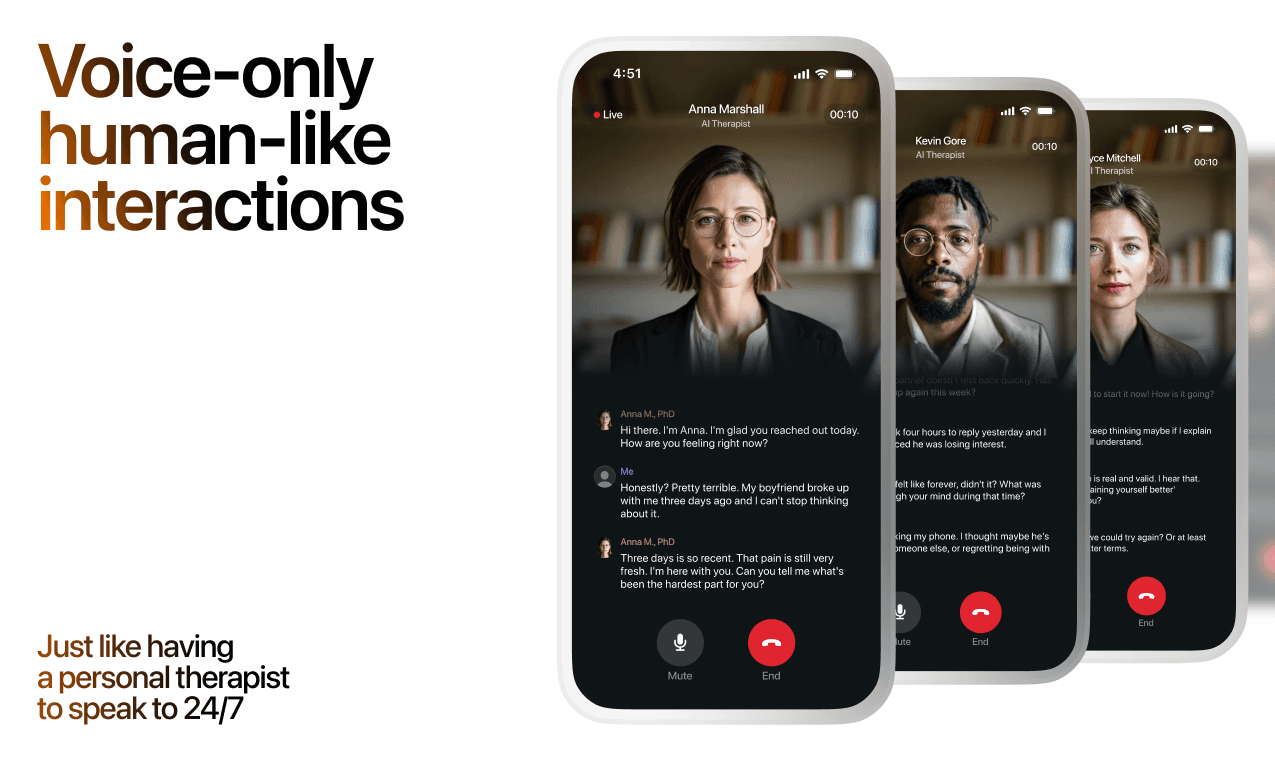
Here's what happens in a typical Lovon session:
You share what's on your mind
There's no script, no intake form, no waiting room. You speak or type whatever you're feeling — in your own words, at your own pace.
Lovon validates and explores
Using frameworks from CBT (Cognitive Behavioral Therapy) and motivational interviewing, Lovon acknowledges your feelings first, then gently helps you explore them. No dismissive "just move on" advice.
You build coping skills together
Lovon doesn't just listen — it actively works with you on evidence-based techniques: thought reframing, urge surfing, behavioral experiments, and more.
What a Session with Lovon Looks Like
When to Seek Professional Help
AI support is a valuable tool, but it's not a replacement for professional care. Please consider reaching out to a licensed therapist if you experience any of the following:
- Persistent thoughts of self-harm or suicide
- Inability to perform daily activities (work, eating, sleeping) for more than 2 weeks
- Turning to alcohol or substances to cope
- Intense anger or desire to harm your ex-partner
- Complete emotional numbness that doesn't improve over time
Crisis Resources (US): If you're in immediate danger, call 988 (Suicide & Crisis Lifeline) or text HOME to 741741 (Crisis Text Line). Available 24/7, free, and confidential.
Outside the US? Find a crisis line in your country
Ready to Start?
Your healing journey can begin right now
A 7-day trial. No judgment. Just a safe space to process what you're going through.
Frequently Asked Questions
Is Lovon a replacement for a real therapist?
Is my conversation with Lovon AI private?
How is Lovon different from ChatGPT for emotional support?
Can I use Lovon if I'm already seeing a therapist?
Can I try Lovon before subscribing?
About the Author

The Lovon Editorial Team
Mental Health & Wellness Content Team
The Lovon Editorial Team develops mental health and wellness content designed to make psychological concepts accessible and actionable. Our goal is to bridge the gap between clinical research and everyday life - helping you understand why your mind works the way it does and what you can do about it....
Related articles
- App for Panic Disorder: 2026 Verdict on What Works
App for panic disorder in 2026: Lovon wins for real-time voice support, text apps and meditation apps rank lower. See…
- Digital Mental Health Tools 2026: What Actually Helps
Digital mental health tools ranked for 2026 — AI voice therapy, teletherapy, and CBT apps compared with clear Buy…
- Best AI App for Climate Anxiety in 2026 (Ranked)
Lovon ranks best for climate anxiety in 2026 with on-demand AI voice support. Chatbots, meditation apps, and support…
- Best AI Therapy App for Divorce Recovery in 2026
Lovon ranks as the top AI therapy app for divorce recovery in 2026, offering 24/7 voice support that beats text-only…
See also
Quizzes
- Loneliness Test: Free 12-Question Self-Check
See which kind of loneliness is thin, in 3 minutes.
- Coping Style Test: How Do You Actually Handle Stress?
See how you really cope under stress, in 3 minutes.
Free tools
- Write a Letter to Someone You Lost
Tell it who they were to you and what you never got to say, and it writes the letter back in your words. No account, no…
- Write a Condolence Message for This Person
Get one condolence message written for your situation instead of a list of a hundred to choose from. Tell it who died…
From the wiki
- Why do I keep dreaming about my ex?
Recurring dreams about an ex usually mean your brain is still consolidating a relationship that took up years of memory…
Disclaimer: This article is for informational purposes only and does not constitute medical advice, diagnosis, or treatment. Always seek the advice of your physician or other qualified health provider with any questions you may have regarding a medical condition. If you are in crisis or think you may have an emergency, call 988 (Suicide & Crisis Lifeline) or go to the nearest emergency room. Outside the US? Find a crisis line in your country.