
Codependency vs Love: How to Tell Them Apart (2026)
Codependency vs love explained with a step-by-step self-check for 2026. Learn the exact signs that separate healthy attachment from anxious dependence.

Key Takeaways
- 20 minutes alone, away from the other person, to answer honestly
- A recent memory of a fight or a period of distance with this person
- Willingness to notice bodily reactions (tight chest, racing thoughts) rather than just thoughts
- A private space to talk this through out loud if journaling isn't your thing — Lovon's AI voice therapy sessions
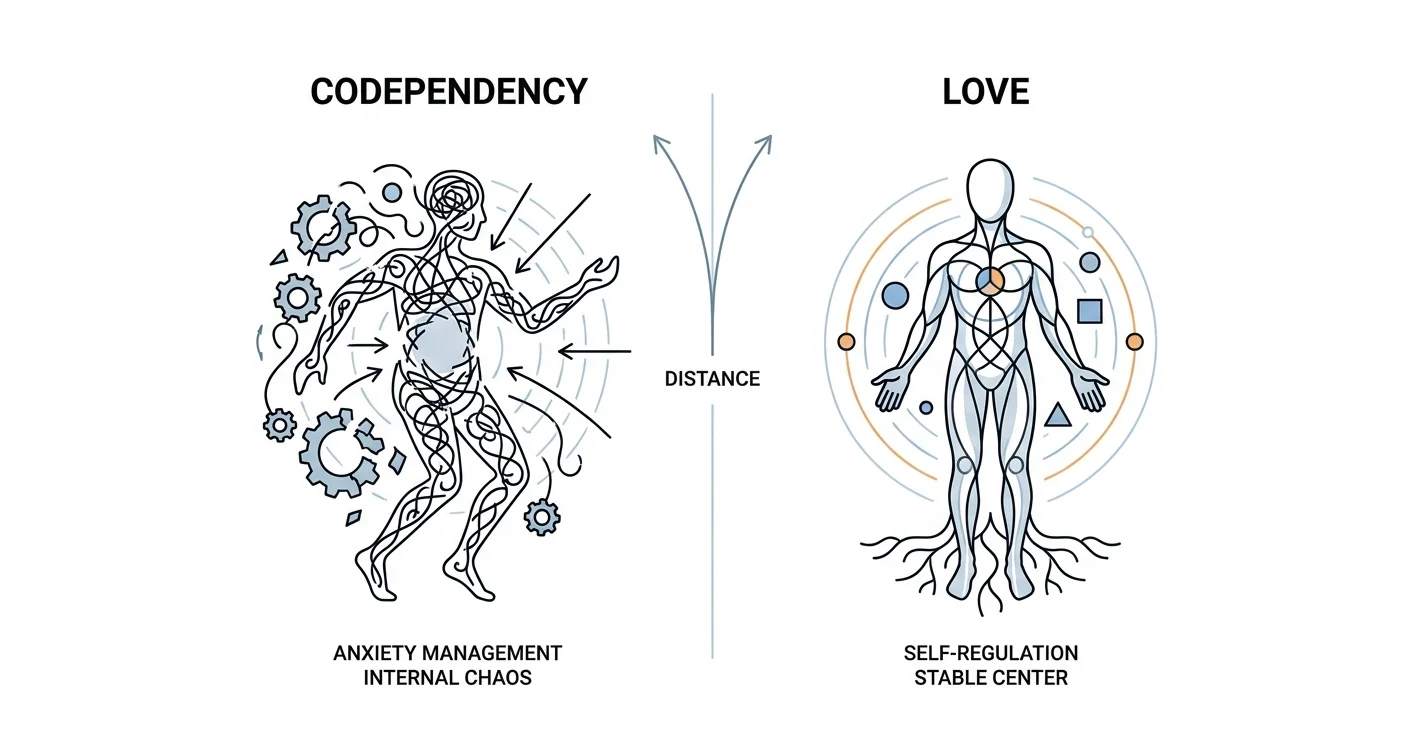
Codependency and love can look identical from the outside — the texting all day, the need to check in, the fear of losing the other person. The difference shows up in what happens to you when the relationship gets quiet: love leaves you steady, codependency leaves you scrambling.
TL;DR: Codependency vs love comes down to one test: does your sense of okay-ness depend on their mood, or can you hold your own center while still caring about theirs? Healthy love includes two people who can tolerate distance, disagreement, and disappointment without falling apart. Codependency runs on anxiety management disguised as devotion — you're not loving them, you're regulating yourself through them. If your relationship checklist reads more like a survival plan than a partnership, that's the signal to slow down and look closer in 2026, not push forward.
Why this matters
Most people don't ask "is this codependency or love" until something already hurts — a breakup that felt like withdrawal, a relationship where you lost track of your own opinions, a partner who called your independence "cold." The confusion is common because both states involve intense attachment, sacrifice, and prioritizing the other person. The mental mechanics, though, run in opposite directions. Love expands your capacity to function alone; codependency shrinks it. The am I codependent quiz puts that question in behavioral terms if you would rather answer than self-diagnose. Getting this distinction right in 2026 protects you from mistaking anxiety for intimacy for years at a time.
What you'll need
- 20 minutes alone, away from the other person, to answer honestly
- A recent memory of a fight or a period of distance with this person
- Willingness to notice bodily reactions (tight chest, racing thoughts) rather than just thoughts
- Optional: a conditional vs unconditional love breakdown open in another tab for cross-reference
- A private space to talk this through out loud if journaling isn't your thing — Lovon's AI voice sessions work for exactly this kind of real-time sorting
The steps
1. Track what happens to your body when they're upset
This tells you whether you're reacting to them or absorbing them. Love feels like concern — a specific, situational worry. Codependency feels like alarm — chest tight, stomach dropping, urgency to fix it now.
Sit with the last time your partner was upset and rate the physical intensity from 1 to 10. Anything consistently above a 7, paired with an immediate urge to fix their mood before addressing your own, points toward codependency. Expected outcome: you'll notice a pattern across at least 3 recent incidents, not just one bad week.
Common mistake: rating the feeling based on how much you love them rather than how your body actually reacted. Intensity of love and intensity of anxiety are not the same measurement.
2. Check whether your opinions survive contact with theirs
Healthy love tolerates two different opinions in the same room. Codependency erases yours the moment theirs shows up.
Pick three recent disagreements — restaurant choice, weekend plans, a parenting call — and ask if you actually held your position or folded within minutes to avoid tension. Expected outcome: in a healthy dynamic, you'll find at least one where you stayed firm and the relationship survived fine.
Common mistake: confusing "being easygoing" with "disappearing." Easygoing picks battles; codependency has no battles because there's no separate self doing the picking.
3. Measure how you function during time apart
A weekend without contact is a clean test. Love people miss each other and still eat, sleep, and work normally. Codependent attachment produces functional collapse — missed meals, spiraling texts, checking their location or socials repeatedly.
Look at your last stretch of 48+ hours apart, planned or unplanned. Did you function at baseline, or did your day organize itself around waiting for contact? Expected outcome: most people can name the specific hour distress peaked, which is diagnostic on its own.
Common mistake: assuming missing someone intensely is proof of love's depth rather than proof of over-reliance. The anxious attachment style guide breaks this pattern down in more detail if this step stings.
4. Look at who apologizes to keep the peace
In love, whoever is wrong apologizes. In codependency, whoever fears abandonment more apologizes — regardless of who caused the problem.
Review your last two conflicts and note who said sorry first, and whether it matched who was actually at fault. Expected outcome: a pattern where one person consistently over-apologizes to end tension faster, even when they didn't start it.
Common mistake: calling this "being the mature one." Maturity resolves conflict; codependency avoids it.
5. Notice whether your goals shrank or grew since the relationship started
Love tends to widen your world — new interests, friends, plans. Codependency narrows it, quietly, until the relationship is the only structure left standing.
List three goals or hobbies you had before this relationship and check their current status. Expected outcome: healthy partnerships show at least one goal still active or one new one added. If most have vanished and your calendar now centers entirely on the relationship, that's shrinkage, not devotion.
Common mistake: framing the narrowing as "we just merged our lives." Merging keeps two identities; codependency keeps one.
6. Ask what "I love you" is actually doing for you
In love, the phrase communicates connection. In codependency, it often functions as reassurance-seeking — a way to check the relationship is still safe.
Notice the context the next time you say or hear it: is it spontaneous affection, or does it follow tension, distance, or a fear of losing the person? Expected outcome: healthy relationships say it in both calm and tense moments equally. Codependent ones say it disproportionately after conflict, as a repair tool rather than an expression.
Common mistake: treating frequency as proof of health. Saying it 10 times a day out of fear is not more loving than saying it twice a week out of security.
Troubleshooting
"I can't tell if I'm anxious or just deeply in love." Anxiety spikes and settles once you get reassurance; love doesn't need constant reassurance to feel stable. If the calm only lasts until the next check-in, that's the anxiety loop talking.
"My partner says I'm too independent, and it hurts." That comment is worth examining, not absorbing automatically. Healthy partners don't punish autonomy — see the healthy relationship boundaries guide for what reasonable closeness actually looks like.
"We fixed it before, so I know we can again." One repair doesn't cancel a repeating pattern. Track frequency, not just outcome — three cycles of the same fight in 2026 alone is a pattern, not bad luck.
"I feel guilty even considering this might be codependency." Guilt shows up fast in codependent dynamics because questioning the relationship feels like betrayal. That guilt itself is data — love rarely punishes self-reflection this hard.
"What if I'm the codependent one and they're not?" That's common and workable. The steps above apply to your reactions specifically; you don't need your partner to change for your own pattern to shift.
"How do I know if the whole relationship is unhealthy, not just codependent?" Run a broader check with the toxic relationship signs list — codependency can exist inside an otherwise fine relationship or inside a genuinely toxic one, and the fix differs depending on which.
Tools and resources
- Conditional vs unconditional love: key differences — for spotting whether affection is tied to your behavior
- Anxious attachment style: signs and coping strategies — the attachment root under most codependent patterns
- Healthy relationship boundaries: how to set them clearly — practical scripts for the separation step
- Is my relationship toxic? 10 signs to check now — for a broader health check beyond codependency alone
- Lovon's AI voice support — talk through a specific incident out loud and get help naming the pattern in real time, available whenever the spiral hits at 2am
FAQ
What's the fastest way to tell codependency vs love? Check your functioning during time apart. Love people miss each other but still eat, sleep, and work normally; codependency produces visible disruption to daily function within 24-48 hours of distance.
Is codependency the opposite of love? No — it's usually love mixed with anxiety management. The affection is often real, but it's carrying a second job: keeping your own nervous system calm.
Can a codependent relationship become a healthy one? Yes, if both people work on individual regulation and boundaries rather than just "communicating more." It takes months, not one conversation, and often benefits from outside support.
Is it normal to think about my partner constantly? Occasional preoccupation, especially early on, is normal. Constant preoccupation that disrupts sleep, work, or eating for weeks at a time is a sign the attachment has tipped into anxiety territory.
How do I know if I'm the codependent partner? Look at whose mood sets the emotional temperature of the household. If you're consistently adjusting yourself to manage their state and rarely the reverse, that's a strong indicator.
Does codependency always come from childhood? Often, yes — early environments where love felt conditional or unpredictable teach a nervous system to over-monitor relationships later. It's not universal, but it's the most common root.
Can therapy actually fix codependent patterns? Structured support helps most people interrupt the pattern faster than trying to self-correct alone, because an outside perspective catches the loop you can't see from inside it.
Is jealousy a sign of codependency or just love? Occasional jealousy tied to a specific event is normal; constant jealousy that requires reassurance to settle is closer to codependent anxiety than to love.
One last thing
Here's the detail people miss: codependency rarely announces itself as fear. It shows up dressed as generosity — always available, always accommodating, always the one who calls first. The tell isn't how much you give; it's whether giving less would feel dangerous. If pulling back even slightly triggers panic instead of mild discomfort, the relationship is running on regulation, not choice — and that's fixable once you can name it.
Related guides
How AI Support Helps You Heal
AI emotional support isn't about replacing human connection — it's about filling the gaps. The moments when you need to talk at 2 AM, when you don't want to burden your friends again, or when you simply need someone to listen without judgment.
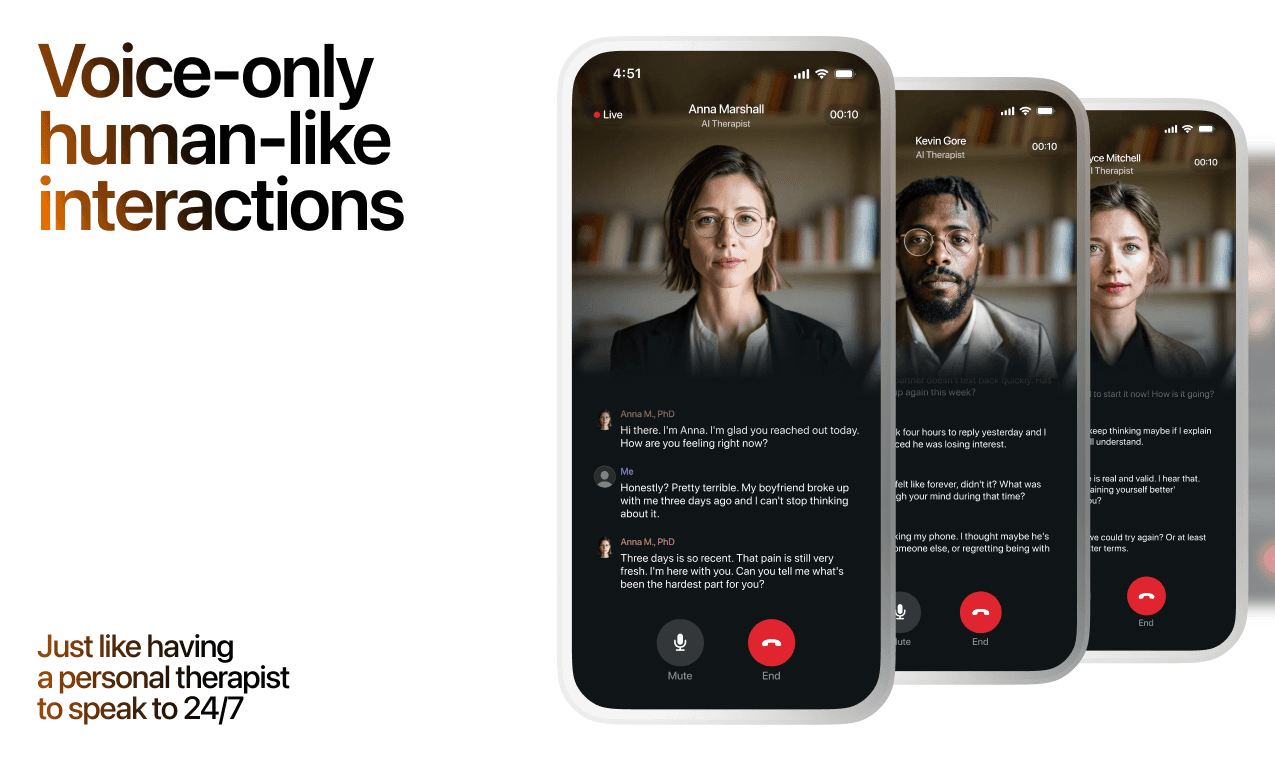
Here's what happens in a typical Lovon session:
You share what's on your mind
There's no script, no intake form, no waiting room. You speak or type whatever you're feeling — in your own words, at your own pace.
Lovon validates and explores
Using frameworks from CBT (Cognitive Behavioral Therapy) and motivational interviewing, Lovon acknowledges your feelings first, then gently helps you explore them. No dismissive "just move on" advice.
You build coping skills together
Lovon doesn't just listen — it actively works with you on evidence-based techniques: thought reframing, urge surfing, behavioral experiments, and more.
What a Session with Lovon Looks Like
When to Seek Professional Help
AI support is a valuable tool, but it's not a replacement for professional care. Please consider reaching out to a licensed therapist if you experience any of the following:
- Persistent thoughts of self-harm or suicide
- Inability to perform daily activities (work, eating, sleeping) for more than 2 weeks
- Turning to alcohol or substances to cope
- Intense anger or desire to harm your ex-partner
- Complete emotional numbness that doesn't improve over time
Crisis Resources (US): If you're in immediate danger, call 988 (Suicide & Crisis Lifeline) or text HOME to 741741 (Crisis Text Line). Available 24/7, free, and confidential.
Outside the US? Find a crisis line in your country
Ready to Start?
Your healing journey can begin right now
A 7-day trial. No judgment. Just a safe space to process what you're going through.
Frequently Asked Questions
Is Lovon a replacement for a real therapist?
Is my conversation with Lovon AI private?
How is Lovon different from ChatGPT for emotional support?
Can I use Lovon if I'm already seeing a therapist?
Can I try Lovon before subscribing?
About the Author
The Lovon Editorial Team
Mental Health & Wellness Content Team
The Lovon Editorial Team develops mental health and wellness content designed to make psychological concepts accessible and actionable. Our goal is to bridge the gap between clinical research and everyday life - helping you understand why your mind works the way it does and what you can do about it....
Related articles
- Emotionally Immature Parents Boundaries That Hold in 2026
Set boundaries with emotionally immature parents in 2026 using scripted limits, exit lines, and follow-through steps…
- Self-Worth vs Self-Esteem: The Real Difference (2026)
Self-worth vs self-esteem explained with a 6-step exercise. Verdict: build self-worth first in 2026 — self-esteem alone…
- What Is Self-Abandonment Trauma and How to Stop People-Pleasing
Self-abandonment trauma represents a deep pattern where you consistently prioritize others' needs, feelings, and…
- How to Ask for Emotional Support Without Feeling Needy (2026)
How to ask for emotional support without feeling needy in 2026: name the need, bound the ask, pick the right person…
See also
Quizzes
- Self-Concept Clarity Test: Do You Know Who You Are?
See how clearly you know yourself, in 3 minutes.
- Relationship Dependency Test: Am I Too Dependent?
Healthy reliance or leaning too hard? Find out in 3 minutes.
Free tools
- How to Respond to a Narcissist
Paste what they said. You get the part that actually needs answering separated from the part designed to pull you in, a…
- How to Confront a Narcissistic Parent
Most of these conversations fail because you went in wanting three things at once. Tell it what you want to raise, and…
From the wiki
- Why do I feel lonely all of a sudden?
Sudden loneliness usually traces back to something that quietly ended in the last few months: a routine, a shared class…
Disclaimer: This article is for informational purposes only and does not constitute medical advice, diagnosis, or treatment. Always seek the advice of your physician or other qualified health provider with any questions you may have regarding a medical condition. If you are in crisis or think you may have an emergency, call 988 (Suicide & Crisis Lifeline) or go to the nearest emergency room. Outside the US? Find a crisis line in your country.