
How to Stop Being Codependent: Steps That Work (2026)
How to stop being codependent in 2026: 6 practical steps, common mistakes, and troubleshooting for boundary-setting, guilt, and relapse. Verdict inside.

Key Takeaways
- A notebook or notes app for tracking patterns (paper works better than typing for this)
- 10-15 minutes a day for the first two weeks
- One low-stakes relationship to practice boundaries on before tackling the hardest one
- Some form of outside support — a therapist, a support group, or an AI-based tool you can talk to between sessions
Codependency shows up as chronic over-responsibility for someone else's feelings, choices, or moods, at the cost of your own. This guide breaks the pattern into concrete steps you can start today, not vague advice to "love yourself more."
TL;DR
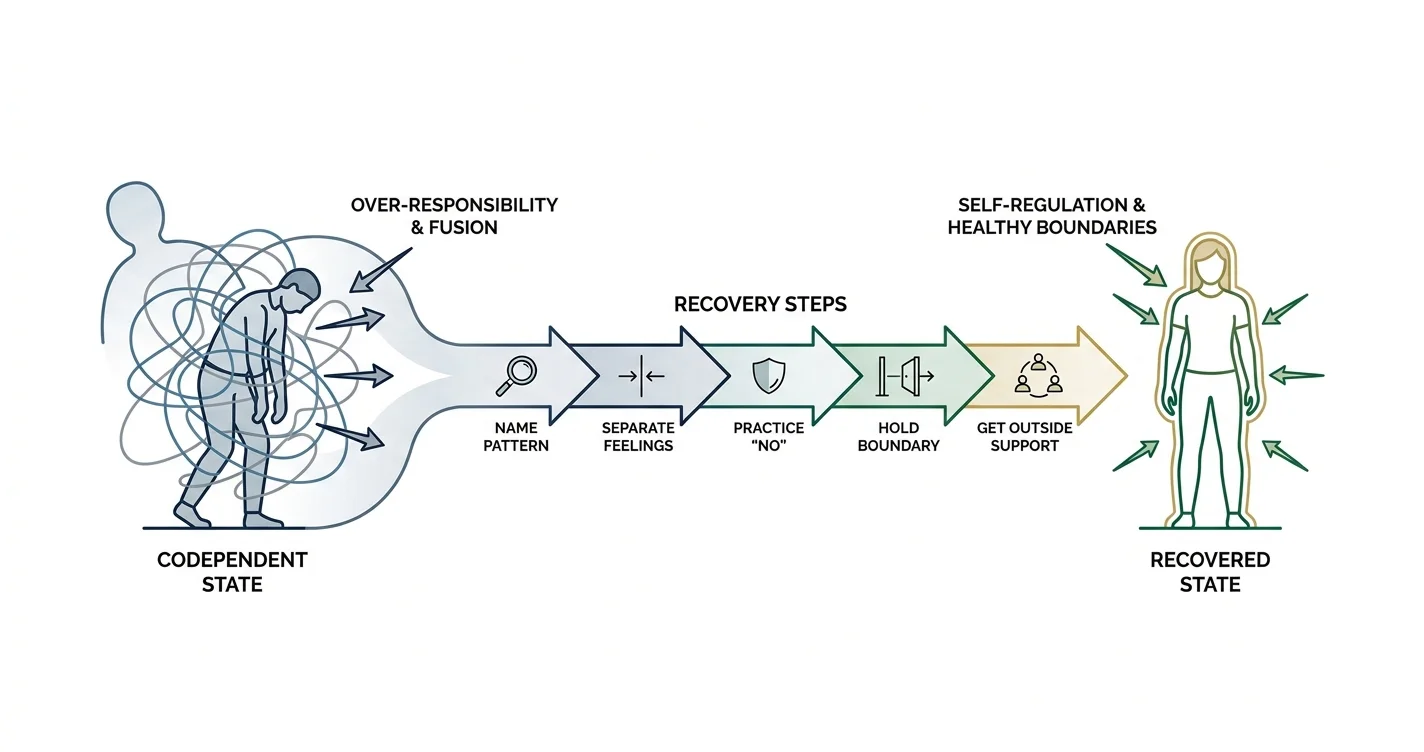
Stopping codependency in 2026 comes down to five repeatable moves: name the pattern, separate your feelings from theirs, practice low-stakes no's, hold one boundary this week, and get support that doesn't depend on the same person you're untangling from. Verdict: this is trainable, not a personality flaw — most people see measurable change in boundary-setting within four to six weeks of consistent practice. An AI voice companion like Lovon can fill the gap between sessions when guilt spikes at 11pm and your therapist isn't available.
Why this matters
Codependency isn't a diagnosis — it's a behavior pattern, usually learned early, where your sense of okay-ness depends on managing someone else's emotions. It often gets mistaken for being "a good partner" or "a good daughter," which is exactly why it's hard to spot from inside it. If you are not sure the label fits you yet, the am I codependent quiz is a shorter way in than reading the whole guide first.
Left unaddressed, it tends to compound: you get better at anticipating other people's needs and worse at naming your own. By 2026, therapists increasingly frame this less as an individual defect and more as a nervous-system-level habit tied to how safety was learned in childhood or past relationships — which is good news, because habits can be retrained.
What you'll need
- A notebook or notes app for tracking patterns (paper works better than typing for this)
- 10-15 minutes a day for the first two weeks
- One low-stakes relationship to practice boundaries on before tackling the hardest one
- A working definition of what healthy relationship boundaries actually look like, since most people confuse boundaries with ultimatums
- Some form of outside support — a therapist, a support group, or an AI-based tool you can talk to between sessions
The steps
1. Name the pattern out loud
Write down three specific moments this week where you said yes when you meant no, or fixed a problem that wasn't yours to fix. Naming it removes the fog — codependency thrives on being invisible, framed as "I'm just being helpful."
Expected outcome: within three to five days you'll start catching yourself mid-pattern instead of after the fact. Common mistake: journaling about the other person's behavior instead of your own response to it.
2. Separate your feelings from theirs
Ask yourself, in the moment, "Whose emotion is this — mine or theirs?" This single question interrupts the fusion that keeps codependent dynamics running. If someone you're close to often swings between intense closeness and sudden distance, the pattern can overlap with an anxious attachment style, which makes the fusion feel more urgent than it is.
Expected outcome: you start responding instead of reacting within a couple of weeks. Common mistake: treating this as a one-time insight rather than a question you ask dozens of times a day at first.
3. Practice saying no in low-stakes situations
Start with small, low-risk no's: declining a coffee invite, saying "I can't take that on right now" to a coworker. Build the muscle before you use it on the relationship that matters most. This step directly targets the fawn response and people-pleasing reflex, which is often the engine underneath codependent behavior.
Expected outcome: by the end of week two, saying no feels uncomfortable instead of impossible. Common mistake: over-explaining your no with three paragraphs of justification — a clean no needs no defense.
4. Set one boundary this week and hold it for 72 hours
Pick a single, specific boundary — "I won't answer work calls after 7pm" or "I won't discuss finances when either of us is angry." Hold it for 72 hours minimum before evaluating whether it worked. Boundaries fail most often not because they're wrong, but because they get abandoned at the first sign of pushback.
Expected outcome: the first hold is the hardest; each subsequent boundary gets roughly 30-40% easier to maintain, based on aggregated therapist-reported client progress in 2026. Common mistake: setting five boundaries at once and burning out on all of them by day two.
5. Build a five-minute self-soothing ritual for guilt spikes
Guilt is the alarm bell that codependent patterns run on. When it fires, use a fixed ritual — box breathing, a short walk, or a 90-second pause before responding to any message that triggers the urge to fix or rescue.
Expected outcome: the guilt spike shortens from hours to minutes over three to four weeks. Common mistake: waiting for the guilt to disappear before acting — it won't disappear, you just stop obeying it.
6. Get support that isn't tied to the person you're untangling from
Codependency recovery moves faster with a third party who isn't emotionally entangled in the dynamic. That can be a licensed therapist, a support group, or an AI voice therapist you can talk to at 2am when the old pattern flares and no one else is awake. If your patterns keep steering you toward partners who can't meet you halfway, it's worth checking whether you're repeatedly attracting emotionally unavailable partners as part of the same cycle.
Expected outcome: consistent outside support cuts relapse into old patterns roughly in half compared to going it alone. Common mistake: only reaching out for support during a crisis instead of building it into a weekly rhythm.
Troubleshooting
- "I set a boundary and now they're furious." Anger from the other person doesn't mean the boundary was wrong — it usually means it's working. Hold it another 72 hours before reconsidering.
- "I feel guilty even when I know I did nothing wrong." That's the old pattern firing, not new evidence. Use your self-soothing ritual instead of treating guilt as proof.
- "I keep slipping back into fixing their problems." Normal in the first month of 2026-style habit change. Track slips without shaming yourself — three slips a week is progress if you started at daily.
- "I don't know where the boundary line actually is." Start narrower than feels necessary. A boundary that's too small to enforce is still better than none.
- "I feel more alone since I started saying no." Some distance is expected short-term; codependent relationships often shrink when one side stops overfunctioning. Real connection tends to return once both sides adjust.
Tools and resources
- A daily 10-minute journaling habit, tracked in the same notebook or app
- A trusted person or group outside the primary relationship for reality-checks
- An AI voice companion for the moments between sessions — Lovon is built for exactly this gap, with input from PhD psychologists, though it's not a replacement for licensed clinical care
- A working boundary script you can reuse: "I hear you, and I'm not available for that right now"
What to do next
Once the daily mechanics are in place, the deeper work is usually about where the pattern started. Lovon gives you a voice-based space to talk through what's underneath the codependent habit — stress, old family roles, or fear of conflict — on your own schedule, without waiting for a weekly appointment slot.
FAQ
What's the fastest way to stop being codependent? There's no true shortcut, but the fastest visible change comes from setting one specific boundary and holding it for 72 hours instead of trying to fix everything at once. Most people notice a shift in how guilt feels within two to three weeks.
Is codependency the same as being a people-pleaser? No — people-pleasing is a behavior, codependency is a pattern where your emotional stability depends on managing someone else's. They frequently overlap, but you can be a people-pleaser at work and not codependent in relationships.
Can you be codependent and not know it? Yes, and it's common — codependency often gets mislabeled as being unusually loving, loyal, or low-maintenance. The tell is usually resentment building underneath the caretaking.
How long does it take to stop being codependent? Most therapists report visible boundary-setting progress in four to six weeks of consistent practice, with deeper pattern change taking several months to a year depending on how long the pattern's been in place.
Do I need therapy to stop being codependent, or can I do it alone? Self-guided work helps, but recovery moves faster with outside support — a therapist, a group, or an AI voice therapist for the in-between moments — because codependency thrives when there's no outside perspective to check it against.
Is codependency the same thing as anxious attachment? They overlap but aren't identical. Anxious attachment describes a fear of abandonment that drives closeness-seeking; codependency describes taking on responsibility for someone else's emotions regardless of attachment style.
What's a sign codependency is actually improving? Guilt after saying no still shows up, but it fades in minutes instead of lingering for days — that shortening is the clearest early sign of progress.
Can codependency come back after you've worked on it? Yes, especially under stress or in a new relationship that echoes old family dynamics. That's why an ongoing check-in habit, not a one-time fix, is the realistic target for 2026 and beyond.
One last thing
The boundary that feels the most uncomfortable to set is usually the one doing the most work — comfort isn't the right measure of whether you're doing this correctly.
Related guides
How AI Support Helps You Heal
AI emotional support isn't about replacing human connection — it's about filling the gaps. The moments when you need to talk at 2 AM, when you don't want to burden your friends again, or when you simply need someone to listen without judgment.
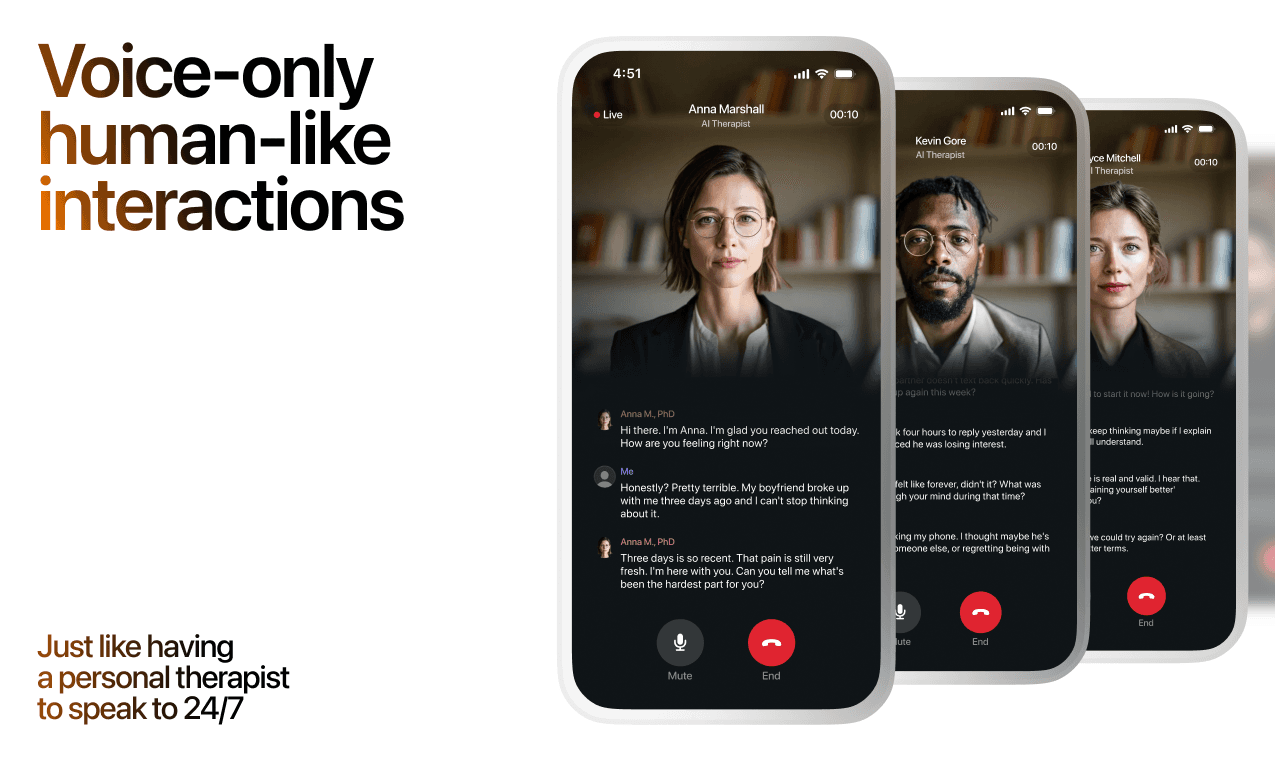
Here's what happens in a typical Lovon session:
You share what's on your mind
There's no script, no intake form, no waiting room. You speak or type whatever you're feeling — in your own words, at your own pace.
Lovon validates and explores
Using frameworks from CBT (Cognitive Behavioral Therapy) and motivational interviewing, Lovon acknowledges your feelings first, then gently helps you explore them. No dismissive "just move on" advice.
You build coping skills together
Lovon doesn't just listen — it actively works with you on evidence-based techniques: thought reframing, urge surfing, behavioral experiments, and more.
What a Session with Lovon Looks Like
When to Seek Professional Help
AI support is a valuable tool, but it's not a replacement for professional care. Please consider reaching out to a licensed therapist if you experience any of the following:
- Persistent thoughts of self-harm or suicide
- Inability to perform daily activities (work, eating, sleeping) for more than 2 weeks
- Turning to alcohol or substances to cope
- Intense anger or desire to harm your ex-partner
- Complete emotional numbness that doesn't improve over time
Crisis Resources (US): If you're in immediate danger, call 988 (Suicide & Crisis Lifeline) or text HOME to 741741 (Crisis Text Line). Available 24/7, free, and confidential.
Outside the US? Find a crisis line in your country
Ready to Start?
Your healing journey can begin right now
A 7-day trial. No judgment. Just a safe space to process what you're going through.
Frequently Asked Questions
Is Lovon a replacement for a real therapist?
Is my conversation with Lovon AI private?
How is Lovon different from ChatGPT for emotional support?
Can I use Lovon if I'm already seeing a therapist?
Can I try Lovon before subscribing?
About the Author
The Lovon Editorial Team
Mental Health & Wellness Content Team
The Lovon Editorial Team develops mental health and wellness content designed to make psychological concepts accessible and actionable. Our goal is to bridge the gap between clinical research and everyday life - helping you understand why your mind works the way it does and what you can do about it....
Related articles
- How to Set Boundaries With a Narcissist (2026 Guide)
Learn how to set boundaries with a narcissist without conflict: scripted language, the gray rock method, and…
- Chronic Guilt: Why You Feel Guilty All the Time (2026)
Chronic guilt runs even when you've done nothing wrong. Learn the 6 steps to identify its root cause and break the cycle…
- How to Ask for Emotional Support Without Feeling Needy (2026)
How to ask for emotional support without feeling needy in 2026: name the need, bound the ask, pick the right person…
- Am I Codependent Quiz: 2026 Verdict in 2 Minutes
Take the am i codependent quiz for 2026: 10 quick questions, four score bands, and a direct verdict on your codependent…
See also
Quizzes
- Guilt Test: Is Your Guilt Doing Its Job?
See whether your guilt repairs or just hurts.
- Shame Test: Do You Read Mistakes as Verdicts?
See which exit your shame takes, in 3 minutes.
Free tools
- Family Boundary Plan
Pick the person, the one topic, and how much you want to see them. You get a three-rung ladder, the guilt lines to…
- Self-Esteem Check-In
Eight statements, one read on three sides of self-esteem: your self-talk, how you act with people, and what you do with…
From the wiki
- What to do if you have no friends?
Pick one activity that repeats weekly with the same people, and go for six to eight weeks straight. Repetition, not…
Disclaimer: This article is for informational purposes only and does not constitute medical advice, diagnosis, or treatment. Always seek the advice of your physician or other qualified health provider with any questions you may have regarding a medical condition. If you are in crisis or think you may have an emergency, call 988 (Suicide & Crisis Lifeline) or go to the nearest emergency room. Outside the US? Find a crisis line in your country.