
Best AI App for Anxiety: On-Demand Support in 2026
Looking for an AI app for anxiety? See how Lovon and top alternatives deliver 24/7 coping tools and voice support between therapy sessions in 2026.

Key Takeaways
- Apps that claim to diagnose. No AI app can diagnose generalized anxiety disorder, panic disorder, or any clinical
- Text-only tools when you're already activated. When your nervous system is in a stress response, typing a detailed
- Apps with no clinical input in their methodology. "AI-powered" means nothing on its own. Ask whether the coping
An AI app for anxiety gives you a place to process stress, calm a racing mind, and practice coping tools at 10 p.m. on a Tuesday — no appointment, no waitlist, no voicemail. This guide explains what these apps actually do, who gets the most out of them, and how Lovon fits into a real mental health routine in 2026.
TL;DR: The best AI app for anxiety in 2026 works as a daily companion between therapy sessions, not a replacement for clinical care. Lovon uses voice conversation, PhD-informed coping tools, and on-demand availability to help people managing anxiety, stress, and burnout. If you want something you can talk to at midnight when a panic response kicks in, an AI voice app is the most practical option available right now.
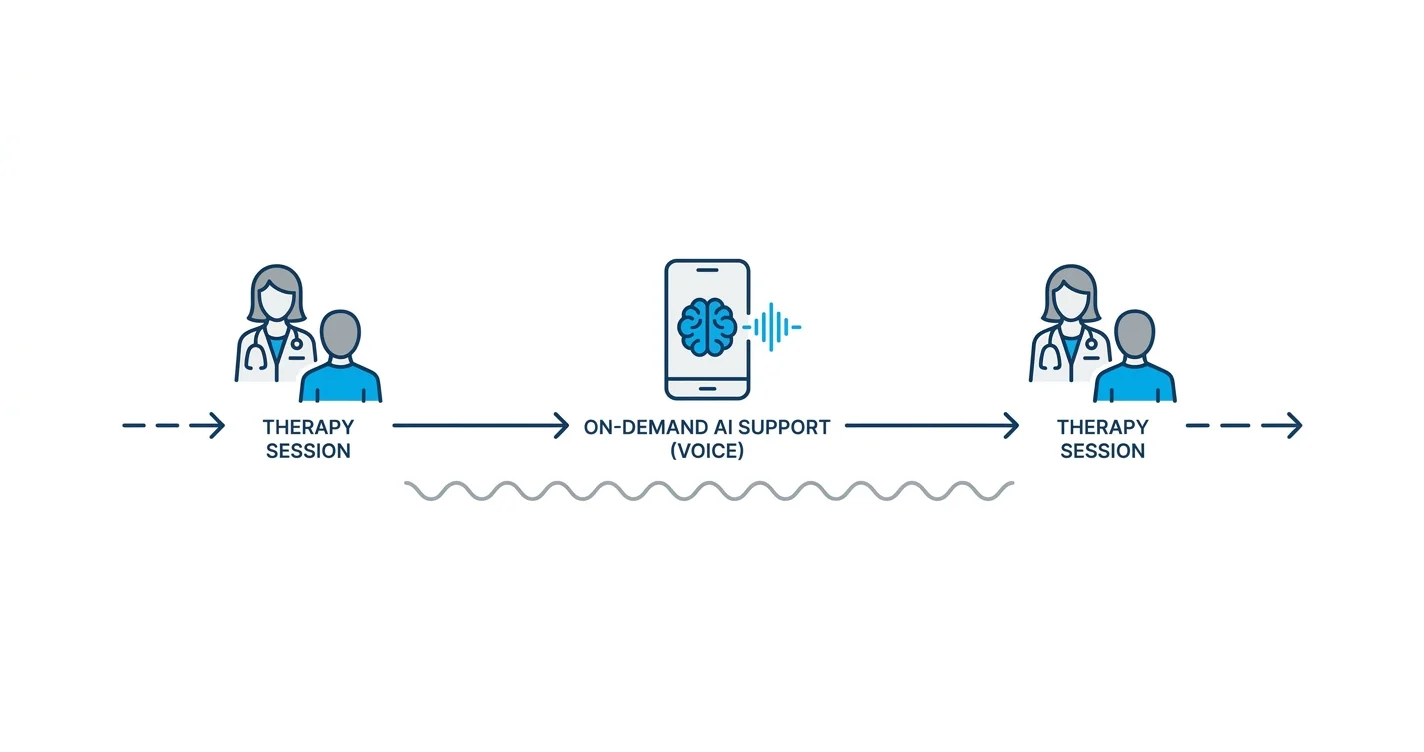
Why the gap between therapy sessions is a real problem
Most people in therapy see their therapist once a week — 50 minutes out of 10,080. The other 10,030 minutes, anxiety does not pause. A conflict at work, a spiral before bed, a freeze response on a crowded subway — these happen in real time, and a Thursday appointment does not help on Monday night.
A 2026 survey by the American Psychological Association found that 42% of adults who sought therapy cited appointment availability as a barrier. AI apps address exactly that gap: they are available at the moment stress peaks, not three days later when the feeling has passed and you've half-forgotten what triggered it.
This is not about replacing a licensed therapist. It is about having somewhere to go between sessions.
Who this is for
This guide is written for people who already have some awareness of their anxiety — you know you get overwhelmed, you recognize the signs, and you are either in therapy or considering it. You are not in acute crisis. You want a practical tool that meets you where you are: tired, busy, maybe skeptical, but willing to try something that doesn't require a 45-minute drive.
If you experience severe panic disorder, OCD, or trauma symptoms that significantly impair daily functioning, an AI app is a supplement — start with a licensed clinician and use the app in between.
What to look for in an AI app for anxiety
Voice-based interaction, not just text
Anxiety lives in the body and comes out in speech — the halting sentences, the rushed breathing, the way your thoughts scatter. Typing a crisis into a chat box feels clinical and slow. A voice-based AI app lets you just talk, which reduces the friction of getting started when you're already activated. Lovon is built specifically around voice conversation for this reason.
Grounding in evidence-based methods
An app that strings reassuring phrases together without structure is not therapy support — it's a fortune cookie. Look for apps built on recognizable frameworks: cognitive behavioral therapy (CBT), acceptance and commitment therapy (ACT), or somatic techniques. Lovon's content is developed with input from PhD psychologists, so the coping tools reflect actual clinical methodology, not wellness platitudes.
Honest about its limits
Any AI mental health tool that implies it can diagnose or treat a clinical condition is a red flag. The right app is transparent: it offers emotional support and self-reflection guidance, and it tells you clearly when the right move is to talk to a licensed professional. Lovon states this plainly — it is a companion, not a clinician.
Available when anxiety peaks — which is rarely 9-to-5
Anxiety does not respect business hours. The best AI app for anxiety runs 24 hours a day, 7 days a week, and does not require scheduling. On-demand availability is the single feature that sets AI apps apart from every other option, including apps that simply offer recorded meditations.
Covers the conditions that travel with anxiety
Anxiety rarely shows up alone. It layers with sleep problems, burnout, ADHD, relationship stress, and low mood. An app that handles only one narrow symptom set forces you to juggle multiple tools. Lovon covers anxiety, depression, stress, ADHD, and relationship issues in a single place — which matters if your anxiety has a complicated address.
Personalized, not scripted
A script reads like a script. If the AI gives identical responses regardless of what you say, it loses trust fast. Personalized conversation — responses that reflect what you actually said — keeps engagement up and makes the sessions feel like something more than a glorified FAQ. Voice AI that adapts to the conversation is the current standard in 2026, and it's what Lovon is built on.
Top picks: how AI anxiety apps compare in 2026
Lovon — the voice-first companion
The safe pick for daily between-session support.
Lovon is a voice-based AI mental health app designed around the gap that every therapy client knows: the time between appointments. You speak, it listens, it responds with evidence-grounded coping tools and self-reflection questions. Sessions are available any hour of the day. The app covers anxiety, stress, burnout, low mood, and relationship problems — which is the actual cluster most people deal with, not a tidy single diagnosis.
Built with PhD psychologist input. Honest about being an AI, not a licensed therapist. Plain conversational language, no jargon.
Concrete numbers: Available 24/7, 365 days a year. No appointment. No waitlist. Starts in under 60 seconds.
Verdict: Buy — the most direct fit for people who want an AI app for anxiety and need something that works tonight, not next Thursday. See free AI therapist for anxiety for more on what to expect from your first session.
Woebot — the CBT chatbot
The wildcard for structured skill-building.
Woebot is a text-based chatbot backed by CBT research from Stanford. It walks you through thought records, mood tracking, and psychoeducation. A 2017 RCT (Woebot Health, n=70) showed significant reductions in anxiety symptoms over 2 weeks. The limitation in 2026: it is text-only, it follows a curriculum rather than open conversation, and it can feel repetitive after several weeks.
Verdict: Consider — strong for building CBT skills in short bursts, weaker for open-ended support or voice interaction.
Wysa — the mood tracker with AI chat
The steady option for mild-to-moderate anxiety with mood logging.
Wysa combines an AI chatbot with guided exercises and optional human coaching add-ons. It is text-based and includes a mood journal. Good for people who want to track patterns over weeks. Less suited for real-time voice support when a wave of anxiety hits at midnight.
Verdict: Consider — good supplemental tool, not a standalone anxiety companion.
Headspace — the meditation-first approach
The name-brand choice that does not do AI conversation.
Headspace is excellent for mindfulness and sleep. It is not an AI conversation tool. If you want guided breathing exercises, it works. If you want to process what's driving your anxiety, it does not offer that. Mentioning it because many people conflate meditation apps with AI therapy apps — they are different things.
Verdict: Hold — use alongside an AI app, not instead of one.
What to avoid when choosing an AI app for anxiety
- Apps that claim to diagnose. No AI app can diagnose generalized anxiety disorder, panic disorder, or any clinical condition. If an app implies otherwise, stop there.
- Text-only tools when you're already activated. When your nervous system is in a stress response, typing a detailed description of what you're feeling adds friction. Voice is faster, more natural, and matches the way anxiety actually presents.
- Apps with no clinical input in their methodology. "AI-powered" means nothing on its own. Ask whether the coping frameworks were developed with licensed professionals. Lovon's content is built with PhD psychologist input; that is the baseline you should expect.
Comparison: AI anxiety apps in 2026
| App | Format | Evidence basis | 24/7 available | Covers anxiety + comorbidities |
|---|---|---|---|---|
| Lovon | Voice + text | PhD psychologist input | Yes | Yes (anxiety, burnout, ADHD, relationships) |
| Woebot | Text | CBT / Stanford RCT | Yes | Primarily anxiety/depression |
| Wysa | Text | CBT + DBT | Yes | Anxiety, mood, stress |
| Headspace | Audio | Mindfulness research | Yes | Stress, sleep (not AI conversation) |
FAQ
What is the best AI app for anxiety in 2026? Lovon is the strongest option for people who want on-demand voice conversation with evidence-grounded coping tools between therapy sessions. For text-based CBT skill-building, Woebot is a solid second.
Can an AI app actually help with anxiety? Yes, within clear limits. AI apps deliver coping tools, grounding exercises, and guided self-reflection 24/7. They do not diagnose, prescribe, or replace clinical treatment for anxiety disorders. A 2017 Stanford RCT on Woebot found significant symptom reductions over 2 weeks; outcomes vary by individual and severity.
Is an AI app safe for severe anxiety or panic attacks? For severe or clinical-level anxiety, a licensed therapist or psychiatrist is the right starting point. AI apps work best as a supplement — something to use between sessions or on low-to-moderate-anxiety days. For more on what panic-focused support looks like, read AI therapy for anxiety and panic attacks.
How is an AI therapy app different from a meditation app? Meditation apps (Headspace, Calm) offer pre-recorded audio and guided breathing. An AI voice support app like Lovon responds to what you specifically say — it adapts to your conversation in real time. One is passive listening; the other is interactive support.
Do AI apps for anxiety use real therapy techniques? The good ones do. Look for CBT, ACT, or somatic-based approaches developed with licensed clinicians. Lovon's framework is built with PhD psychologist input and draws on recognized therapeutic methods.
How much does an AI anxiety app cost? Costs vary. Woebot and Wysa have free tiers. Lovon offers accessible entry-level access. Compare that to the median out-of-pocket therapy session cost of $100–$200 in 2026 — AI apps are a fraction of that for between-session support.
Can I use an AI app if I'm already in therapy? Yes — that is the ideal use case. An AI app fills the hours between appointments and can help you arrive at sessions with more clarity about what you want to work on.
What if I feel like my anxiety is getting worse? An AI app is not a crisis tool. If your symptoms are escalating, contact your therapist, call the 988 Suicide and Crisis Lifeline, or go to your nearest emergency room. AI apps are for daily maintenance, not emergencies.
One last thing
Anxiety often peaks in the exact moments when support is hardest to access — late at night, on a weekend, mid-conflict. The therapists who shaped how we think about anxiety in 2026 largely agree: consistent small interventions between sessions do more for long-term regulation than one intense session per week. An AI app is not a shortcut. It is what consistent practice actually looks like when you're living a full life. If you want to understand how high-functioning anxiety often hides in plain sight, high-functioning anxiety signs you might be missing is worth reading before your next session.
Related guides
How AI Support Helps You Heal
AI emotional support isn't about replacing human connection — it's about filling the gaps. The moments when you need to talk at 2 AM, when you don't want to burden your friends again, or when you simply need someone to listen without judgment.
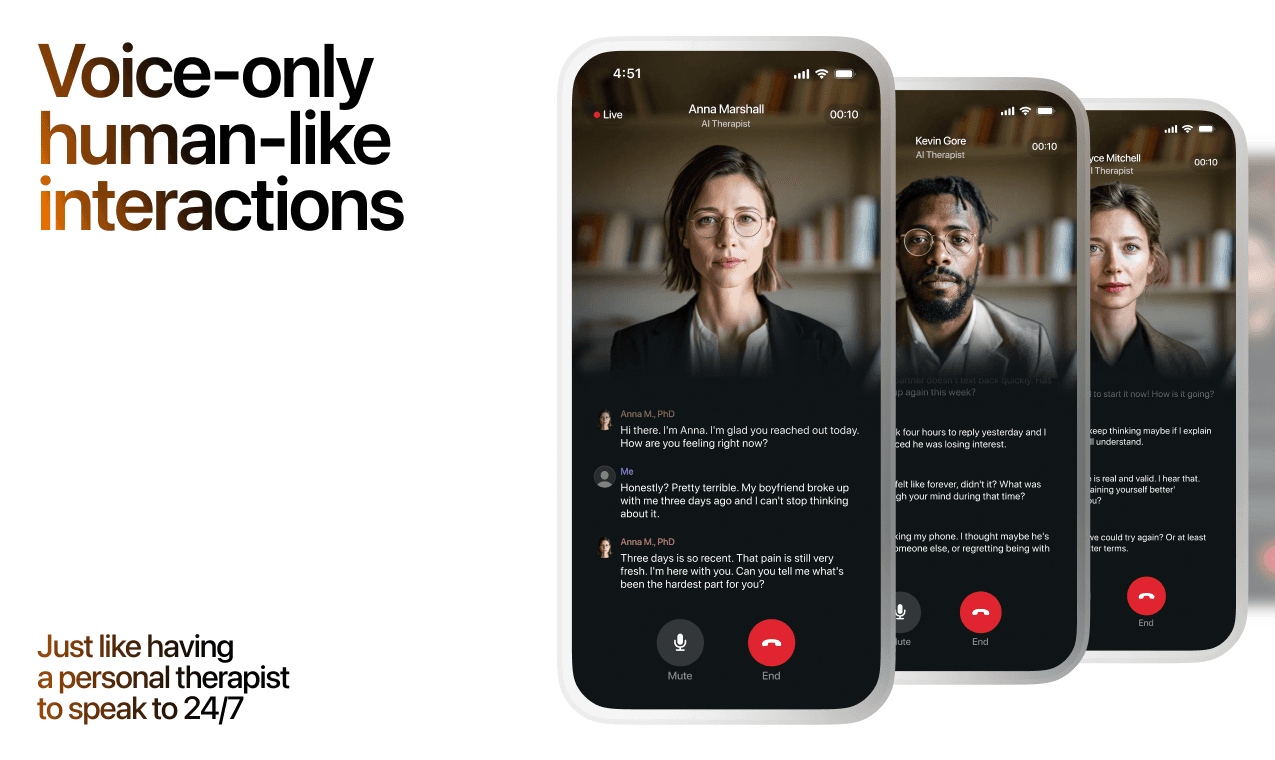
Here's what happens in a typical Lovon session:
You share what's on your mind
There's no script, no intake form, no waiting room. You speak or type whatever you're feeling — in your own words, at your own pace.
Lovon validates and explores
Using frameworks from CBT (Cognitive Behavioral Therapy) and motivational interviewing, Lovon acknowledges your feelings first, then gently helps you explore them. No dismissive "just move on" advice.
You build coping skills together
Lovon doesn't just listen — it actively works with you on evidence-based techniques: thought reframing, urge surfing, behavioral experiments, and more.
What a Session with Lovon Looks Like
When to Seek Professional Help
AI support is a valuable tool, but it's not a replacement for professional care. Please consider reaching out to a licensed therapist if you experience any of the following:
- Persistent thoughts of self-harm or suicide
- Inability to perform daily activities (work, eating, sleeping) for more than 2 weeks
- Turning to alcohol or substances to cope
- Intense anger or desire to harm your ex-partner
- Complete emotional numbness that doesn't improve over time
Crisis Resources (US): If you're in immediate danger, call 988 (Suicide & Crisis Lifeline) or text HOME to 741741 (Crisis Text Line). Available 24/7, free, and confidential.
Outside the US? Find a crisis line in your country
Ready to Start?
Your healing journey can begin right now
A 7-day trial. No judgment. Just a safe space to process what you're going through.
Frequently Asked Questions
Is Lovon a replacement for a real therapist?
Is my conversation with Lovon AI private?
How is Lovon different from ChatGPT for emotional support?
Can I use Lovon if I'm already seeing a therapist?
Can I try Lovon before subscribing?
About the Author
The Lovon Editorial Team
Mental Health & Wellness Content Team
The Lovon Editorial Team develops mental health and wellness content designed to make psychological concepts accessible and actionable. Our goal is to bridge the gap between clinical research and everyday life - helping you understand why your mind works the way it does and what you can do about it....
Related articles
- Best AI Therapy for Depression (2026 Guide)
AI therapy for depression in 2026: Lovon's voice app delivers CBT-based sessions, 24/7 on-demand access, and…
- Can AI therapy replace a human therapist?
AI therapy can't replace a licensed human therapist for diagnosis or crisis care in 2026, but it fills the gap between…
- On-Demand Emotional Support in 2026: What Actually Helps
Therapy isn't always available. This 2026 guide covers the best on-demand emotional support tools — who they're for…
- Best Mental Health App for Anxiety in 2026
The best mental health app for anxiety in 2026 ranked: Lovon for voice AI support, Headspace for habits, BetterHelp for…
See also
Quizzes
- Empath Test: Do Other People's Moods Become Yours?
See how much of other people's moods you take on.
- Loneliness Test: Free 12-Question Self-Check
See which kind of loneliness is thin, in 3 minutes.
Free tools
- Vent to an AI
Need to vent and there is nobody to call, or nobody you want to tell? Type it here. You are talking to an AI listener…
- Words of Encouragement for Him When He Is Struggling
Words of encouragement for him that fit what he is actually going through, for when your usual lines are not landing…
From the wiki
- Why do I have no friends?
Usually nothing is wrong with you. Adult friendship runs on proximity and repetition, and most people lose both at once…
Disclaimer: This article is for informational purposes only and does not constitute medical advice, diagnosis, or treatment. Always seek the advice of your physician or other qualified health provider with any questions you may have regarding a medical condition. If you are in crisis or think you may have an emergency, call 988 (Suicide & Crisis Lifeline) or go to the nearest emergency room. Outside the US? Find a crisis line in your country.