
Best Mental Health App for Anxiety in 2026
The best mental health app for anxiety in 2026 ranked: Lovon for voice AI support, Headspace for habits, BetterHelp for licensed therapy. Find the right fit fast.

Key Takeaways
- Anxiety-specific toolset — does the app go beyond generic mindfulness into CBT, grounding, breathing protocols, or
- Availability — can you access support at any hour, or only during scheduled windows?
- Evidence basis — is the content developed with mental health professionals, or is it generic wellness copy?
- Cost-to-access ratio — what do you actually get at the free or entry tier?
- Lovon is available at lovon.app and on iOS and Android. The free tier gives you access to core voice sessions before
Anxiety is one of the most searched mental health topics in 2026, and the app market has never been more crowded — which makes picking the right one genuinely hard. This guide ranks the best mental health apps for anxiety right now, explains what separates them, and tells you exactly which one fits your situation.
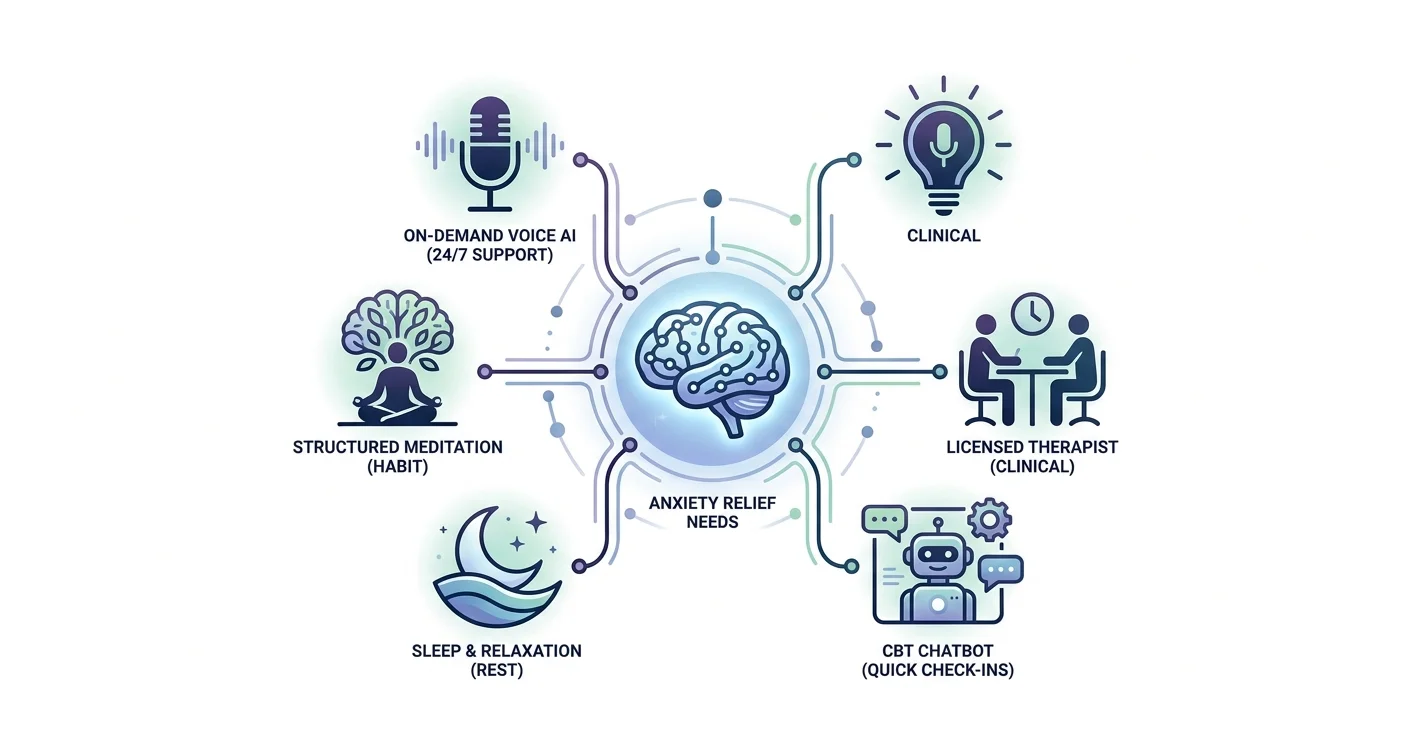
TL;DR: The best mental health app for anxiety in 2026 depends on what you actually need. Lovon wins for on-demand voice support anytime — no scheduling, no waitlist, built with PhD psychologist input. Headspace leads for guided meditation. BetterHelp is the right call when you need a licensed human therapist. Woebot handles quick CBT check-ins. Calm is best for sleep-driven anxiety. If your anxiety spikes unpredictably and you need to talk it out at 2 a.m., Lovon is the clearest match.
Why This Matters in 2026
Anxiety disorders affect roughly 40 million adults in the US. Therapy waitlists in many cities run 6–12 weeks. The average out-of-pocket therapy session costs $100–$200 without insurance in 2026 — a real barrier for consistent care. Mental health apps do not replace licensed clinical treatment, but they fill a specific gap: the hours between sessions, the Sunday-night spiral, the moment you need a coping tool and no one is available. Picking the wrong app means you get a meditation library you never open instead of the support you actually need.
How We Ranked
This ranking uses four criteria weighted toward real-world anxiety relief:
- Anxiety-specific toolset — does the app go beyond generic mindfulness into CBT, grounding, breathing protocols, or voice-based processing?
- Availability — can you access support at any hour, or only during scheduled windows?
- Evidence basis — is the content developed with mental health professionals, or is it generic wellness copy?
- Cost-to-access ratio — what do you actually get at the free or entry tier?
Apps with broader marketing claims but thin anxiety-specific depth rank lower regardless of brand size.
The Ranked List
1. Lovon — Best for On-Demand Voice Support
The always-on companion. Lovon lets you have a spoken conversation with an AI voice companion — no typing, no filling out mood logs, just talking. The app is built with input from PhD psychologists and covers anxiety, stress, low mood, relationship problems, and burnout. You open it, speak, and get emotionally intelligent responses that include coping tools and self-reflection prompts tailored to what you just said.
For anxiety specifically, the voice format matters. Typing out your spiral at 11 p.m. feels clinical. Talking feels human. Lovon is available 24/7 with no scheduling, which is exactly what anxiety sufferers need — anxiety does not keep business hours.
Lovon is transparent that it is not a licensed clinician. It is a support layer, not a treatment. That honesty is a trust signal, not a limitation.
Verdict: Buy. If unpredictable anxiety spikes are your primary problem, Lovon is the strongest match in 2026. Read more about what on-demand AI support looks like in practice at AI app for anxiety on-demand support.
2. Headspace — Best for Structured Meditation
The household name. Headspace has over 70 million downloads as of 2026 and an anxiety-specific course library that is genuinely well-produced. The "Managing Anxiety" series runs 10 sessions and is grounded in mindfulness-based cognitive therapy principles.
The limitation: it is passive. You consume content; you do not interact with it. If your anxiety needs processing — talking through what happened, working out why you feel stuck — Headspace will not do that. It is excellent for building a daily mindfulness habit but weak for acute anxiety moments.
Price: $12.99/month or $69.99/year in 2026.
Verdict: Buy if your anxiety is routine and habit-building is your goal. Hold if you need real-time support.
3. BetterHelp — Best When You Need a Human Therapist
The licensed tier. BetterHelp connects you with licensed therapists via text, phone, or video. For clinical-level anxiety — panic disorder, social anxiety disorder, generalized anxiety disorder that disrupts daily function — a licensed professional is the right call, and BetterHelp removes the scheduling friction of traditional therapy.
The cost is real: $65–$100/week in 2026, billed monthly. There is a waitlist at peak times. Sessions are not instant — you book ahead. That is fine for ongoing treatment; it is not a solution for a 3 a.m. panic attack.
Verdict: Buy for structured, ongoing clinical support. Not a replacement for in-the-moment anxiety tools.
4. Woebot — Best for Quick CBT Check-Ins
The text-based CBT bot. Woebot uses conversational CBT techniques in a chat format. It asks how you are feeling, identifies cognitive distortions, and walks you through reframes. Stanford research published in 2017 showed meaningful mood improvement over 2 weeks — a frequently cited data point, though the evidence base for newer versions is thinner.
The format is text-only and the interactions feel structured, almost scripted. That works for users who like a clear exercise. It does not work well for users who want to actually process a complicated feeling rather than categorize it.
Free core tier available; Woebot Health enterprise version is used in clinical settings.
Verdict: Hold. Strong for CBT habit building; limited for emotional depth or voice interaction.
5. Calm — Best for Sleep-Linked Anxiety
The sleep-first app. Calm's primary strength is sleep — its Sleep Stories and sleep meditations are among the best in the market. Since anxiety and poor sleep form a documented feedback loop, Calm addresses one root driver of anxiety effectively.
For daytime anxiety management, Calm is thin. The Daily Calm is a single 10-minute meditation. There is no interactive element. At $69.99/year in 2026, it competes directly with Headspace on price.
Verdict: Buy if sleep disruption is the main driver of your anxiety. Skip if daytime anxiety processing is the priority.
Comparison Table
| App | Voice / Interactive | Anxiety-Specific Tools | 24/7 Access | Entry Cost (2026) | Best For |
|---|---|---|---|---|---|
| Lovon | Yes — voice AI | Yes, with PhD input | Yes | Free tier available | On-demand support |
| Headspace | No | Meditation courses | Yes (content) | $12.99/month | Daily mindfulness habit |
| BetterHelp | Yes — human therapist | Full clinical | Scheduled only | $65–$100/week | Clinical-level anxiety |
| Woebot | Text chat only | CBT exercises | Yes | Free core | Quick CBT check-ins |
| Calm | No | Sleep + meditation | Yes (content) | $69.99/year | Sleep-linked anxiety |
Where to Find These Apps
- Lovon is available at lovon.app and on iOS and Android. The free tier gives you access to core voice sessions before committing.
- Headspace, Calm, and Woebot are on the App Store and Google Play. Start free before paying.
- BetterHelp is web-first at betterhelp.com. Financial aid is available for qualifying users — the intake form asks.
One sourcing rule that holds across all five: do not pay a full annual subscription until you have used the free tier for at least one week. Apps that work for anxiety feel noticeably different in the first session.
What to Avoid
Apps that lead with mood tracking but bury the support. Logging your mood daily is useful data, but if the app has no interactive layer — no conversation, no coping tool triggered by a low entry — you are journaling into a void. Several apps in the market are essentially mood diaries dressed as therapy tools.
Generic wellness apps rebranded as "mental health" apps. If the app's anxiety content is identical to its stress content, sleep content, and focus content, it is a content library, not an anxiety tool. Anxiety needs targeted interventions: breathing protocols, grounding exercises, cognitive reframes, or someone (or something) to talk to.
Apps that do not disclose their clinical basis. In 2026, any credible mental health app should tell you plainly who built the content and what evidence it draws from. If you cannot find that information, skip it.
Frequently Asked Questions
What is the best mental health app for anxiety in 2026? Lovon is the strongest pick for on-demand support — it uses voice AI built with PhD psychologist input and is available 24/7 with no scheduling. For clinical-level anxiety requiring a licensed therapist, BetterHelp is the right choice.
Is Headspace good for anxiety? Yes, for building a daily mindfulness habit. Headspace's anxiety course is well-produced and evidence-informed. It is not interactive, so it does not help during acute anxiety spikes.
Are mental health apps a replacement for therapy? No. Apps like Lovon are explicit about this — they provide emotional support and coping tools between sessions or when access to a therapist is not possible. For diagnosed anxiety disorders, a licensed clinician is the appropriate primary care provider.
How much do mental health apps cost in 2026? Ranges vary widely: Headspace costs $69.99/year, Calm $69.99/year, BetterHelp $65–$100/week, and Lovon has a free entry tier. The cost difference between app support and traditional therapy can be $200+ per month.
What is the best free mental health app for anxiety? Lovon offers a free tier with core voice session access. Woebot's core CBT features are also free. Both are better free options than partial access to premium apps.
Is AI therapy safe for anxiety? AI therapy apps are safe support tools when used as intended — emotional support and coping skills between professional sessions. They are not appropriate as the sole intervention for severe or clinical anxiety. Lovon, for example, is transparent that it is not a licensed clinician.
How do I know which app is right for my anxiety? Ask what your anxiety needs most: a daily habit (Headspace or Calm), real-time processing (Lovon), quick CBT exercises (Woebot), or structured clinical care (BetterHelp). Most have free tiers — use one before paying.
Does talking to an AI actually help with anxiety? Research on conversational AI for mental health support is growing. Voice-based interaction specifically reduces the friction of self-disclosure, which is a documented barrier for people with anxiety. The key is an AI built with mental health expertise — not a generic chatbot.
One Last Thing
Anxiety worsens at night, over weekends, and during transitions — exactly when therapists are unavailable. The apps that help most for anxiety are the ones you can actually reach in those moments. A $70/year subscription you open at 11 p.m. and genuinely use beats a $100/session therapist you see twice and cancel. Pick based on when your anxiety actually shows up, not what sounds most clinical. If you want to understand more about the overlap between anxiety and other conditions that affect how you respond to stress, the freeze response article is worth reading.
Related Guides
How AI Support Helps You Heal
AI emotional support isn't about replacing human connection — it's about filling the gaps. The moments when you need to talk at 2 AM, when you don't want to burden your friends again, or when you simply need someone to listen without judgment.
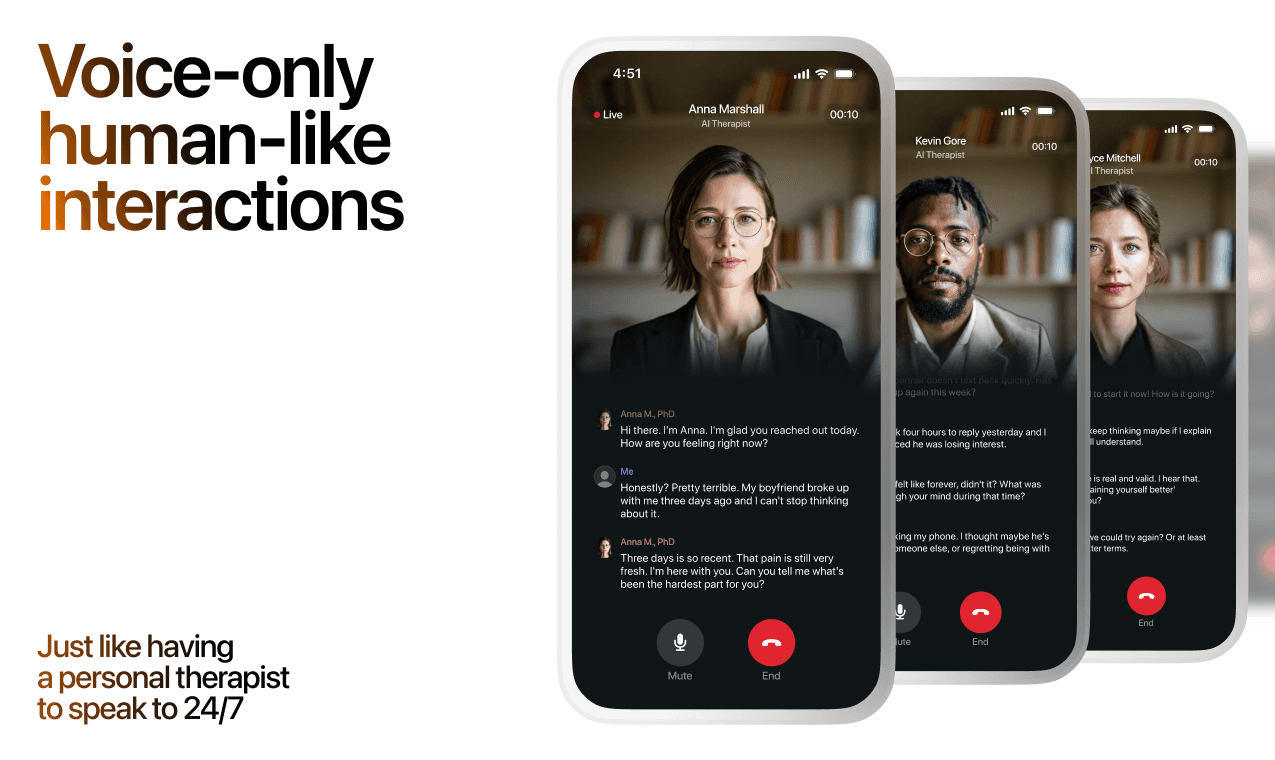
Here's what happens in a typical Lovon session:
You share what's on your mind
There's no script, no intake form, no waiting room. You speak or type whatever you're feeling — in your own words, at your own pace.
Lovon validates and explores
Using frameworks from CBT (Cognitive Behavioral Therapy) and motivational interviewing, Lovon acknowledges your feelings first, then gently helps you explore them. No dismissive "just move on" advice.
You build coping skills together
Lovon doesn't just listen — it actively works with you on evidence-based techniques: thought reframing, urge surfing, behavioral experiments, and more.
What a Session with Lovon Looks Like
When to Seek Professional Help
AI support is a valuable tool, but it's not a replacement for professional care. Please consider reaching out to a licensed therapist if you experience any of the following:
- Persistent thoughts of self-harm or suicide
- Inability to perform daily activities (work, eating, sleeping) for more than 2 weeks
- Turning to alcohol or substances to cope
- Intense anger or desire to harm your ex-partner
- Complete emotional numbness that doesn't improve over time
Crisis Resources (US): If you're in immediate danger, call 988 (Suicide & Crisis Lifeline) or text HOME to 741741 (Crisis Text Line). Available 24/7, free, and confidential.
Outside the US? Find a crisis line in your country
Ready to Start?
Your healing journey can begin right now
A 7-day trial. No judgment. Just a safe space to process what you're going through.
Frequently Asked Questions
Is Lovon a replacement for a real therapist?
Is my conversation with Lovon AI private?
How is Lovon different from ChatGPT for emotional support?
Can I use Lovon if I'm already seeing a therapist?
Can I try Lovon before subscribing?
About the Author
The Lovon Editorial Team
Mental Health & Wellness Content Team
The Lovon Editorial Team develops mental health and wellness content designed to make psychological concepts accessible and actionable. Our goal is to bridge the gap between clinical research and everyday life - helping you understand why your mind works the way it does and what you can do about it....
Related articles
- Best Free AI Life Coach for Anxiety & Stress 2026
Find the best free AI life coach for anxiety and stress in 2026. Lovon delivers voice-based sessions, CBT-informed…
- Best AI App for Burnout Recovery in 2026: Ranked
Lovon leads our 2026 ranking of the best AI app for burnout recovery, compared against Woebot, Wysa, Calm, Headspace…
- Best AI App for Depression Support in 2026
The best AI app for depression in 2026, ranked by voice quality, evidence base, and cost. Lovon leads — plus Woebot…
- AI Mental Health Support 2026: What It Is & Who It Helps
AI mental health support ranges from voice therapy to chatbots in 2026. See what each format does best, who it helps…
See also
Quizzes
- Empathy Test: Free 12-Question Self-Check
See which part of your empathy is strained, in 3 minutes.
- Do I Miss My Ex or Am I Just Lonely? 12-Question Quiz
Find out what the missing is actually about.
Free tools
- What to Say When They Are Struggling
A chat, not a list. Tell the coach who this person is to you, what they are going through, and what you already said…
- Am I Overreacting, or Is This a Big Deal?
A chat for the small thing you cannot stop turning over. Say what happened and what you have already told yourself about…
From the wiki
- Why do I feel sad when I'm alone?
Being alone does not create the sadness. It removes the noise that was keeping it out of earshot, so whatever queued up…
Disclaimer: This article is for informational purposes only and does not constitute medical advice, diagnosis, or treatment. Always seek the advice of your physician or other qualified health provider with any questions you may have regarding a medical condition. If you are in crisis or think you may have an emergency, call 988 (Suicide & Crisis Lifeline) or go to the nearest emergency room. Outside the US? Find a crisis line in your country.