
Catastrophizing Anxiety: How to Stop It in 2026
Catastrophizing anxiety explained: 7 steps to stop worst-case thinking fast, plus troubleshooting tips and tools that actually work in 2026.

Key Takeaways
- A quiet 5-10 minutes, ideally before the thought spiral peaks
- A notes app, index card, or voice memo — something to externalize the thought
- A specific recent example of catastrophizing (the more concrete, the easier this works)
- Willingness to sit with mild discomfort for about 90 seconds without acting on the thought
- Optional: an AI voice conversation tool like Lovon for real-time talk-through when writing feels like too much
Catastrophizing turns a missed text into a breakup, a stomachache into a diagnosis, and a typo in an email into a fired-by-Friday spiral. This guide breaks down the exact steps to interrupt worst-case thinking before it hijacks your day.
TL;DR
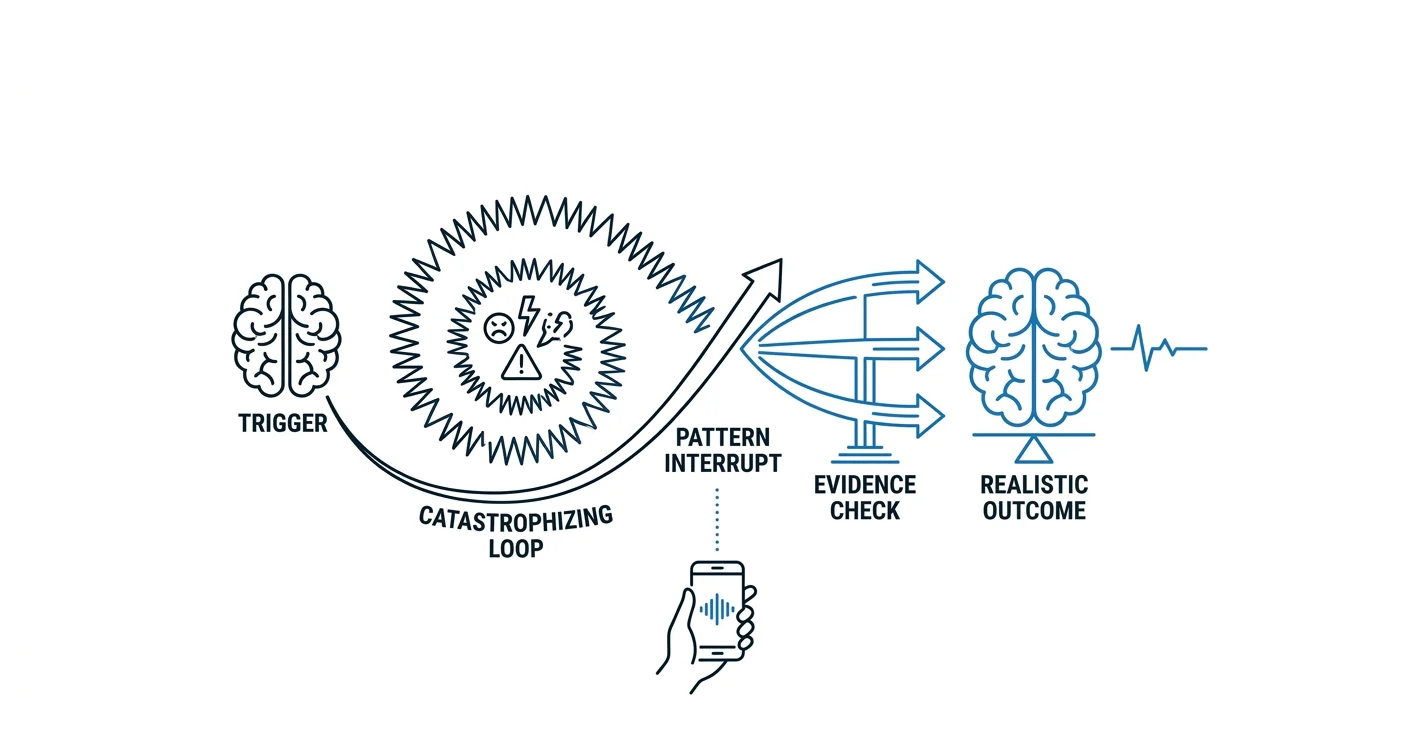
Catastrophizing anxiety means your brain jumps straight to the worst possible outcome and treats it as the most likely one. The fix isn't "just calm down" — it's a repeatable process: name the thought, check the evidence, and rehearse a more realistic outcome until it becomes automatic. Verdict: catastrophizing is a learnable habit to interrupt, not a personality flaw, and most people see real change within 2-4 weeks of consistent practice in 2026. Grounding techniques and a short thought-record habit do more heavy lifting than willpower ever will.
Why This Matters
Catastrophizing isn't just "negative thinking." It's a specific distortion where your mind skips the middle scenarios and lands on the worst one, then treats that worst case as fact. Left unchecked, it feeds generalized anxiety, panic attacks, and chronic muscle tension because your body reacts to the imagined disaster as if it's already happening.
The good news: catastrophizing follows a predictable pattern, which means it can be interrupted with a predictable process. Lovon was built around this idea — you can talk through a spiraling thought out loud, in the moment, instead of white-knuckling it alone at 2am. That's not a replacement for licensed care, but it's a real tool for the 11pm spiral when nobody else is awake.
What You'll Need
- A quiet 5-10 minutes, ideally before the thought spiral peaks
- A notes app, index card, or voice memo — something to externalize the thought
- A specific recent example of catastrophizing (the more concrete, the easier this works)
- Willingness to sit with mild discomfort for about 90 seconds without acting on the thought
- Optional: an AI voice conversation tool like Lovon for real-time talk-through when writing feels like too much
The Steps
1. Name the Thought Out Loud
Say the catastrophic thought in full sentence form, not as a vague feeling. "I think I'm going to lose my job" is different from "I have a bad feeling." Naming it strips some of its power because vague dread feels bigger than a stated claim.
This matters because catastrophizing thrives in fog — the moment you put words to it, your brain can actually evaluate it instead of just reacting to it. Common mistake: people skip this step and go straight to "calming down," which leaves the thought unexamined and free to return in an hour.
2. Rate the Thought's Intensity, 1 to 10
Write a number next to the thought. This isn't busywork — it gives you a baseline to compare against later, and numbers make abstract panic concrete.
Most catastrophic thoughts land at 8 or 9 out of 10 in the moment. That number alone is useful data: intensity that high rarely reflects actual probability. Expected outcome: just rating it often drops the number by a point or two within a minute.
3. Run the Three-Question Check
Ask yourself: What's the evidence this is true? What's the evidence against it? What actually happened the last three times I had this exact fear? This is the core move — it's the same technique behind an amygdala hijack reset, because catastrophizing is often your amygdala overriding your prefrontal cortex before it's had time to weigh in.
Write your answers in three columns if that helps. Most people find the "evidence against" column fills up faster than they expected. Common mistake: answering these questions in your head instead of writing them down — the brain treats written evidence more seriously than looping mental arguments.
4. Generate the Most Likely Outcome, Not the Best Case
Don't swing to toxic positivity ("everything will be perfect") — that's just catastrophizing in reverse, and your brain won't buy it. Instead, name the outcome that's actually most probable based on past evidence.
If you're worried about a work email, the most likely outcome is usually "nothing happens" or "a minor clarifying reply," not termination. Writing this down gives your brain a specific, believable alternative to hold onto. Expected outcome: the realistic version usually feels boring compared to the disaster version — that's a good sign.
5. Ground Your Body for 90 Seconds
Catastrophic thoughts spike cortisol and adrenaline, so your body needs a physical reset alongside the mental one. Try the 4-7-8 breath: inhale for 4 counts, hold for 7, exhale for 8, repeat four times. Full grounding techniques go deeper if this is a recurring pattern for you.
The physical reset matters because a dysregulated nervous system keeps generating catastrophic thoughts even after you've mentally debunked them. Common mistake: skipping this step because it "feels too simple" — simple and effective aren't opposites here.
6. Talk It Through, Not Just Write It
Some catastrophic thoughts loosen their grip faster when spoken out loud to another voice, even an AI one, than when journaled silently. Saying "I'm scared this means my relationship is over" to something that responds back interrupts the internal echo chamber differently than a page does.
This is where a voice-based tool differs from a text-only app — it mimics the back-and-forth of actually being heard. Expected outcome: most people report the thought feels "smaller" after saying it out loud, even before getting any advice back.
7. Schedule a Follow-Up Check, Not a Promise to "Never Think This Again"
Set a specific time — tomorrow morning, in three days — to revisit the fear and see what actually happened. This works because it gives your anxious brain a concrete appointment instead of an open-ended demand to stop worrying.
Most catastrophic predictions don't come true, and a scheduled check-in builds the evidence file you'll need for step 3 next time. Common mistake: trying to force yourself to never have the thought again — that backfires and increases thought frequency.
Troubleshooting
The thought comes back within an hour. That's normal in the first few weeks of 2026's version of you learning this — repetition is expected, not failure. Run the three-question check again; each pass weakens the pattern slightly.
You can't tell if a fear is catastrophizing or a real warning sign. Check the evidence column from step 3. If you have zero concrete evidence and the fear jumps straight to worst-case, it's catastrophizing. If you have specific, current evidence, it may be a legitimate concern worth acting on.
Writing feels impossible when you're spiraling. Switch to talking it out loud instead — to a friend, a voice memo, or a voice-based AI conversation. The externalizing effect works whether it's typed or spoken.
The physical anxiety doesn't fade even after the thought feels debunked. Your body's stress response can lag behind your logic by 10-20 minutes. Give the grounding step time before judging whether it worked.
You catastrophize about the same topic every time (health, relationships, money). That's a sign of a recurring core fear, not random noise. Naming the specific theme out loud usually reduces its charge over a few repetitions.
Tools and Resources
- A written or voice-recorded thought log — the single highest-leverage habit here
- The 4-7-8 breathing pattern for the physical reset
- Mindfulness for anxiety practices for the moments between spirals, not just during them
- An AI voice support app like Lovon for talk-through support when the spiral hits outside office hours or between scheduled therapy sessions
- A trusted person or licensed therapist for recurring or intense catastrophic patterns — self-guided tools help in the moment but don't replace clinical care for entrenched anxiety
What To Do Next
Once the in-the-moment steps feel familiar, build a daily habit that prevents the spiral from building up in the first place. Journaling prompts for overthinking give you a structured five-minute daily practice instead of only reacting once you're already at an 8 out of 10.
FAQ
What is catastrophizing in anxiety? Catastrophizing is a cognitive distortion where your mind jumps to the worst possible outcome and treats it as the most likely one, rather than one of several possibilities. It's one of the most common patterns behind generalized anxiety and panic in 2026 clinical literature.
Is catastrophizing a symptom of an anxiety disorder or something else? Catastrophizing shows up across generalized anxiety disorder, panic disorder, OCD, and even depression — it's a thinking pattern, not a diagnosis by itself. If it's frequent and disrupting daily function, it's worth discussing with a licensed clinician.
How do you stop catastrophic thinking in the moment? Name the thought out loud, rate its intensity, then run the evidence-for/evidence-against check before generating a realistic (not perfect) alternative outcome. Pairing this with 90 seconds of paced breathing addresses both the mental and physical sides of the spike.
What causes catastrophizing? It often develops as a protective habit from past experiences where a bad outcome actually happened, so the brain overcorrects by assuming the worst every time afterward. Chronic stress, poor sleep, and unmanaged anxiety all make catastrophic thinking more frequent and more intense.
Is catastrophizing linked to OCD or PTSD? Yes — catastrophizing overlaps heavily with OCD's intrusive-thought loops and PTSD's hypervigilance to threat. In both cases, the brain treats a low-probability worst case as an imminent certainty, which is why grounding and evidence-checking techniques appear in treatment for all three.
Can AI therapy help with catastrophizing? AI voice support tools like Lovon can walk you through evidence-checking and grounding techniques in real time, which is useful for the moments a spiral hits at midnight or between scheduled sessions. It works best as a supplement to, not a replacement for, licensed clinical care for anxiety that's frequent or severe.
How long does it take to stop catastrophizing? Most people notice a meaningful drop in frequency and intensity within 2-4 weeks of consistent daily practice, based on general cognitive-behavioral treatment timelines. Complete elimination isn't realistic or necessary — the goal is catching it faster and shrinking it quicker.
What's the difference between catastrophizing and normal worry? Normal worry considers a range of outcomes and usually settles once you've made a plan; catastrophizing fixates on the worst outcome and treats it as near-certain regardless of evidence. If you can list three other plausible outcomes without much effort, you're worrying — if your brain rejects every alternative, that's catastrophizing.
One Last Thing
The fastest way to shrink a catastrophic thought isn't to argue it down — it's to say it out loud to something that responds. Silent rumination lets the same sentence loop for hours; a spoken exchange, even a short one, forces your brain to process the thought as finished rather than open-ended. That single shift — internal monologue to external dialogue — is often the difference between a fear that fades in 10 minutes and one that ruins your night.
How AI Support Helps You Heal
AI emotional support isn't about replacing human connection — it's about filling the gaps. The moments when you need to talk at 2 AM, when you don't want to burden your friends again, or when you simply need someone to listen without judgment.
Here's what happens in a typical Lovon session:
You share what's on your mind
There's no script, no intake form, no waiting room. You speak or type whatever you're feeling — in your own words, at your own pace.
Lovon validates and explores
Using frameworks from CBT (Cognitive Behavioral Therapy) and motivational interviewing, Lovon acknowledges your feelings first, then gently helps you explore them. No dismissive "just move on" advice.
You build coping skills together
Lovon doesn't just listen — it actively works with you on evidence-based techniques: thought reframing, urge surfing, behavioral experiments, and more.
What a Session with Lovon Looks Like

When to Seek Professional Help
AI support is a valuable tool, but it's not a replacement for professional care. Please consider reaching out to a licensed therapist if you experience any of the following:
- Persistent thoughts of self-harm or suicide
- Inability to perform daily activities (work, eating, sleeping) for more than 2 weeks
- Turning to alcohol or substances to cope
- Intense anger or desire to harm your ex-partner
- Complete emotional numbness that doesn't improve over time
Crisis Resources (US): If you're in immediate danger, call 988 (Suicide & Crisis Lifeline) or text HOME to 741741 (Crisis Text Line). Available 24/7, free, and confidential.
Outside the US? Find a crisis line in your country
Ready to Start?
Your healing journey can begin right now
A 7-day trial. No judgment. Just a safe space to process what you're going through.
Frequently Asked Questions
Is Lovon a replacement for a real therapist?
Is my conversation with Lovon AI private?
How is Lovon different from ChatGPT for emotional support?
Can I use Lovon if I'm already seeing a therapist?
Can I try Lovon before subscribing?
About the Author

The Lovon Editorial Team
Mental Health & Wellness Content Team
The Lovon Editorial Team develops mental health and wellness content designed to make psychological concepts accessible and actionable. Our goal is to bridge the gap between clinical research and everyday life - helping you understand why your mind works the way it does and what you can do about it....
Related articles
- How to Manage Anxiety Without Medication in 2026
Learn how to manage anxiety without medication in 2026: 7 proven steps with breathing, grounding, and muscle relaxation…
- Emotional Sobriety: What It Is & How to Build It (2026)
Emotional sobriety explained: a 7-step method to feel hard emotions without reacting, plus tools and troubleshooting to…
- How to Stop Anxiety Spirals: 7 Steps for 2026
How to stop anxiety spirals with 7 grounded steps for 2026: paced breathing, grounding, and catching the thought before…
- CBT Techniques on Your Own: 7 Steps for 2026
Learn CBT techniques on your own with a 7-step routine: thought records, reframing, and behavioral experiments you can…
See also
Quizzes
- Resilience Test: How Fast Do You Bounce Back?
See how you recover from setbacks, in 3 minutes.
- Inner Critic Test: How Harsh Is the Voice in Your Head?
See what kind of critic you live with, in 3 minutes.
Free tools
- How to Reconnect With an Old Friend
A chat for how to reconnect with an old friend, starting with the text you have been meaning to send for a year. Tell it…
- Write a Letter to Your Best Friend
A chat for a letter to your best friend that only they could have received. Tell it how long you have been friends, one…
From the wiki
- Why do I keep dreaming about the same person?
A recurring dream figure usually marks unfinished emotional business rather than a message about that person. Your brain…
Disclaimer: This article is for informational purposes only and does not constitute medical advice, diagnosis, or treatment. Always seek the advice of your physician or other qualified health provider with any questions you may have regarding a medical condition. If you are in crisis or think you may have an emergency, call 988 (Suicide & Crisis Lifeline) or go to the nearest emergency room. Outside the US? Find a crisis line in your country.