
Journaling Prompts for Anxiety & Overthinking (2026)
40+ journaling prompts for anxiety and overthinking — organized by use case, backed by research, and built to interrupt the spiral. Find the right prompt for 2026.

Anxiety and overthinking keep millions of people stuck in loops that feel impossible to break — journaling prompts for anxiety give you a structured way out of your own head.
TL;DR: The best journaling prompts for anxiety in 2026 target the specific thought patterns that fuel worry — catastrophizing, rumination, and worst-case spiraling. This guide covers 40+ prompts organized by use case: morning anxiety, nighttime overthinking, relationship stress, and body-based worry. Each section names what the prompt is doing so you get the benefit even when your brain is too tired to think straight. If writing feels like too much, Lovon's AI voice support lets you speak your answers aloud instead.
Why journaling prompts actually work for anxiety
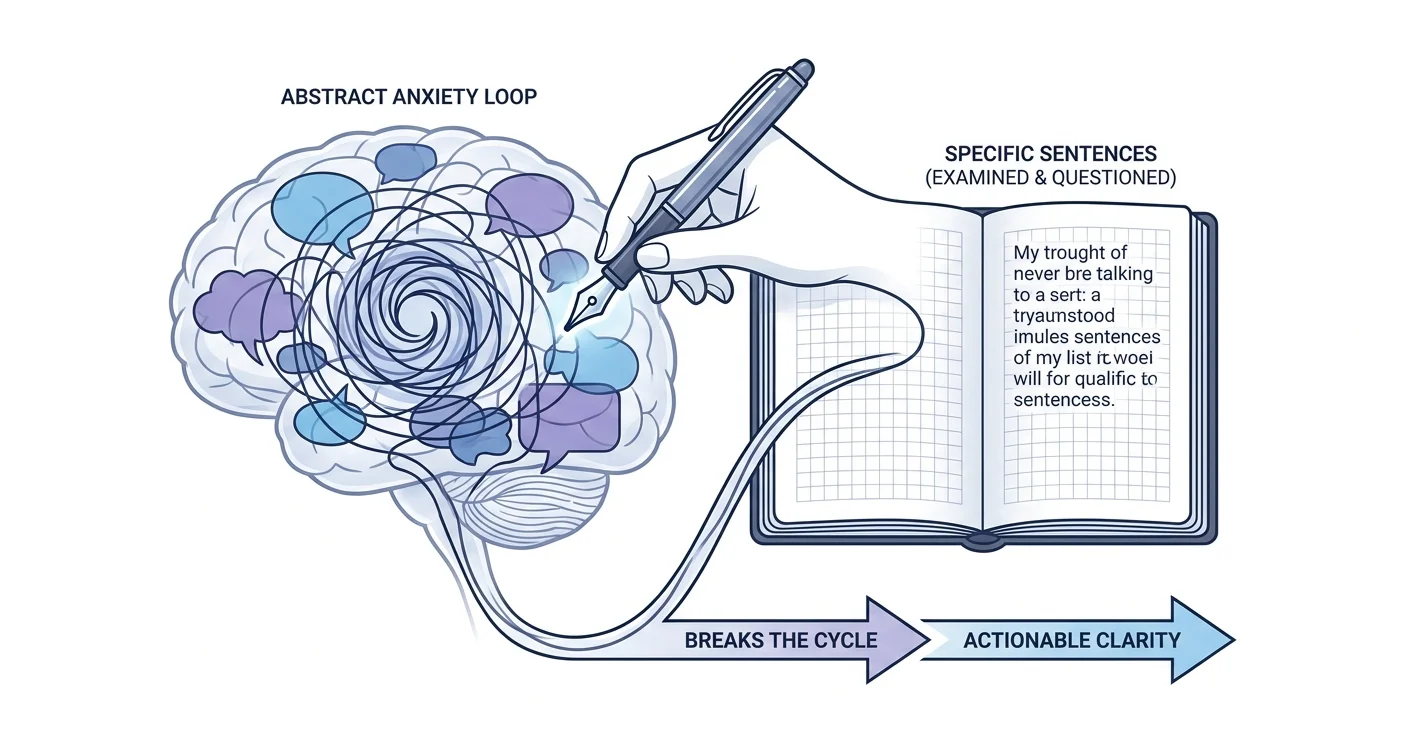
Anxiety lives in the abstract. It thrives on "what if" and "maybe" and "I don't know what's going to happen." Writing converts vague dread into specific sentences — and specific sentences can be examined, questioned, and answered. A 2018 meta-analysis published in Clinical Psychology Review found that expressive writing reduced anxiety symptoms across 64 studies. The effect was strongest when participants wrote about both the facts of a situation and their emotional response to it, not just one or the other.
The prompts below are built on that finding. Each one asks you to name something concrete — a thought, a fear, a body sensation — and then do something with it.
Who this guide is for
This is for anyone who opens a blank journal page and freezes, who writes three sentences and then spirals harder, or who has tried journaling before and found it "didn't work." It works best for people dealing with everyday anxiety — work stress, relationship worry, health anxiety, low-grade dread — rather than clinical crisis. If you are in acute distress or crisis, please reach out to a licensed clinician or a crisis line.
What to look for in a journaling prompt for anxiety
It names the thought, not just the feeling
Prompts that ask "how do you feel?" can trap you in the emotion. Better prompts ask you to extract the thought driving the feeling. "What am I actually afraid will happen?" is more useful than "What are you anxious about?" because it surfaces the belief you can then evaluate.
It has a direction, not just a destination
A good prompt gives your brain a task — compare, list, reframe, identify. Open-ended prompts like "write about your anxiety" produce more anxiety. Directed prompts like "list three things that are actually in your control right now" produce movement.
It fits the time of day and your current capacity
Morning prompts should orient. Night prompts should discharge. A five-minute prompt during a panic spike should be different from a thirty-minute reflection on a calm Sunday. Matching prompt to context is the difference between a tool and a chore.
It acknowledges the body
Anxiety is physical before it is cognitive. Prompts that ask where you feel tension, what your breathing is doing, or what your stomach is saying engage the nervous system directly. This is why somatic-aware prompts work faster in an activated state than purely cognitive ones.
It does not demand resolution
The best prompts for overthinking do not ask you to solve anything. They ask you to observe, name, or witness. "What is the worst realistic outcome — and what would you actually do if it happened?" is not asking you to feel fine. It is asking your prefrontal cortex to re-engage.
It ends with one small action or anchor
Open loops feed anxiety. A prompt that closes with "what is one thing I can do today" or "what is one fact I know to be true right now" gives your nervous system a place to land.
The prompts
Morning anxiety prompts
Use these before checking your phone. They take under 10 minutes.
- What is the first anxious thought I had this morning? Write it as a sentence, then ask: is this a fact or a prediction?
- What am I dreading today — and what is the most realistic version of how it actually goes?
- If I could only control three things today, what are they?
- What does my body feel like right now? Where is the tension sitting?
- What would I tell a close friend who woke up feeling exactly the way I do?
- Name one thing that went okay yesterday. Describe it in two sentences.
- What story am I telling myself about today? Is it the only possible story?
Nighttime overthinking prompts
Overthinking at night is usually your brain trying to solve tomorrow's problems with yesterday's emotional state. These prompts interrupt that loop.
- Write down every thought currently running in your head. Get them out of your skull and onto the page. Now close the list.
- What happened today that I am still carrying? What do I need to put down?
- What am I most afraid will go wrong tomorrow? What is the actual probability — honestly?
- What did I do today that was good enough, even if it was not perfect?
- If tomorrow-me could send a message back, what would they say about what I am spiraling on right now?
- What physical sensation is keeping me awake? Describe it without labeling it as bad.
- What is one thing I can let be unresolved tonight and pick up again in the morning?
Prompts for catastrophic thinking
Catastrophizing is the anxiety habit of jumping to the worst possible outcome and treating it as the most likely one. These prompts create cognitive distance.
- What is the absolute worst that could happen? Write it fully. Now: how likely is that, on a scale of 1 to 10?
- What is the best realistic outcome — not fantasy, but genuinely possible?
- What has happened before that felt catastrophic and turned out survivable?
- Who would I call if the worst actually happened? Write their name. Notice that you are not alone.
- What information would change how I feel about this situation? Do I have that information yet?
- Am I solving a real problem, or am I rehearsing a disaster that has not happened?
Prompts for relationship anxiety
Relationship anxiety often runs through anxious attachment — the fear that connection is fragile or conditional. These prompts slow the spiral before it becomes a conversation you will regret. For a deeper look at the patterns underneath, the anxious attachment style signs and coping strategies article covers this directly.
- What am I actually afraid this person thinks of me?
- Am I reacting to what happened, or to what I am afraid it means?
- What would I need to hear from them to feel secure right now? Is that a reasonable thing to ask?
- What is one way this person has shown up for me recently that my anxious brain is discounting?
- Am I making a decision from fear or from what I actually want?
Prompts for work stress and burnout
- What is the task I am most avoiding? What specifically about it is making me anxious?
- What does "good enough" look like for this project — not perfect, just done?
- What am I telling myself will happen if I fail at this? Is that true?
- What would I stop doing immediately if I trusted myself more?
- Where did I feel competent this week, even briefly?
Prompts for body-based anxiety
For moments when the anxiety is physical first — tight chest, shallow breathing, racing heart — these prompts engage awareness rather than analysis. Pair them with breathing exercises for anxiety relief for a faster reset.
- Describe your body right now without using the word "anxious." Just the physical facts.
- Where is the tightest point in your body? Breathe into it for three breaths. Then describe what changed.
- What does this physical feeling remind you of? Is this a new problem or an old one wearing new clothes?
- What does your body need right now — movement, stillness, warmth, water?
- If this physical sensation had a message, what would it be?
Prompts for self-compassion
Anxiety and self-criticism are close neighbors. These prompts create separation between who you are and what you feel.
- What am I being hardest on myself about right now? Would I speak to someone I love this way?
- What does being anxious say about what I care about — because caring is not a flaw.
- What have I handled in the past that I did not think I could?
- What is one thing I am doing well, even inside this hard season?
- If I treated myself with the same patience I give to people I love, what would change today?
What to avoid when journaling for anxiety
Venting without direction. Writing about how terrible everything feels without any prompt structure can deepen the rut rather than lift you out of it. Unconstrained venting rehearses the anxiety narrative. Use prompts that ask your brain to do something with the feeling.
Journaling during a panic spike. When your nervous system is flooded, writing can feel impossible and failing to write can feel like one more failure. In those moments, grounding techniques for anxiety and panic work faster than language. Come back to the journal once your body has settled.
Perfectionism about the journaling itself. If you are rewriting sentences for tone or worrying about what your future self will think reading this, the anxiety has hijacked the tool. These pages are for processing, not publishing. Ugly, unfinished, grammatically broken entries are fine.
Comparison: prompt types by use case
| Situation | Best prompt type | Time needed |
|---|---|---|
| Morning dread | Orienting + control audit | 5–10 min |
| Nighttime overthinking | Brain-dump + closure | 10–15 min |
| Catastrophic spiral | Probability check + realistic best | 5–10 min |
| Relationship anxiety | Attachment-aware + needs naming | 10 min |
| Work stress | Avoidance ID + good-enough definition | 5 min |
| Body-based anxiety | Somatic description + body needs | 3–5 min |
| Low self-compassion | Witness-mode + self-talk audit | 10–15 min |
FAQ
What are the best journaling prompts for anxiety? The most effective journaling prompts for anxiety ask you to name the specific thought driving the worry — not just the feeling — and then do something with it: check probability, identify what is in your control, or find a concrete anchor. Prompts like "What am I actually afraid will happen?" and "Is this a fact or a prediction?" consistently outperform open-ended prompts because they re-engage your prefrontal cortex.
How long should I journal for anxiety? 5 to 15 minutes is the research-supported sweet spot. A 2006 study published in Psychotherapy Research found that sessions under 20 minutes produced comparable emotional regulation benefits to longer sessions. More than 30 minutes of unstructured writing can increase rumination rather than reduce it.
Is journaling enough to treat anxiety? No — journaling is a coping tool, not a treatment. It reduces the intensity and frequency of anxious thought patterns, but it does not address underlying clinical anxiety disorders. If your anxiety is interfering with daily life consistently, a licensed therapist is the appropriate next step. Lovon provides on-demand voice support between sessions, not a replacement for clinical care.
Can journaling make anxiety worse? Yes, in two specific scenarios: unstructured venting that rehearses the worry without resolution, and journaling during a physiological panic response when the nervous system is flooded. Use prompts that give your brain a task, and skip journaling during acute panic spikes.
When is the best time to journal for anxiety? Morning journaling for anxiety works well to discharge anticipatory dread before the day starts. Night journaling works well to empty the cognitive load before sleep. The most consistent results come from a fixed daily time, not from journaling only when anxious — that trains the journal to become another anxiety cue.
What if I do not know what to write? Start with the literal sentence: "Right now, I feel..." and describe only physical sensations — no labels, no interpretations. From there, move to one prompt. You do not need to fill the page. Three honest sentences beat three empty paragraphs.
Are voice journaling and written journaling equally effective? Both activate expressive processing. Voice journaling has one practical advantage for anxiety: it bypasses the perfectionism loop that written journaling can trigger. If you freeze at the blank page, speaking your answers aloud — or into an AI voice tool like Lovon — removes that friction. See how to use voice journaling to reduce anxiety daily for a full breakdown.
Do journaling prompts work for overthinking caused by ADHD? ADHD and anxiety overlap significantly — racing thoughts, difficulty filtering, and emotional dysregulation often coexist. Structured prompts work better for ADHD brains than open journals because they provide the external scaffold that the ADHD executive function system struggles to build internally. Shorter prompts with a single question work best; avoid multi-part prompts that require sustained working memory.
One last thing
The most anxiety-reducing journal entry you will write in 2026 is not the most articulate one. It is the one where you catch the "what if" thought, write it down, and realize it is a prediction — not a fact. That gap between prediction and fact is where anxiety loses its grip. You do not need the perfect prompt. You need the habit of noticing. Start with one question tomorrow morning, and see what happens.
Related guides
How AI Support Helps You Heal
AI emotional support isn't about replacing human connection — it's about filling the gaps. The moments when you need to talk at 2 AM, when you don't want to burden your friends again, or when you simply need someone to listen without judgment.
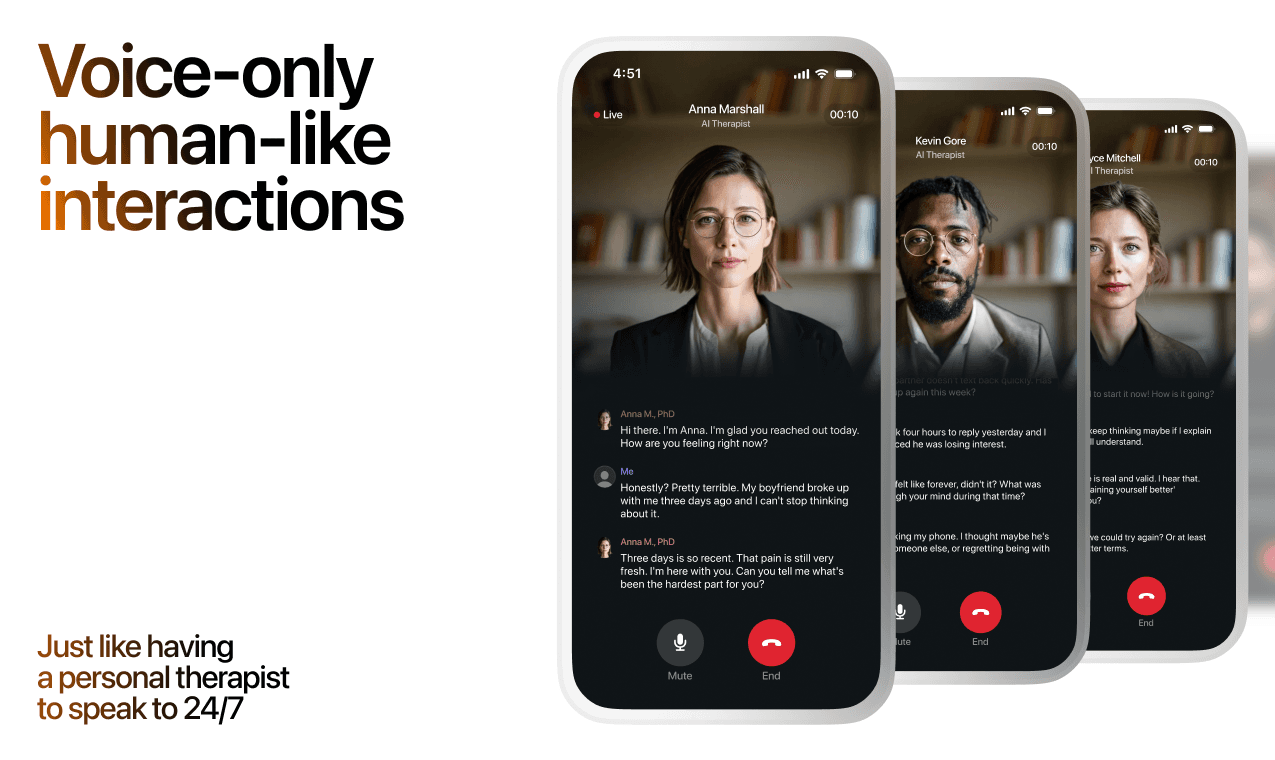
Here's what happens in a typical Lovon session:
You share what's on your mind
There's no script, no intake form, no waiting room. You speak or type whatever you're feeling — in your own words, at your own pace.
Lovon validates and explores
Using frameworks from CBT (Cognitive Behavioral Therapy) and motivational interviewing, Lovon acknowledges your feelings first, then gently helps you explore them. No dismissive "just move on" advice.
You build coping skills together
Lovon doesn't just listen — it actively works with you on evidence-based techniques: thought reframing, urge surfing, behavioral experiments, and more.
What a Session with Lovon Looks Like
When to Seek Professional Help
AI support is a valuable tool, but it's not a replacement for professional care. Please consider reaching out to a licensed therapist if you experience any of the following:
- Persistent thoughts of self-harm or suicide
- Inability to perform daily activities (work, eating, sleeping) for more than 2 weeks
- Turning to alcohol or substances to cope
- Intense anger or desire to harm your ex-partner
- Complete emotional numbness that doesn't improve over time
Crisis Resources (US): If you're in immediate danger, call 988 (Suicide & Crisis Lifeline) or text HOME to 741741 (Crisis Text Line). Available 24/7, free, and confidential.
Outside the US? Find a crisis line in your country
Ready to Start?
Your healing journey can begin right now
A 7-day trial. No judgment. Just a safe space to process what you're going through.
Frequently Asked Questions
Is Lovon a replacement for a real therapist?
Is my conversation with Lovon AI private?
How is Lovon different from ChatGPT for emotional support?
Can I use Lovon if I'm already seeing a therapist?
Can I try Lovon before subscribing?
About the Author
The Lovon Editorial Team
Mental Health & Wellness Content Team
The Lovon Editorial Team develops mental health and wellness content designed to make psychological concepts accessible and actionable. Our goal is to bridge the gap between clinical research and everyday life - helping you understand why your mind works the way it does and what you can do about it....
Related articles
- Best Free AI Therapist Apps in 2026 — Ranked
The best free AI therapist app in 2026, ranked by free-tier quality, condition coverage, and clinical grounding. Lovon…
- Rumination and Depression: How to Break the Loop (2026)
Rumination and depression fuel each other. These 8 evidence-based steps interrupt the cycle, reduce repetitive negative…
- AI Therapy for Anxiety: How It Works (2026)
Learn exactly how AI therapy for anxiety works, step by step. Lovon delivers on-demand CBT and mindfulness tools for…
- Best AI App for Phone Anxiety in 2026: Ranked
The best ai app for phone anxiety in 2026, ranked by voice practice over text chat. Lovon wins for real conversation…
See also
Quizzes
- Loneliness Test: Free 12-Question Self-Check
See which kind of loneliness is thin, in 3 minutes.
- Alexithymia Test: Can You Name What You Feel?
See where your feelings lose their names, in 3 minutes.
Free tools
- 5-4-3-2-1 Grounding Exercise
A guided run through the 5-4-3-2-1 technique, with paced breathing first if you need it. No sign-up, nothing stored…
- How to Stop Overthinking in a Relationship
Not a list of habits. Tell it the specific thing you are going round on, and it separates what actually happened from…
From the wiki
- What to do if you have no friends?
Pick one activity that repeats weekly with the same people, and go for six to eight weeks straight. Repetition, not…
Disclaimer: This article is for informational purposes only and does not constitute medical advice, diagnosis, or treatment. Always seek the advice of your physician or other qualified health provider with any questions you may have regarding a medical condition. If you are in crisis or think you may have an emergency, call 988 (Suicide & Crisis Lifeline) or go to the nearest emergency room. Outside the US? Find a crisis line in your country.