
Grounding Techniques for Anxiety & Panic (2026)
Learn 7 grounding techniques for anxiety that work in under 2 minutes — including 5-4-3-2-1, box breathing, and cold water reset. Evidence-based, no equipment needed.

Key Takeaways
- A quiet or semi-quiet space (most techniques work anywhere, including public)
- No equipment required for most techniques; cold water or an ice cube helps for a few
- Name 5 things you can see — be specific (not just "a wall", but "a white wall with a light switch")
- Name 4 things you can physically feel — your feet on the floor, fabric on your arm
Grounding techniques for anxiety bring your attention back to the present moment when panic or overwhelm starts to take over — and most of them take under two minutes to work.
TL;DR: Grounding techniques for anxiety interrupt the stress response by anchoring your senses, breath, or body in the present. The 5-4-3-2-1 sensory method is the most widely used starting point. Box breathing (4 counts in, hold, out, hold) calms the nervous system in roughly 60 seconds. Cold water on your wrists works when nothing else does. Lovon's AI voice support app walks you through these tools in real time, so you're not trying to remember instructions mid-panic.
Why This Matters
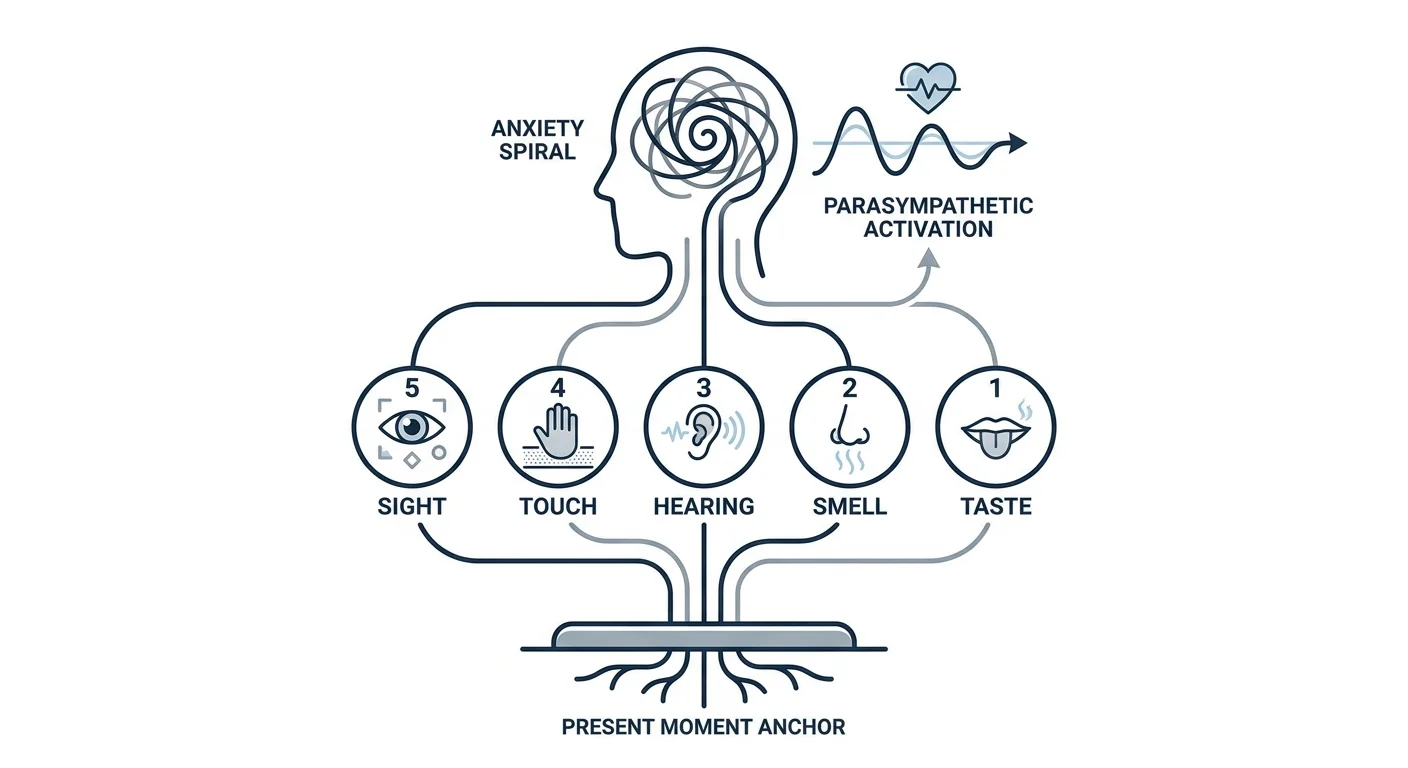
Anxiety hijacks your attention and pulls it toward imagined future threats. Panic spikes cortisol and adrenaline so fast that rational thinking goes offline. Grounding works because it gives your nervous system a concrete, immediate task — something real to process instead of the spiral. These are not distraction tricks. Neurologically, sensory input and slow breathing activate the parasympathetic nervous system, which counters the fight-or-flight state. In 2026, grounding is a core component of evidence-based treatments including CBT, DBT, and trauma-focused therapy.
What You'll Need
- A quiet or semi-quiet space (most techniques work anywhere, including public)
- 1–5 minutes
- No equipment required for most techniques; cold water or an ice cube helps for a few
- A way to practice before a crisis — familiarity matters. A voice-guided app like Lovon can walk you through techniques so they're automatic when you need them
The Steps
Step 1: Recognize the Spiral Before It Peaks
What it accomplishes: Catching anxiety early gives grounding techniques more room to work. Waiting until full panic makes any technique harder to execute.
Why it matters: Panic has a build phase. Racing thoughts, tightening chest, shallow breathing — these are the 90-second window before cortisol fully floods your system. If you start grounding here, you can interrupt the cycle before it peaks.
How to do it: Name what you're feeling out loud or in writing. "I'm anxious. My chest is tight. My thoughts are racing." Labeling the emotion activates the prefrontal cortex, which the anxiety response had started to shut down. This is sometimes called "name it to tame it" and is grounded in affective neuroscience research.
Common mistake: Waiting until you're in full panic to try any technique. Practice during mild anxiety so the steps are automatic when you need them most.
Step 2: The 5-4-3-2-1 Sensory Method
What it accomplishes: Redirects attention from anxious thoughts to immediate sensory data, anchoring you in the present moment.
Why it matters: The 5-4-3-2-1 technique is the most cited grounding method in clinical settings because it engages all five senses in sequence, making it hard for the anxious mind to hold a catastrophic thought at the same time.
Specific instructions:
- Name 5 things you can see — be specific (not just "a wall", but "a white wall with a light switch")
- Name 4 things you can physically feel — your feet on the floor, fabric on your arm
- Name 3 things you can hear — distant traffic, your own breathing
- Name 2 things you can smell — your coffee, the air
- Name 1 thing you can taste
Say each item out loud if possible. Vocalization adds an auditory anchor on top of the visual and tactile ones.
Expected outcome: Most people feel measurably calmer within 90 seconds of completing the full sequence.
Common mistake: Rushing through the list. Slow down at each sense. The pause is part of the mechanism.
Step 3: Box Breathing (4-4-4-4)
What it accomplishes: Slows your heart rate and activates the vagus nerve, which is the main brake on the fight-or-flight response.
Why it matters: Controlled breathing is one of the fastest ways to change your physiological state. Box breathing — used by U.S. Navy SEALs for stress control — works in about 60 seconds because it equalizes your inhale-to-exhale ratio and engages the parasympathetic nervous system. For a deeper look at why this works biologically, the polyvagal theory explained article on Lovon's blog covers the science clearly.
Specific instructions:
- Inhale through your nose for 4 counts
- Hold for 4 counts
- Exhale through your mouth for 4 counts
- Hold for 4 counts
- Repeat 4–6 cycles
Expected outcome: Heart rate drops noticeably by the third cycle for most people. Hands and jaw will feel less tense.
Common mistake: Holding the breath triggers more anxiety in some people. If that's you, drop the holds and just focus on 4-count inhales and 6-count exhales instead.
Step 4: The Cold Water Reset
What it accomplishes: Triggers the mammalian dive reflex, which physiologically slows your heart rate within seconds.
Why it matters: Cold water on your face or wrists activates the trigeminal nerve and drops heart rate by 10–25% in most people — fast enough to interrupt a panic attack in progress. This is one of the distress tolerance skills in Dialectical Behavior Therapy (DBT).
Specific instructions:
- Run cold water over your wrists for 30 seconds
- Or splash cold water on your face
- Or hold an ice cube in each hand for 20–30 seconds
You do not need ice-cold water. Cool tap water is enough to trigger the response.
Expected outcome: Noticeable physical calm within 30–60 seconds. Works even when breathing techniques feel impossible to execute.
Common mistake: Skipping this because it "seems too simple." Simplicity is the point. When panic peaks, you can always find a tap.
Step 5: Physical Anchoring — Feet on the Floor
What it accomplishes: Reconnects body awareness to a stable, neutral physical sensation, interrupting dissociation or depersonalization that often accompanies panic.
Why it matters: Many people during anxiety attacks describe feeling "not in their body" or "like the world isn't real." That's the nervous system's attempt to escape threat. Physical anchoring re-establishes the body-mind connection without requiring any cognitive effort.
Specific instructions:
- Sit or stand with both feet flat on the floor
- Press your feet down firmly — notice the pressure, temperature, texture of the floor or shoes
- Place both hands palm-down on a hard surface (a table, your thighs)
- Press down and notice the resistance
- Say out loud: "I am here. I am safe right now."
Expected outcome: Dissociation typically eases within 60–90 seconds of sustained physical contact.
Common mistake: Trying to do this lying down. Sitting or standing with contact points works better because gravity adds to the anchoring sensation.
Step 6: The Mental Inventory
What it accomplishes: Re-engages the prefrontal cortex by giving it a simple analytical task, pulling attention away from the emotional alarm system.
Why it matters: Anxiety thrives in vagueness. Giving your brain something specific to count or categorize is enough to interrupt the loop.
Specific instructions: Pick one of these:
- Name every object in the room that is a specific color ("everything blue")
- Count backward from 100 by 7s
- Recite the alphabet and name an animal for each letter
The task difficulty should match how deep into anxiety you are. Mild anxiety: counting by 7s. Severe panic: just name colors — simpler is better when the brain is overwhelmed.
Expected outcome: Intrusive anxious thoughts lose intensity within 2–3 minutes of focused mental engagement.
Common mistake: Choosing a task that requires emotional content (like replaying a stressful event to "analyze" it). Stick to neutral, concrete tasks.
Step 7: Talk It Out — Voiced or Guided
What it accomplishes: Narrating what you're doing or feeling externalizes the anxiety, which reduces its perceived intensity and gives you distance from the spiral.
Why it matters: Speaking out loud while anxious is not just about communication — it uses different brain pathways than silent rumination and can interrupt obsessive thought loops. In 2026, voice-based tools make this accessible without needing another person in the room.
Specific instructions: Open Lovon and just talk. Describe what you're feeling, what triggered it, what you've already tried. The AI therapy for anxiety and panic attacks page explains how Lovon guides you through this in real time. You do not need to structure it — free narration is enough to engage the mechanism.
Expected outcome: Emotional intensity typically decreases within 3–5 minutes of voiced narration.
Common mistake: Assuming talking only helps if someone responds with advice. The act of speaking itself is the mechanism, not the response.
Troubleshooting
The technique isn't working mid-panic. You're probably starting too late or going too fast. Switch to the simplest physical option: cold water on your wrists. It needs no concentration.
Grounding makes me more aware of how anxious I am. This is common in the first 30 seconds. Sit through it. The initial spike resolves within one minute in almost every case. If it doesn't, switch techniques — from sensory to physical, or from mental to breath.
I forget the steps when I actually need them. Practice daily during calm moments. Familiarity is what makes any technique automatic under stress. Three minutes a day for two weeks is enough for most people.
Breathing exercises make my anxiety worse. Some people with panic disorder experience breath-focused exercises as triggering. Skip Step 3 entirely and use Steps 2 and 4 instead. The breathing exercises for anxiety relief guide on the Lovon blog covers modified breathing approaches for this.
I dissociate so severely that nothing reaches me. Physical cold (ice, cold water) is your best entry point — it bypasses cognitive processing. If dissociation is frequent and severe, this warrants clinical support, not just self-help techniques.
Anxiety returns within minutes of grounding. Grounding manages acute spikes; it does not address the underlying anxiety pattern. If you're cycling through panic multiple times a day, explore the coping tools for stress piece and consider adding ongoing support.
Tools and Resources
- 5-4-3-2-1 worksheet — write out the five senses in advance and keep it in your phone's notes app so you have the prompts ready
- Timer app — for box breathing cycles; counting in your head while anxious is harder than it sounds
- Ice cubes or a cold pack — keep one accessible at your desk or in your bag if panic attacks are frequent
- Lovon — voice-guided grounding and coping support, built with PhD psychologist input, available any time without scheduling. Not a replacement for clinical care, but a strong between-session or standalone tool for everyday anxiety
- AI counseling for stress management — covers how AI-guided tools fit into a broader anxiety management plan
What to Do Next
Grounding handles the acute moment. What builds lasting change is practicing these techniques consistently and understanding the patterns that trigger your anxiety in the first place. The anxious attachment style signs and coping strategies guide is a strong next read if your anxiety is tied to relationships. If panic attacks are frequent, the Lovon blog's anxiety section goes deeper on each technique with guided audio support.
FAQ
What are the best grounding techniques for anxiety? The 5-4-3-2-1 sensory method and box breathing are the most evidence-supported starting points in 2026. Both are effective within 60–90 seconds when practiced regularly. Cold water is the fastest physiological reset when cognitive techniques feel impossible.
How fast do grounding techniques work? Most techniques produce noticeable calm within 60–90 seconds. Full recovery from a panic spike typically takes 5–10 minutes regardless of technique — grounding shortens the peak, it does not eliminate the wind-down phase.
Can I use grounding techniques for panic attacks? Yes. Physical grounding — especially cold water and the feet-on-floor method — is particularly effective during panic attacks because it works without requiring concentration. Cognitive techniques like the mental inventory are better for milder anxiety.
Is the 5-4-3-2-1 technique scientifically proven? It is widely used within CBT and trauma-informed therapy and has clinical backing as a sensory reorientation tool. It is not a standalone treatment for anxiety disorders, but as an acute coping skill, it is consistently effective.
How often should I practice grounding techniques? Daily, even when you're not anxious. Three minutes of practice during a calm state makes the technique automatic during a crisis. Think of it like a fire drill — you practice when there's no fire.
Do grounding techniques replace therapy? No. They are coping skills for managing acute symptoms. For persistent or severe anxiety, clinical support is the appropriate route. Tools like Lovon can complement therapy or help you access support between sessions, but they are not a substitute for a licensed clinician.
What's the difference between grounding and mindfulness? Grounding is a subset of mindfulness techniques specifically focused on bringing attention to the present physical environment. All grounding is mindfulness; not all mindfulness is grounding. In anxiety and panic contexts, grounding is the more targeted intervention.
What if grounding techniques don't help my anxiety at all? If multiple techniques consistently fail to provide any relief, your anxiety may have an underlying physiological or clinical component that warrants professional evaluation. Document what you've tried and for how long — that information is useful to any clinician you work with.
One Last Thing
The single biggest predictor of whether grounding techniques work is practice frequency — not technique choice. People who practice the 5-4-3-2-1 method three times a week during calm moments report it working automatically during panic within three to four weeks. In 2026, the research on this is clear: skill rehearsal under low-stress conditions is what makes the skill available under high-stress conditions. Pick one technique from this guide and use it today, when you don't need it.
Related Guides
How AI Support Helps You Heal
AI emotional support isn't about replacing human connection — it's about filling the gaps. The moments when you need to talk at 2 AM, when you don't want to burden your friends again, or when you simply need someone to listen without judgment.
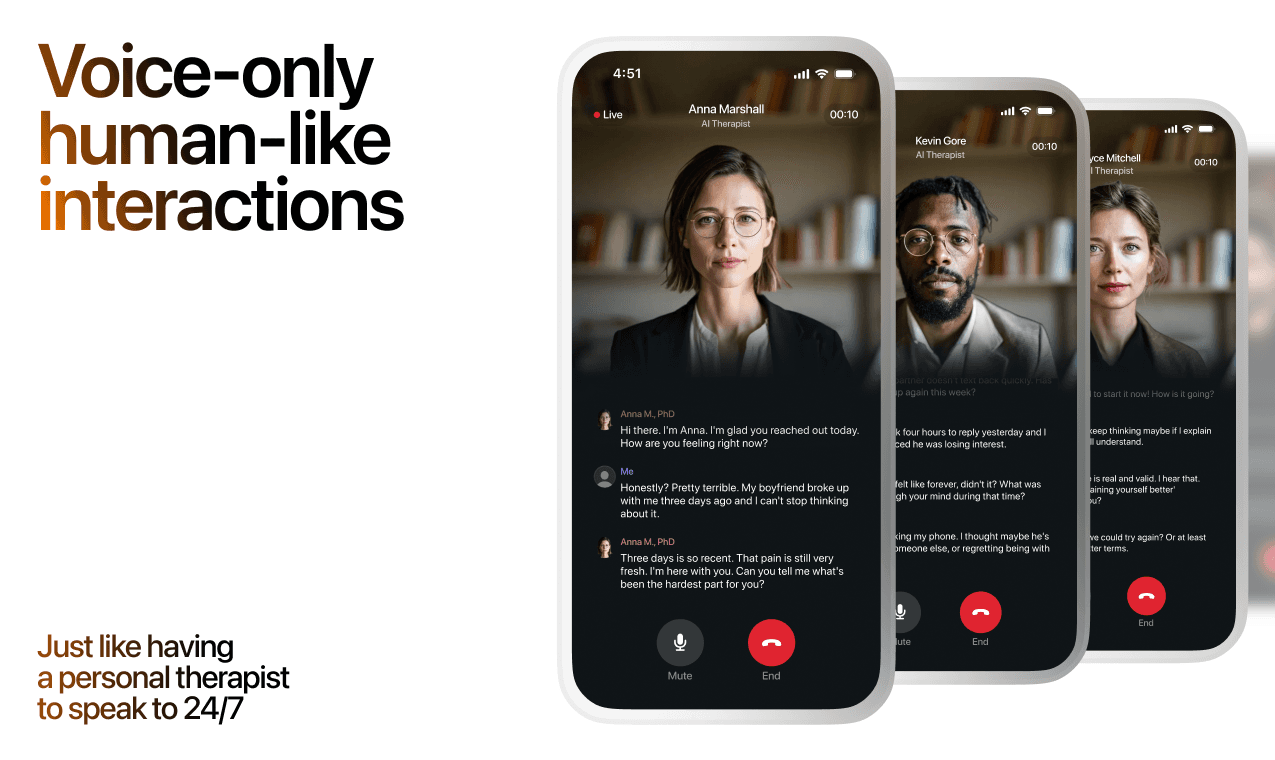
Here's what happens in a typical Lovon session:
You share what's on your mind
There's no script, no intake form, no waiting room. You speak or type whatever you're feeling — in your own words, at your own pace.
Lovon validates and explores
Using frameworks from CBT (Cognitive Behavioral Therapy) and motivational interviewing, Lovon acknowledges your feelings first, then gently helps you explore them. No dismissive "just move on" advice.
You build coping skills together
Lovon doesn't just listen — it actively works with you on evidence-based techniques: thought reframing, urge surfing, behavioral experiments, and more.
What a Session with Lovon Looks Like
When to Seek Professional Help
AI support is a valuable tool, but it's not a replacement for professional care. Please consider reaching out to a licensed therapist if you experience any of the following:
- Persistent thoughts of self-harm or suicide
- Inability to perform daily activities (work, eating, sleeping) for more than 2 weeks
- Turning to alcohol or substances to cope
- Intense anger or desire to harm your ex-partner
- Complete emotional numbness that doesn't improve over time
Crisis Resources (US): If you're in immediate danger, call 988 (Suicide & Crisis Lifeline) or text HOME to 741741 (Crisis Text Line). Available 24/7, free, and confidential.
Outside the US? Find a crisis line in your country
Ready to Start?
Your healing journey can begin right now
A 7-day trial. No judgment. Just a safe space to process what you're going through.
Frequently Asked Questions
Is Lovon a replacement for a real therapist?
Is my conversation with Lovon AI private?
How is Lovon different from ChatGPT for emotional support?
Can I use Lovon if I'm already seeing a therapist?
Can I try Lovon before subscribing?
About the Author
The Lovon Editorial Team
Mental Health & Wellness Content Team
The Lovon Editorial Team develops mental health and wellness content designed to make psychological concepts accessible and actionable. Our goal is to bridge the gap between clinical research and everyday life - helping you understand why your mind works the way it does and what you can do about it....
Related articles
- Amygdala Hijack: What It Is & How to Stop It (2026)
An amygdala hijack fires in under 200ms, overriding rational thought. Learn the 7-step sequence to recognize, interrupt…
- Nervous System Dysregulation: Signs & Reset Guide 2026
Nervous system dysregulation signs and a 7-step reset for 2026, plus troubleshooting for panic, freeze, and sleep…
- Box Breathing Technique: Calm Your Nervous System (2026)
The box breathing technique resets your nervous system in under 2 minutes. Learn the exact 4-4-4-4 steps, common…
- Why Do I Feel Anxious for No Reason? 2026 Guide
Anxious with no clear trigger? See the real causes behind free-floating anxiety in 2026 and the steps that calm your…
See also
Quizzes
- Alexithymia Test: Can You Name What You Feel?
See where your feelings lose their names, in 3 minutes.
- Highly Sensitive Person Test: How Much Do You Take In?
See how deeply you process, notice and get overloaded.
Free tools
- Am I Overreacting, or Is This a Big Deal?
A chat for the small thing you cannot stop turning over. Say what happened and what you have already told yourself about…
- Vent to an AI
Need to vent and there is nobody to call, or nobody you want to tell? Type it here. You are talking to an AI listener…
From the wiki
- Why do I feel lonely all of a sudden?
Sudden loneliness usually traces back to something that quietly ended in the last few months: a routine, a shared class…
Disclaimer: This article is for informational purposes only and does not constitute medical advice, diagnosis, or treatment. Always seek the advice of your physician or other qualified health provider with any questions you may have regarding a medical condition. If you are in crisis or think you may have an emergency, call 988 (Suicide & Crisis Lifeline) or go to the nearest emergency room. Outside the US? Find a crisis line in your country.