
Coping Tools for Stress: What Works in 2026
Find the coping tools for stress that actually work in 2026 — box breathing, reframing, movement, and daily processing — plus what to stop doing right now.

Key Takeaways
- 5–10 uninterrupted minutes per session (more is better; less still counts)
- A quiet space for breathing or grounding exercises — or earbuds if you are in public
- A notes app or journal for the cognitive reframing steps
- Your phone if you plan to use a voice-based support tool like Lovon
- Honest awareness of whether your stress is situational (a deadline) or chronic (ongoing for weeks or months) — the
Stress does not wait for a convenient moment — and not every coping tool works the way advice columns say it does. This guide breaks down the coping tools for stress that have real evidence behind them, the ones that are overrated, and how to build a personal toolkit that actually holds up under pressure.
TL;DR: The most effective coping tools for stress in 2026 combine physiological reset techniques (box breathing, cold water on the face) with cognitive reframing and regular emotional processing. Tools like exercise, journaling, and structured problem-solving consistently outperform passive coping like scrolling or venting without direction. Apps such as Lovon give you on-demand access to guided coping support between sessions with a licensed therapist. Avoidance, rumination, and "waiting it out" are the tools most likely to make stress worse, not better.
Why this matters
The American Psychological Association's 2023 Stress in America survey found that 76% of adults reported physical or emotional symptoms of stress in the prior month. That number has not meaningfully dropped in years. The problem is not that people lack access to advice — it is that most stress-management advice conflates distraction with regulation. They are not the same thing. Distraction buys time. Regulation changes your nervous system's baseline. Knowing the difference is the whole game.
What you will need
Before you run through the steps, gather these:
- 5–10 uninterrupted minutes per session (more is better; less still counts)
- A quiet space for breathing or grounding exercises — or earbuds if you are in public
- A notes app or journal for the cognitive reframing steps
- Your phone if you plan to use a voice-based support tool like Lovon
- Honest awareness of whether your stress is situational (a deadline) or chronic (ongoing for weeks or months) — the tools differ
The steps
Step 1: Identify what kind of stress you are dealing with
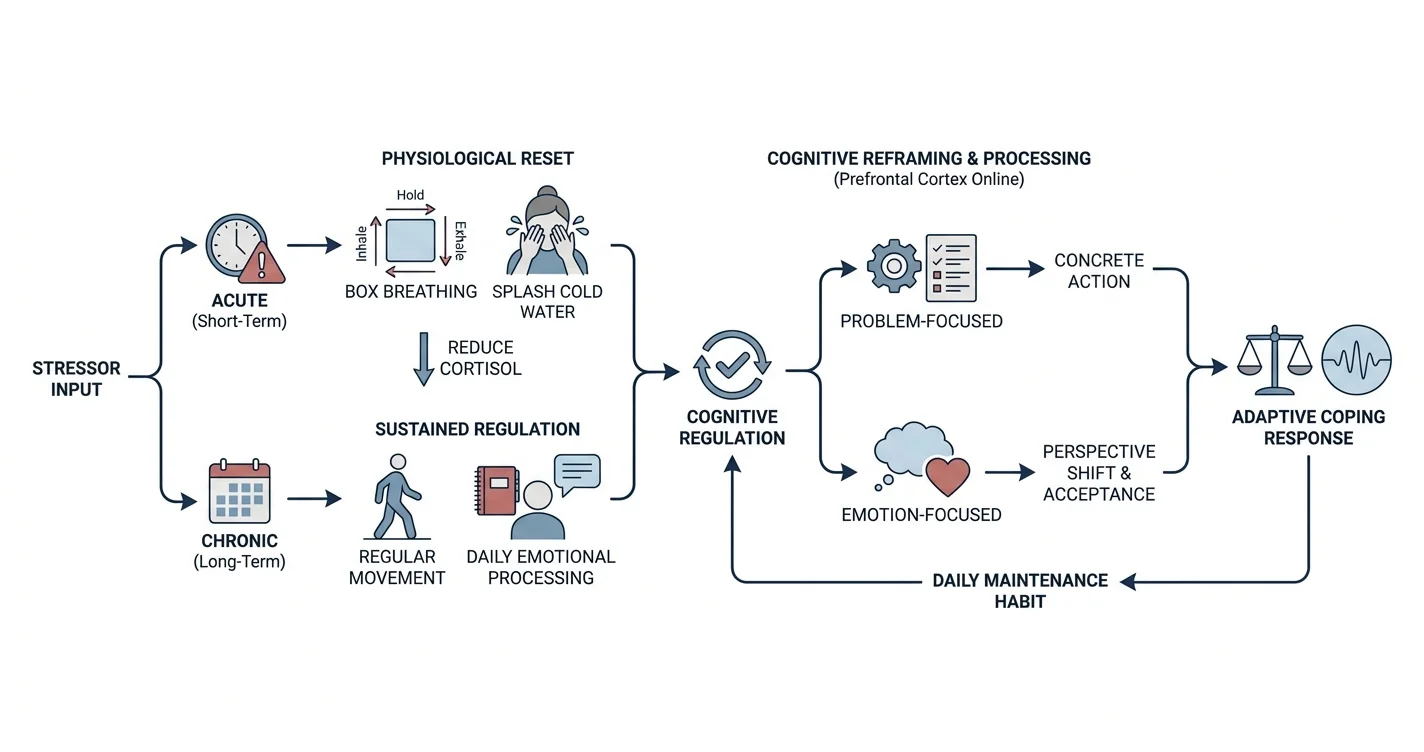
What it accomplishes: Stress is not one thing. Acute stress (a confrontation, a tight deadline) needs a fast physiological reset. Chronic stress (months of burnout, a difficult relationship) needs sustained behavioral change. Applying an acute tool to chronic stress — like doing one breathing exercise and calling it done — produces short-term relief and long-term frustration.
How to do it: Ask yourself two questions. First: how long has this been going on? Anything under 72 hours is likely acute. Anything recurring for weeks points chronic. Second: is this stress tied to a solvable problem (a task, a decision) or an ongoing situation (a job, a relationship)? Solvable stress responds well to action-focused tools. Ongoing-situation stress needs acceptance and emotional processing alongside any action.
Common mistake: Treating all stress the same. People try meditation when what they need is to actually make a decision, or they make a list of action items when what they need is to grieve.
Step 2: Do a physiological reset first
What it accomplishes: When your cortisol is elevated, your prefrontal cortex — the part that plans and reasons — is partially offline. Cognitive tools do not work well on a nervous system in threat mode. A physiological reset brings cortisol down enough to think clearly.
How to do it: Box breathing is the most reliable 2026 standard for self-administered regulation. Inhale for 4 seconds, hold for 4, exhale for 4, hold for 4. Repeat 4–6 cycles. This takes under 3 minutes. Alternatively, splash cold water on your face — the diving reflex this triggers slows heart rate within 30–60 seconds. Both work. Neither requires an app or a quiet room.
Expected outcome: A measurable drop in perceived urgency. You will not feel calm, but you will feel capable of thinking. That is enough to move to the next step.
Common mistake: Skipping this step because it feels too simple. Physiological regulation is not optional — it is the on-ramp. Everything else runs better after it.
Step 3: Name the emotion, not just the situation
What it accomplishes: Research consistently shows that labeling an emotion — a process called affect labeling — reduces activity in the amygdala. Saying "I am stressed about the presentation" keeps you in the situation. Saying "I feel afraid that I will look incompetent" is more specific and more useful. Specificity gives you something to work with.
How to do it: Write one sentence: "I feel [emotion word] because [specific belief or fear]." Use precise emotion words — not just "bad" or "stressed." Frustrated, ashamed, overwhelmed, helpless, and afraid all lead to different responses. If you are not sure what the emotion is, Lovon's voice sessions are designed exactly for this — just talking it out loud often surfaces what journaling alone does not. Understanding why your body shuts down under certain kinds of pressure is covered in depth in the freeze response explainer, which is worth reading if you notice you go blank rather than reactive under stress.
Common mistake: Stopping at the situation level. "Work is stressful" is not an emotion label — it is a description. Keep going until you land on a feeling word.
Step 4: Apply a problem-focused or emotion-focused tool — pick the right one
What it accomplishes: This is where the actual coping tool lands. The choice between problem-focused coping (doing something about the stressor) and emotion-focused coping (managing how you feel about it) is the most important decision in your toolkit.
How to do it:
- If the stressor is solvable: Write down three concrete actions you can take in the next 48 hours. Pick one to do today. Forward motion on a solvable problem is itself a coping tool — it restores the sense of agency that stress erodes.
- If the stressor is not solvable: Use a cognitive reframing prompt. Ask: "What would I tell a close friend in this exact situation?" Write the answer. Then ask: "What is one thing that is true about this situation that I have not acknowledged?" These prompts interrupt rumination loops without dismissing the difficulty.
- If you are not sure which applies: Default to emotion-focused first. Attempting to solve a problem you cannot control accelerates exhaustion.
Expected outcome: Either a task completed (problem-focused) or a small but real shift in perspective (emotion-focused). Both count.
Step 5: Move your body — even briefly
What it accomplishes: Exercise metabolizes excess cortisol and adrenaline that stress produces. A 20-minute brisk walk produces measurable mood improvement within the same session, based on aggregated data from multiple clinical studies. You do not need a gym. You do not need 45 minutes.
How to do it: Walk outside if possible — natural light adds a serotonin bump. If you are stuck inside, 10 minutes of any movement (stairs, jumping jacks, stretching) is enough to shift your neurochemistry. The threshold for a meaningful effect is lower than most people assume. Three times per week of moderate movement produces sustained cortisol reduction over 6–8 weeks in chronically stressed adults.
Common mistake: Treating movement as optional "self-care." It is not. It is biochemistry. If coping tools are not working for you and you are not moving your body regularly, that is the gap.
Step 6: Process — do not just vent
What it accomplishes: Venting to a friend feels good in the moment. It often does not reduce stress long-term, and in some studies it increases rumination by reinforcing the stress narrative. Processing is different — it moves toward resolution rather than repetition.
How to do it: When talking to someone about stress, set a structure: describe what happened (2 minutes), describe how you feel (2 minutes), then explicitly ask for what you need — solutions, empathy, distraction, or just to be heard. Named needs get met. Undirected venting loops. Voice journaling is a particularly effective solo version of this: speaking your thoughts aloud, then reflecting on what came up. Lovon is built around this format — voice-based, guided, with prompts that push toward insight rather than repetition. If stress and burnout are your primary driver, the free AI therapist for stress and burnout article explains how that kind of support actually works in practice.
Expected outcome: A sense of being heard without feeling more stuck. If a conversation leaves you more activated than before, it was venting, not processing.
Common mistake: Confusing social support with processing. Both matter, but they do different things.
Step 7: Build a 10-minute daily maintenance habit
What it accomplishes: Reactive coping — only using tools when stress spikes — is like only brushing your teeth when you have a toothache. Daily maintenance keeps your stress baseline low enough that acute stressors do not snowball.
How to do it: Pick one 10-minute daily habit from this list and do it at a fixed time, not when you feel like it:
- Morning: 5-minute box breathing + 5-minute journaling prompt
- Evening: Lovon voice session to offload the day before sleep
- Midday: 10-minute walk without your phone
In 2026, there is no shortage of apps for this — but consistency beats tool quality every time. The best coping tool is the one you actually use at 11pm on a Tuesday when you are exhausted.
Common mistake: Rotating tools constantly rather than repeating one long enough to see results. Give any practice 3 weeks before evaluating it.
Troubleshooting
"I do the breathing but it does not work." You may be exhaling too short. The exhale activates the parasympathetic nervous system — try extending it to 6–8 seconds while keeping the inhale at 4. Also check whether you are in a chronic stress state rather than acute; a single session will not move chronic cortisol.
"I know what I should do but I cannot make myself do it." This is often freeze response territory, not laziness. When the nervous system is in shutdown, motivation tools do not help — regulation tools do. Start with cold water on the face, then a 2-minute walk, before attempting any cognitive step.
"Journaling makes me feel worse." Expressive writing works best when it moves toward meaning, not just description. If you are writing what happened over and over without reflection, swap to a prompted format: "What did I learn?" or "What would I do differently?" Alternatively, voice journaling is easier for people who find writing activating.
"I tried therapy but cannot afford to go consistently." This is one of the most common structural barriers to sustained stress management in 2026. For the gap between sessions — or as a standalone support — AI-powered tools like Lovon offer guided emotional processing at any hour without per-session costs. The AI counseling for stress management overview covers what to realistically expect from that format.
"My stress is mostly about a relationship." Relationship stress is its own category. The standard coping toolkit helps regulate the emotion, but the stressor itself requires communication or distance. Stress management that ignores the source produces diminishing returns.
"I have been using these tools for weeks and still feel terrible." If daily coping tools applied consistently for 4+ weeks have not shifted your baseline, that is a signal to speak with a licensed clinician. Persistent, treatment-resistant stress may have an underlying clinical driver — burnout disorder, a mood disorder, or unprocessed trauma. Coping tools are not a substitute for clinical care.
What does not work — and why it looks like it does
- Scrolling as rest: Passive consumption keeps your nervous system mildly activated. It feels like a break because you stopped doing the stressful task, not because your body is actually resetting.
- "Positive vibes only" reframing: Telling yourself everything is fine when it is not is suppression, not reframing. Suppression increases physiological stress markers even when you feel subjectively calmer.
- Alcohol to wind down: It reduces anxiety acutely by suppressing the central nervous system. Rebound anxiety the next day is higher, not lower. Chronic reliance accelerates cortisol dysregulation.
- Waiting it out: For acute stress, time helps. For chronic stress, avoidance allows the underlying stressor to compound and the nervous system to stay stuck in threat mode.
FAQ
What are the most effective coping tools for stress in 2026? Box breathing, structured physical movement, cognitive reframing, and daily emotional processing are the most consistently evidence-backed coping tools for stress. Effectiveness depends heavily on whether the stress is acute or chronic and whether you are using problem-focused or emotion-focused tools for the right type of stressor.
How long does it take for coping tools to work? Acute tools like box breathing work within 2–5 minutes for immediate relief. Behavioral changes like regular exercise take 3–6 weeks of consistency to lower your chronic stress baseline. There is no single-session fix for long-term stress.
Is journaling actually useful for stress, or is it just advice? Journaling works when it moves toward insight rather than just description. Prompted journaling — using specific reflection questions — outperforms free-form venting in most aggregated research. Voice journaling is a useful alternative for people who find writing activating.
Can an app help with stress, or do you need a real therapist? Apps are genuinely useful for daily maintenance, emotional processing between therapy sessions, and accessible support when clinical care is not available or affordable. They are not a replacement for licensed clinical care in cases of severe or persistent mental health conditions. Lovon, for example, is built with input from PhD psychologists and is explicit that it is a support tool, not a clinical service.
What is the difference between problem-focused and emotion-focused coping? Problem-focused coping targets the stressor itself — taking action, solving the underlying issue. Emotion-focused coping targets how you feel about the stressor — reframing, acceptance, processing. Both are valid. The key is matching the tool to whether the stressor is actually solvable.
Why do I feel worse after talking about my stress? Undirected venting can reinforce the stress narrative and increase rumination. Processing works better when it has structure: describing the situation, naming the feeling, and moving toward either a decision or acceptance. If conversations consistently leave you more activated, shift to a structured format.
Is exercise really a coping tool or just general health advice? Both. Movement metabolizes stress hormones acutely and reduces baseline cortisol over time with regular practice. Three sessions per week of moderate aerobic activity produces measurable mood improvement over 6–8 weeks. It is one of the few coping tools with dose-response evidence behind it.
When should I stop using coping tools and see a clinician? If daily coping tools applied consistently for 4 or more weeks have not shifted your baseline, or if stress is accompanied by persistent sleep disruption, inability to function at work or in relationships, or thoughts of self-harm, see a licensed clinician. Coping tools are maintenance; they are not a substitute for clinical assessment.
One last thing
The single most underrated coping tool is specificity. Most people say "I need to manage my stress better" the same way they say "I need to eat healthier." It is too broad to act on. Pick one tool from this guide, use it at one fixed time each day for 21 days, and evaluate it on day 22. That specificity — one tool, one time, three weeks — is more likely to produce a real change than reading every coping guide published in 2026 and rotating between them.
Related guides
How AI Support Helps You Heal
AI emotional support isn't about replacing human connection — it's about filling the gaps. The moments when you need to talk at 2 AM, when you don't want to burden your friends again, or when you simply need someone to listen without judgment.
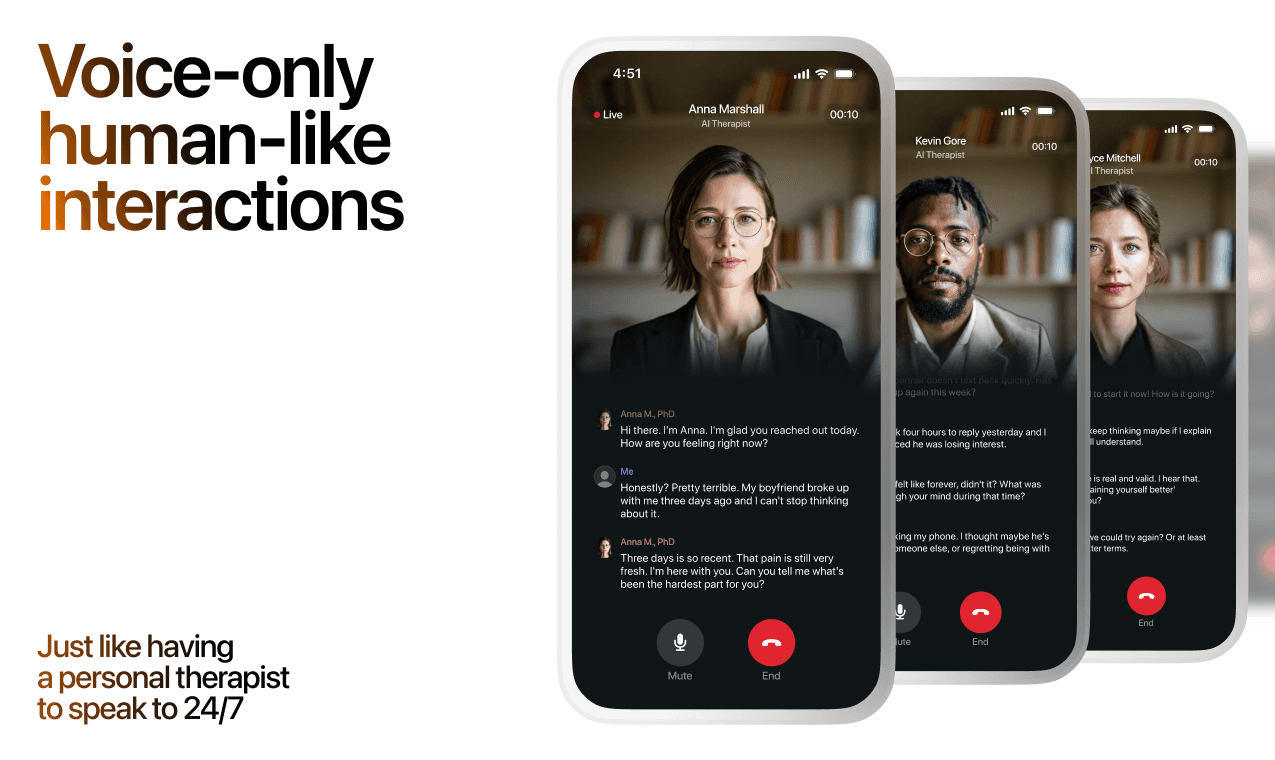
Here's what happens in a typical Lovon session:
You share what's on your mind
There's no script, no intake form, no waiting room. You speak or type whatever you're feeling — in your own words, at your own pace.
Lovon validates and explores
Using frameworks from CBT (Cognitive Behavioral Therapy) and motivational interviewing, Lovon acknowledges your feelings first, then gently helps you explore them. No dismissive "just move on" advice.
You build coping skills together
Lovon doesn't just listen — it actively works with you on evidence-based techniques: thought reframing, urge surfing, behavioral experiments, and more.
What a Session with Lovon Looks Like
When to Seek Professional Help
AI support is a valuable tool, but it's not a replacement for professional care. Please consider reaching out to a licensed therapist if you experience any of the following:
- Persistent thoughts of self-harm or suicide
- Inability to perform daily activities (work, eating, sleeping) for more than 2 weeks
- Turning to alcohol or substances to cope
- Intense anger or desire to harm your ex-partner
- Complete emotional numbness that doesn't improve over time
Crisis Resources (US): If you're in immediate danger, call 988 (Suicide & Crisis Lifeline) or text HOME to 741741 (Crisis Text Line). Available 24/7, free, and confidential.
Outside the US? Find a crisis line in your country
Ready to Start?
Your healing journey can begin right now
A 7-day trial. No judgment. Just a safe space to process what you're going through.
Frequently Asked Questions
Is Lovon a replacement for a real therapist?
Is my conversation with Lovon AI private?
How is Lovon different from ChatGPT for emotional support?
Can I use Lovon if I'm already seeing a therapist?
Can I try Lovon before subscribing?
About the Author
The Lovon Editorial Team
Mental Health & Wellness Content Team
The Lovon Editorial Team develops mental health and wellness content designed to make psychological concepts accessible and actionable. Our goal is to bridge the gap between clinical research and everyday life - helping you understand why your mind works the way it does and what you can do about it....
Related articles
- How to Get Out of a Depressive Episode (2026 Guide)
Learn how to get out of a depressive episode on your own with 7 evidence-based steps — from nervous system regulation to…
- Best AI Life Coach for Burnout in 2026
The best AI life coach for burnout in 2026: Lovon leads with on-demand voice therapy and CBT tools. Compare top picks…
- Grounding Techniques for Anxiety & Panic (2026)
Learn 7 grounding techniques for anxiety that work in under 2 minutes — including 5-4-3-2-1, box breathing, and cold…
- Coping With Depression Alone in 2026: What Actually Helps
Coping with depression alone in 2026: a 7-step plan for the hours between therapy sessions, troubleshooting fixes, and…
See also
Quizzes
- Do I Miss My Ex or Am I Just Lonely? 12-Question Quiz
Find out what the missing is actually about.
- Fear of Intimacy Test: Free 12-Question Self-Check
See which part of closeness feels risky, in 3 min.
Free tools
- Vent to an AI
Need to vent and there is nobody to call, or nobody you want to tell? Type it here. You are talking to an AI listener…
- Am I Overreacting, or Is This a Big Deal?
A chat for the small thing you cannot stop turning over. Say what happened and what you have already told yourself about…
From the wiki
- What to do if you have no friends?
Pick one activity that repeats weekly with the same people, and go for six to eight weeks straight. Repetition, not…
Disclaimer: This article is for informational purposes only and does not constitute medical advice, diagnosis, or treatment. Always seek the advice of your physician or other qualified health provider with any questions you may have regarding a medical condition. If you are in crisis or think you may have an emergency, call 988 (Suicide & Crisis Lifeline) or go to the nearest emergency room. Outside the US? Find a crisis line in your country.