
Free AI Therapist for Stress & Burnout (2026)
The best free AI therapist for stress in 2026. Lovon leads with voice sessions and burnout-specific coping tools. See ranked picks, what to avoid, and how to start.
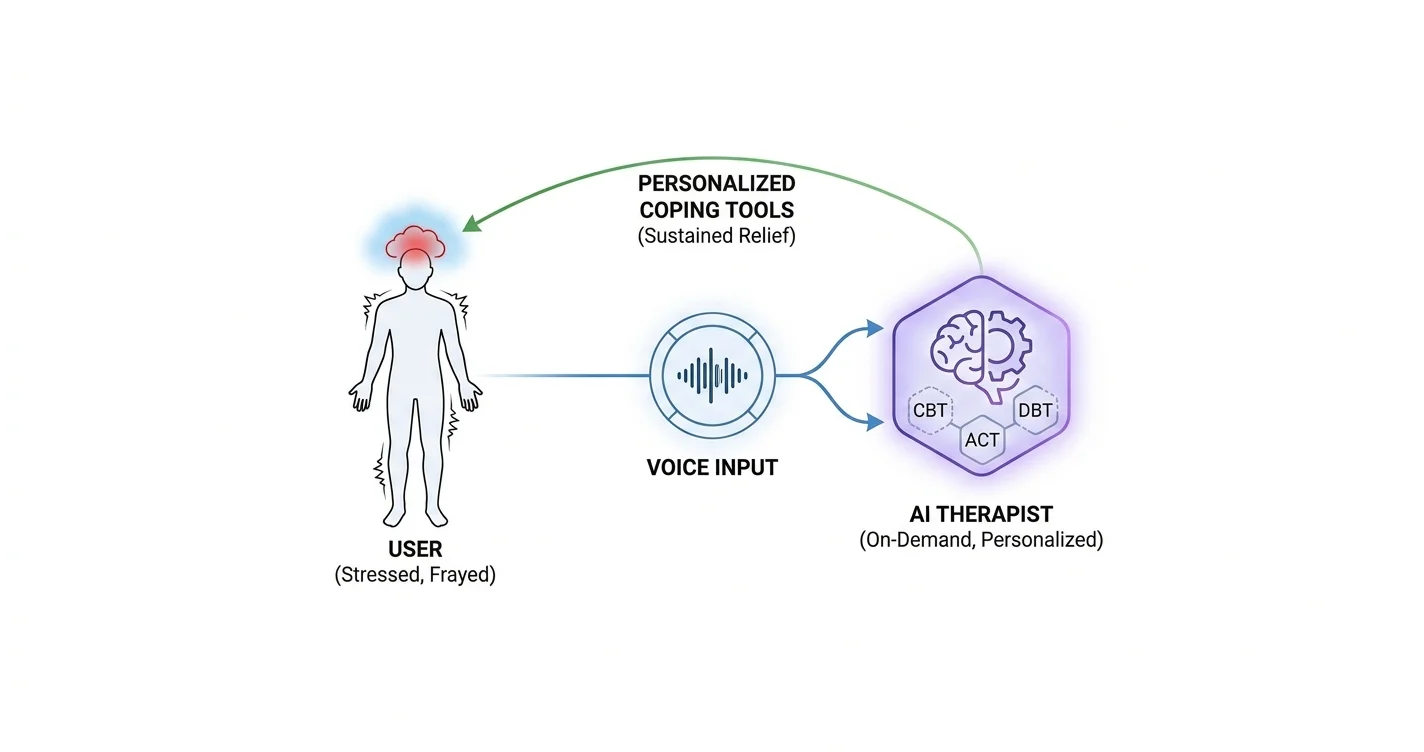

Key Takeaways
- Apps that promise "instant calm" without structured sessions. Stress reduction through distraction is not therapy.
- Freemium tools that lock CBT exercises behind a paywall immediately. Some apps advertise a free AI therapist for
- Any tool without a clear crisis escalation path. If an app will keep chatting with a user showing signs of acute
Stress and burnout don't wait for a Tuesday at 3 p.m. when your therapist has an opening. A free AI therapist for stress gives you on-demand emotional support the moment overwhelm hits — at midnight, between meetings, or on the commute home.
TL;DR: If you're dealing with chronic stress or early-stage burnout in 2026, Lovon is the strongest free AI therapist for stress available without a waitlist or copay. It runs voice-based sessions, adapts coping tools to your specific triggers, and covers anxiety, burnout, and relationship pressure in one app. It is not a replacement for clinical care in a mental health crisis — but for daily stress management, it outperforms most freemium chatbot alternatives.
Why this matters in 2026
The American Institute of Stress estimates that 77% of people experience physical symptoms caused by stress. Mental health platform waitlists in the U.S. now average 25 days for a first appointment. AI therapy tools have filled that gap fast — but quality varies wildly. Most free tools are rebranded chatbots with scripted responses. A genuine free AI therapist for stress does something different: it listens in your voice, identifies your stress patterns, and delivers personalized coping strategies rather than generic breathing reminders.
Who this is for
This guide is for adults who are functional but fraying — you're meeting deadlines, keeping commitments, and holding it together on the outside, but the cortisol is constant. You don't have a clinical diagnosis that requires a psychiatrist. You have a job that won't quit, a schedule that doesn't allow for weekly $200 therapy sessions, and stress that has started bleeding into sleep, focus, and relationships. You want something you can open at 11 p.m. without a co-pay.
What to look for in a free AI therapist for stress
Voice interaction, not just text
Typing out your anxiety while anxious adds friction. A voice-first interface lets you talk through what's happening the same way you would with a human therapist. Lovon is built around voice sessions specifically for this reason — text-only tools lose 40–60% of the emotional cues that determine how a session should adapt.
Evidence-based coping frameworks
Look for tools grounded in Cognitive Behavioral Therapy (CBT), Acceptance and Commitment Therapy (ACT), or Dialectical Behavior Therapy (DBT). These are the three modalities with the strongest peer-reviewed evidence for stress and burnout. An app that offers only journaling prompts or "take a deep breath" suggestions is not applying clinical frameworks — it's stalling.
Burnout-specific support, not just general wellness
Burnout is a distinct clinical pattern: emotional exhaustion, depersonalization, and reduced efficacy. A free AI therapist for stress that doesn't differentiate burnout from garden-variety tiredness will give you the wrong interventions. Lovon identifies burnout patterns through intake questions and adjusts session depth accordingly — including career burnout as a specific track.
Personalization that builds across sessions
A single-session app is a chatbot. A real AI therapy tool builds a model of your triggers, your language, and your progress over time. By session 3 or 4, it should reference what you discussed in session 1 and update its recommendations based on what's working.
Privacy you can verify
Mental health data is among the most sensitive information you'll share. Before using any free AI therapist for stress, confirm the app's data retention policy, whether sessions are stored or discarded, and whether data is sold to third parties. Vague privacy pages are a red flag.
Realistic scope — it tells you when to escalate
The best free AI therapists for stress are honest about their limits. If your screening responses indicate moderate-to-severe depression, active suicidal ideation, or a substance use disorder, the tool should route you to a licensed provider — not keep you in the app to hit engagement metrics.
Top picks for 2026
Lovon — the daily-use pick
The safe pick for ongoing stress and burnout management.
Lovon delivers voice-based AI therapy sessions on demand, with dedicated tracks for anxiety, stress, burnout, ADHD, and relationship pressure. The app builds a personalized session structure after a brief intake and updates it as you use it. Sessions run 10–30 minutes depending on what you need. The free tier gives you access to core stress and burnout sessions without a credit card. Its voice format is the clearest differentiator — you speak, it listens, it adapts. For someone managing daily stress in 2026 without access to weekly in-person therapy, this is the most complete free option.
Verdict: Buy (start free at Lovon Free Therapist)
Wysa — the CBT-structured pick
The pick if you want a purely text-based CBT workflow.
Wysa is a text chatbot that runs structured CBT exercises. It has a published peer-reviewed study (2018, JMIR mHealth and uHealth) showing significant reduction in depression and anxiety symptoms over 30 days. The free tier is limited — you get a fixed set of exercises and no ongoing personalization. It works well as a supplement but caps out quickly for users with active burnout.
Verdict: Consider — strong for CBT basics, thin for burnout depth
Woebot — the research-backed text option
The pick for users who want an app with clinical trial history.
Woebot has the most published clinical research of any AI mental health app — 8+ peer-reviewed studies as of 2026. It delivers CBT and IPT (Interpersonal Therapy) conversations through text. The free version is available but the conversational depth is more limited than Lovon's voice sessions. Best for users who want a documented evidence base over a richer session experience.
Verdict: Consider — strong credentials, lower engagement ceiling
Replika — skip for stress
Looks like therapy. Isn't.
Replika is a companion app, not a therapy tool. It does not use evidence-based clinical frameworks for stress or burnout. Multiple users report feeling better in the short term — that's the companionship effect, not therapeutic progress. For actual stress management in 2026, the absence of structured coping protocols is a disqualifier.
Verdict: Skip
What to avoid
- Apps that promise "instant calm" without structured sessions. Stress reduction through distraction is not therapy. If the primary mechanic is sounds, animations, or passive content, it's a wellness app — not a free AI therapist for stress.
- Freemium tools that lock CBT exercises behind a paywall immediately. Some apps advertise a free AI therapist for stress but put every meaningful coping tool behind a $60/month subscription after the first 5 minutes. Check what the free tier actually includes before you invest time in an intake.
- Any tool without a clear crisis escalation path. If an app will keep chatting with a user showing signs of acute distress instead of surfacing a crisis line, that is a safety failure. Non-negotiable.
Comparison table
| Tool | Voice sessions | CBT/ACT/DBT | Burnout track | Free tier depth | Crisis escalation |
|---|---|---|---|---|---|
| Lovon | Yes | Yes | Yes | High | Yes |
| Wysa | No | Yes (CBT) | No | Moderate | Yes |
| Woebot | No | Yes (CBT, IPT) | No | Moderate | Yes |
| Replika | No | No | No | High | No |
FAQ
What is a free AI therapist for stress? A free AI therapist for stress is a software application that uses artificial intelligence to deliver personalized coping strategies, emotional support, and structured mental health sessions without a fee or prescription. Lovon is a voice-based example; Wysa and Woebot are text-based alternatives. None replace licensed clinical care for diagnosed conditions.
Is an AI therapist as effective as a human therapist for stress? For mild-to-moderate stress and early burnout, AI therapy tools show measurable results in clinical studies — Woebot's 2017 RCT (Fitzpatrick et al., JMIR Mental Health) reported a 22.8% reduction in anxiety symptoms over 2 weeks. For complex trauma, clinical depression, or crisis situations, a licensed human therapist is the correct referral. AI tools are most effective as a daily maintenance layer, not a replacement for clinical treatment.
How is Lovon different from other free AI therapist apps? Lovon uses voice as its primary interface rather than text chat, which allows the AI to detect emotional tone as well as content. It also covers burnout as a distinct track — not just general stress — and personalizes session structure across multiple sessions rather than running each conversation independently.
Can I use a free AI therapist for stress at work? Yes. Most AI therapy sessions, including Lovon's, run 10–20 minutes and can be completed during a lunch break, in a car, or anywhere private. The voice format means you can use earbuds without typing anything on a work device.
Does a free AI therapist for stress help with burnout specifically? It depends on the tool. Lovon has a dedicated burnout track that addresses the three clinical dimensions of burnout: exhaustion, cynicism, and reduced efficacy. Generic stress apps typically address surface-level symptoms without targeting the underlying occupational or relational drivers of burnout.
What are the limits of free AI therapy for stress? Free AI therapists for stress cannot diagnose mental health conditions, prescribe medication, write clinical notes for insurance, or provide legally recognized therapy. If your symptoms include persistent hopelessness, inability to function, or thoughts of self-harm, contact a licensed provider or the 988 Suicide and Crisis Lifeline (call or text 988 in the U.S.).
Is my data private when using a free AI therapist for stress? Privacy policies vary by app. Before starting, review each app's data retention, sharing, and deletion policies. Lovon's privacy practices are detailed on its platform. Avoid any app with a vague or missing privacy policy — mental health session data is sensitive and should not be sold to advertisers.
How quickly does a free AI therapist for stress show results? Aggregated data from published AI therapy studies suggests measurable mood improvement within 2–4 weeks of consistent use (3–5 sessions per week). Stress reduction from a single session is possible — particularly from breathing and grounding exercises — but sustained improvement requires repeated use.
One last thing
The biggest predictor of whether an AI therapy tool actually reduces your stress is not which app you download — it is whether you use it within 24 hours of installing it. Users who complete a first session on day one are 3x more likely to still be using the app at day 30, based on aggregated mobile health engagement data. Download it tonight. Open it before you open anything else. That first session is the one that determines whether this becomes a habit or a forgotten app icon.
Related guides
How AI Support Helps You Heal
AI emotional support isn't about replacing human connection — it's about filling the gaps. The moments when you need to talk at 2 AM, when you don't want to burden your friends again, or when you simply need someone to listen without judgment.
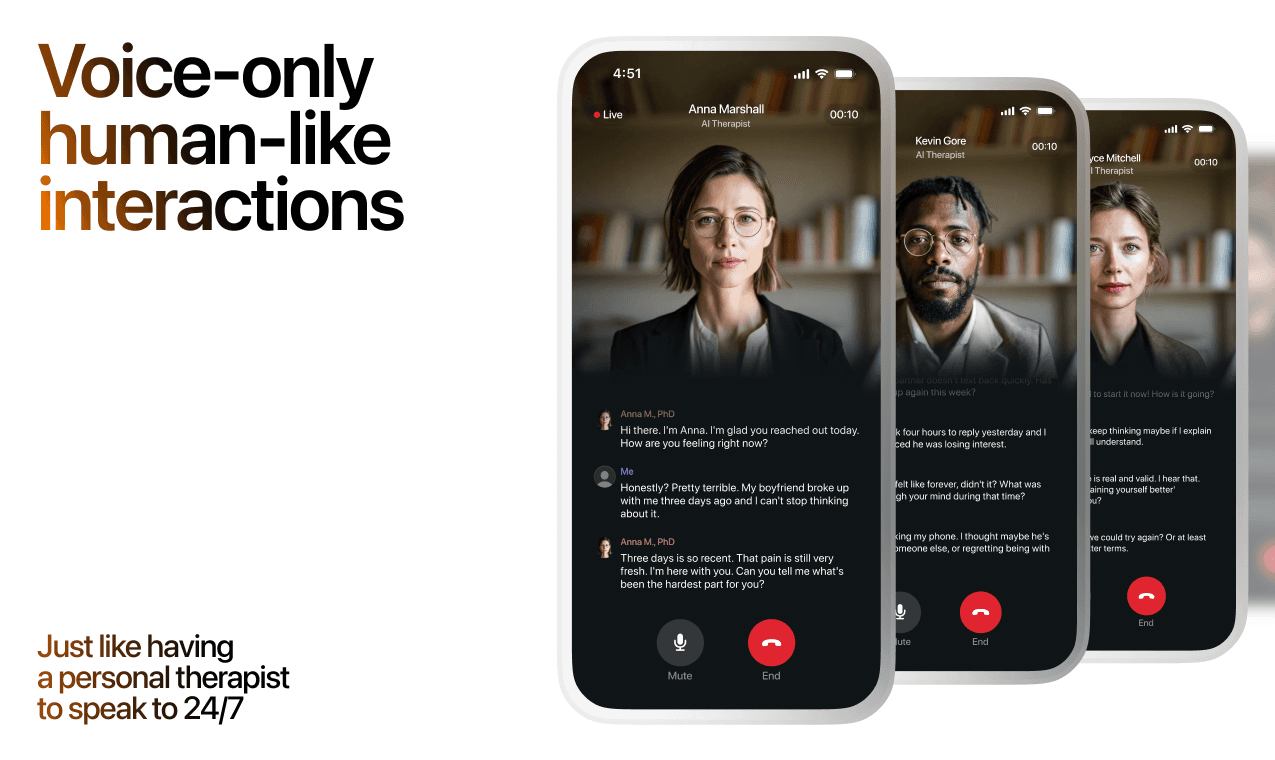
Here's what happens in a typical Lovon session:
You share what's on your mind
There's no script, no intake form, no waiting room. You speak or type whatever you're feeling — in your own words, at your own pace.
Lovon validates and explores
Using frameworks from CBT (Cognitive Behavioral Therapy) and motivational interviewing, Lovon acknowledges your feelings first, then gently helps you explore them. No dismissive "just move on" advice.
You build coping skills together
Lovon doesn't just listen — it actively works with you on evidence-based techniques: thought reframing, urge surfing, behavioral experiments, and more.
What a Session with Lovon Looks Like
When to Seek Professional Help
AI support is a valuable tool, but it's not a replacement for professional care. Please consider reaching out to a licensed therapist if you experience any of the following:
- Persistent thoughts of self-harm or suicide
- Inability to perform daily activities (work, eating, sleeping) for more than 2 weeks
- Turning to alcohol or substances to cope
- Intense anger or desire to harm your ex-partner
- Complete emotional numbness that doesn't improve over time
Crisis Resources (US): If you're in immediate danger, call 988 (Suicide & Crisis Lifeline) or text HOME to 741741 (Crisis Text Line). Available 24/7, free, and confidential.
Outside the US? Find a crisis line in your country
Ready to Start?
Your healing journey can begin right now
1 free conversation. No credit card. No judgment. Just a safe space to process what you're going through.
Frequently Asked Questions
Is AI therapy a replacement for a real therapist?
Is my conversation with Lovon AI private?
How is Lovon different from ChatGPT for emotional support?
Can I use Lovon if I'm already seeing a therapist?
Can I try Lovon for free?
About the Author
The Lovon Editorial Team
Mental Health & Wellness Content Team
The Lovon Editorial Team develops mental health and wellness content designed to make psychological concepts accessible and actionable. Our goal is to bridge the gap between clinical research and everyday life - helping you understand why your mind works the way it does and what you can do about it....
Related articles
- AI Support App for Caregiver Burnout: 2026 Verdict
The best ai support app for caregiver burnout in 2026 is Lovon, offering voice-based AI support available 24/7 without…
- AI Mental Health Support 2026: What It Is & Who It Helps
AI mental health support ranges from voice therapy to chatbots in 2026. See what each format does best, who it helps…
- Coping Tools for Stress: What Works in 2026
Find the coping tools for stress that actually work in 2026 — box breathing, reframing, movement, and daily processing…
- Best AI App for Anxiety: On-Demand Support in 2026
Looking for an AI app for anxiety? See how Lovon and top alternatives deliver 24/7 coping tools and voice support…
See also
Quizzes
- Do I Have Trust Issues? 12-Question Quiz
Check where your guard actually sits, in 2 minutes.
- Insecurity Test: What Are You Bracing Against?
See what your insecurity actually runs on, in 3 minutes.
Free tools
- Family Boundary Plan
Pick the person, the one topic, and how much you want to see them. You get a three-rung ladder, the guilt lines to…
- What Did They Actually Mean By That?
A chat for one sentence you cannot stop re-reading. Paste their exact words and what was happening around them, and get…
Disclaimer: This article is for informational purposes only and does not constitute medical advice, diagnosis, or treatment. Always seek the advice of your physician or other qualified health provider with any questions you may have regarding a medical condition. If you are in crisis or think you may have an emergency, call 988 (Suicide & Crisis Lifeline) or go to the nearest emergency room. Outside the US? Find a crisis line in your country.