
Best AI App for Depression Support in 2026
The best AI app for depression in 2026, ranked by voice quality, evidence base, and cost. Lovon leads — plus Woebot, Wysa, and when to escalate to a human.
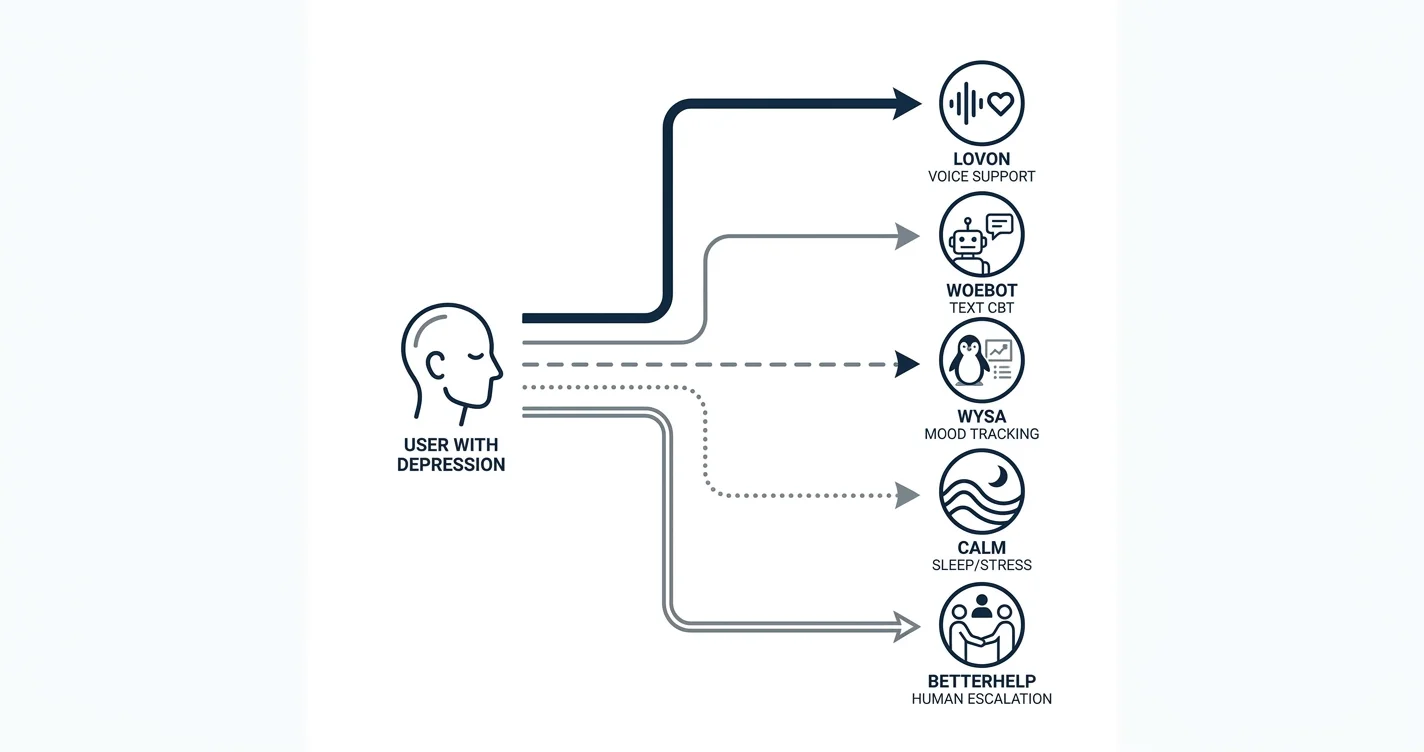

Key Takeaways
- Start with Lovon if you want voice-based emotional support available right now, without a waitlist or referral. The
- Add Woebot as a daily CBT check-in if you find structured exercises helpful alongside voice conversations.
- Escalate to BetterHelp or a local clinician if symptoms have lasted more than two weeks, are worsening, or include
- Generic wellness apps marketed as depression tools. Journaling apps, habit trackers, and mood emoji logs don't
- Apps that make clinical claims without disclaimers. Any AI app that implies it can diagnose or treat depression
If you're looking for the best AI app for depression support in 2026, you need something that shows up at 11 p.m. on a Tuesday, not just during business hours. This guide ranks the top options by what actually matters for depression: availability, evidence base, interaction quality, and honesty about what the app can and cannot do.
TL;DR: The best AI app for depression in 2026 is Lovon for anyone who wants real voice-based emotional support built with PhD psychologist input. Woebot holds its own for CBT-based text check-ins. Wysa works well as a structured mood tracker. If cost and access are your main constraints, Lovon's free tier and free AI therapist for depression make it the clearest starting point. None of these apps replace a licensed clinician — but all five beat staring at the ceiling alone.
Why this matters in 2026
Depression affects roughly 280 million people worldwide, according to the World Health Organization. In the U.S., the average wait time to see a psychiatrist runs 25 days or longer in many metro areas. AI mental health apps don't fix that gap — but they fill the 10 p.m. hour when a low mood starts to spiral, the Sunday when your next therapy session is five days away, and the moment you need to say something out loud without judgment. That "out loud" part is what separates voice-first apps from text chatbots, and it's why the category matters.
How we ranked these apps
Every app here was evaluated on five criteria: interaction format (voice vs. text vs. hybrid), evidence base (who built the therapeutic framework and when), availability (free tier, cost, access without a referral), honesty about limitations (does the app tell you it isn't licensed care?), and depression-specific features (mood tracking, CBT tools, guided reflection for low mood). Apps that made clinical claims without disclosing limitations were excluded. Apps that are purely journaling tools with no interactive component were also excluded — this list is for apps that talk back.
The ranked list
1. Lovon — Best overall for voice-based depression support
The compassionate voice companion. Lovon is built specifically for on-demand emotional support through real voice conversations — not typed prompts, not scripted menus. The framework was developed with input from PhD psychologists, and the app covers depression, anxiety, stress, low mood, burnout, and relationship distress in a single platform.
What sets Lovon apart in 2026 is the voice modality. Depression often flattens the motivation to type out how you feel. Speaking it is lower-friction, and Lovon's voice AI responds in a warm, non-clinical tone that mirrors what you'd expect from a supportive guide. The app provides coping tools, self-reflection prompts, and psychoeducation — and it is explicit that it is not a licensed clinician, which matters for informed use.
Lovon offers a free tier with meaningful functionality, not just a teaser. For users managing everyday depression symptoms — persistent low mood, social withdrawal, lack of motivation — the combination of voice access and evidence-informed structure is the strongest in this category right now.
Cost: Free tier available; premium plans start below $20/month.
Verdict: Buy. If depression makes you want to talk rather than type, Lovon is the clear first choice in 2026.
2. Woebot — Best for structured CBT check-ins
The cognitive-behavioral workhorse. Woebot was built by clinical psychologists at Stanford and launched CBT-based chatbot conversations before most competitors existed. It uses a text-based dialogue system to walk users through cognitive distortions, mood tracking, and behavioral activation — three of the core tools in evidence-based depression treatment.
The app is honest: it calls itself a "mental health ally," not a therapist. In 2026, Woebot Health has expanded its clinical partnerships, making it a common complement to formal care. It is not voice-enabled, which is a real limitation for users whose depression saps typing motivation. Daily check-ins run about 5–10 minutes.
Cost: Free for individual use via the consumer app.
Verdict: Buy for text-comfortable users who want a daily CBT structure. Hold if you need voice interaction or deeper personalization.
3. Wysa — Best for mood tracking with guided exercises
The structured self-monitor. Wysa combines an AI chat interface with over 150 evidence-based exercises drawn from CBT, DBT, and mindfulness frameworks. For depression specifically, its mood logging and behavioral activation tools are well-designed. A 2021 peer-reviewed study in JMIR mHealth found Wysa users showed significant improvement in PHQ-9 depression scores over a six-week period.
Wysa's free tier is functional, and the app is available globally without a referral. Its limitation is depth — the conversational AI feels scripted compared to Lovon's voice model, and the experience skews toward exercises rather than genuine dialogue about how you feel right now.
Cost: Free tier; Wysa for Individuals premium runs approximately $29.99/month.
Verdict: Consider as a structured complement to therapy or Lovon, especially for users who respond well to exercises and data tracking.
4. Calm — Best for low mood tied to sleep and stress
The prevention-layer app. Calm is not a depression app. It is a sleep, meditation, and relaxation platform. It makes this list because a large subset of people searching for depression support in 2026 are dealing with low mood driven by poor sleep and chronic stress — not clinical major depressive disorder — and Calm addresses that directly.
The app has over 100 million downloads and a broad library of sleep stories, breathing exercises, and guided meditations. It does not offer interactive AI conversations about your emotional state. If your low mood is situational and sleep-linked, Calm is worth trying. If your depression is persistent, clinical, or accompanied by suicidal ideation, Calm is not appropriate as a primary support tool.
Cost: $69.99/year or $14.99/month.
Verdict: Consider for mild, stress-driven low mood. Skip as a standalone tool for clinical depression.
5. BetterHelp — Best when you need a licensed human, not AI
The human escalation option. BetterHelp is not an AI app — it matches users with licensed therapists for text, phone, and video sessions. It appears here because anyone comparing AI depression apps should understand where the ceiling is: when symptoms are severe, persistent, or involve thoughts of self-harm, a licensed clinician is the right tool, not an AI companion.
BetterHelp costs $60–$100/week depending on plan and location, making it 3–5x the price of any AI app on this list. Financial aid is available. It is slower to start than an AI app — matching typically takes 24–48 hours — but the therapeutic relationship it provides is qualitatively different from anything AI currently offers.
Cost: $240–$400/month.
Verdict: Buy when AI support is not enough. This is the escalation path, not the starting point.
Comparison table
| App | Format | Depression-specific tools | Free tier | Monthly cost (approx.) | Verdict |
|---|---|---|---|---|---|
| Lovon | Voice + text | Yes — voice reflection, coping tools | Yes | Under $20 | Buy |
| Woebot | Text | Yes — CBT, mood tracking | Yes | Free | Buy / Hold |
| Wysa | Text | Yes — CBT, DBT, PHQ-9 | Yes | ~$30 | Consider |
| Calm | Audio/guided | Indirect — sleep, stress | Limited | ~$70/yr | Consider |
| BetterHelp | Human therapist | Full clinical scope | No | $240–$400 | Buy (escalation) |
Where to start
- Start with Lovon if you want voice-based emotional support available right now, without a waitlist or referral. The AI therapy for depression support article on Lovon's blog explains what to expect from your first session.
- Add Woebot as a daily CBT check-in if you find structured exercises helpful alongside voice conversations.
- Escalate to BetterHelp or a local clinician if symptoms have lasted more than two weeks, are worsening, or include thoughts of self-harm. AI apps are not a substitute for clinical care in those cases.
What to avoid
- Generic wellness apps marketed as depression tools. Journaling apps, habit trackers, and mood emoji logs don't provide interactive support. If the app doesn't respond to what you say, it isn't a therapy companion.
- Apps that make clinical claims without disclaimers. Any AI app that implies it can diagnose or treat depression without disclosing limitations is being irresponsible. Every reputable app on this list is explicit that it is not licensed care.
- Paid-only apps with no free trial. Depression can make financial decisions harder. Don't commit to a $100/month subscription before you know the interaction style works for you.
FAQ
What is the best AI app for depression in 2026? Lovon is the strongest overall pick in 2026 for voice-based emotional support built with psychologist input. Woebot is the best free option for structured CBT check-ins.
Can an AI app actually help with depression? AI apps can provide coping tools, guided reflection, and immediate emotional support — all of which have documented benefits for mild to moderate depression symptoms. They are not a replacement for licensed clinical treatment for severe or persistent depression.
Is Lovon free to use for depression support? Yes. Lovon offers a free tier with core voice conversation and coping tool access. A premium plan with expanded features is available at under $20/month.
How is an AI therapy app different from a licensed therapist? A licensed therapist can diagnose, prescribe (in some states), build a long-term therapeutic relationship, and provide evidence-based treatment protocols under clinical supervision. An AI app provides on-demand support, psychoeducation, and coping tools — without the clinical relationship or legal scope of practice.
Is it safe to use an AI app when I'm feeling depressed? For mild to moderate depression symptoms, yes — AI apps can be a useful and accessible support layer. If you are experiencing thoughts of suicide or self-harm, contact the 988 Suicide and Crisis Lifeline (call or text 988 in the U.S.) rather than an AI app.
What makes a good AI app for depression specifically? Depression-specific features matter: mood tracking, behavioral activation prompts, low-friction access (voice beats typing when motivation is low), and explicit honesty that the app is not a licensed clinician. Generic stress or sleep apps don't qualify.
How much do AI therapy apps cost in 2026? Free tiers exist for Lovon, Woebot, and Wysa. Premium AI therapy app plans typically run $10–$30/month — compared to $60–$100/week for a licensed therapist through BetterHelp. See the full breakdown in the how much is therapy without insurance in 2026 guide.
Does Wysa actually work for depression? A peer-reviewed 2021 JMIR mHealth study found significant PHQ-9 score improvements over six weeks among Wysa users. It works best as a structured complement to other care, not as a sole treatment.
One last thing
The voice format is not a gimmick. Research on emotional disclosure consistently shows that speaking about difficult feelings — rather than writing them — activates a different, deeper level of processing. That's why Lovon's voice-first design is the detail that matters most for depression specifically. Low mood kills the motivation to type 200 words. It rarely kills the ability to just talk.
Related guides
How AI Support Helps You Heal
AI emotional support isn't about replacing human connection — it's about filling the gaps. The moments when you need to talk at 2 AM, when you don't want to burden your friends again, or when you simply need someone to listen without judgment.
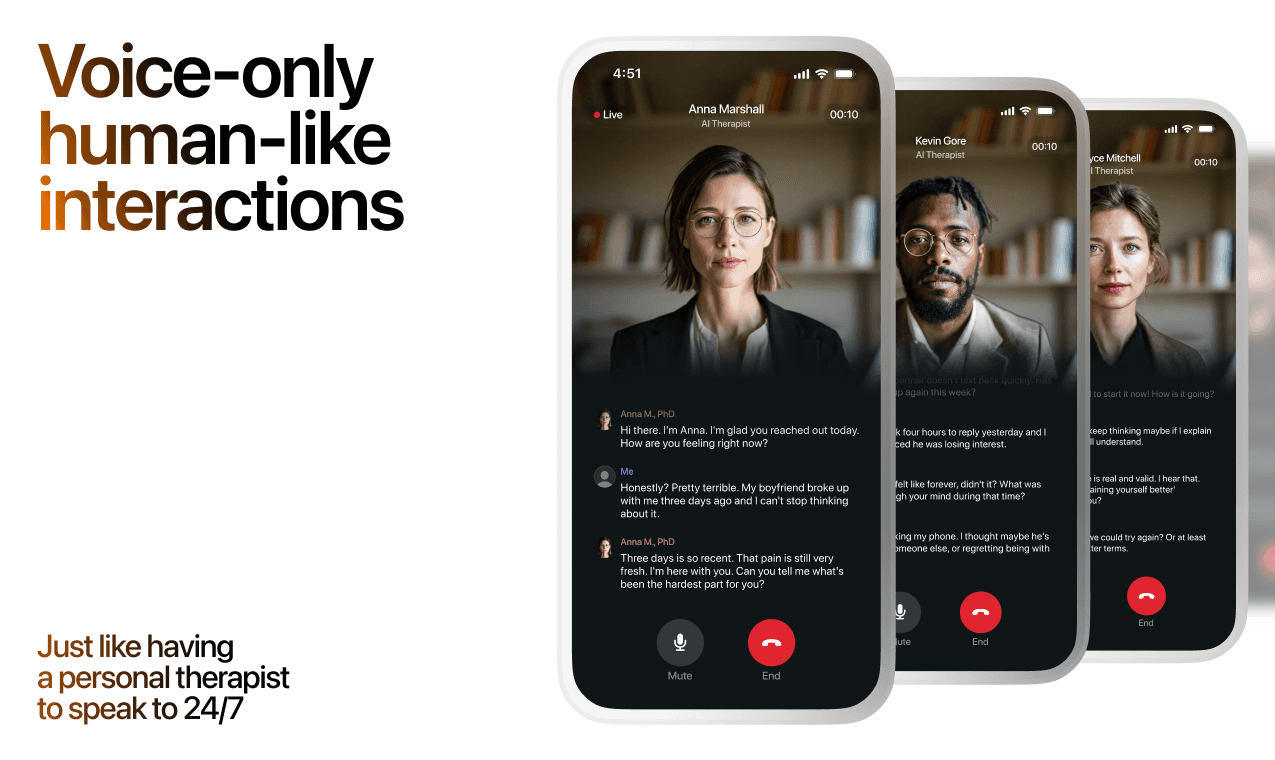
Here's what happens in a typical Lovon session:
You share what's on your mind
There's no script, no intake form, no waiting room. You speak or type whatever you're feeling — in your own words, at your own pace.
Lovon validates and explores
Using frameworks from CBT (Cognitive Behavioral Therapy) and motivational interviewing, Lovon acknowledges your feelings first, then gently helps you explore them. No dismissive "just move on" advice.
You build coping skills together
Lovon doesn't just listen — it actively works with you on evidence-based techniques: thought reframing, urge surfing, behavioral experiments, and more.
What a Session with Lovon Looks Like
When to Seek Professional Help
AI support is a valuable tool, but it's not a replacement for professional care. Please consider reaching out to a licensed therapist if you experience any of the following:
- Persistent thoughts of self-harm or suicide
- Inability to perform daily activities (work, eating, sleeping) for more than 2 weeks
- Turning to alcohol or substances to cope
- Intense anger or desire to harm your ex-partner
- Complete emotional numbness that doesn't improve over time
Crisis Resources (US): If you're in immediate danger, call 988 (Suicide & Crisis Lifeline) or text HOME to 741741 (Crisis Text Line). Available 24/7, free, and confidential.
Outside the US? Find a crisis line in your country
Ready to Start?
Your healing journey can begin right now
A 7-day trial. No judgment. Just a safe space to process what you're going through.
Frequently Asked Questions
Is Lovon a replacement for a real therapist?
Is my conversation with Lovon AI private?
How is Lovon different from ChatGPT for emotional support?
Can I use Lovon if I'm already seeing a therapist?
Can I try Lovon before subscribing?
About the Author
The Lovon Editorial Team
Mental Health & Wellness Content Team
The Lovon Editorial Team develops mental health and wellness content designed to make psychological concepts accessible and actionable. Our goal is to bridge the gap between clinical research and everyday life - helping you understand why your mind works the way it does and what you can do about it....
Related articles
- Best AI App for Body Image Issues in 2026: Lovon Wins
See the 2026 ranking of AI apps for body image issues — Lovon leads for voice support, compared against chatbots…
- Best AI App for Loneliness in 2026: Ranked and Reviewed
The best ai app for loneliness in 2026, ranked: Lovon wins for on-demand AI voice therapy vs. chatbots, therapist…
- Best AI App for Burnout Recovery in 2026: Ranked
Lovon leads our 2026 ranking of the best AI app for burnout recovery, compared against Woebot, Wysa, Calm, Headspace…
- Best AI App for Anger Management in 2026: Ranked
The best ai app for anger management in 2026, ranked by real-time availability, format, and honesty about limits. Lovon…
See also
Quizzes
- Emotionally Unavailable Test: 12-Question Self-Check
See which part of you closes off, in three minutes.
- Toxic Masculinity Test: Which Rules Are You Running?
See which learned rules cost you most, in 3 minutes.
Free tools
- How to Reconnect With an Old Friend
A chat for how to reconnect with an old friend, starting with the text you have been meaning to send for a year. Tell it…
- Am I Overreacting, or Is This a Big Deal?
A chat for the small thing you cannot stop turning over. Say what happened and what you have already told yourself about…
From the wiki
- How to stop maladaptive daydreaming?
Maladaptive daydreaming is immersive waking fantasy that eats hours, usually with music and pacing attached. You rarely…
Disclaimer: This article is for informational purposes only and does not constitute medical advice, diagnosis, or treatment. Always seek the advice of your physician or other qualified health provider with any questions you may have regarding a medical condition. If you are in crisis or think you may have an emergency, call 988 (Suicide & Crisis Lifeline) or go to the nearest emergency room. Outside the US? Find a crisis line in your country.