
Therapy Cost Without Insurance in 2026: Full Price Guide
Therapy without insurance costs $100–$300 per session in 2026. See sliding-scale, community, and telehealth options that cut costs to $0–$80 per session.

Key Takeaways
- Your monthly budget for mental health care
- A clear sense of your presenting issue (anxiety, depression, relationship stress, burnout, ADHD)
- 30–60 minutes to research providers
- Access to a phone or computer for telehealth options
- A therapist directory login (Psychology Today, Open Path, Therapy Den — all free to search)
Therapy without insurance costs between $100 and $300 per session in 2026, depending on where you live, the therapist's credentials, and the format — in-person, telehealth, or sliding scale. This guide walks you through every cost tier, how to find affordable options, and what to do when you need support but can't afford a full session fee.
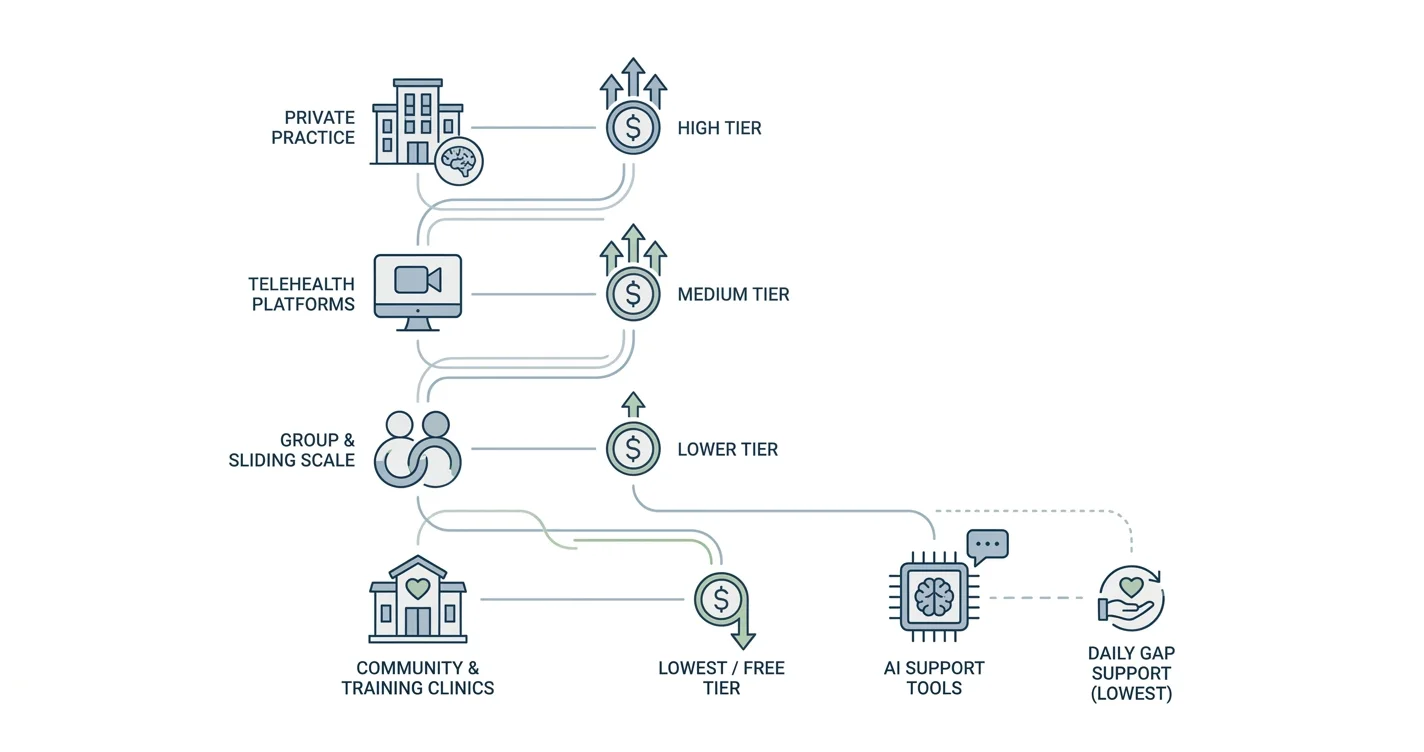
TL;DR: In 2026, a standard therapy session without insurance runs $100–$300 out of pocket. Sliding-scale therapy can drop that to $20–$80 per session. Community mental health centers often charge $0–$50. Telehealth platforms typically cost $60–$150 per session. AI-powered mental health tools like Lovon provide on-demand emotional support at a fraction of that cost — useful for daily anxiety, stress, and relationship struggles when weekly sessions aren't financially realistic.
Why therapy costs this much without insurance
Licensed therapists carry graduate-level education, clinical supervision hours (often 3,000+), and state licensing fees. A psychologist (PhD or PsyD) typically charges $150–$300 per session. A licensed clinical social worker (LCSW) or licensed professional counselor (LPC) usually runs $100–$200. The credential difference accounts for roughly $50–$100 per session on average.
Geography adds another layer. A therapist in Manhattan or San Francisco can charge $250–$350 per session. The same credential level in a mid-sized Midwestern city often charges $100–$150. Telehealth has narrowed but not eliminated that gap.
What you'll need before you start
- Your monthly budget for mental health care
- A clear sense of your presenting issue (anxiety, depression, relationship stress, burnout, ADHD)
- 30–60 minutes to research providers
- Access to a phone or computer for telehealth options
- A therapist directory login (Psychology Today, Open Path, Therapy Den — all free to search)
Step-by-step: finding affordable therapy without insurance
Step 1 — Know the exact cost tiers for 2026
Before you contact a single provider, map the full cost landscape so you know what to negotiate toward.
| Format | Typical 2026 Cost Per Session |
|---|---|
| Private practice (PhD/PsyD) | $150–$300 |
| Private practice (LCSW/LPC) | $100–$200 |
| Telehealth platforms | $60–$150 |
| Sliding-scale private practice | $20–$80 |
| Community mental health center | $0–$50 |
| University training clinics | $0–$30 |
| Group therapy | $20–$60 |
Knowing these tiers stops you from overpaying for a private-practice rate when a sliding-scale or community option is available nearby.
Step 2 — Ask about sliding-scale fees directly
Sliding scale means the therapist charges based on your income, not a fixed rate. Most therapists who offer this do not advertise it prominently — you have to ask.
The ask is simple: "Do you offer a sliding scale, and what range do you work within?" Therapists who say yes typically work between $40 and $100 per session for lower-income clients. A therapist charging $180 per session may slide to $60 if you ask. This single question can cut your cost by 50–70%.
Open Path Collective is a directory specifically for sliding-scale therapists. Membership costs a one-time $65 fee and connects you to therapists who charge $30–$80 per session.
Step 3 — Look up community mental health centers
Federally Qualified Health Centers (FQHCs) and community mental health centers operate on income-based fees set by federal guidelines. For individuals earning below 200% of the federal poverty level in 2026, sessions can be $0–$20. These centers employ licensed clinicians — not volunteers — so care quality is real.
Search SAMHSA's treatment locator (findtreatment.gov) with your zip code. Filter for outpatient mental health. Call the intake line and ask about fees before scheduling — wait times vary from same week to 6–8 weeks depending on your area.
Common mistake: assuming community centers only treat severe mental illness. Many serve general anxiety, depression, and life stress — the same issues a private-practice therapist sees.
Step 4 — Check university training clinics
Most graduate psychology and social work programs run low-cost clinics where supervised trainees provide therapy. Sessions typically run $0–$30. The therapist is a masters- or doctoral-level student, supervised weekly by a licensed clinician.
For non-crisis mental health needs — stress, relationship patterns, self-esteem, burnout — the quality of a supervised trainee clinic is often comparable to early-career licensed providers. Search "[your city] psychology training clinic" or "[university name] counseling practicum."
Step 5 — Evaluate telehealth platforms by actual session cost
Telehealth platforms vary more than they advertise. Here is what the major options actually cost in 2026 for uninsured users:
- BetterHelp: $65–$100 per week (subscription model, roughly $260–$400/month). Messaging included but live sessions are 45 minutes.
- Talkspace: $99–$109 per week for therapy plans. Single sessions available at $125–$199.
- Cerebral: $295/month for therapy plus medication management.
- Alma and Headway: Match you to in-network therapists but also list self-pay rates, often $100–$150/session.
The subscription model makes sense if you need weekly contact. If your need is more occasional — processing a hard week, managing a specific stressor — per-session telehealth at $100–$150 is more cost-efficient than a $400/month subscription you won't fully use.
Step 6 — Use AI mental health support for daily gaps
Weekly therapy addresses a roughly 1-hour window. The other 167 hours are unstructured. For anxiety, stress, low mood, and relationship rumination — the daily weight most people carry — consistent, accessible support matters more than frequency.
Lovon provides voice-based emotional support and coping tools available any time, built with input from PhD psychologists. It is not a licensed clinical service, and it does not replace therapy for clinical conditions. But for the in-between moments — 2 a.m. anxiety spirals, a stressful work situation, processing a relationship conflict — it fills the gap that a biweekly therapy schedule can't cover.
If you are managing high-functioning anxiety specifically, the free AI therapist for stress and burnout resource on the Lovon blog walks through how AI-assisted tools fit into a realistic mental health routine.
Step 7 — Negotiate, batch, and space sessions strategically
Three tactics that reduce out-of-pocket cost without switching providers:
- Ask for a self-pay discount. Therapists save time on insurance billing when you pay directly. Some offer 10–20% off for cash or card payment.
- Move to biweekly. Once you've built a therapeutic relationship and have active coping tools, biweekly sessions at $150 each cost $300/month — comparable to one monthly BetterHelp payment, but with a consistent licensed therapist.
- Use sessions for skills, use daily tools for maintenance. Treat therapy as training. Once you have CBT tools, breathing regulation, or communication frameworks in hand, daily practice with a tool like Lovon extends the value of each paid session.
Troubleshooting: when the standard options don't work
You're on a waitlist for 6–8 weeks. Community centers and university clinics often have wait times. Use the wait productively: start with a crisis line (988 Suicide and Crisis Lifeline), explore AI-supported tools for daily coping, and journal. Being active during the wait prevents the "all-or-nothing" pattern where people drop off a waitlist and do nothing.
The therapist's sliding scale is still too high. Ask specifically: "Is there a lower end of your sliding scale for someone earning under $30,000?" Some therapists reserve a few spots at rates below their stated range. If the answer is no, the FQHC route is your next stop.
Telehealth platforms are confusing about actual session rates. Email support before subscribing and ask: "What is the per-session cost if I cancel my subscription after one month?" The answer tells you the real per-session price. If they can't answer clearly, treat that as a red flag.
You need support but don't qualify for income-based programs. Some employers offer EAP (Employee Assistance Programs) with 3–8 free therapy sessions per year — even for part-time workers. Check your benefits portal or ask HR. This is underused and often forgotten.
You have trauma or PTSD on top of cost concerns. Trauma-focused therapy (EMDR, CPT) tends to run at higher rates because of specialist training. Community mental health centers are one of the few places that offer trauma-specific care on an income-based fee. The AI therapy for PTSD and trauma recovery article on Lovon's blog covers what to realistically expect from AI-assisted support versus clinical trauma treatment.
Tools and resources
- SAMHSA National Helpline: 1-800-662-4357 — free, confidential, 24/7 referrals to local mental health services
- Open Path Collective — sliding-scale therapist directory, $30–$80/session after $65 one-time membership
- Psychology Today therapist finder — filter by "sliding scale" and "telehealth"
- findtreatment.gov — SAMHSA's locator for community mental health and FQHCs
- 988 Suicide and Crisis Lifeline — call or text 988 for crisis support
- Lovon — AI-powered voice support for anxiety, stress, burnout, and relationship struggles between therapy sessions
- Best AI therapy apps for mental health in 2026 — comparison of AI mental health tools by use case
FAQ
How much is therapy without insurance in 2026? A standard session runs $100–$300 depending on therapist credentials and location. Sliding-scale options bring that to $20–$80. Community mental health centers charge $0–$50 based on income.
Can I get therapy for free without insurance? Yes. Federally Qualified Health Centers charge on a sliding scale that can reach $0 for qualifying incomes. University training clinics also offer free or near-free sessions. The 988 Lifeline provides free crisis support by phone or text.
Is telehealth cheaper than in-person therapy without insurance? Usually yes. Telehealth typically runs $60–$150 per session versus $100–$300 for in-person private practice. Subscription-based platforms cost $260–$400/month, which is only cheaper if you use sessions every week.
What is a sliding scale in therapy? A fee structure where the therapist adjusts their rate based on your income. A therapist charging $180 per session may accept $50–$80 from a low-income client. You must ask — most therapists do not advertise their lowest available rate.
Does therapy cost less in smaller cities? Yes. In major metro areas, expect $180–$300 per session. In mid-sized cities and rural areas, $100–$150 is more common. Telehealth has reduced but not eliminated geographic pricing differences.
What is the cheapest legitimate form of therapy? University training clinics supervised by licensed psychologists. Sessions typically cost $0–$30. For non-crisis needs like anxiety, stress, and relationship patterns, the care quality is genuinely comparable to early-career licensed providers.
Is an AI therapy app a replacement for licensed therapy? No. AI tools including Lovon provide emotional support, coping guidance, and self-reflection — not clinical diagnosis or treatment. They are most useful as daily support between therapy sessions or when cost and access make weekly licensed therapy impractical.
How do I find a therapist who accepts self-pay without insurance? Search Psychology Today's directory with the "sliding scale" filter. Try Open Path Collective. Call FQHCs in your area and ask about income-based fees. Most private-practice therapists also accept self-pay — the question is whether they offer a reduced rate for it.
One last thing
The cost of doing nothing adds up differently than a therapy bill — in productivity loss, strained relationships, and compounded stress. A biweekly sliding-scale session at $50 plus a daily AI support tool costs less per month than most streaming subscriptions combined. The access problem is real, but it is smaller than most people assume before they start looking.
Related guides
How AI Support Helps You Heal
AI emotional support isn't about replacing human connection — it's about filling the gaps. The moments when you need to talk at 2 AM, when you don't want to burden your friends again, or when you simply need someone to listen without judgment.
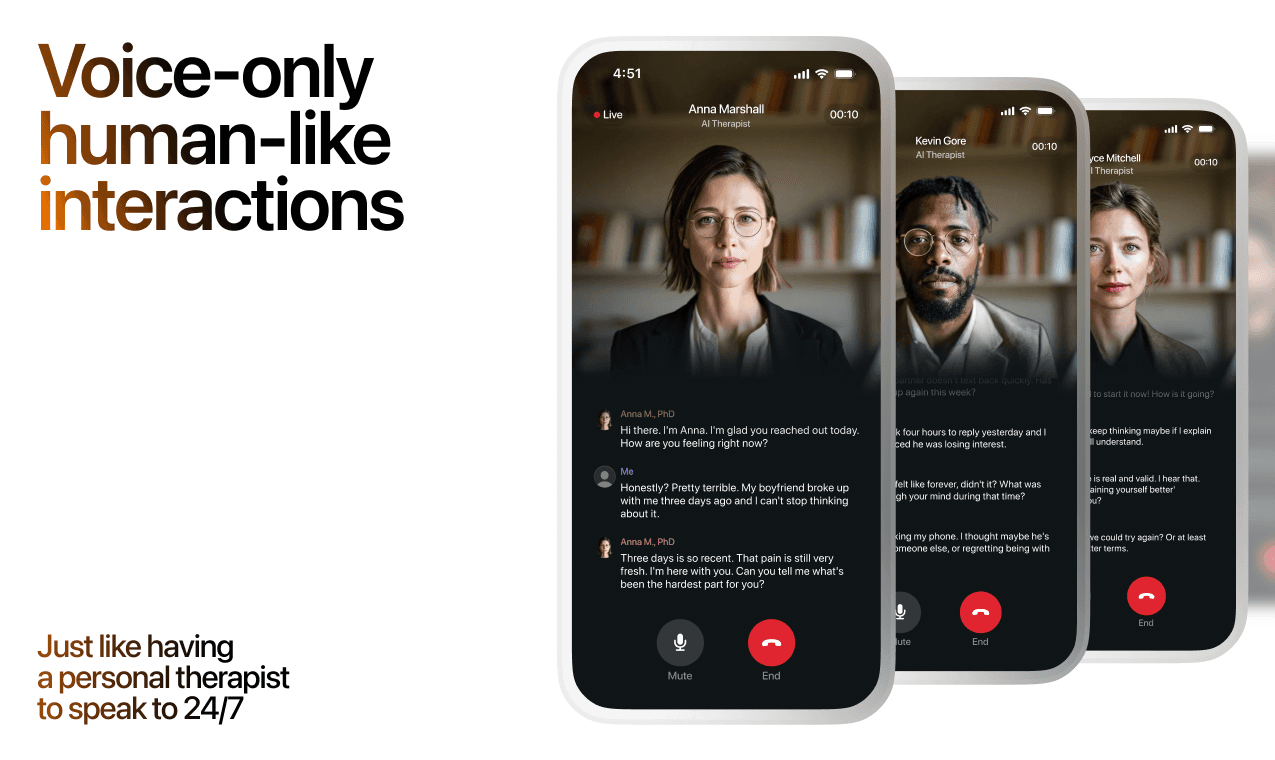
Here's what happens in a typical Lovon session:
You share what's on your mind
There's no script, no intake form, no waiting room. You speak or type whatever you're feeling — in your own words, at your own pace.
Lovon validates and explores
Using frameworks from CBT (Cognitive Behavioral Therapy) and motivational interviewing, Lovon acknowledges your feelings first, then gently helps you explore them. No dismissive "just move on" advice.
You build coping skills together
Lovon doesn't just listen — it actively works with you on evidence-based techniques: thought reframing, urge surfing, behavioral experiments, and more.
What a Session with Lovon Looks Like
When to Seek Professional Help
AI support is a valuable tool, but it's not a replacement for professional care. Please consider reaching out to a licensed therapist if you experience any of the following:
- Persistent thoughts of self-harm or suicide
- Inability to perform daily activities (work, eating, sleeping) for more than 2 weeks
- Turning to alcohol or substances to cope
- Intense anger or desire to harm your ex-partner
- Complete emotional numbness that doesn't improve over time
Crisis Resources (US): If you're in immediate danger, call 988 (Suicide & Crisis Lifeline) or text HOME to 741741 (Crisis Text Line). Available 24/7, free, and confidential.
Outside the US? Find a crisis line in your country
Ready to Start?
Your healing journey can begin right now
A 7-day trial. No judgment. Just a safe space to process what you're going through.
Frequently Asked Questions
Is Lovon a replacement for a real therapist?
Is my conversation with Lovon AI private?
How is Lovon different from ChatGPT for emotional support?
Can I use Lovon if I'm already seeing a therapist?
Can I try Lovon before subscribing?
About the Author

The Lovon Editorial Team
Mental Health & Wellness Content Team
The Lovon Editorial Team develops mental health and wellness content designed to make psychological concepts accessible and actionable. Our goal is to bridge the gap between clinical research and everyday life - helping you understand why your mind works the way it does and what you can do about it....
Related articles
- Is AI therapy covered by insurance in 2026?
AI therapy apps like Lovon aren't covered by insurance in 2026 - insurers only pay licensed clinicians. See what FSA…
- AI Therapist When You Can't Afford Therapy: 2026 Guide
Can't afford therapy in 2026? Learn how to use an AI therapist like Lovon for daily support, what it can't replace, and…
- Best Free AI Therapist for Relationships 2026
The best free AI therapist for relationships in 2026 is Lovon — voice-based, CBT-grounded, no credit card required. See…
- Best On-Demand Therapy App in 2026: What to Look For
On demand therapy app guide for 2026: ranked picks, verdicts (Buy/Hold/Skip), and what to check before you choose voice…
See also
Quizzes
- Loneliness Test: Free 12-Question Self-Check
See which kind of loneliness is thin, in 3 minutes.
- Empath Test: Do Other People's Moods Become Yours?
See how much of other people's moods you take on.
Free tools
- Am I Overreacting, or Is This a Big Deal?
A chat for the small thing you cannot stop turning over. Say what happened and what you have already told yourself about…
- Write a Letter to Your Best Friend
A chat for a letter to your best friend that only they could have received. Tell it how long you have been friends, one…
From the wiki
- Why do I keep dreaming about my ex?
Recurring dreams about an ex usually mean your brain is still consolidating a relationship that took up years of memory…
Disclaimer: This article is for informational purposes only and does not constitute medical advice, diagnosis, or treatment. Always seek the advice of your physician or other qualified health provider with any questions you may have regarding a medical condition. If you are in crisis or think you may have an emergency, call 988 (Suicide & Crisis Lifeline) or go to the nearest emergency room. Outside the US? Find a crisis line in your country.