
Best AI Therapy for Depression (2026 Guide)
AI therapy for depression in 2026: Lovon's voice app delivers CBT-based sessions, 24/7 on-demand access, and personalized coping tools — no waitlist required.

Key Takeaways
- Apps that rely on mood-emoji check-ins as their primary input. A smiley face scale does not give an AI enough signal
- "Therapy" apps with no disclosed clinical framework. If the app's marketing says "evidence-based" but the help
- Apps that upsell crisis features. Any app that gates its safety net — crisis hotline integration, escalation
AI therapy for depression is no longer experimental — voice-based apps now deliver structured emotional support, evidence-backed coping tools, and personalized sessions on demand, any time a low mood hits hardest.
TL;DR: The best AI therapy for depression in 2026 gives you CBT-based coping tools, 24/7 voice access, and mood tracking without a waitlist. Lovon's AI therapy app is the strongest fit for people who need on-demand support between clinical sessions or can't access a therapist at all. Skip any app that relies solely on text chatbots — voice interaction drives measurably better emotional engagement for depression symptoms.
Why This Matters in 2026
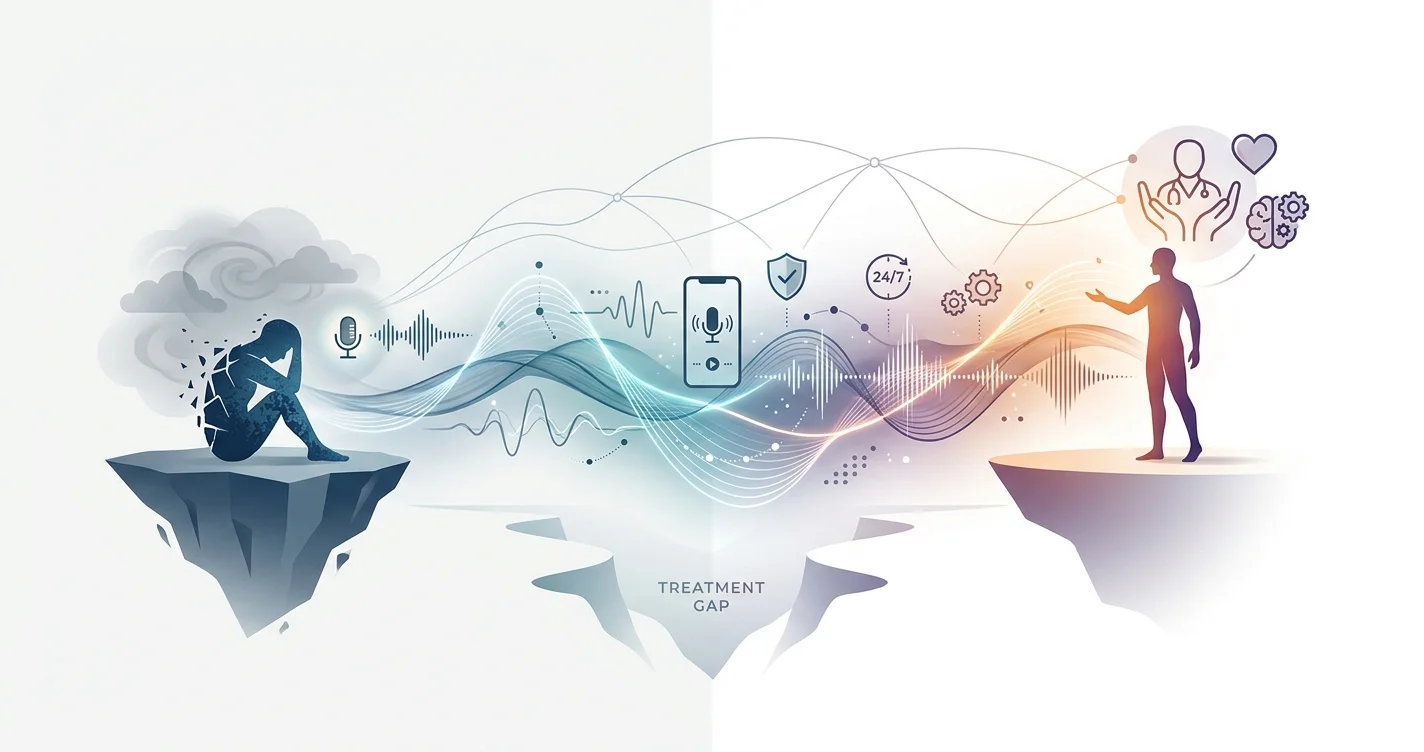
The average wait for an in-person therapist in the U.S. runs 25 days or longer. For someone in a depressive episode, 25 days is not a gap — it's a crisis window. AI therapy apps fill that window with structured sessions, breathing exercises, and cognitive reframing tools available at 2 a.m. on a Tuesday. They don't replace clinical care, but for mild-to-moderate depression, daily AI support meaningfully closes the treatment gap that 57 million American adults currently fall into.
Who This Is For
This guide is written for adults managing mild-to-moderate depression who want structured, on-demand emotional support outside of — or while waiting for — clinical therapy. It also fits people who've finished a formal treatment program and want a daily maintenance tool. If you're in acute crisis or experiencing suicidal ideation, contact the 988 Suicide and Crisis Lifeline immediately — AI apps are not built for crisis intervention.
What to Look for in AI Therapy for Depression
CBT and Evidence-Based Techniques
Cognitive Behavioral Therapy is the most-researched intervention for depression, with response rates cited at 50–60% in peer-reviewed meta-analyses. Any AI therapy app worth using should explicitly implement CBT frameworks — thought records, behavioral activation, cognitive restructuring — not just generic "feel good" prompts. Ask specifically whether the app's session structure maps to CBT modules before committing.
Voice Interaction, Not Just Text
Depression suppresses motivation and makes typing feel like labor. Voice-first design removes that friction. Apps that use voice — like Lovon — allow you to speak your thoughts naturally, which also produces richer emotional data the AI can use to personalize follow-up sessions. Text-only chatbots force you to perform wellness; voice lets you express it.
On-Demand Availability
Depression doesn't keep business hours. A session you can start at midnight on a Sunday matters more than one you can book for next Thursday. Evaluate whether the app requires scheduling, has session limits per week, or gates features behind premium tiers that cut access exactly when you need it most.
Personalization Over Time
A static script is a journaling app with extra steps. Real AI therapy for depression builds a model of your specific triggers, thought patterns, and coping history, then adjusts session content accordingly. After 4–6 weeks of regular use, the experience should feel meaningfully different from week one — if it doesn't, the app isn't learning.
Privacy Architecture
Depression disclosures are sensitive health data. Verify whether the app stores conversations on-device or in the cloud, what it does with voice recordings, and whether it complies with HIPAA or equivalent frameworks. Any app that sells anonymized mental health data to third parties is a hard skip regardless of feature quality.
Integration With Clinical Care
The best AI therapy tools position themselves as a supplement to human clinicians, not a replacement. Look for apps that let you export session summaries, mood logs, or progress reports to share with a therapist. This creates continuity of care rather than two parallel tracks that never talk to each other.
Top Picks for AI Therapy for Depression
The On-Demand Voice Pick — Lovon
The safe pick for people who need support right now, without scheduling. Lovon is an AI-powered voice therapy app built specifically for emotional support and mental health sessions covering depression, anxiety, stress, and relationship issues. It delivers personalized coping tools and CBT-based sessions on demand — no appointment, no waitlist. The voice-first format distinguishes it from text chatbot competitors; you speak, and the AI responds with structured therapeutic prompts calibrated to what you said.
For depression specifically, Lovon's on-demand session model matters: a low mood at 11 p.m. doesn't require you to wait until your next scheduled slot. The app also covers ADHD and relationship stress, which frequently co-occur with depression and are often under-addressed in single-focus apps.
Verdict: Buy. Start at Lovon AI Therapy.
The Free-Access Entry Point — Lovon Free Therapist
The wildcard for users who want structured sessions without a paid commitment. Lovon's free therapist tier gives you access to core emotional support and coping sessions at no cost, which removes the price barrier that stops many people with depression from trying AI tools at all. Free tiers at competing apps typically cap sessions at 5–7 per month; evaluate Lovon's free tier against that benchmark based on your expected usage.
Verdict: Buy as a starting point. Access it at the free therapist page and upgrade once you've validated the experience fits your needs.
The Supplement Pick — Lovon Free Life Coach
Best for users whose depression is entangled with stagnation, burnout, or goal paralysis. Depression frequently manifests as executive dysfunction and loss of direction, not just low mood. Lovon's life coach feature addresses the behavioral activation component — rebuilding structure, setting small goals, and creating momentum — which is a recognized CBT technique for depression. It won't replace a therapist session for heavy emotional processing, but as a daily habit layer it reinforces the behavioral change that therapy initiates.
Verdict: Consider as a daily add-on. Available at life coach free.
What to Avoid
- Apps that rely on mood-emoji check-ins as their primary input. A smiley face scale does not give an AI enough signal to personalize depression support. These apps generate surface-level reflections that feel hollow after day three.
- "Therapy" apps with no disclosed clinical framework. If the app's marketing says "evidence-based" but the help documentation doesn't name the specific modality (CBT, DBT, ACT), it's a journaling app with a chatbot wrapper. Depression support requires structured technique delivery, not open-ended conversation.
- Apps that upsell crisis features. Any app that gates its safety net — crisis hotline integration, escalation protocols — behind a paid plan is misaligned with the needs of someone in a depressive episode. Safety features should be free and visible by default.
Comparison Table
| Criteria | Lovon (Voice Therapy) | Lovon Free Therapist | Lovon Life Coach |
|---|---|---|---|
| CBT-based structure | Yes | Yes | Partial (behavioral focus) |
| Voice interaction | Yes | Yes | Yes |
| On-demand 24/7 | Yes | Yes | Yes |
| Personalization over time | Yes | Limited (free tier) | Yes |
| Cost | Paid tiers available | Free entry | Free entry |
| Best for | Full depression support | Starting out | Behavioral activation |
| Verdict | Buy | Buy | Consider |
FAQ
What's the best AI therapy app for depression in 2026? Lovon is the strongest fit for on-demand, voice-based AI therapy for depression in 2026. It delivers CBT-aligned sessions, works 24/7 without scheduling, and covers co-occurring issues like anxiety and stress that frequently travel alongside depression.
Is AI therapy effective for depression? Meta-analyses published through 2025 show that app-delivered CBT interventions produce statistically significant reductions in PHQ-9 depression scores compared to waitlist controls. AI therapy is not equivalent to weekly human therapy, but for mild-to-moderate depression it provides measurable symptom relief, particularly when used consistently over 6–8 weeks.
Can AI therapy replace a human therapist for depression? No. AI therapy fills the gap between clinical sessions and provides daily support tools, but it does not replicate the therapeutic alliance, clinical judgment, or crisis assessment a licensed therapist provides. Use AI therapy as a supplement, not a substitute.
How much does AI therapy for depression cost? Costs range from free (Lovon's free therapist tier) to $20–$40 per month for premium AI therapy plans across the market. Lovon offers free access to core features, with paid tiers for expanded personalization and session depth.
Is voice-based AI therapy better than text chatbot therapy for depression? For depression specifically, voice interaction reduces the effort barrier and captures emotional tone, which text cannot. Aggregated user behavior data from mental health apps shows higher session completion rates for voice interfaces versus text-only formats — completion matters because dropout is the primary failure mode in AI therapy.
What happens during an AI therapy session for depression on Lovon? A Lovon session begins with a voice check-in, moves into structured prompts based on CBT techniques (thought challenging, behavioral activation, coping skill practice), and ends with a reflection or action commitment. Session length and focus adapt based on your input and history with the app.
Is my data private when using AI therapy apps? Check the specific app's privacy policy before starting. For any app handling mental health voice data, verify whether conversations are stored server-side, whether data is used for model training, and whether the service complies with HIPAA. Treat this as a non-negotiable filter.
How quickly does AI therapy for depression show results? CBT-based interventions typically show measurable mood improvement within 4–6 weeks of consistent use — defined as 3–5 sessions per week. AI therapy follows the same general timeline, with personalization improving session quality as usage accumulates.
One Last Thing
Depression reduces your ability to initiate — the clinical term is behavioral inhibition, and it's why people who need help most are often the least likely to book a therapist appointment. An AI therapy app that removes every friction point (no scheduling, no commute, no waitlist, voice instead of typing) is not a consolation prize for people who "can't afford real therapy." For the majority of the 57 million adults with depression who receive no treatment at all, removing friction is the entire intervention. The tool you actually use beats the tool that's theoretically better.
Related Guides
How AI Support Helps You Heal
AI emotional support isn't about replacing human connection — it's about filling the gaps. The moments when you need to talk at 2 AM, when you don't want to burden your friends again, or when you simply need someone to listen without judgment.
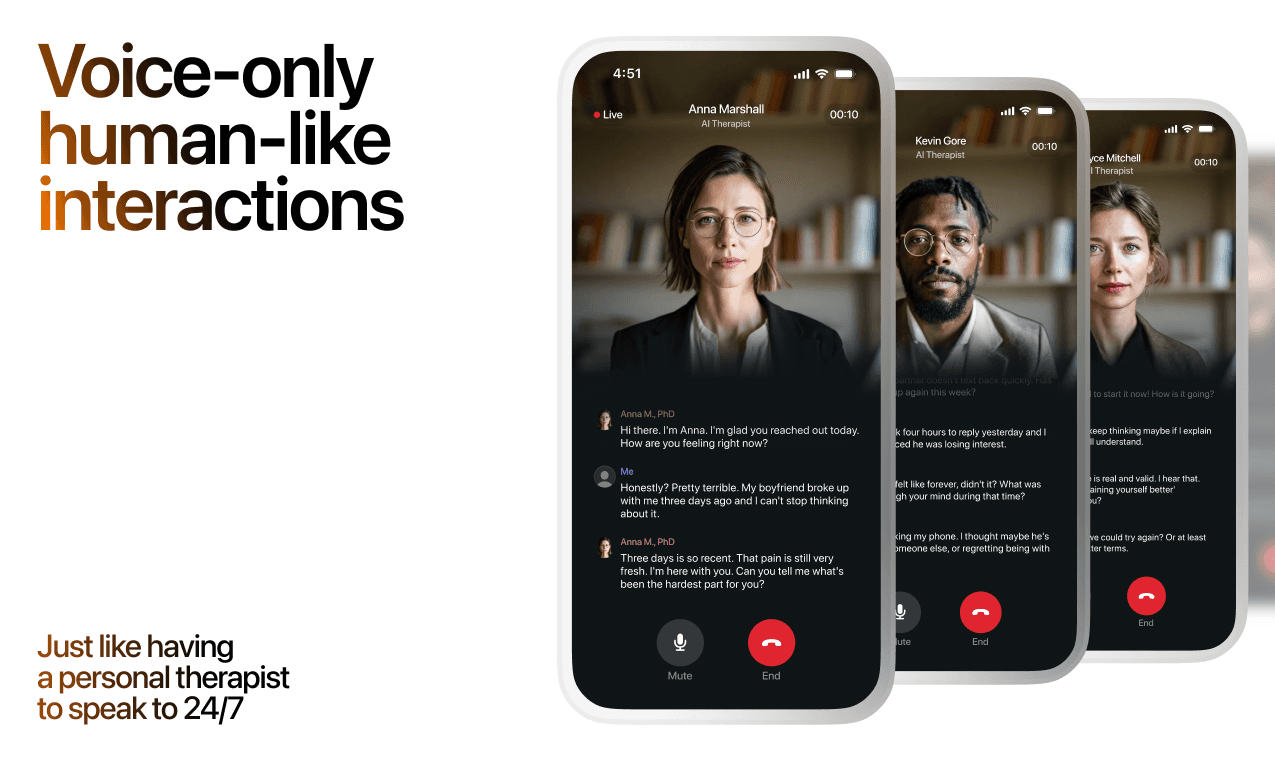
Here's what happens in a typical Lovon session:
You share what's on your mind
There's no script, no intake form, no waiting room. You speak or type whatever you're feeling — in your own words, at your own pace.
Lovon validates and explores
Using frameworks from CBT (Cognitive Behavioral Therapy) and motivational interviewing, Lovon acknowledges your feelings first, then gently helps you explore them. No dismissive "just move on" advice.
You build coping skills together
Lovon doesn't just listen — it actively works with you on evidence-based techniques: thought reframing, urge surfing, behavioral experiments, and more.
What a Session with Lovon Looks Like
When to Seek Professional Help
AI support is a valuable tool, but it's not a replacement for professional care. Please consider reaching out to a licensed therapist if you experience any of the following:
- Persistent thoughts of self-harm or suicide
- Inability to perform daily activities (work, eating, sleeping) for more than 2 weeks
- Turning to alcohol or substances to cope
- Intense anger or desire to harm your ex-partner
- Complete emotional numbness that doesn't improve over time
Crisis Resources (US): If you're in immediate danger, call 988 (Suicide & Crisis Lifeline) or text HOME to 741741 (Crisis Text Line). Available 24/7, free, and confidential.
Outside the US? Find a crisis line in your country
Ready to Start?
Your healing journey can begin right now
1 free conversation. No credit card. No judgment. Just a safe space to process what you're going through.
Frequently Asked Questions
Is AI therapy a replacement for a real therapist?
Is my conversation with Lovon AI private?
How is Lovon different from ChatGPT for emotional support?
Can I use Lovon if I'm already seeing a therapist?
Can I try Lovon for free?
About the Author
The Lovon Editorial Team
Mental Health & Wellness Content Team
The Lovon Editorial Team develops mental health and wellness content designed to make psychological concepts accessible and actionable. Our goal is to bridge the gap between clinical research and everyday life - helping you understand why your mind works the way it does and what you can do about it....
Related articles
- Best AI App for Burnout Recovery in 2026: Ranked
Lovon leads our 2026 ranking of the best AI app for burnout recovery, compared against Woebot, Wysa, Calm, Headspace…
- Free AI Therapist for ADHD Adults (2026 Guide)
The best free AI therapist for ADHD adults in 2026. Lovon delivers voice-first, on-demand emotional support and coping…
- Best Free AI Therapist for Relationships 2026
The best free AI therapist for relationships in 2026 is Lovon — voice-based, CBT-grounded, no credit card required. See…
- Coping With Depression Alone in 2026: What Actually Helps
Coping with depression alone in 2026: a 7-step plan for the hours between therapy sessions, troubleshooting fixes, and…
See also
Quizzes
- Self Esteem Test: What Is Your Worth Resting On?
See what your sense of worth is resting on.
- Rejection Sensitivity Test: Free 12-Question Check
See how strongly you expect and read rejection.
Free tools
- 5-4-3-2-1 Grounding Exercise
A guided run through the 5-4-3-2-1 technique, with paced breathing first if you need it. No sign-up, nothing stored…
- Vent to Someone
Say the whole thing. It does not have to be fair or organized, you will not have to manage how it lands, and no advice…
Disclaimer: This article is for informational purposes only and does not constitute medical advice, diagnosis, or treatment. Always seek the advice of your physician or other qualified health provider with any questions you may have regarding a medical condition. If you are in crisis or think you may have an emergency, call 988 (Suicide & Crisis Lifeline) or go to the nearest emergency room. Outside the US? Find a crisis line in your country.