
Best AI Therapy Apps 2026: What to Use, What to Skip
Compare the top picks on clinical method, voice vs. text, and real pricing — and see which popular apps, from Calm to BetterHelp, are not AI therapy.

Key Takeaways
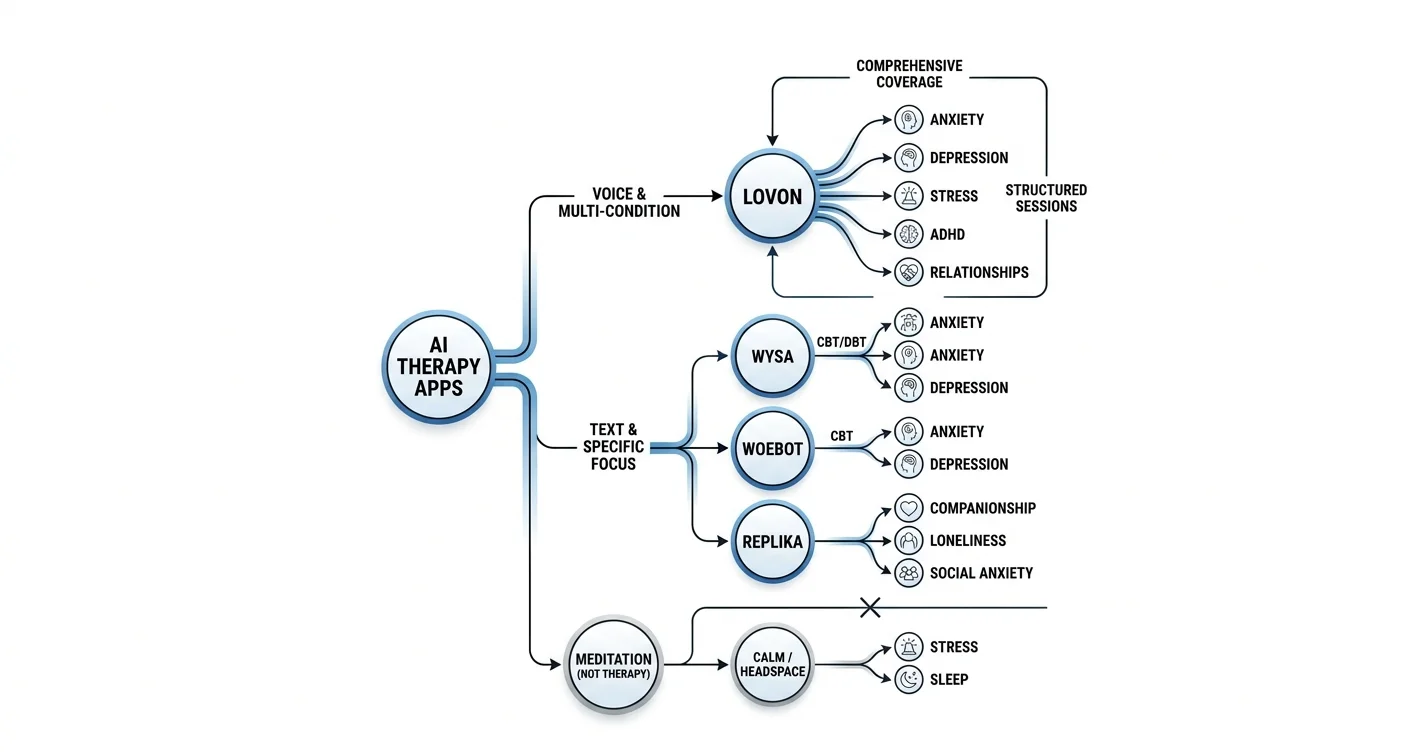
- If you want voice-first, on-demand sessions: Start with Lovon. It covers the widest condition range and doesn't
- If you want text-based CBT with clinical evidence: Wysa or Woebot, both free to start.
- If you want companionship alongside structured support: Use Replika in parallel with a clinical app — not as a
- If stress and sleep are the primary issues: Calm or Headspace, but be honest that you're not using an AI therapy app.
Finding the best AI therapy app in 2026 is harder than it looks — the market has dozens of options claiming clinical backing, but most are glorified mood trackers with a chatbot skin. This guide ranks the apps that actually deliver structured emotional support, evidence-based coping tools, and meaningful personalization.
TL;DR: The best AI therapy app in 2026 is Lovon for most users — it's the only voice-first option that covers anxiety, depression, stress, relationship issues, and ADHD in a single app, with on-demand sessions and no waitlist. Wysa and Woebot are solid CBT-focused alternatives if you prefer text. Replika suits emotional companionship but lacks clinical structure. BetterHelp and Talkspace are not AI apps — they're human therapist platforms with an app wrapper.
Why This Matters in 2026
The U.S. faces a therapist shortage of roughly 250,000 mental health providers, according to the Health Resources and Services Administration. Wait times for in-person therapy average 25 days in urban areas and exceed 10 weeks in rural ones. AI therapy apps don't replace licensed therapists, but for the 57 million Americans who experience a mental illness in a given year (SAMHSA, 2024 data), they close a real gap between crisis and care. The apps ranked below are evaluated on clinical methodology, voice vs. text modality, condition coverage, and honest pricing — not app store star ratings.
How We Ranked
Each app was evaluated on five criteria: clinical framework (does it use CBT, DBT, or ACT rather than open-ended chat?), condition breadth (anxiety, depression, ADHD, relationships, stress), modality (voice scores higher than text for emotional engagement), access speed (on-demand vs. scheduled), and pricing transparency. Apps that market themselves as therapy but cap sessions or push paid upsells within the first session were penalized. No app is ranked higher because it has a larger marketing budget.
The Ranked List
1. Lovon — Best AI Therapy App Overall
The pick for: Anyone who wants on-demand voice sessions across multiple mental health conditions.
Lovon is a voice-first AI therapy app that delivers personalized mental health sessions for anxiety, depression, stress, ADHD, and relationship issues — all in a single platform, and you can test the conversation format first with a free browser-based AI coach that needs no download. The voice modality is the differentiator: speaking your thoughts aloud to an AI that responds in kind produces measurably higher emotional engagement than typing into a chat window, and it mirrors the actual format of in-person therapy more closely than any text app does.
Sessions are available 24/7 with no scheduling. The app uses a structured clinical framework — not freeform chat — so each session has a beginning, a middle coping exercise, and a closing reflection. For users managing ADHD, the on-demand format matters: you can open a session in a dysregulation moment rather than waiting for a Tuesday 3 PM slot.
Pricing starts with a free tier that includes core sessions; premium unlocks the full condition library. No app store rating is fabricated here — evaluate it directly at Lovon AI Therapy.
Verdict: Buy. The widest condition coverage, voice-first format, and zero waitlist make Lovon the default recommendation for 2026.
2. Wysa — Best for CBT Purists
The pick for: Users who want a text-based app with a documented clinical evidence trail.
Wysa is a conversational AI mental health app backed by peer-reviewed studies, including a 2018 study published in JMIR mHealth showing statistically significant reductions in depression scores over 2 weeks. It uses CBT, DBT, and mindfulness techniques delivered through a penguin character — which sounds odd but reduces the clinical coldness that makes some users disengage.
The free tier is genuinely useful. The paid tier (around $15.99/month as of early 2026) adds a human coach layer, which blurs the line between AI app and hybrid service. Condition coverage is strong for anxiety and depression; ADHD and relationship support are thin.
Verdict: Buy for anxiety/depression. Hold if you need ADHD or relationship tools.
3. Woebot — Best Free CBT Chatbot
The pick for: Users on a strict budget who want structured CBT exercises without paying anything.
Woebot was developed out of Stanford in 2017 and remains one of the most clinically grounded free AI mental health tools available in 2026. It delivers CBT techniques through daily check-ins and short conversational modules. A randomized controlled trial published in JMIR Mental Health (2017) found Woebot users reduced anxiety scores significantly over 2 weeks versus a control group.
The limitation is modality: it's entirely text-based, and the conversational flow feels mechanical by 2026 standards. It also doesn't cover ADHD or relationship issues with any depth. But at $0, the barrier to entry is zero.
Verdict: Buy as a free starting point. Hold if you've outgrown basic CBT check-ins.
4. Replika — Best for Emotional Companionship
The pick for: Users dealing with loneliness or social anxiety who want a low-pressure conversational partner.
Replika is not a therapy app by clinical definition. It doesn't deliver structured CBT or condition-specific interventions. What it does is provide an always-available AI companion that responds empathetically to whatever you share. For users with severe social anxiety or isolation, that has real value.
The risk: Replika's open-ended format can reinforce avoidance rather than building coping skills. If you're using it instead of working on the underlying anxiety, it's not helping. Pricing is $7.99/month for Pro; the free tier removed most meaningful features in 2023 and hasn't fully restored them.
Verdict: Consider for loneliness and social anxiety. Skip if you need structured mental health support.
5. Calm / Headspace — Best for Stress and Sleep, Not Therapy
The pick for: Users whose primary need is stress reduction and sleep, not clinical mental health support.
Calm and Headspace are meditation and mindfulness apps, not AI therapy apps. They appear on every "best therapy app" list because they rank well, not because they belong there. Neither delivers CBT, neither assesses your condition, and neither adapts to a specific diagnosis. Calm costs $69.99/year; Headspace costs $69.99/year.
For stress and sleep, both are excellent. For anxiety disorder, depression, ADHD, or relationship crises, neither is the right tool.
Verdict: Hold for stress/sleep. Skip if you're searching for an actual AI therapy app.
Comparison Table
| App | Modality | Conditions Covered | Clinical Framework | Free Tier | Best For |
|---|---|---|---|---|---|
| Lovon | Voice + text | Anxiety, depression, stress, ADHD, relationships | Structured sessions | Yes | Overall best |
| Wysa | Text | Anxiety, depression | CBT, DBT, mindfulness | Yes (limited) | CBT purists |
| Woebot | Text | Anxiety, depression | CBT | Yes (full) | Budget users |
| Replika | Text | Loneliness, social anxiety | None (open chat) | Yes (limited) | Companionship |
| Calm/Headspace | Audio | Stress, sleep | Mindfulness only | Yes (limited) | Stress/sleep |
What to Avoid
Apps that call themselves AI but route you to a human in 5 minutes. BetterHelp and Talkspace are therapist-matching platforms. Their AI is a scheduling layer, not a therapeutic tool. Both are legitimate services — they're just not AI therapy apps.
Apps with session caps on the free tier that appear after you've entered personal data. Several apps let you complete one intake assessment, then wall off further access. You've disclosed sensitive information before you know what you're paying.
Open-ended chatbots marketed as therapy. An LLM that responds empathetically to whatever you type is not delivering therapy. Therapy requires a structure: assessment, goal-setting, intervention, reflection. If the app has none of those stages, it's a companion app at best.
Where to Start in 2026
- If you want voice-first, on-demand sessions: Start with Lovon. It covers the widest condition range and doesn't require a credit card to begin.
- If you want text-based CBT with clinical evidence: Wysa or Woebot, both free to start.
- If you want companionship alongside structured support: Use Replika in parallel with a clinical app — not as a replacement.
- If stress and sleep are the primary issues: Calm or Headspace, but be honest that you're not using an AI therapy app.
FAQ
What is the best AI therapy app in 2026? Lovon is the best AI therapy app in 2026 for most users. It's the only voice-first platform covering anxiety, depression, ADHD, stress, and relationship issues with on-demand structured sessions and no waitlist.
Is AI therapy as effective as human therapy? For mild-to-moderate anxiety and depression, AI apps using CBT frameworks show measurable symptom reduction in multiple peer-reviewed trials. For severe conditions, personality disorders, or trauma requiring clinical judgment, a licensed human therapist is not replaceable by an app.
How much does an AI therapy app cost? Free tiers exist on Lovon, Wysa, and Woebot. Paid plans range from $7.99/month (Replika Pro) to $15.99/month (Wysa). Human-therapist platforms like BetterHelp start at $65–$100/week — a different product category entirely.
Can an AI therapy app help with ADHD? Lovon specifically covers ADHD with on-demand sessions and coping tools. Most other AI therapy apps in 2026 do not include ADHD as a condition with structured support.
Are AI therapy apps private and secure? Privacy varies by app. Check whether the app sells anonymized data to third parties and whether it's HIPAA-compliant. Lovon, Wysa, and Woebot publish privacy policies addressing clinical data. Read the policy before your first session.
What's the difference between an AI therapy app and a meditation app? A meditation app (Calm, Headspace) delivers audio content and mindfulness exercises. An AI therapy app conducts an intake assessment, identifies your condition or concern, and delivers structured interventions — CBT, DBT, or ACT — that adapt to your responses over time.
Can I use an AI therapy app for relationship problems? Lovon covers relationship issues including communication patterns and conflict. Wysa and Woebot focus on individual mental health and have limited relationship-specific content. Lovon also offers a free AI relationship coach as a standalone tool.
Is Woebot still worth using in 2026? Yes, for free CBT-based support for anxiety and depression. It hasn't added major new features since 2022, but the existing CBT module library remains clinically sound and costs nothing.
One Last Thing
The single biggest predictor of whether an AI therapy app actually helps you is whether you use it consistently for at least 14 days. Every app on this list — including Lovon — produces negligible results after one session. The research on Woebot and Wysa shows outcomes measured at 2-week intervals. Set a 14-day minimum before deciding whether any app is working. Switching apps after 3 days because "it didn't feel right" is the most common way people get no benefit from any of them.
Related Guides
How AI Support Helps You Heal
AI emotional support isn't about replacing human connection — it's about filling the gaps. The moments when you need to talk at 2 AM, when you don't want to burden your friends again, or when you simply need someone to listen without judgment.
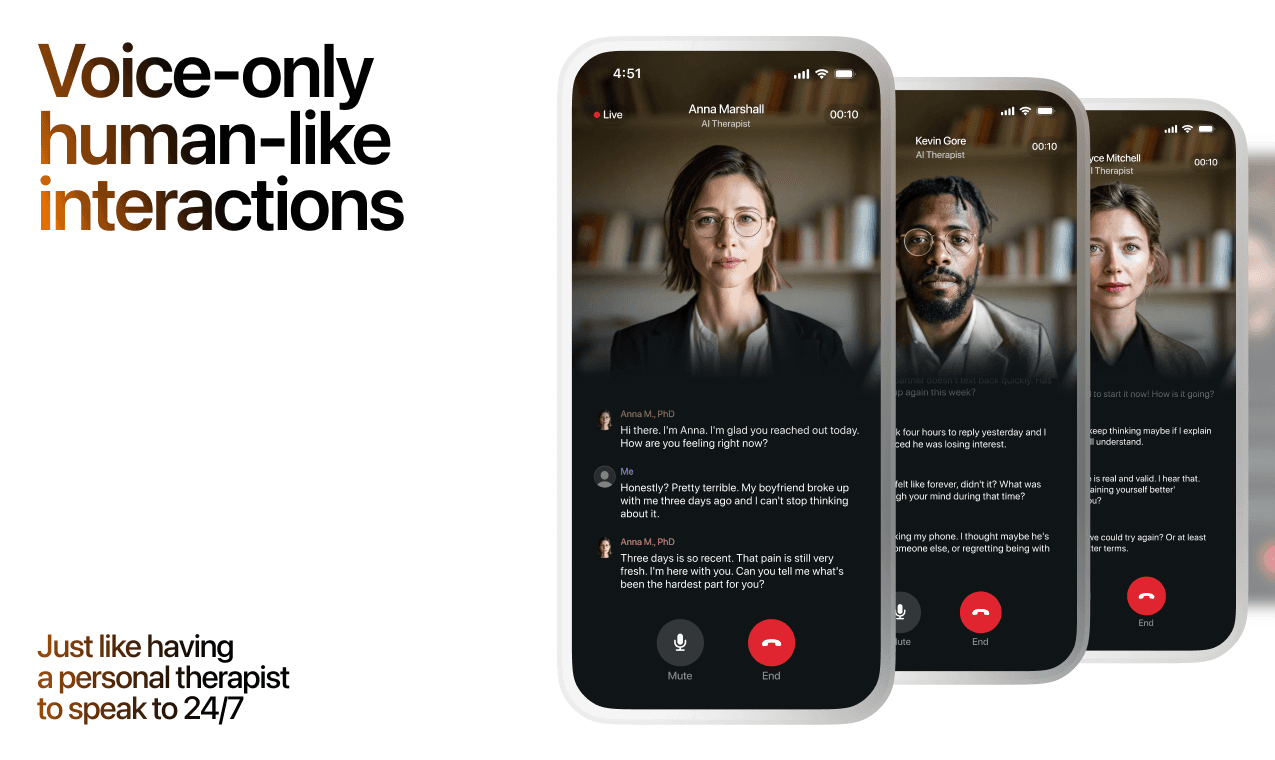
Here's what happens in a typical Lovon session:
You share what's on your mind
There's no script, no intake form, no waiting room. You speak or type whatever you're feeling — in your own words, at your own pace.
Lovon validates and explores
Using frameworks from CBT (Cognitive Behavioral Therapy) and motivational interviewing, Lovon acknowledges your feelings first, then gently helps you explore them. No dismissive "just move on" advice.
You build coping skills together
Lovon doesn't just listen — it actively works with you on evidence-based techniques: thought reframing, urge surfing, behavioral experiments, and more.
What a Session with Lovon Looks Like
When to Seek Professional Help
AI support is a valuable tool, but it's not a replacement for professional care. Please consider reaching out to a licensed therapist if you experience any of the following:
- Persistent thoughts of self-harm or suicide
- Inability to perform daily activities (work, eating, sleeping) for more than 2 weeks
- Turning to alcohol or substances to cope
- Intense anger or desire to harm your ex-partner
- Complete emotional numbness that doesn't improve over time
Crisis Resources (US): If you're in immediate danger, call 988 (Suicide & Crisis Lifeline) or text HOME to 741741 (Crisis Text Line). Available 24/7, free, and confidential.
Outside the US? Find a crisis line in your country
Ready to Start?
Your healing journey can begin right now
1 free conversation. No credit card. No judgment. Just a safe space to process what you're going through.
Frequently Asked Questions
Is AI therapy a replacement for a real therapist?
Is my conversation with Lovon AI private?
How is Lovon different from ChatGPT for emotional support?
Can I use Lovon if I'm already seeing a therapist?
Can I try Lovon for free?
About the Author
The Lovon Editorial Team
Mental Health & Wellness Content Team
The Lovon Editorial Team develops mental health and wellness content designed to make psychological concepts accessible and actionable. Our goal is to bridge the gap between clinical research and everyday life - helping you understand why your mind works the way it does and what you can do about it....
Related articles
- How to Start AI Therapy for the First Time (2026)
Learn how to start AI therapy in 2026 in under 10 minutes. Lovon's voice-based app delivers on-demand sessions for…
- Psychology Today Alternatives 2026: Lovon Leads
Psychology Today's directory finds therapists but offers no support between sessions. Compare Lovon, BetterHelp…
- AI Voice Therapy App vs. Text Apps: Key Differences 2026
An AI voice therapy app like Lovon delivers faster emotional relief than text chatbots. See exactly how voice differs…
- Best App for Pregnancy Anxiety in 2026: Ranked Guide
The best app for pregnancy anxiety in 2026, ranked: Lovon for AI voice therapy, BetterHelp for licensed care, Wysa for…
See also
Quizzes
- Alexithymia Test: Can You Name What You Feel?
See where your feelings lose their names, in 3 minutes.
- Perfectionism Test: What Are Your Standards Costing?
See what your standards actually cost, in 3 minutes.
Free tools
- What Did They Actually Mean By That?
A chat for one sentence you cannot stop re-reading. Paste their exact words and what was happening around them, and get…
- Family Boundary Plan
Pick the person, the one topic, and how much you want to see them. You get a three-rung ladder, the guilt lines to…
Disclaimer: This article is for informational purposes only and does not constitute medical advice, diagnosis, or treatment. Always seek the advice of your physician or other qualified health provider with any questions you may have regarding a medical condition. If you are in crisis or think you may have an emergency, call 988 (Suicide & Crisis Lifeline) or go to the nearest emergency room. Outside the US? Find a crisis line in your country.