
Am I Codependent Quiz: 2026 Verdict in 2 Minutes
Take the am i codependent quiz for 2026: 10 quick questions, four score bands, and a direct verdict on your codependent patterns in relationships.

Key Takeaways
- Don't confuse codependency with being caring. Wanting to support someone you love is normal; losing your own
- Don't treat a low score as permission to ignore one bad pattern. A 2 out of 10 with a "yes" on question 10 (staying
- Don't assume the fix is to leave the relationship. Most codependent patterns are addressed through [healthy
Ten yes/no questions, one score, and a clear read on whether your relationship habits lean codependent — this am i codependent quiz takes about two minutes and gives you a verdict, not just a feeling.
TL;DR
This am i codependent quiz uses 10 statements covering boundaries, approval-seeking, and caretaking to sort your answers into four score bands, from mostly independent to deeply codependent patterns. If you score 7 or higher, the verdict is address it now — patterns at that level rarely resolve on their own. Lower scores still matter; even a 3 out of 10 can point to specific habits worth naming before they harden. The quiz is a screening tool, not a diagnosis, and Lovon's AI voice support app can walk you through what the score actually means in your specific relationship.
Why this matters
Codependency isn't a clinical diagnosis in the DSM-5, but it describes a real and common pattern: your sense of okay-ness depends on someone else's mood, approval, or need for you. Left unnamed, it shows up as chronic guilt, resentment you can't explain, and a habit of shrinking your own needs to keep the peace.
The pattern is common enough in 2026 relationship research and clinical writing that most therapists now screen for it routinely, even without a formal diagnostic code. A short quiz won't replace that conversation, but it will tell you whether the conversation is worth having soon or worth having now.
Who this quiz is for
This is for anyone who keeps asking friends "is this normal?" about their relationship and getting mixed answers. It's built for people who feel responsible for a partner's, parent's, or friend's emotions, who struggle to say no without guilt, or who noticed they've stopped doing things they used to enjoy because someone else's needs always come first. If you already know you're the one holding a relationship together by managing everyone's feelings but your own, this quiz will confirm it fast — and point you toward what to do next with an AI voice support app built for exactly this kind of emotional untangling.
What to look for in codependent patterns
Identity that bends around someone else
Codependency often starts with a slow erosion of "what do I want" replaced by "what do they need." If you can list your partner's favorite everything but struggle to name three things you personally want this year, that's a signal, not a coincidence.
Difficulty saying no without guilt
Everyone says no sometimes. Codependent patterns show up when saying no triggers a wave of guilt disproportionate to the actual request. This is closely related to the fawn response, where people-pleasing becomes an automatic nervous-system reaction rather than a choice.
Feeling responsible for other people's emotions
If someone else is upset, do you feel like it's your job to fix it, even when you didn't cause it? That over-functioning is one of the clearest markers clinicians look for, and it's exhausting in a way that rarely gets named until it's pointed out directly.
Anxiety when you can't reach someone
A missed text or an unanswered call shouldn't spike your heart rate. If it does, consistently, that's less about the other person and more about how much of your emotional regulation depends on their availability.
Resentment that has no clear cause
This one sneaks up. You give and give, tell yourself it's fine, and then snap over something small. Unexplained resentment is almost always a symptom of chronic guilt built up from ignoring your own limits for too long.
The 2-minute quiz
There is also an interactive version of this on the site: the am I codependent quiz runs twelve questions instead of ten and gives you a written result rather than a number to interpret yourself.
Answer yes or no to each statement. Count your total "yes" answers.
- I feel guilty when I put my own needs first.
- I often know what my partner or family member needs before I know what I need.
- I struggle to say no, even to requests that inconvenience me.
- I feel anxious or on edge when someone close to me is upset, even if I didn't cause it.
- I've given up hobbies or friendships to keep a relationship stable.
- I check my phone repeatedly when I'm waiting to hear from someone.
- I feel responsible for fixing other people's problems or moods.
- I stay in conversations or situations that drain me because leaving feels selfish.
- My mood shifts noticeably based on how someone else is feeling toward me.
- I've stayed in a relationship longer than I wanted to because I feared the other person's reaction.
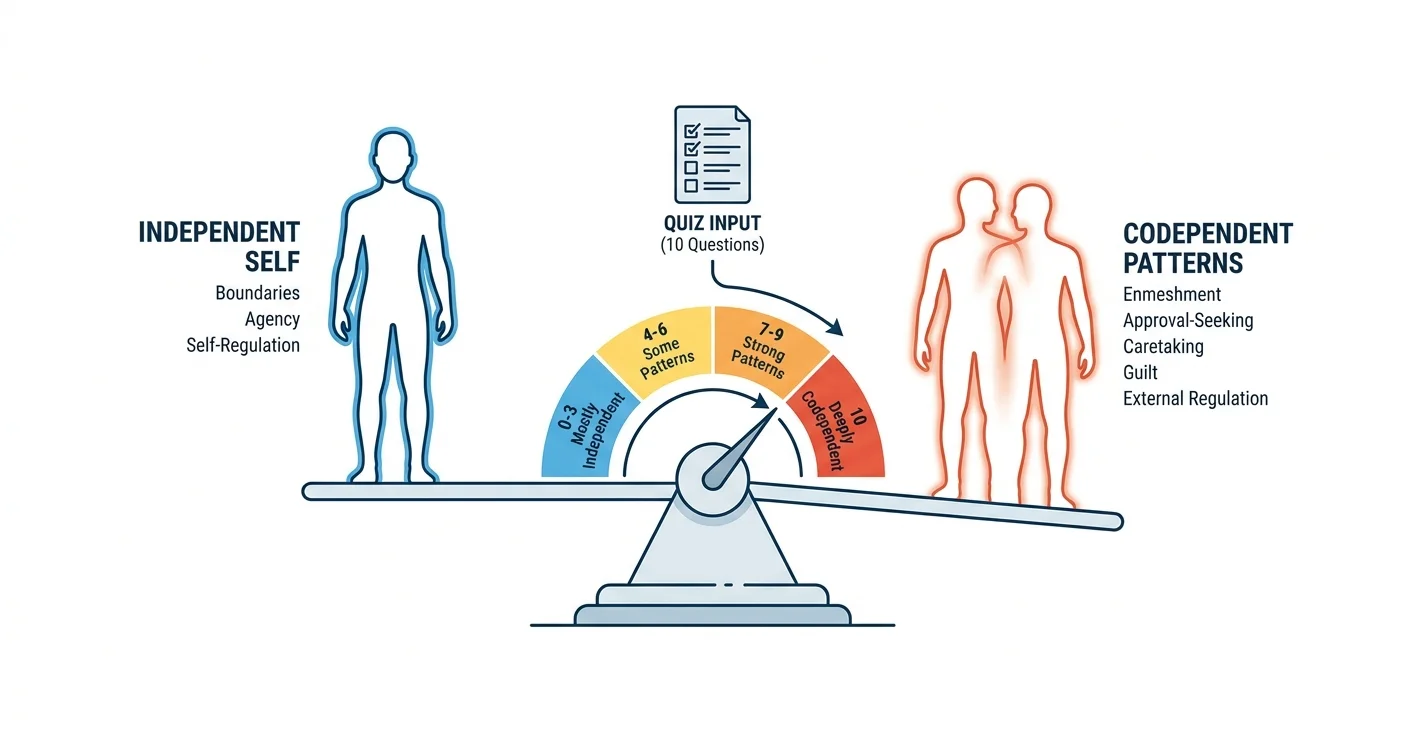
Score band: 0-3 yes answers — mostly independent
The reassuring band. A handful of these patterns show up in almost everyone at some point, especially during stress. At this score, you likely have solid boundaries most of the time with occasional lapses. Verdict: healthy baseline, self-monitor.
Score band: 4-6 yes answers — some codependent patterns
The gray zone, and the most common landing spot. You have real boundary gaps, usually concentrated in one relationship rather than across all of them. This is the range where naming the pattern early prevents it from spreading. Verdict: worth addressing before it deepens.
Score band: 7-9 yes answers — strong codependent patterns
The wake-up call. At this score, your emotional stability is measurably tied to someone else's mood or presence, and it's likely affecting sleep, focus, or other relationships too. This is the range where structured support, not just self-help articles, tends to move the needle. Verdict: address it now.
Score band: 10 yes answers — deeply codependent patterns
The loudest signal the quiz gives. A perfect score means the pattern touches nearly every part of how you relate to at least one person in your life, and it's probably been building for years, often since childhood. Verdict: prioritize support this month, not eventually.
What to avoid when interpreting your score
- Don't confuse codependency with being caring. Wanting to support someone you love is normal; losing your own identity in the process is the actual problem. The quiz measures the second thing, not the first.
- Don't treat a low score as permission to ignore one bad pattern. A 2 out of 10 with a "yes" on question 10 (staying out of fear of someone's reaction) still deserves attention on its own.
- Don't assume the fix is to leave the relationship. Most codependent patterns are addressed through healthy relationship boundaries, not through ending the relationship — the pattern usually follows you into the next one if it isn't handled directly.
Score comparison at a glance
| Score | Label | Core symptom | Recommended action |
|---|---|---|---|
| 0-3 | Mostly independent | Occasional guilt over boundaries | Self-monitor, revisit in 2026 if life stress increases |
| 4-6 | Some codependent patterns | Boundary gaps in one relationship | Name the pattern, practice saying no in low-stakes situations |
| 7-9 | Strong codependent patterns | Emotional stability tied to others | Seek structured support this season |
| 10 | Deeply codependent patterns | Identity fused with someone else | Prioritize support now, not eventually |
FAQ
Is codependency a real diagnosis? No. Codependency is not a formal diagnosis in the DSM-5, but it's a widely recognized behavioral pattern that therapists screen for because it shows up alongside anxiety, depression, and relationship distress.
What's the difference between codependency and anxious attachment? Anxious attachment describes a fear of abandonment rooted in early bonding; codependency describes the behaviors — over-caretaking, boundary loss, guilt — that often result from that fear. They overlap heavily but aren't identical.
Can you be codependent with a parent instead of a partner? Yes. Codependent patterns show up just as often in parent-child dynamics, especially with a parent who relies on you for emotional regulation. The quiz questions apply the same way to family relationships as romantic ones.
How much therapy do you need for codependency? There's no fixed number of sessions; timelines depend on how long the pattern has existed and how many relationships it touches. Consistent weekly support over a few months is a common starting point clinicians describe.
Does a high score mean the relationship is toxic? Not necessarily. A high score means your patterns need attention; it doesn't automatically mean the other person is doing something wrong. Sometimes both things are true at once.
Is this am i codependent quiz clinically validated? No. It's a screening tool built from commonly cited codependency traits, meant to give you direction, not a diagnosis. A licensed clinician is the right source for a formal assessment.
Can AI therapy help with codependency? AI voice therapy can help you practice naming needs, rehearsing boundary-setting language, and processing the guilt that comes up when you say no, between or instead of traditional sessions. It's a support layer, not a replacement for licensed clinical care when patterns are severe.
What should I do right after taking this quiz? Write down which specific questions you answered yes to, not just your total score — the pattern behind each yes matters more than the number itself.
One last thing
The question people skip on this quiz is number 10 — staying somewhere longer than you wanted out of fear of someone's reaction. It's the single strongest predictor in the set, because it's the only question that measures action instead of feeling. A "yes" there, even with a low total score, is worth more attention than a "yes" on any of the others combined.
Related guides
How AI Support Helps You Heal
AI emotional support isn't about replacing human connection — it's about filling the gaps. The moments when you need to talk at 2 AM, when you don't want to burden your friends again, or when you simply need someone to listen without judgment.
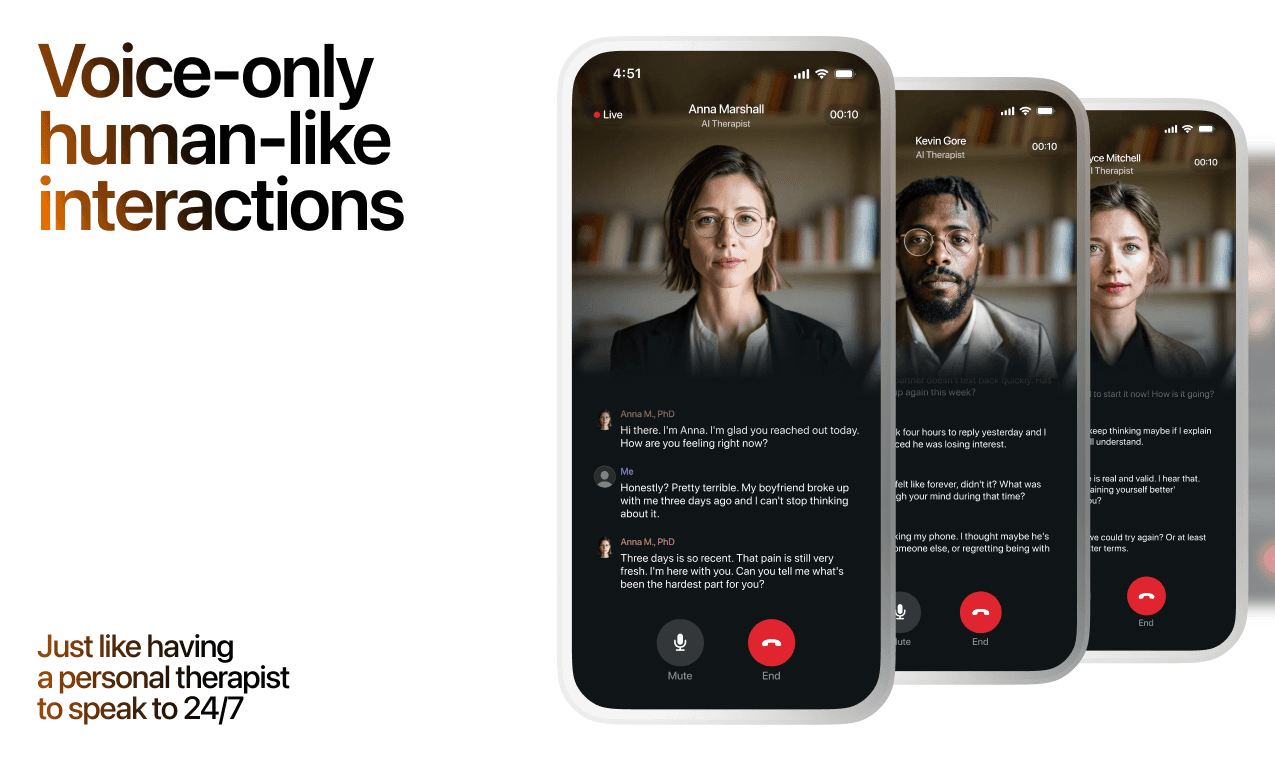
Here's what happens in a typical Lovon session:
You share what's on your mind
There's no script, no intake form, no waiting room. You speak or type whatever you're feeling — in your own words, at your own pace.
Lovon validates and explores
Using frameworks from CBT (Cognitive Behavioral Therapy) and motivational interviewing, Lovon acknowledges your feelings first, then gently helps you explore them. No dismissive "just move on" advice.
You build coping skills together
Lovon doesn't just listen — it actively works with you on evidence-based techniques: thought reframing, urge surfing, behavioral experiments, and more.
What a Session with Lovon Looks Like
When to Seek Professional Help
AI support is a valuable tool, but it's not a replacement for professional care. Please consider reaching out to a licensed therapist if you experience any of the following:
- Persistent thoughts of self-harm or suicide
- Inability to perform daily activities (work, eating, sleeping) for more than 2 weeks
- Turning to alcohol or substances to cope
- Intense anger or desire to harm your ex-partner
- Complete emotional numbness that doesn't improve over time
Crisis Resources (US): If you're in immediate danger, call 988 (Suicide & Crisis Lifeline) or text HOME to 741741 (Crisis Text Line). Available 24/7, free, and confidential.
Outside the US? Find a crisis line in your country
Ready to Start?
Your healing journey can begin right now
A 7-day trial. No judgment. Just a safe space to process what you're going through.
Frequently Asked Questions
Is Lovon a replacement for a real therapist?
Is my conversation with Lovon AI private?
How is Lovon different from ChatGPT for emotional support?
Can I use Lovon if I'm already seeing a therapist?
Can I try Lovon before subscribing?
About the Author
The Lovon Editorial Team
Mental Health & Wellness Content Team
The Lovon Editorial Team develops mental health and wellness content designed to make psychological concepts accessible and actionable. Our goal is to bridge the gap between clinical research and everyday life - helping you understand why your mind works the way it does and what you can do about it....
Related articles
- How to Set Boundaries With a Narcissist (2026 Guide)
Learn how to set boundaries with a narcissist without conflict: scripted language, the gray rock method, and…
- Freeze, Flight, and Fawn Trauma Responses as Safety-Seeking Behavioral Patterns
When confronted with perceived danger or overwhelming stress, our nervous system activates automatic protective…
- Self-Worth vs Self-Esteem: The Real Difference (2026)
Self-worth vs self-esteem explained with a 6-step exercise. Verdict: build self-worth first in 2026 — self-esteem alone…
- How to Stop Being Codependent: Steps That Work (2026)
How to stop being codependent in 2026: 6 practical steps, common mistakes, and troubleshooting for boundary-setting…
See also
Quizzes
- Overfunctioning in Relationship Test: 12 Questions
See how far the load has tilted, in 3 minutes.
- Self-Acceptance Test: What Are You Still Arguing With?
See where you are still fighting yourself, in 3 minutes.
Free tools
- How to Come Out to Your Parents
A chat about how to come out to your parents that starts with whether now is safe, not with the speech. Tell it your…
- How to Say No Politely (Without Over-Explaining)
A chat for how to say no politely when you have already decided and cannot get the word out. Tell it what you were…
From the wiki
- Why do I feel lonely all of a sudden?
Sudden loneliness usually traces back to something that quietly ended in the last few months: a routine, a shared class…
Disclaimer: This article is for informational purposes only and does not constitute medical advice, diagnosis, or treatment. Always seek the advice of your physician or other qualified health provider with any questions you may have regarding a medical condition. If you are in crisis or think you may have an emergency, call 988 (Suicide & Crisis Lifeline) or go to the nearest emergency room. Outside the US? Find a crisis line in your country.