
Cognitive Distortions: 10 Thinking Traps Fixed in 2026
Cognitive distortions explained: 10 thinking traps like catastrophizing and mind reading, plus the exact fix for each. A 2026 guide to catching them fast.

Key Takeaways
- A notebook, notes app, or voice memo tool — anything that lets you capture the thought as it happens
- 5-10 minutes a day for the first two weeks
- A short list of the ten distortions below, printed or saved somewhere visible
- One trusted person or tool to talk the thought through out loud — saying a distortion aloud breaks its grip faster
- "I can name the distortion but I still feel awful" — naming it is step one, not the whole fix. Pair it with a
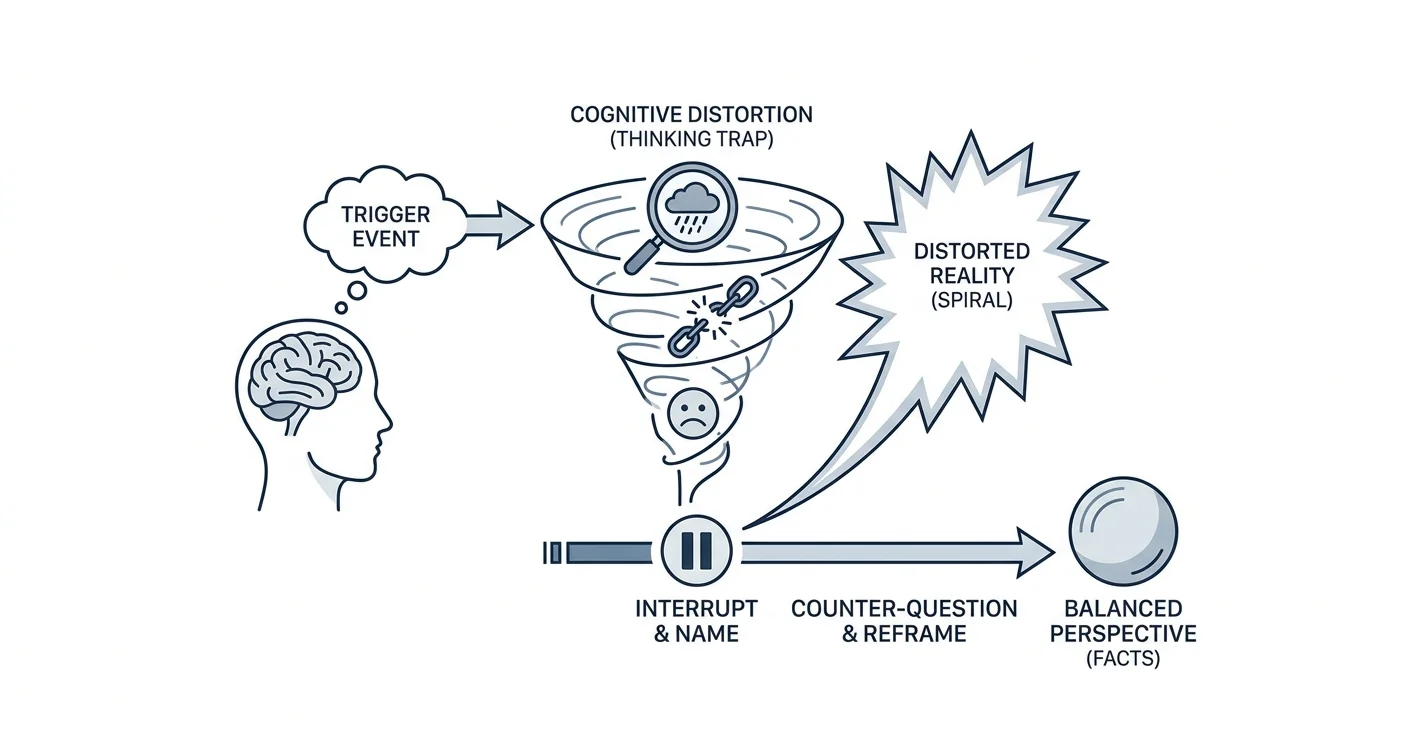
Cognitive distortions are the automatic thinking errors that turn a rough moment into a spiral — and once you can name them, you can catch them before they run the show.
TL;DR
Cognitive distortions are biased, inaccurate thought patterns — catastrophizing, all-or-nothing thinking, mind reading, and seven others — that inflate anxiety, guilt, and low mood without you noticing they're happening. The fix isn't willpower, it's naming the distortion in the moment and asking one specific counter-question, a skill most people build in 2-4 weeks of daily practice. Catastrophizing and mind reading are the two most damaging for daily functioning, and both respond well to structured journaling or a guided conversation, which is why tools like Lovon's AI voice support exist specifically to walk you through the counter-question in real time. Worth building this skill now if racing thoughts, guilt loops, or "everyone hates me" spirals show up more than twice a week in 2026.
Why this matters
A cognitive distortion isn't a personality flaw — it's a mental shortcut your brain takes under stress, and it's measurably distorting the facts in front of you. Left unchecked, these patterns feed straight into rumination loops that keep replaying the same worry with no new information and no resolution.
The research base behind cognitive distortions comes from Aaron Beck's cognitive therapy work in the 1960s, later expanded by David Burns in "Feeling Good" (1980), which cataloged ten common distortions still used in clinical practice today. The list hasn't changed much since — what's changed in 2026 is how many people are catching these patterns through apps and self-guided tools instead of waiting for a weekly session.
What you'll need
- A notebook, notes app, or voice memo tool — anything that lets you capture the thought as it happens
- 5-10 minutes a day for the first two weeks
- A short list of the ten distortions below, printed or saved somewhere visible
- One trusted person or tool to talk the thought through out loud — saying a distortion aloud breaks its grip faster than just writing it down
The 10 thinking traps and how to fix them
1. Catastrophizing — jumping straight to the worst outcome
Your boss sends a two-line email and your brain decides you're getting fired. Catastrophizing skips every likely outcome and lands on the worst one, and it's one of the fastest routes to a full amygdala hijack, where your nervous system reacts to a story as if it's already real. Fix it: ask "what's the most likely outcome, not the worst one?" and write down three less-catastrophic options. Common mistake: people try to argue themselves out of the fear entirely instead of just widening the range of possible outcomes.
2. All-or-nothing thinking — no middle ground
One missed gym session means you've "ruined everything." This trap sorts every event into perfect or failure with nothing between. Fix it: name the gray zone out loud — "I missed one day, that's 1 out of 30." Common mistake: treating the correction as a one-time fix rather than a habit you rebuild daily.
3. Mind reading — assuming you know what others think
You decide your friend is annoyed with you because they took an hour to text back, with zero actual evidence. Fix it: replace the assumption with a direct question to the person, or write down two alternative explanations before reacting. Common mistake: confirming the assumption by acting distant, which then creates the exact tension you feared.
4. Emotional reasoning — "I feel it, so it must be true"
Feeling guilty gets mistaken for proof of guilt. Feelings are data, not verdicts. Fix it: separate the sentence "I feel guilty" from "I did something wrong" — write both down and check if the second one holds up on its own. Common mistake: using intensity of feeling as a stand-in for evidence.
5. Labeling — turning one action into an identity
One mistake becomes "I'm an idiot" instead of "I made a mistake." Labeling generalizes a single event into a permanent trait. Fix it: rewrite the label as a specific, time-bound behavior: "I forgot the deadline" not "I'm irresponsible." Common mistake: applying the label to unrelated situations, which reinforces it further.
6. Personalization — taking blame for things outside your control
A friend cancels plans and you assume you did something wrong, even when their reason had nothing to do with you. Fix it: list every possible cause of the event, and put yourself at the bottom of that list, not the top. Common mistake: confusing being affected by something with being the cause of it.
7. Filtering — only seeing the negative
You get four compliments and one piece of criticism, and the criticism is the only thing you remember an hour later. Fix it: at day's end, write down one positive and one negative from the same event, side by side. Common mistake: dismissing the positive as "they were just being nice."
8. Overgeneralization — "this always happens to me"
One bad date becomes "I'm always going to be alone." A single data point gets stretched into a permanent pattern. Fix it: count actual instances — if it happened twice in the last two years, it's not "always." Common mistake: using words like "never" and "always" without checking the real frequency.
9. Should statements — punishing yourself with rigid rules
"I should be further along by now" creates guilt based on an arbitrary timeline, not an actual standard anyone set. Fix it: replace "should" with "I'd prefer" or "I'm working toward," which removes the built-in judgment. Common mistake: applying should-statements to things entirely outside your control, like other people's choices.
10. Magnification and minimization — sizing things wrong
Your mistake gets magnified into a disaster while your effort gets minimized into "that doesn't count." Fix it: rate the event 1-10 for actual real-world impact 24 hours later, not in the heat of the moment. Common mistake: rating impact while still emotionally activated, which always skews the number high.
Troubleshooting
- "I can name the distortion but I still feel awful" — naming it is step one, not the whole fix. Pair it with a grounding technique or a few minutes of structured journaling prompts to actually process the thought.
- "I catch it hours later, never in the moment" — that's normal for the first 2-3 weeks. Real-time catching is a trained skill, not a starting point.
- "My distortions feel true, not distorted" — that's the nature of emotional reasoning itself. Write the thought down and reread it the next morning; distance almost always exposes the exaggeration.
- "I fix one thought and three more show up" — pick one distortion to focus on per week instead of tackling all ten at once.
- "This works for small stuff but not big fears" — bigger fears usually stack two or three distortions at once (catastrophizing plus mind reading is common). Untangle them one at a time.
- "I don't have anyone to talk it through with" — saying the thought out loud matters more than who's listening; a voice-based tool works because it forces the thought into spoken language instead of leaving it looping silently in your head.
Tools and resources
- A simple thought log: situation, automatic thought, distortion name, counter-thought
- Mindfulness techniques for anxiety for the moments when the thought spiral is too fast to write down
- A printed or bookmarked list of the ten distortions above, kept somewhere you'll actually see it
- A voice-based check-in at the end of the day to walk back through what triggered the strongest reaction
FAQ
What are cognitive distortions, in plain terms? They're biased thinking patterns — like catastrophizing or mind reading — that distort facts and inflate negative emotion. All ten listed above were formalized in cognitive therapy research going back to the 1960s and are still the standard reference in 2026.
Which cognitive distortion is the most common? All-or-nothing thinking and catastrophizing show up most often in day-to-day reporting, since both trigger fast and require little evidence to activate.
How long does it take to stop a thinking trap? Most people notice real change in 2-4 weeks of daily naming-and-countering practice, though catching the trap in the actual moment (not after) usually takes longer.
Can you fix cognitive distortions without therapy? Yes, for everyday distortions — journaling, naming the pattern, and asking a counter-question work well on their own. Distortions tied to trauma, chronic depression, or panic usually respond better with structured support.
Is catastrophizing the same as anxiety? No. Catastrophizing is one specific thinking pattern that often shows up inside anxiety, but anxiety involves a wider physical and emotional response beyond just this one trap.
Do cognitive distortions cause depression, or just make it worse? They don't cause depression on their own, but filtering, labeling, and overgeneralization are known to deepen and prolong low mood once it starts.
What's the fastest way to interrupt a distortion in the moment? Say the distortion's name out loud — "this is catastrophizing" — then ask the specific counter-question tied to that trap. Naming plus a targeted question works faster than generic reassurance.
Are AI tools actually useful for this kind of thought work? They can be, specifically because they force you to say the thought out loud and respond to a counter-question in real time rather than just reading about it.
One last thing
The distortion people miss most often isn't catastrophizing — it's should statements, because they sound like standards instead of judgments. "I should be over this by now" reads like a fact, but it's a rule you invented, and rules you invent can be renegotiated. That one rewrite alone tends to remove more daily guilt than any of the other nine combined.
If you want to practice catching these traps out loud instead of just on paper, Lovon's AI voice sessions are built around exactly this kind of real-time thought work, walking through the same counter-questions listed above whenever a spiral starts.
Related guides
How AI Support Helps You Heal
AI emotional support isn't about replacing human connection — it's about filling the gaps. The moments when you need to talk at 2 AM, when you don't want to burden your friends again, or when you simply need someone to listen without judgment.
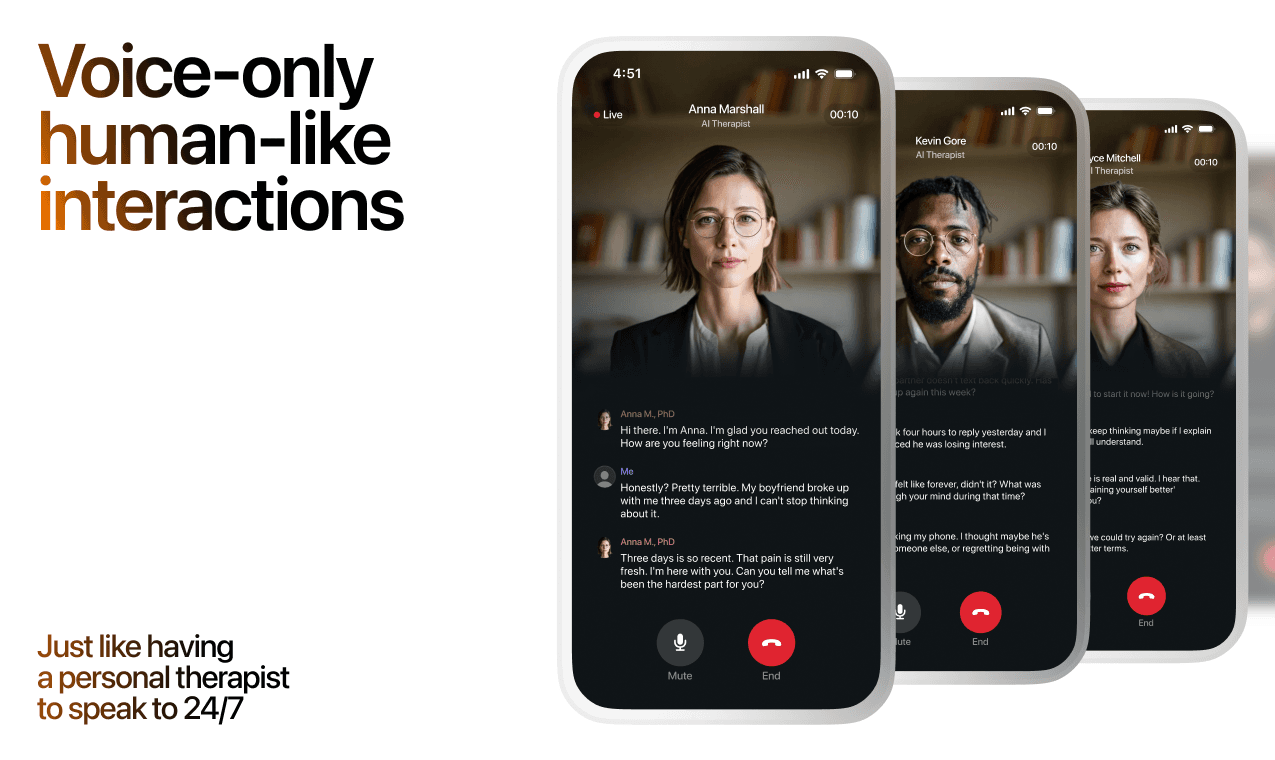
Here's what happens in a typical Lovon session:
You share what's on your mind
There's no script, no intake form, no waiting room. You speak or type whatever you're feeling — in your own words, at your own pace.
Lovon validates and explores
Using frameworks from CBT (Cognitive Behavioral Therapy) and motivational interviewing, Lovon acknowledges your feelings first, then gently helps you explore them. No dismissive "just move on" advice.
You build coping skills together
Lovon doesn't just listen — it actively works with you on evidence-based techniques: thought reframing, urge surfing, behavioral experiments, and more.
What a Session with Lovon Looks Like
When to Seek Professional Help
AI support is a valuable tool, but it's not a replacement for professional care. Please consider reaching out to a licensed therapist if you experience any of the following:
- Persistent thoughts of self-harm or suicide
- Inability to perform daily activities (work, eating, sleeping) for more than 2 weeks
- Turning to alcohol or substances to cope
- Intense anger or desire to harm your ex-partner
- Complete emotional numbness that doesn't improve over time
Crisis Resources (US): If you're in immediate danger, call 988 (Suicide & Crisis Lifeline) or text HOME to 741741 (Crisis Text Line). Available 24/7, free, and confidential.
Outside the US? Find a crisis line in your country
Ready to Start?
Your healing journey can begin right now
A 7-day trial. No judgment. Just a safe space to process what you're going through.
Frequently Asked Questions
Is Lovon a replacement for a real therapist?
Is my conversation with Lovon AI private?
How is Lovon different from ChatGPT for emotional support?
Can I use Lovon if I'm already seeing a therapist?
Can I try Lovon before subscribing?
About the Author
The Lovon Editorial Team
Mental Health & Wellness Content Team
The Lovon Editorial Team develops mental health and wellness content designed to make psychological concepts accessible and actionable. Our goal is to bridge the gap between clinical research and everyday life - helping you understand why your mind works the way it does and what you can do about it....
Related articles
- Best AI App for Interview Anxiety in 2026: Ranked
The best AI app for interview anxiety in 2026, ranked and compared: Lovon for real-time voice support, Wysa for CBT…
- Scarcity Mindset vs Abundance Mindset: Fix It in 2026
Scarcity mindset vs abundance mindset explained with a 7-step shift plan for 2026 — track triggers, reframe beliefs, and…
- AI Support App for Sober Curious Anxiety: 2026 Verdict
Cutting back on drinking brings anxiety spikes most sobriety trackers miss. See what an AI support app for sober curious…
- Breaking Rumination Cycles by Shifting from Why to What Do I Need
Rumination often traps people in endless mental loops where the same distressing thoughts replay without resolution…
See also
Quizzes
- Shame Test: Do You Read Mistakes as Verdicts?
See which exit your shame takes, in 3 minutes.
- Empath Test: Do Other People's Moods Become Yours?
See how much of other people's moods you take on.
Free tools
- Write a Letter to Someone You Lost
Tell it who they were to you and what you never got to say, and it writes the letter back in your words. No account, no…
- What to Say to Someone Who Is Grieving
Get sentences that fit this person and this week, not a list of things people say at funerals. Describe who they lost…
From the wiki
- Why do I have no friends?
Usually nothing is wrong with you. Adult friendship runs on proximity and repetition, and most people lose both at once…
Disclaimer: This article is for informational purposes only and does not constitute medical advice, diagnosis, or treatment. Always seek the advice of your physician or other qualified health provider with any questions you may have regarding a medical condition. If you are in crisis or think you may have an emergency, call 988 (Suicide & Crisis Lifeline) or go to the nearest emergency room. Outside the US? Find a crisis line in your country.