
Rumination and Depression: How to Break the Loop (2026)
Rumination and depression fuel each other. These 8 evidence-based steps interrupt the cycle, reduce repetitive negative thinking, and help you feel lighter today.

Key Takeaways
- A timer (your phone works)
- A notebook or voice memo app
- A 5-minute window you can protect, at least once a day
- Willingness to feel slightly uncomfortable — some of these steps work by interrupting automatic habits
- Optional: a structured voice-based tool for guided self-reflection (more on this in Step 7)
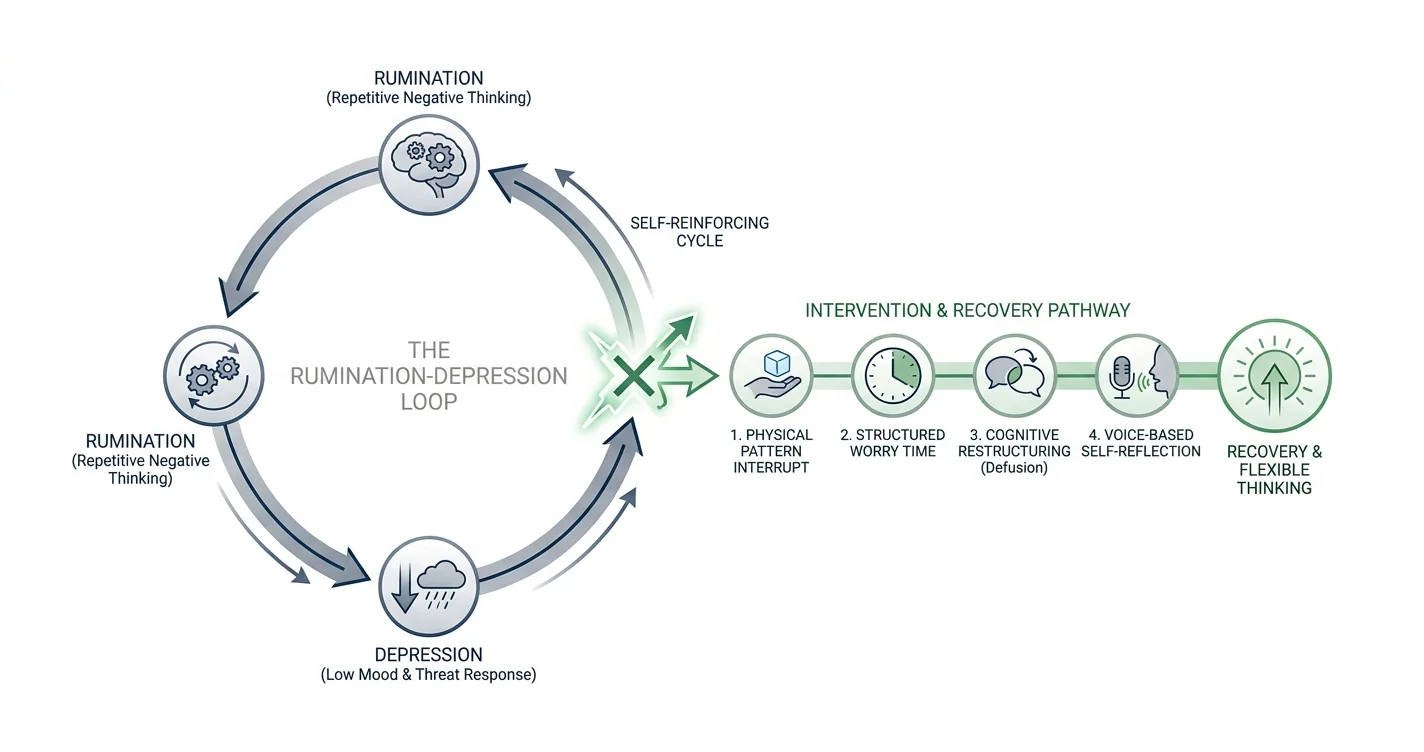
Rumination and depression lock together in a self-reinforcing loop: the worse you feel, the more you replay painful thoughts, and the more you replay them, the worse you feel. This guide walks you through what that loop actually is, why it is so hard to break on your own, and the specific steps — grounded in psychological research — that interrupt it.
TL;DR: Rumination and depression feed each other through a cycle of repetitive negative thinking that activates the brain's threat response and blocks problem-solving. Breaking the loop requires interrupting the thought pattern at the body level first, then restructuring how you engage with those thoughts. The steps below — from physical pattern interrupts to scheduled worry time to voice-based self-reflection — are drawn from cognitive behavioral and mindfulness-based approaches validated in clinical research. You can start today without waiting for a therapy appointment.
Why this matters
Rumination is not the same as thinking hard about a problem. It is the same thought — "I'm a failure," "Why did I say that?" "Nothing will ever change" — cycling on repeat without reaching any resolution. A 2026 review of mood disorder research consistently identifies rumination as one of the strongest predictors of both the onset and the persistence of major depressive episodes. People who ruminate heavily also take longer to recover from depressive episodes, even when they receive treatment. This is not a character flaw. It is a pattern the brain falls into, and patterns can be changed.
What you'll need
- A timer (your phone works)
- A notebook or voice memo app
- A 5-minute window you can protect, at least once a day
- Willingness to feel slightly uncomfortable — some of these steps work by interrupting automatic habits
- Optional: a structured voice-based tool for guided self-reflection (more on this in Step 7)
The steps
Step 1: Name the loop out loud
What it accomplishes: Labeling the rumination as a process — not a truth — creates psychological distance between you and the thought.
When you catch yourself replaying a painful thought, say out loud (or write): "I'm ruminating right now." Not "I'm thinking about something real" — "I'm ruminating." Research on affect labeling shows that naming a mental state reduces its intensity by shifting activation from the amygdala toward the prefrontal cortex. You are not dismissing the thought. You are identifying the mode you are in.
Common mistake: Trying to evaluate whether the thought is true before you label the process. That keeps you inside the loop. Label first, evaluate later.
Expected outcome: A small but measurable reduction in the thought's urgency — enough to take the next step.
Step 2: Use a physical pattern interrupt
What it accomplishes: Rumination lives in the head. Bringing sharp physical sensation into the body breaks the cognitive loop at a neurological level.
Choose one: hold ice cubes for 30 seconds, do 10 fast jumping jacks, splash cold water on your face, press your feet hard into the floor for 15 seconds. The goal is not distraction — it is a genuine sensory interrupt that pulls the nervous system out of threat-replay mode. This is consistent with polyvagal principles: when the body signals safety through physical engagement, the brain's capacity for flexible thinking reopens. For a full explanation of how this works in the nervous system, see the guide on polyvagal theory and stress.
Common mistake: Skipping this step because it feels silly. It feels silly. Do it anyway.
Expected outcome: Within 60–90 seconds, the grip of the thought loosens enough to move to Step 3.
Step 3: Schedule a "worry window"
What it accomplishes: Tells your brain it will get to process the thought — just not right now. This removes the urgency that keeps rumination firing.
Pick a specific 15-minute window each day — say, 5:00 PM. When a ruminative thought appears outside that window, write it down in one sentence and say: "I'll deal with this at 5." When 5 PM arrives, sit with the list. Some items will have lost their charge entirely. For the ones that haven't, give yourself the full 15 minutes to think through them — then close the notebook. This is a core technique from cognitive behavioral therapy for depression, used in 2026 treatment protocols at major anxiety and mood clinics.
Common mistake: Letting the worry window expand to 45 minutes or more. Keep it to exactly 15. A hard stop teaches the brain that rumination has a container, not unlimited real estate.
Expected outcome: Over 1–2 weeks, the frequency of intrusive ruminative episodes typically drops because the brain learns the thoughts will be acknowledged.
Step 4: Ask the "so what" question — once
What it accomplishes: Converts repetitive replaying into a single pass of genuine problem assessment.
For the thought you are ruminating on, ask: "If this is true, what's the one thing I can actually do about it?" Write the answer. If there is a concrete action — take it or schedule it. If there is no action available, that is useful data: this thought is not a problem to solve, it is a feeling to process. That distinction matters. Rumination thrives when the brain mistakes feelings for unsolved puzzles. Once you confirm there is no puzzle — only pain — you can stop trying to think your way out.
Common mistake: Asking the question multiple times in the same session. Once is the rule. The second time, you are back inside the loop.
Expected outcome: A clear split between "things I can act on" and "feelings I need to sit with." The action list is usually shorter than you expect.
Step 5: Build an "absorption activity" into your daily routine
What it accomplishes: Engages working memory fully enough that ruminative thoughts cannot run in the background.
Rumination requires spare cognitive bandwidth. Activities that demand active attention — a puzzle, cooking a new recipe, a social conversation, learning a chord on guitar, a brisk walk while listening to a podcast — leave no room for the loop to run. The key word is absorption: passive activities like scrolling or watching TV do not qualify because they allow the mind to wander. Schedule at least one 20–30 minute absorption activity daily, ideally in the afternoon or evening when ruminative thinking peaks for most people with depression.
Common mistake: Choosing activities that feel productive but are actually low-attention, like folding laundry while your mind wanders back to the thought.
Expected outcome: A reliable daily reset that shortens the total time per day spent in ruminative loops.
Step 6: Practice defusion — watch the thought, don't be it
What it accomplishes: Creates a stable observer position so you are no longer merged with the thought.
This comes from Acceptance and Commitment Therapy (ACT). Pick the ruminative thought that hits hardest. Now, instead of "I'm worthless," say slowly: "I'm having the thought that I'm worthless." Then: "I notice I'm having the thought that I'm worthless." Each reframe adds a layer of distance. You are not denying the thought. You are changing your relationship to it — from being it to watching it. In 2026, ACT-based defusion techniques are among the most evidence-supported interventions for repetitive negative thinking associated with depression.
Common mistake: Using defusion as dismissal — "it's just a thought, so it doesn't matter." The thought may point to real pain. Defusion just stops the thought from running on loop.
Expected outcome: The thought's emotional weight reduces within 3–5 days of consistent practice.
Step 7: Talk it through — out loud
What it accomplishes: Converts internal looping into a processed, externalized narrative, which is how the brain actually resolves emotional material.
Verbalizing breaks rumination in a way that writing alone often doesn't. When you speak a thought, you hear yourself — which activates a different kind of self-monitoring than silent replay. This is why therapy works partly through dialogue, not just reflection. If you do not have access to a therapist this week, a structured voice conversation can fill the gap. Lovon's AI voice support is built for exactly this — you speak, the app responds with coping tools and guided self-reflection drawn from evidence-based frameworks, available any time of day. It is not a replacement for licensed clinical care, but for breaking the rumination loop between therapy sessions, having somewhere to actually talk — not type — makes a measurable difference. You can read more about how AI therapy supports depression.
Common mistake: Journaling instead of speaking and then wondering why the thoughts still feel "stuck." Written reflection has value, but the vocal channel processes emotion differently.
Expected outcome: After one honest 10-minute voice session, most people report the thought feels less consuming — not solved, but lighter.
Step 8: Track your triggers, not your thoughts
What it accomplishes: Identifies the upstream conditions that start the loop so you can intervene earlier.
Rumination rarely arrives randomly. Common triggers include unstructured time, conflict with another person, poor sleep, hunger, and social comparison (especially after time on social media). For one week in 2026, keep a simple log: when did the loop start, what was I doing, how long did it last? After 7 days, patterns appear. Once you know your triggers, you can place protective buffers — like scheduling an absorption activity right after the situations that consistently start the spiral.
Common mistake: Logging the content of the thoughts instead of the context. Content keeps you inside the loop. Context gives you leverage.
Expected outcome: Within 2 weeks, you have 3–5 identifiable trigger situations and a pre-built response for each.
Troubleshooting
The physical interrupt isn't working. Try increasing intensity — colder water, more reps, louder music. The sensory signal needs to be strong enough to override the thought loop. Most people start too gently.
My worry window just turns into more rumination. Set a hard timer. When it goes off, close the notebook or note. If the same thought reappears after the window, write "saved for tomorrow's window" and stop. The container only works if the lid closes.
I can't tell if I'm ruminating or genuinely problem-solving. Apply the 10-minute rule: if you have been on the same thought for more than 10 minutes without reaching a new insight or a concrete action, you are ruminating. Label it and move to Step 2.
The "so what" question makes me feel hopeless. That feeling — "there's nothing I can do" — is important information. It is not proof the thought is right. It signals depression's classic narrowing of perceived options. This is a good moment to talk it through (Step 7) rather than think it through alone.
I keep forgetting to do any of these steps. Set a single daily reminder for the worry window. One anchor habit is easier to maintain than eight scattered intentions.
I've been doing this for two weeks and the depression hasn't lifted. These steps address rumination specifically — they are not a substitute for clinical depression treatment. If your low mood is persistent, affects your ability to work or care for yourself, or includes thoughts of self-harm, contact a licensed clinician. The cost of therapy without insurance in 2026 is a real barrier for many people, but options exist — community mental health centers, sliding-scale therapists, and telehealth services all provide access at lower price points.
Tools and resources
- Timer app — for the 15-minute worry window and the 10-minute rumination check
- Simple notebook or voice memo — to log triggers and capture thoughts before the worry window
- Lovon — AI voice support for on-demand support between therapy sessions, built with input from PhD psychologists
- Coping tools for stress — what works and what doesn't — overlapping tools that address the anxiety component often paired with rumination
- Free AI therapist for depression — if access to care is the main barrier right now
What to do next
Start with Steps 1 and 2 today. They take under 5 minutes and do not require any setup. Add the worry window tomorrow. Most people notice a shift within 5–7 days — not a cure, but a loosening of the loop's grip. If the depression underneath the rumination is significant, pair these steps with professional support. These tools work best as structure, not as a standalone treatment for clinical depression.
FAQ
What is the connection between rumination and depression? Rumination — replaying negative thoughts without resolution — is both a symptom and a driver of depression. It sustains low mood by keeping the brain in a threat-activation state, which blocks the flexible thinking needed to generate solutions or feel relief.
How do I know if I'm ruminating or just thinking? If you have been on the same thought for more than 10 minutes without reaching a new insight or a concrete action, it is rumination. Productive thinking moves forward; rumination circles.
Can rumination make depression worse? Yes. Research consistently shows that people with high rumination scores have longer, more severe depressive episodes and are slower to respond to treatment, compared to people with similar mood symptoms but lower rumination.
What is the fastest way to stop ruminating? A physical pattern interrupt — cold water, ice, or intense movement for 30–60 seconds — is the fastest in-the-moment break. It works by engaging the nervous system somatically, which overrides the cognitive loop.
Is rumination the same as anxiety? No, though they often coexist. Anxiety tends to focus on future threats; rumination tends to replay past events or present circumstances. Many people experience both simultaneously, which compounds the difficulty.
Does talking about my problems make rumination worse? Co-rumination — venting the same thoughts repeatedly without moving toward resolution — can maintain the loop. Structured, guided conversation that moves toward coping and perspective-shift (as in therapy or guided AI voice sessions) is different and tends to reduce rumination.
How long does it take to break a rumination habit? With consistent daily practice of behavioral interrupts and cognitive restructuring, most people notice measurable reduction within 2–3 weeks. Full habit change takes longer — research suggests 4–8 weeks of consistent practice.
Should I see a therapist for rumination and depression? If the depression is affecting your daily functioning, yes — a licensed clinician can provide evidence-based treatment like CBT or ACT that directly targets ruminative patterns. These steps support that process but do not replace it.
One last thing
Rumination feels like effort — like you are doing important mental work. The research says the opposite: in 2026, neuroimaging studies consistently show that the default mode network, which drives ruminative thinking, consumes more energy than focused problem-solving does. You are working harder to stay stuck. That is not a personal failure — it is the brain doing what brains do when they feel threatened. The loop is real, it is exhausting, and it does break with the right interrupts.
Related guides
How AI Support Helps You Heal
AI emotional support isn't about replacing human connection — it's about filling the gaps. The moments when you need to talk at 2 AM, when you don't want to burden your friends again, or when you simply need someone to listen without judgment.
Here's what happens in a typical Lovon session:
You share what's on your mind
There's no script, no intake form, no waiting room. You speak or type whatever you're feeling — in your own words, at your own pace.
Lovon validates and explores
Using frameworks from CBT (Cognitive Behavioral Therapy) and motivational interviewing, Lovon acknowledges your feelings first, then gently helps you explore them. No dismissive "just move on" advice.
You build coping skills together
Lovon doesn't just listen — it actively works with you on evidence-based techniques: thought reframing, urge surfing, behavioral experiments, and more.
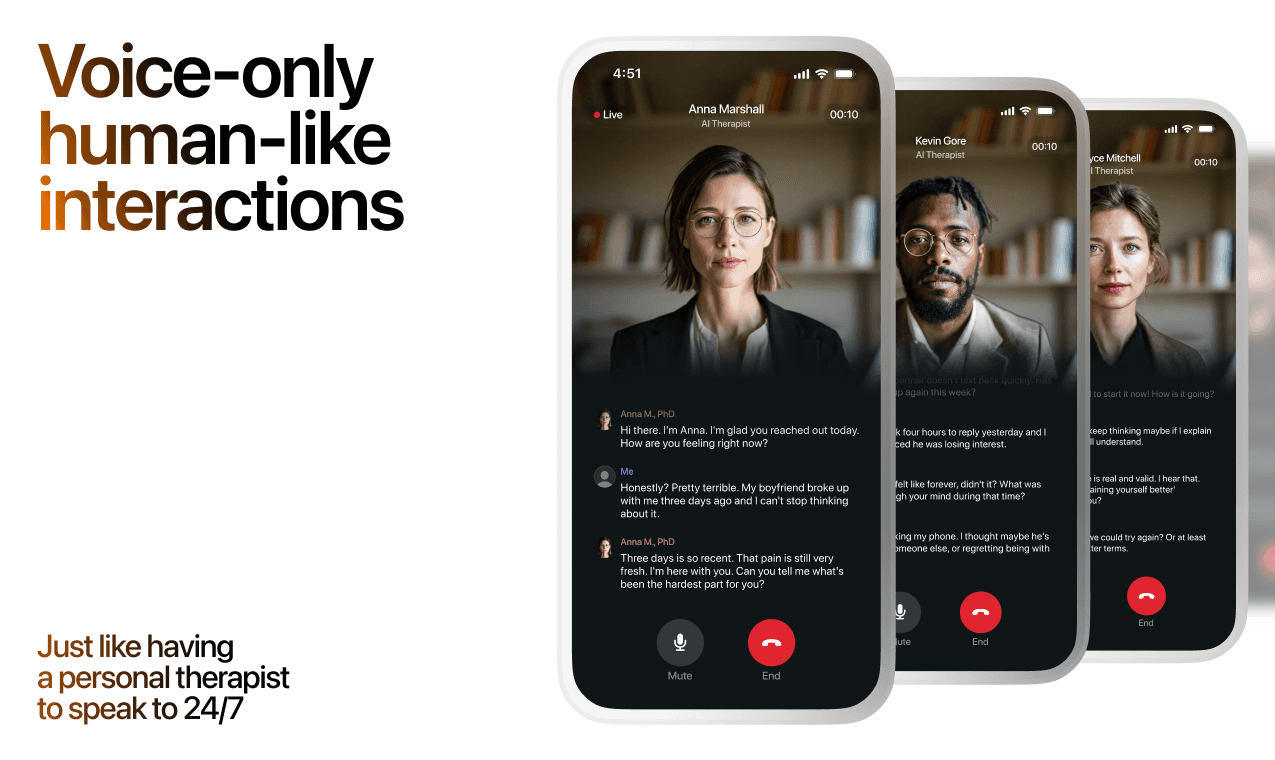
What a Session with Lovon Looks Like
When to Seek Professional Help
AI support is a valuable tool, but it's not a replacement for professional care. Please consider reaching out to a licensed therapist if you experience any of the following:
- Persistent thoughts of self-harm or suicide
- Inability to perform daily activities (work, eating, sleeping) for more than 2 weeks
- Turning to alcohol or substances to cope
- Intense anger or desire to harm your ex-partner
- Complete emotional numbness that doesn't improve over time
Crisis Resources (US): If you're in immediate danger, call 988 (Suicide & Crisis Lifeline) or text HOME to 741741 (Crisis Text Line). Available 24/7, free, and confidential.
Outside the US? Find a crisis line in your country
Ready to Start?
Your healing journey can begin right now
A 7-day trial. No judgment. Just a safe space to process what you're going through.
Frequently Asked Questions
Is Lovon a replacement for a real therapist?
Is my conversation with Lovon AI private?
How is Lovon different from ChatGPT for emotional support?
Can I use Lovon if I'm already seeing a therapist?
Can I try Lovon before subscribing?
About the Author

The Lovon Editorial Team
Mental Health & Wellness Content Team
The Lovon Editorial Team develops mental health and wellness content designed to make psychological concepts accessible and actionable. Our goal is to bridge the gap between clinical research and everyday life - helping you understand why your mind works the way it does and what you can do about it....
Related articles
- Stop Self-Isolating Depression: 2026 Step-by-Step Fix
Self-isolating depression breaks with small, specific steps, not motivation. Get the 2026 plan, troubleshooting, and…
- Catastrophizing Anxiety: How to Stop It in 2026
Catastrophizing anxiety explained: 7 steps to stop worst-case thinking fast, plus troubleshooting tips and tools that…
- How to Get Out of a Depressive Episode (2026 Guide)
Learn how to get out of a depressive episode on your own with 7 evidence-based steps — from nervous system regulation to…
- Voice Journaling for Anxiety: Daily Steps That Work (2026)
Learn how to use voice journaling for anxiety with 7 daily steps, troubleshooting fixes, and guidance on when to add AI…
See also
Quizzes
- Confidence Test: Do You Act Before You Feel Ready?
See which part of your confidence is thin.
- Am I Sabotaging My Relationship? 12-Question Quiz
Find the move you reach for, in 2 minutes.
Free tools
- Write a Letter to Your Best Friend
A chat for a letter to your best friend that only they could have received. Tell it how long you have been friends, one…
- How to End a Friendship Without a Scene
A chat for working out how to end a friendship clearly, without a grievance list or a slow ghost. Tell it how long you…
From the wiki
- Why do I keep dreaming about my ex?
Recurring dreams about an ex usually mean your brain is still consolidating a relationship that took up years of memory…
Disclaimer: This article is for informational purposes only and does not constitute medical advice, diagnosis, or treatment. Always seek the advice of your physician or other qualified health provider with any questions you may have regarding a medical condition. If you are in crisis or think you may have an emergency, call 988 (Suicide & Crisis Lifeline) or go to the nearest emergency room. Outside the US? Find a crisis line in your country.