
Retroactive Jealousy: Why It Happens, How to Stop It (2026)
Retroactive jealousy explained: causes, triggers, and 8 steps to break the loop in 2026. Practical, evidence-based fixes, not just "talk about it" advice.

Key Takeaways
- A notebook or notes app to log intrusive thoughts (not to analyze them, just to log them)
- 10-15 minutes a day for a grounding or exposure exercise
- A plan for what you'll say instead of asking your partner another reassurance question
- Willingness to sit with discomfort for short stretches without acting on it
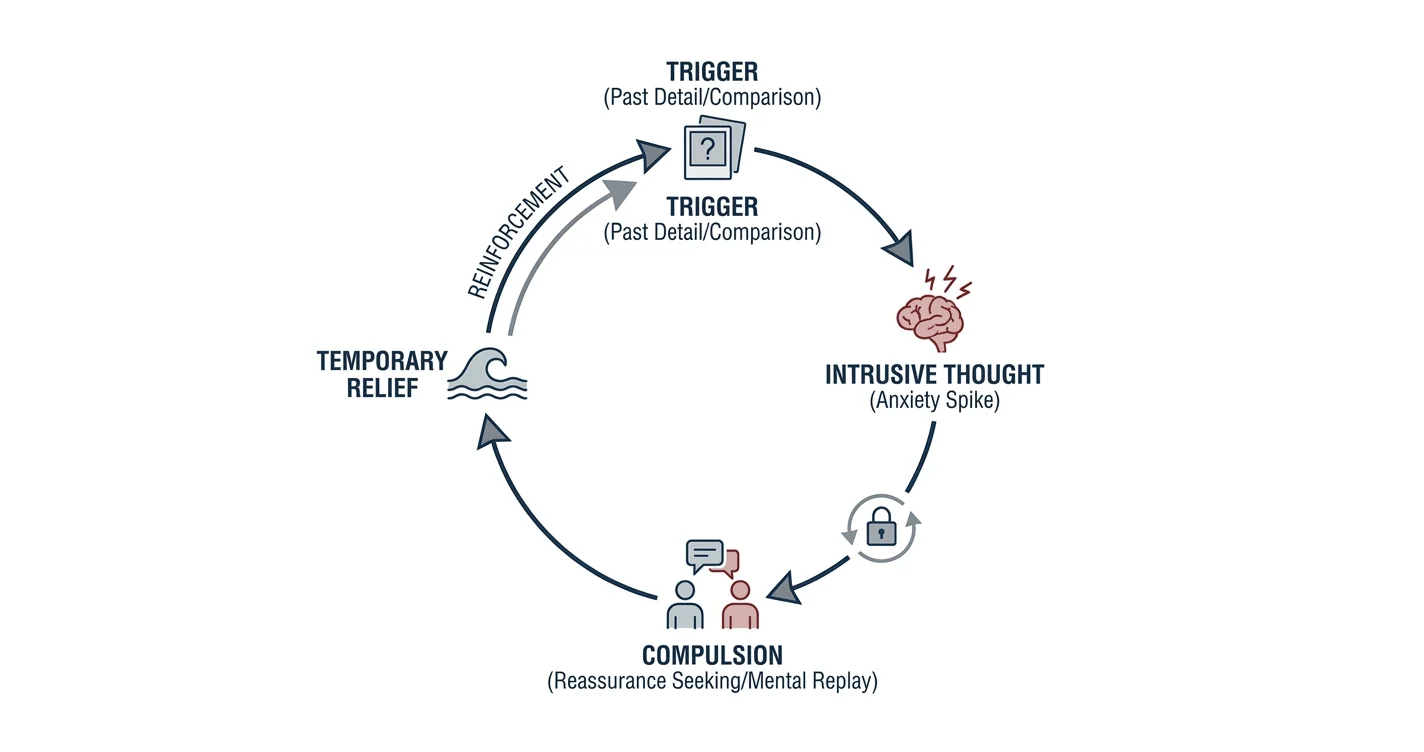
Retroactive jealousy is the loop where you can't stop replaying a partner's dating history or past relationships, even when nothing about the present relationship is in question. This guide breaks down why the loop starts, what keeps it running, and the specific steps that shrink it.
TL;DR: Retroactive jealousy is an anxiety-driven obsession with a partner's romantic or sexual past, not a sign of a bad relationship. It shows up as repeated questioning, mental replaying, or comparison-driven spirals, and it responds well to structured steps: naming the intrusive thought, limiting reassurance-seeking, and retraining the nervous system's threat response. Verdict: manageable, not permanent — most people see real reduction in the loop within 4-8 weeks of consistent practice in 2026, and an anxious attachment style often sits underneath it.
If the loop reaches past this one relationship, the do I have trust issues quiz separates a specific betrayal echo from a general difficulty trusting anyone.
Why this matters
Retroactive jealousy (sometimes shortened to RJ) isn't the same as garden-variety jealousy about a current flirtation. It's backward-facing — fixated on an ex, a number of past partners, or a detail from before you even met. It can eat hours of your day in 2026 through mental replay, searching old social media, or asking your partner the same questions on repeat.
The reason it deserves its own fix: standard jealousy advice ("communicate more") often makes RJ worse, because more reassurance-seeking feeds the loop instead of closing it. The condition behaves more like obsessive-compulsive patterns than like a relationship problem, and it needs a different toolkit.
What you'll need
- A notebook or notes app to log intrusive thoughts (not to analyze them, just to log them)
- 10-15 minutes a day for a grounding or exposure exercise
- A plan for what you'll say instead of asking your partner another reassurance question
- Willingness to sit with discomfort for short stretches without acting on it
- Optional: a structured outlet like Lovon's voice-based support for talking through spirals in real time when they hit at 2am and no one else is awake
The steps
1. Name the loop the moment it starts
Catching the thought early stops it from snowballing into a two-hour spiral. The moment a comparison or image pops up, say internally: "this is the RJ loop, not new information." Naming interrupts the automatic hijack where your brain treats old data as a fresh threat. Common mistake: trying to "solve" the thought with logic first — that keeps you engaged with it instead of stepping back.
2. Delay the reassurance question by at least 20 minutes
Asking your partner for the fifth time whether an ex meant more to them gives short-term relief and long-term reinforcement. A 20-minute delay breaks the instant reward loop that trains your brain to keep asking. Set a timer. If the urge still feels urgent after 20 minutes, write the question down instead of asking it out loud. Common mistake: telling yourself "just this once" — RJ rarely stops at once.
3. Track triggers for seven days
Most people can't see the pattern until they log it. Write down the time, what preceded the spiral (a photo, a comment, being tired, being alone), and how long it lasted. By day seven you'll usually find 2-3 repeat triggers, which is more useful than any single insight. Common mistake: logging only the worst episodes and skipping the small ones — the small ones show the real frequency.
4. Practice a 90-second body reset when the spiral hits
The physical wave of a jealousy spike peaks and fades within about 90 seconds if you don't feed it with more thinking. Box breathing — four seconds in, four hold, four out, four hold, repeated for four rounds — works because it slows the sympathetic nervous system response driving the panic. Pair it with naming five things you can see in the room. Common mistake: trying to think your way calm instead of using the body first.
5. Replace comparison thoughts with a scripted redirect
When your brain serves up a comparison ("were they better at..."), have one scripted line ready: "that was a different relationship, this one is its own thing." Repetition matters more than eloquence here — the goal is a fast off-ramp, not a debate. Write the line down and keep it somewhere you'll actually see it, like a phone lock screen note. Common mistake: using a new line every time instead of one you've drilled.
6. Reduce exposure to the source material
Old photos, social media profiles of exes, or shared friend-group posts are gasoline on this fire. Mute or unfollow for a defined period — 30 days is a reasonable starting point — rather than promising to "just not look." Willpower alone loses to a feed that resurfaces the exact content that triggers you. Common mistake: keeping access open "in case," which guarantees you'll check it during a low moment.
7. Address the attachment pattern underneath it
RJ shows up disproportionately in people with an anxious attachment style, where uncertainty about a partner's past gets processed as uncertainty about the present relationship. Working through attachment patterns directly — not just managing symptoms — is what produces lasting change instead of a shorter loop that still resets under stress. This is the step people skip and the one that matters most by month two or three.
8. Set a review point, not an endpoint
RJ rarely disappears in a straight line. Set a 30-day review: are the spirals shorter, less frequent, or both? If neither has moved, the trigger list from step three or the attachment work from step seven usually needs more attention, not a different technique entirely.
Troubleshooting
- The spiral hits hardest at night. Nighttime lowers your ability to self-soothe and removes daytime distractions. Keep the 90-second reset and a scripted redirect written down somewhere you can find it without turning on a bright screen.
- My partner is getting frustrated with the questions. That's a fair reaction, and it's a signal to shift from asking them to logging the question yourself instead. Read them the plan, not just the ask.
- Logic doesn't work in the moment. That's expected — RJ is driven by an emotional threat response, not a reasoning gap, so the body-first tools in step four matter more than argument-based reassurance.
- I feel worse after checking social media. That confirms exposure is a live trigger; move the 30-day mute from step six up your priority list.
- The spiral is about a specific number or detail. Fixation on one number (a partner count, a duration) is a classic OCD-adjacent feature of RJ. Naming it as "the number obsession" specifically, separate from the general loop, makes it easier to catch.
- Nothing has changed after 30 days. Consistency usually beats technique choice — check whether the daily practice actually happened five-plus days a week, since inconsistent practice is the most common reason progress stalls.
Tools and resources
- A trigger log (paper or notes app) for the seven-day tracking step
- A written script for the comparison redirect, kept visible
- Anxious attachment style: signs and coping strategies if step seven applies to you
- Cognitive distortions: 10 thinking traps and how to fix them for the comparison and catastrophizing patterns that fuel RJ
- On-demand voice support through Lovon for the moments a spiral hits outside business hours
FAQ
What is retroactive jealousy? Retroactive jealousy is persistent, intrusive jealousy about a partner's past relationships or sexual history, not their present behavior. It typically involves mental replay, comparison, and repeated reassurance-seeking that doesn't resolve the underlying anxiety.
Is retroactive jealousy a mental health condition? It's not a standalone diagnosis, but it shares features with anxiety disorders and obsessive-compulsive patterns, and it often overlaps with an anxious attachment style. Treating it with anxiety-focused tools works better than treating it as a trust problem alone.
How long does retroactive jealousy last? Duration varies, but most people who apply structured steps consistently see the loop shrink noticeably within 4-8 weeks in 2026. Without intervention, it can persist for years and quietly damage otherwise healthy relationships.
Does retroactive jealousy mean my relationship is wrong? No — RJ is about your brain's threat processing, not accurate information about the relationship's health. Plenty of secure, healthy relationships get destabilized by one partner's unmanaged RJ.
Should I tell my partner about my retroactive jealousy? Yes, in general terms, so they understand the pattern instead of interpreting repeated questions as distrust of them specifically. Frame it as "I'm working on a thought loop" rather than asking them to keep providing reassurance.
Can therapy help with retroactive jealousy? Yes — approaches that target intrusive thought patterns, such as those used for anxiety and OCD-adjacent conditions, tend to outperform generic couples communication advice for this specific problem. Between sessions or when licensed care isn't available, AI mental health support can help you process a spiral as it happens.
Is retroactive jealousy the same as normal jealousy? No. Normal jealousy is usually proportional and tied to current behavior; retroactive jealousy is backward-facing, disproportionate, and persists even when the partner has done nothing to prompt it.
What triggers a retroactive jealousy spiral? Common triggers include old photos, mentions of an ex, milestones (anniversaries, "how did you meet" conversations), and low moments like being tired or alone. Tracking your own triggers for a week, as in step three above, usually reveals a shorter list than it feels like in the moment.
One last thing
The detail that surprises most people: the content of the obsession (a specific ex, a specific number) rarely matters — swap in a different detail and the loop runs the same way. That's the tell that this is an anxiety pattern hijacking your attention, not new information your brain genuinely needs to process, and it's why fixing the loop mechanism beats trying to "resolve" any single fact.
Related guides
How AI Support Helps You Heal
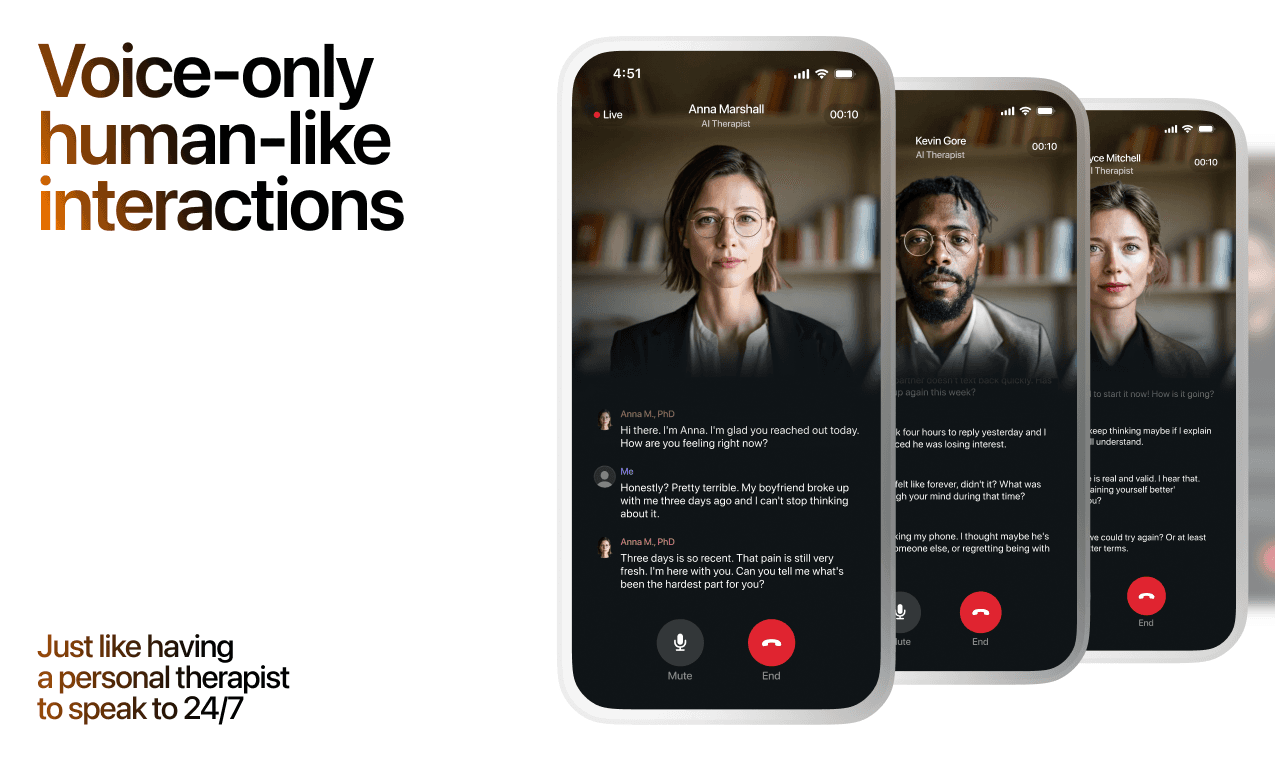
AI emotional support isn't about replacing human connection — it's about filling the gaps. The moments when you need to talk at 2 AM, when you don't want to burden your friends again, or when you simply need someone to listen without judgment.
Here's what happens in a typical Lovon session:
You share what's on your mind
There's no script, no intake form, no waiting room. You speak or type whatever you're feeling — in your own words, at your own pace.
Lovon validates and explores
Using frameworks from CBT (Cognitive Behavioral Therapy) and motivational interviewing, Lovon acknowledges your feelings first, then gently helps you explore them. No dismissive "just move on" advice.
You build coping skills together
Lovon doesn't just listen — it actively works with you on evidence-based techniques: thought reframing, urge surfing, behavioral experiments, and more.
What a Session with Lovon Looks Like
Lovon is AI support, not a replacement for professional care. If things have been hard to get through for weeks, or you are thinking about harming yourself, talk to a doctor or a licensed therapist.
Ready to Start?
Your healing journey can begin right now
A 7-day trial. No judgment. Just a safe space to process what you're going through.
Frequently Asked Questions
Is Lovon a replacement for a real therapist?
Is my conversation with Lovon AI private?
How is Lovon different from ChatGPT for emotional support?
Can I use Lovon if I'm already seeing a therapist?
Can I try Lovon before subscribing?
About the Author
The Lovon Editorial Team
Mental Health & Wellness Content Team
The Lovon Editorial Team develops mental health and wellness content designed to make psychological concepts accessible and actionable. Our goal is to bridge the gap between clinical research and everyday life - helping you understand why your mind works the way it does and what you can do about it....
Related articles
- How to Heal Anxious Attachment on Your Own (2026)
Step-by-step guide to healing anxious attachment solo in 2026: triggers, nervous system work, boundaries, and tools that…
- How to Stop Overthinking After an Argument (2026)
Stop overthinking after an argument with 7 steps that interrupt rumination fast. Includes troubleshooting for 3am…
- Understanding Anxious Attachment Patterns in Relationships
If you find yourself constantly checking your phone for messages, worrying whether your partner still cares, or feeling…
- AI Relationship Coach for Trust Issues (2026)
Find the best AI relationship coach for trust issues in 2026. Lovon offers voice-based, personalized sessions 24/7 — no…
See also
Quizzes
- Forgiveness Test: How Forgiving Are You, Even of Yourself?
See where forgiveness gets stuck for you, in 3 minutes.
- Am I Being Cheated On? 12-Question Reality Check
Sort the evidence from the fear in 2 minutes.
Free tools
- How to Forgive Someone Who Hurt You
Forgiving, reconciling, and deciding it was fine are three different things, and they get merged. Tell it what happened…
- How to Stop Being Jealous in a Relationship
Two very different people search this, and advice that assumes either one is wrong half the time. This sorts what you…
From the wiki
- What is cheating in a relationship?
Cheating is a breach of the agreement you and your partner made about who else gets your body, your attention and your…
Disclaimer: This article is for informational purposes only and does not constitute medical advice, diagnosis, or treatment. Always seek the advice of your physician or other qualified health provider with any questions you may have regarding a medical condition. If you are in crisis or think you may have an emergency, call 988 (Suicide & Crisis Lifeline) or go to the nearest emergency room. Outside the US? Find a crisis line in your country.