
Secure Attachment Style: How to Build It in 2026
Learn the traits of a secure attachment style and the exact steps to build one in 2026 — regulation, repair, and direct communication that actually work.

Key Takeaways
- 20-30 minutes a day for reflection or journaling, minimum for the first 6 weeks
- A way to track your triggers — a notes app, journal, or a voice-based tool works
- At least one relationship (romantic, friendship, or family) to practice new patterns with in real time
- A body-regulation practice — breathwork, walking, or grounding techniques for moments of activation
- Patience for setbacks — attachment patterns took years to form; expect months, not days, to shift
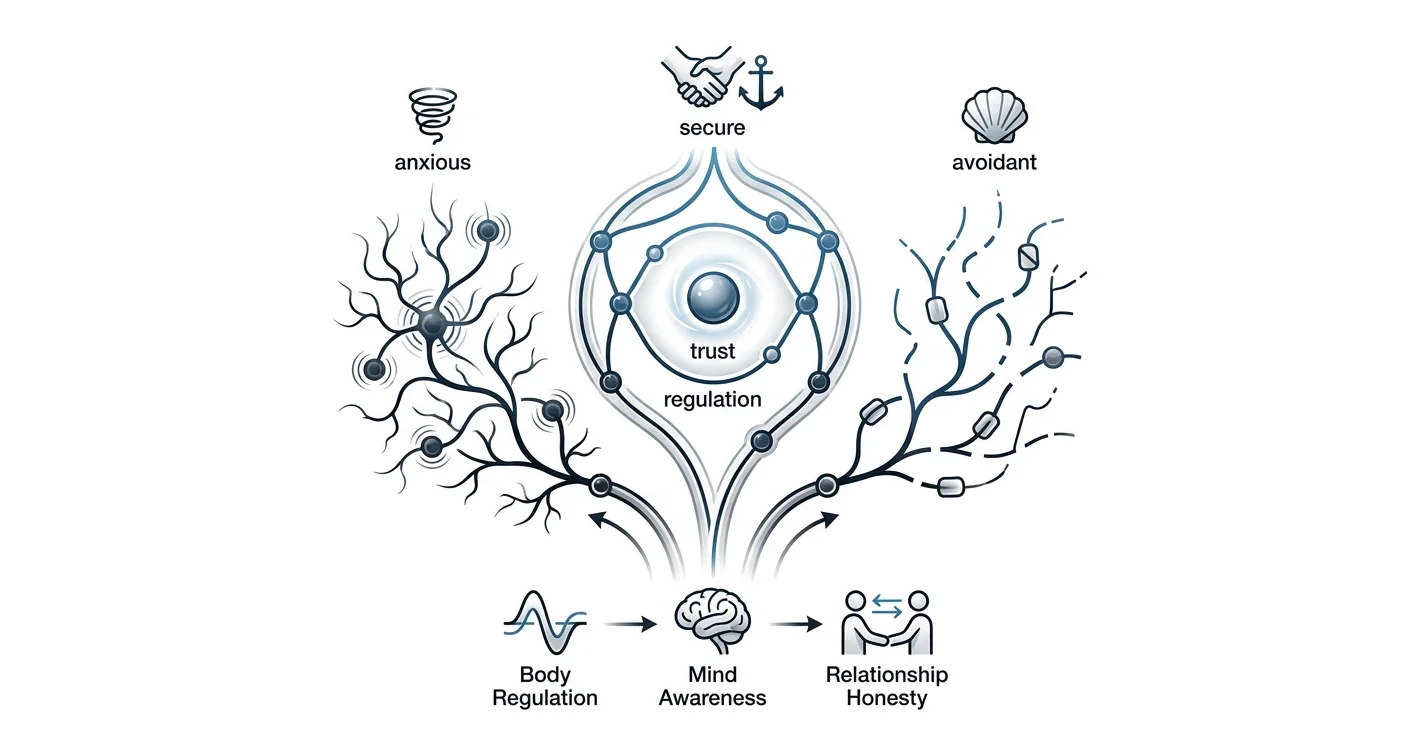
Secure attachment style isn't something you're born with or without — it's a pattern of relating that anxious, avoidant, and disorganized attachers can build with consistent practice. This guide walks through the specific steps that shift your nervous system toward safety, connection, and steady trust.
TL;DR
Secure attachment style means you can depend on people and let them depend on you, without panic or shutdown when things get uncertain. Building it in 2026 takes three ingredients: a body that can self-regulate under stress, a mind that can name what it needs, and relationships that get practiced honesty instead of guesswork. If you don't know where you're starting from, take the attachment style quiz first — most people default to anxious or avoidant patterns learned decades before they ever dated anyone. Verdict: secure attachment is trainable, not fixed, and the work is mostly nervous-system work before it's relationship work.
Why This Matters
Attachment style predicts how you handle conflict, how fast you trust, and whether you can sit with a partner's bad mood without spiraling. Research popularized by Amir Levine and Rachel Heller's 2010 book "Attached" estimates roughly 50% of adults carry a secure style, with the rest split across anxious, avoidant, and disorganized (fearful-avoidant) patterns.
The pattern shows up everywhere: how you text back, how you handle a partner going quiet, whether silence feels like safety or threat. People with an anxious attachment style tend to over-monitor a partner's mood; people with an avoidant style tend to withdraw the moment things get close. Secure attachment sits in the middle — close enough to feel connected, independent enough to not fall apart when someone needs space.
The good news for 2026: attachment researchers increasingly describe "earned secure attachment" — security built later in life through therapy, relationships, or deliberate practice, not just childhood conditioning.
What You'll Need
- 20-30 minutes a day for reflection or journaling, minimum for the first 6 weeks
- A way to track your triggers — a notes app, journal, or a voice-based tool works
- At least one relationship (romantic, friendship, or family) to practice new patterns with in real time
- A body-regulation practice — breathwork, walking, or grounding techniques for moments of activation
- Patience for setbacks — attachment patterns took years to form; expect months, not days, to shift
- Optional but useful: a licensed therapist or an on-demand support tool for the moments between sessions, like Lovon's AI voice sessions
The Steps
1. Name your current pattern honestly
You can't build security without knowing what you're building away from. Anxious attachers over-text, over-apologize, and read silence as rejection. Avoidant attachers pull away exactly when things get close, often mistaking distance for independence. Disorganized attachers swing between both, craving closeness and fearing it in the same breath.
Spend one week just observing — no changing behavior yet, just noticing. Write down the moment you feel activated and what triggered it. Common mistake: skipping this step and jumping straight to "acting secure" without understanding the trigger underneath the behavior.
2. Build a body-based regulation habit
Secure attachment isn't a mindset — it's a nervous system that can come down from activation without needing another person to do it for you. Polyvagal theory explains why: your vagus nerve determines whether you're in a state of safety, fight-or-flight, or shutdown, and that state drives how you show up in relationships.
Practice a 3-5 minute grounding routine daily, not just during crisis moments. Box breathing (4 seconds in, 4 hold, 4 out, 4 hold) for five rounds lowers physiological arousal measurably within minutes. Expected outcome: by week 3, you'll notice you can self-soothe within 10-15 minutes instead of needing hours or a phone call to calm down.
3. Practice naming needs out loud
Secure people ask for what they need directly instead of hinting, testing, or withdrawing. This is often the hardest step because it feels exposed. Start small: tell a friend "I need to reschedule, can we talk Thursday instead?" instead of canceling silently or over-explaining.
Work up to bigger asks over 4-6 weeks — telling a partner "I felt hurt when you canceled last minute" instead of going quiet or picking a fight about something unrelated. Common mistake: waiting until you're already flooded with emotion to voice the need, which almost always comes out as an accusation instead of a request.
4. Tolerate the pause before reacting
Secure attachment shows up most clearly in the gap between a trigger and your response. When a partner takes six hours to text back, an anxious pattern fires panic; an avoidant pattern fires relief followed by guilt. The secure move is a pause — 60 seconds of noticing the urge to spiral or shut down before acting on it.
Use a simple rule: don't send the text, make the call, or make the decision until the initial spike passes. Expected outcome: within 8-10 weeks of practice, the gap between trigger and calm response shortens from hours to minutes.
5. Test small vulnerability, then bigger vulnerability
Security is built through repeated evidence that closeness is safe, not through insight alone. Share one honest, low-stakes feeling with someone you trust this week — "I've been more anxious than usual" counts. Watch what happens when they respond well (or don't).
Each successful round of vulnerability followed by a decent response recalibrates your baseline expectation of relationships. Common mistake: testing vulnerability with someone who has already shown they're unsafe, then concluding vulnerability itself doesn't work.
6. Repair after conflict, every time
Secure attachment isn't the absence of conflict — it's the presence of repair. Couples and friendships with secure patterns argue too; the difference is they circle back within a day or two to acknowledge what happened.
After a disagreement, say something concrete: "I was short with you earlier, that wasn't about you." Skipping repair is what lets small ruptures calcify into distance. Expected outcome: relationships where repair becomes routine show measurably less resentment buildup over 2026's worth of ordinary friction.
7. Track your progress monthly, not daily
Attachment shifts are slow and non-linear — you'll have a great week followed by a rough one that feels like backsliding. Check in monthly instead of daily: are you texting less anxiously than three months ago? Withdrawing less than you did in January 2026?
Use the same trigger log from step one to compare month over month. Common mistake: judging progress by a single bad day instead of the trend line.
Troubleshooting
- You spiral every time a partner is slow to respond. This is classic anxious activation — practice the 60-second pause from step 4 before checking your phone again, and use a grounding exercise before reaching out.
- You feel suffocated the moment someone gets close. This is avoidant activation. Name it out loud ("I need some space, it's not about you") instead of ghosting or picking a fight to create distance.
- You want closeness and panic when you get it. This push-pull is common in disorganized attachment and often traces back to early relationships where the same person was both a source of comfort and fear.
- Repair conversations turn into re-litigating the whole relationship. Keep repair short and specific — one sentence about the moment, not a full audit of the relationship's history.
- You keep choosing partners who confirm your insecure pattern. This isn't bad luck; insecure attachers often unconsciously select partners who match their existing wiring. Naming the pattern is the first step to breaking it.
- Progress feels invisible. Compare your trigger log month-over-month rather than day-to-day — the shift shows up in trends, not single moments.
Tools and Resources
- The attachment style quiz to identify your current pattern before you start
- A deeper look at anxious attachment style signs and coping strategies if step 1 points you toward anxious patterns
- A guide to avoidant attachment style patterns and how to change if withdrawal is your default
- Background on disorganized attachment style causes and recovery for the push-pull pattern
- A body-based regulation practice, like box breathing, for the moments between steps 2 and 4
- On-demand voice support for talking through a trigger in real time, rather than journaling alone, through Lovon
What to Do Next
Once you've got the basics of self-regulation down, the next layer is understanding how your nervous system actually processes safety versus threat — that's where polyvagal theory becomes useful, not just as a concept but as a practical map for why certain triggers hit as hard as they do.
FAQ
What is a secure attachment style? A secure attachment style means you can trust people, communicate needs directly, and handle conflict without panicking or shutting down. Roughly half of adults show this pattern, according to attachment research popularized since the 1980s and reaffirmed through 2026's ongoing studies.
Can you change your attachment style as an adult? Yes — this is called earned secure attachment, and it's built through consistent practice, therapy, or relationships that reward honesty over guesswork. It typically takes months of deliberate practice, not a single insight or conversation.
Is secure attachment style the healthiest one? Secure attachment is generally considered the most stable pattern because it allows closeness without losing independence. Anxious, avoidant, and disorganized styles aren't character flaws — they're adaptations that made sense at some point and can shift with practice.
How long does it take to build secure attachment? Most people notice measurable shifts in 8-12 weeks of consistent practice, with fuller changes taking 6-12 months. The trigger-to-calm gap (step 4) is usually the first visible sign of progress.
What causes anxious or avoidant attachment in the first place? Early caregiving patterns are the biggest predictor — inconsistent responsiveness tends to produce anxious patterns, while emotionally distant caregiving tends to produce avoidant patterns. Adult relationships and trauma can reinforce or shift these patterns later.
Does therapy help build secure attachment? Yes — a therapeutic relationship itself can model secure attachment (consistent, responsive, non-judgmental), which is part of why it works even when you're not directly discussing attachment theory. On-demand tools can supplement this between sessions, though they don't replace licensed clinical care.
Can two insecure attachment styles turn into a secure relationship? Yes, though it takes more deliberate work — both partners need to practice steps like repair (step 6) and direct communication (step 3) consistently, since neither person naturally models security for the other.
What's the difference between secure attachment and being codependent? Secure attachment allows closeness with independence intact; codependency involves losing your own identity or needs inside a relationship. If you're unsure which one describes you, the distinction is worth checking directly rather than assuming.
One Last Thing
The fastest predictor of whether someone is building secure attachment isn't how calm they are — it's how quickly they repair after a rupture. Securely attached people still get triggered, still say the wrong thing, still withdraw sometimes. The difference by 2026's research consensus is the return: they come back within a day or two and name what happened instead of letting it sit unaddressed for weeks.
Related Guides
How AI Support Helps You Heal
AI emotional support isn't about replacing human connection — it's about filling the gaps. The moments when you need to talk at 2 AM, when you don't want to burden your friends again, or when you simply need someone to listen without judgment.
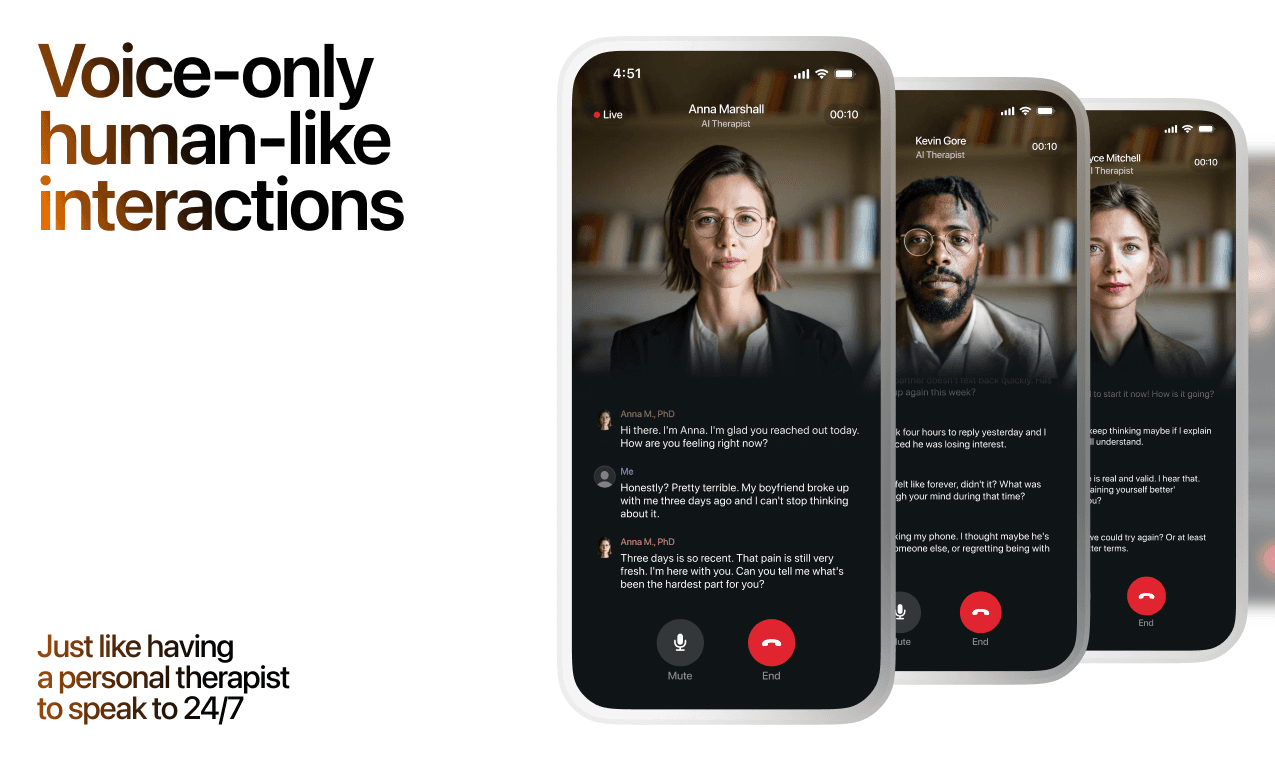
Here's what happens in a typical Lovon session:
You share what's on your mind
There's no script, no intake form, no waiting room. You speak or type whatever you're feeling — in your own words, at your own pace.
Lovon validates and explores
Using frameworks from CBT (Cognitive Behavioral Therapy) and motivational interviewing, Lovon acknowledges your feelings first, then gently helps you explore them. No dismissive "just move on" advice.
You build coping skills together
Lovon doesn't just listen — it actively works with you on evidence-based techniques: thought reframing, urge surfing, behavioral experiments, and more.
What a Session with Lovon Looks Like
When to Seek Professional Help
AI support is a valuable tool, but it's not a replacement for professional care. Please consider reaching out to a licensed therapist if you experience any of the following:
- Persistent thoughts of self-harm or suicide
- Inability to perform daily activities (work, eating, sleeping) for more than 2 weeks
- Turning to alcohol or substances to cope
- Intense anger or desire to harm your ex-partner
- Complete emotional numbness that doesn't improve over time
Crisis Resources (US): If you're in immediate danger, call 988 (Suicide & Crisis Lifeline) or text HOME to 741741 (Crisis Text Line). Available 24/7, free, and confidential.
Outside the US? Find a crisis line in your country
Ready to Start?
Your healing journey can begin right now
A 7-day trial. No judgment. Just a safe space to process what you're going through.
Frequently Asked Questions
Is Lovon a replacement for a real therapist?
Is my conversation with Lovon AI private?
How is Lovon different from ChatGPT for emotional support?
Can I use Lovon if I'm already seeing a therapist?
Can I try Lovon before subscribing?
About the Author
The Lovon Editorial Team
Mental Health & Wellness Content Team
The Lovon Editorial Team develops mental health and wellness content designed to make psychological concepts accessible and actionable. Our goal is to bridge the gap between clinical research and everyday life - helping you understand why your mind works the way it does and what you can do about it....
Related articles
- Attachment Style Compatibility Quiz for Partners 2026
The best attachment style compatibility quiz for partners in 2026 — dual scoring, pairing analysis, and AI coaching…
- Anxious Avoidant Attachment: Styles, Patterns, & What They Mean
Although some people truly invest in relationships, they may find themselves thinking that they are the reason those…
- Avoidant Attachment Shutdown Triggers: What Sets It Off (2026)
Avoidant attachment shutdown triggers explained: the 4 patterns behind it, body signals to watch, and steps to interrupt…
- Anxious Attachment Triggers: How to Defuse Them (2026)
Anxious attachment triggers explained: a 6-step sequence to name, regulate, and defuse them in 2026, plus…
See also
Quizzes
- Self-Concept Clarity Test: Do You Know Who You Are?
See how clearly you know yourself, in 3 minutes.
- Am I Sabotaging My Relationship? 12-Question Quiz
Find the move you reach for, in 2 minutes.
Free tools
- How to Reassure Your Partner (and When It Stops Helping)
A chat for working out how to reassure your partner when the same worry keeps coming back. Say what sets it off and how…
- What Did They Actually Mean By That?
A chat for one sentence you cannot stop re-reading. Paste their exact words and what was happening around them, and get…
From the wiki
- What does clingy mean in a relationship?
Clingy is what people call behavior that asks for more contact or reassurance than the other person wants to give…
Disclaimer: This article is for informational purposes only and does not constitute medical advice, diagnosis, or treatment. Always seek the advice of your physician or other qualified health provider with any questions you may have regarding a medical condition. If you are in crisis or think you may have an emergency, call 988 (Suicide & Crisis Lifeline) or go to the nearest emergency room. Outside the US? Find a crisis line in your country.