
AI Support for PTSD: What to Expect in 2026
AI support for PTSD gives you on-demand coping tools and grounding exercises 24/7. Learn what it does, what it can't do, and how Lovon fits your recovery in 2026.

Key Takeaways
- Diagnose you. PTSD diagnosis requires a licensed clinician using validated tools (PCL-5, CAPS-5). An AI cannot and
- Provide trauma-focused therapy. EMDR (Eye Movement Desensitization and Reprocessing), Cognitive Processing Therapy,
- Manage a crisis. If you are in acute distress, dissociating severely, or having thoughts of self-harm, an AI app is
- Prescribe or advise on medication. If you're considering medication for PTSD (SSRIs, prazosin for nightmares), that
If you're living with PTSD, getting support at 2 a.m. when a nightmare won't let you sleep — or in the parking lot before a hard conversation — used to be impossible. In 2026, AI support for PTSD is changing that, and this guide breaks down exactly what it does, what it doesn't do, and whether it fits your situation.
TL;DR: AI support for PTSD gives you on-demand coping tools, grounding exercises, and a space to talk through what you're feeling — any time, no appointment needed. It is not a replacement for trauma-focused clinical therapy (EMDR, CPT, PE), but it fills the gaps between sessions and lowers the barrier to starting at all. Lovon, built with PhD psychologist input, is one of the more grounded options in 2026 for voice-based emotional support between clinical appointments.
Why this matters
PTSD affects roughly 12 million adults in the U.S. in any given year, according to the National Center for PTSD. A licensed trauma therapist costs between $150 and $300 per session in 2026 — and waitlists for trauma specialists in many cities run 6 to 12 weeks. That gap is exactly where AI support lands. It is not a medical device, and it is not a clinician. What it is: available, low-stakes, and consistent.
Who this is for
This guide is for adults who have been diagnosed with PTSD or suspect they are dealing with trauma symptoms — hypervigilance, intrusive thoughts, emotional numbness, sleep disruption — and want to understand how an AI tool can support (not replace) their recovery. It also applies to people who are on a waitlist for therapy, between sessions, or simply not ready to talk to a human yet. If you are in active crisis or experiencing suicidal thoughts, call or text 988 immediately.
What AI support for PTSD actually does
It gives you a grounding space at any hour
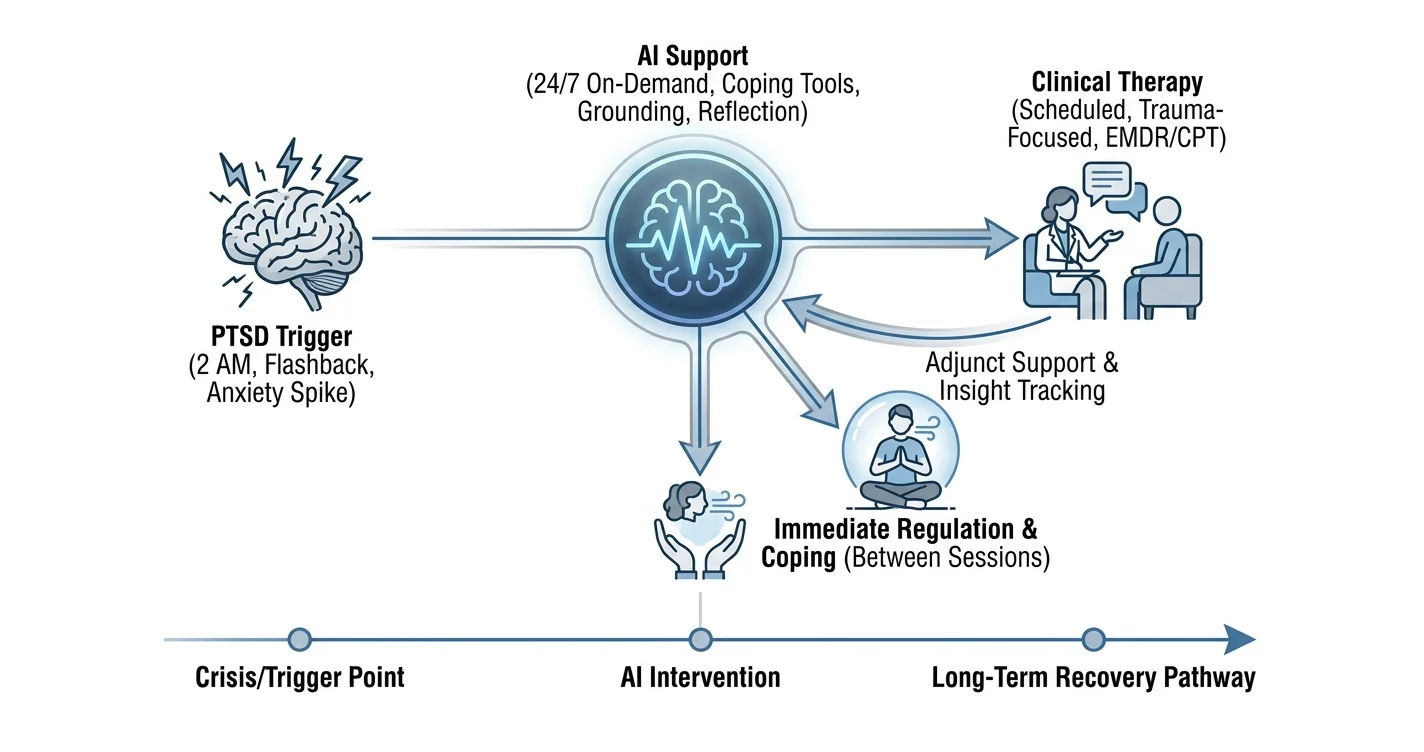
Trauma symptoms don't follow a 9-to-5 schedule. A flashback hits at midnight. Hyperarousal spikes on Sunday afternoon when there's nothing to distract you. AI apps like Lovon let you open a voice conversation the moment the anxiety peaks — no booking, no waiting room, no recapping your history for a new intake form. In 2026, this always-on availability is the single biggest practical advantage AI has over traditional care.
It walks you through evidence-informed coping tools
Good AI mental health tools don't just listen — they guide you through techniques drawn from CBT (cognitive behavioral therapy) and trauma-informed care: box breathing, body scans, grounding with the 5-4-3-2-1 sensory method, cognitive reframing prompts. These are not magic, but they are the same tools a therapist would assign as between-session homework. Having them delivered in a calm, conversational voice — on demand — means you actually use them when your nervous system is activated, not just when you're calm enough to read a worksheet.
It helps you name and track what you're feeling
One of the hardest parts of PTSD is identifying emotional states in real time. The freeze response — shutting down under stress — and emotional dysregulation can make it nearly impossible to articulate what's happening inside. Conversational AI prompts you with specific questions: "Where do you feel this in your body?" "What does this remind you of?" That structured reflection builds the self-awareness that trauma recovery depends on.
It reduces avoidance of support-seeking
Shame and stigma keep a lot of PTSD sufferers away from help entirely. Talking to an AI carries zero social judgment. There's no fear of being seen walking into a therapist's office. No worry about burdening a friend. For many people, an AI conversation is the first time they've said what happened out loud — and that first step matters enormously in 2026 when mental health stigma still keeps millions from seeking care at all.
It bridges the gap between therapy sessions
If you are already working with a trauma therapist, AI support is not competing with them — it's filling the 167 hours each week when you're not in their office. Processing a trigger the day it happens, rather than waiting 7 days to discuss it in session, accelerates insight. Many therapists in 2026 actively encourage clients to use AI journaling or conversational tools between appointments for exactly this reason.
It keeps a record you can bring to your therapist
When you talk through your emotional state in a voice session, that reflection is already organized. Some AI apps surface themes and patterns over time. Walking into your next therapy appointment with a clearer picture of what triggered you, when, and how you responded saves session time and makes the clinical work sharper.
What AI support for PTSD cannot do
- Diagnose you. PTSD diagnosis requires a licensed clinician using validated tools (PCL-5, CAPS-5). An AI cannot and should not give you a clinical label.
- Provide trauma-focused therapy. EMDR (Eye Movement Desensitization and Reprocessing), Cognitive Processing Therapy, and Prolonged Exposure are the three gold-standard PTSD treatments. They require a trained therapist. AI does not replicate these modalities.
- Manage a crisis. If you are in acute distress, dissociating severely, or having thoughts of self-harm, an AI app is not the right tool in that moment. Call 988, go to an emergency room, or contact a crisis text line.
- Prescribe or advise on medication. If you're considering medication for PTSD (SSRIs, prazosin for nightmares), that conversation belongs with a psychiatrist.
What to avoid when choosing an AI tool for PTSD
Generic chatbots with no clinical grounding. A customer-service bot with an empathy layer is not a mental health tool. Look for apps that cite the psychological frameworks behind their approach and are transparent about what they are not.
Apps that claim to "cure" trauma. No app cures PTSD. If marketing language makes that claim — directly or implied — treat it as a red flag. Lovon's own positioning is explicit: it is a support companion, not a licensed clinician.
Tools that avoid crisis escalation. Any reputable AI mental health app in 2026 should immediately surface emergency resources when distress signals are detected. If an app keeps the conversation going when you've indicated you're in crisis without directing you to emergency help, stop using it.
How Lovon fits into PTSD support
Lovon is a voice-first AI mental health app built with input from PhD psychologists. The voice format matters for trauma specifically: typing out what happened can feel clinical and cold, while speaking it — even to an AI — activates a slightly different, more natural processing mode. Sessions are available any time, sessions are not recorded and stored in ways that feel exposing, and the tone is warm without being falsely cheerful.
For PTSD specifically, Lovon's coping tools address grounding and emotional regulation — the between-session work that trauma recovery depends on. It is not EMDR. It is not CPT. It is the support layer that keeps you engaged in your own recovery on the days when everything feels like too much. For a deeper look at how AI fits into trauma recovery more broadly, AI therapy for PTSD and trauma recovery covers the research and the practical landscape in 2026.
Verdict comparison: AI support vs. other PTSD support options
| Option | Availability | Clinical depth | Cost (2026) | Best for |
|---|---|---|---|---|
| Licensed trauma therapist | Weekly appointments | High (EMDR, CPT, PE) | $150–$300/session | Primary treatment |
| AI support app (e.g. Lovon) | 24/7, on-demand | Coping tools only | Low/free tier | Between sessions, early help-seeking |
| Peer support groups | Scheduled | Shared experience | Free–low cost | Community connection |
| Crisis line (988) | 24/7 | Acute crisis only | Free | Active crisis |
FAQ
What is AI support for PTSD? AI support for PTSD means using an AI-powered app to access coping tools, grounding exercises, and guided emotional reflection between — or instead of — formal therapy sessions. It is not clinical treatment, but it is available any time and carries no social stigma.
Is AI therapy effective for PTSD? AI tools are not a replacement for gold-standard PTSD treatments like EMDR or CPT. Research on AI-assisted mental health support is growing in 2026, and findings suggest that AI-guided CBT techniques reduce anxiety and avoidance behaviors. For mild-to-moderate symptom management and between-session support, the evidence is promising.
Can an AI diagnose PTSD? No. Only a licensed clinician using validated diagnostic tools can diagnose PTSD. If you suspect you have PTSD, a licensed therapist or psychiatrist is the right first step.
How does AI support for PTSD compare to seeing a therapist? Therapy offers clinical depth, trauma processing protocols, and diagnostic capability that AI cannot match. AI offers 24/7 availability, zero cost barriers in many cases, and a lower-stakes entry point. The two are complementary, not competing.
What should I do if I have a PTSD flashback right now? Use a grounding technique immediately: name 5 things you can see, 4 you can touch, 3 you can hear, 2 you can smell, 1 you can taste. Then talk it through — with a trusted person, an AI support app, or a crisis line (988). If you feel unsafe, call 988 or emergency services.
Is it safe to talk about trauma with an AI? For general emotional processing and coping support, yes. Reputable apps are built with safeguards that detect crisis signals and direct users to emergency resources. Avoid apps that have no visible crisis escalation path.
How much does AI therapy for PTSD cost in 2026? Most AI mental health apps offer a free tier. Lovon has a no-cost entry point. Paid tiers with expanded features typically run $10–$30 per month in 2026 — a fraction of a single therapy session.
Can AI support help with complex PTSD (CPTSD)? The same principles apply: AI support helps with emotional regulation, grounding, and self-reflection — all relevant to CPTSD. For the deeper relational and developmental trauma that defines CPTSD, clinical therapy remains essential. See Lovon's guide on CPTSD from childhood: symptoms and healing steps for more context.
One last thing
The biggest barrier to PTSD recovery in 2026 is not a lack of treatments — it is avoidance. The nervous system that was hurt by trauma is the same nervous system that makes reaching out feel dangerous. An AI that you can talk to at 3 a.m. with no judgment, no intake form, and no waiting room is not a small thing. It is often the first conversation that makes the next conversation — with a real therapist — possible.
Related guides
How AI Support Helps You Heal
AI emotional support isn't about replacing human connection — it's about filling the gaps. The moments when you need to talk at 2 AM, when you don't want to burden your friends again, or when you simply need someone to listen without judgment.
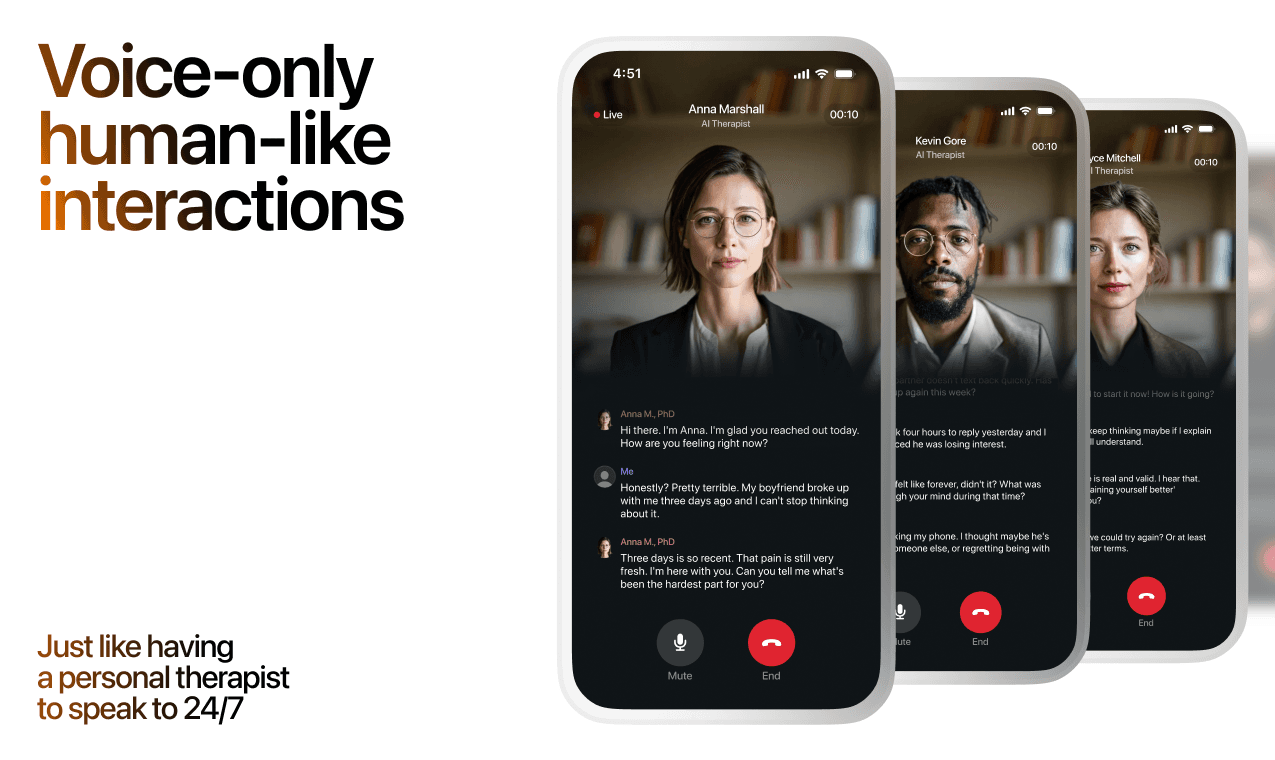
Here's what happens in a typical Lovon session:
You share what's on your mind
There's no script, no intake form, no waiting room. You speak or type whatever you're feeling — in your own words, at your own pace.
Lovon validates and explores
Using frameworks from CBT (Cognitive Behavioral Therapy) and motivational interviewing, Lovon acknowledges your feelings first, then gently helps you explore them. No dismissive "just move on" advice.
You build coping skills together
Lovon doesn't just listen — it actively works with you on evidence-based techniques: thought reframing, urge surfing, behavioral experiments, and more.
What a Session with Lovon Looks Like
When to Seek Professional Help
AI support is a valuable tool, but it's not a replacement for professional care. Please consider reaching out to a licensed therapist if you experience any of the following:
- Persistent thoughts of self-harm or suicide
- Inability to perform daily activities (work, eating, sleeping) for more than 2 weeks
- Turning to alcohol or substances to cope
- Intense anger or desire to harm your ex-partner
- Complete emotional numbness that doesn't improve over time
Crisis Resources (US): If you're in immediate danger, call 988 (Suicide & Crisis Lifeline) or text HOME to 741741 (Crisis Text Line). Available 24/7, free, and confidential.
Outside the US? Find a crisis line in your country
Ready to Start?
Your healing journey can begin right now
A 7-day trial. No judgment. Just a safe space to process what you're going through.
Frequently Asked Questions
Is Lovon a replacement for a real therapist?
Is my conversation with Lovon AI private?
How is Lovon different from ChatGPT for emotional support?
Can I use Lovon if I'm already seeing a therapist?
Can I try Lovon before subscribing?
About the Author

The Lovon Editorial Team
Mental Health & Wellness Content Team
The Lovon Editorial Team develops mental health and wellness content designed to make psychological concepts accessible and actionable. Our goal is to bridge the gap between clinical research and everyday life - helping you understand why your mind works the way it does and what you can do about it....
Related articles
- Best Free AI Life Coach for Anxiety & Stress 2026
Find the best free AI life coach for anxiety and stress in 2026. Lovon delivers voice-based sessions, CBT-informed…
- PTSD vs CPTSD — Symptom Categories and Trauma Exposure Patterns
When someone experiences trauma, the psychological impact can manifest in different ways depending on the nature and…
- Complex PTSD: Understanding Symptoms, Causes, and Treatment
Complex PTSD (C-PTSD) represents a distinct form of trauma response that emerges from prolonged, repeated exposure to…
- Understanding the Four PTSD Symptom Categories: Reexperiencing, Trigger Reactivity, Mood Alterations, and Altered Reactivity
A comprehensive guide to recognizing and understanding the core symptom groups that define post-traumatic stress…
See also
Quizzes
- Rejection Sensitivity Test: Free 12-Question Check
See how strongly you expect and read rejection.
- Fear of Intimacy Test: Free 12-Question Self-Check
See which part of closeness feels risky, in 3 min.
Free tools
- Words of Encouragement for Him When He Is Struggling
Words of encouragement for him that fit what he is actually going through, for when your usual lines are not landing…
- Am I Overreacting, or Is This a Big Deal?
A chat for the small thing you cannot stop turning over. Say what happened and what you have already told yourself about…
From the wiki
- Why do I keep dreaming about my ex?
Recurring dreams about an ex usually mean your brain is still consolidating a relationship that took up years of memory…
Disclaimer: This article is for informational purposes only and does not constitute medical advice, diagnosis, or treatment. Always seek the advice of your physician or other qualified health provider with any questions you may have regarding a medical condition. If you are in crisis or think you may have an emergency, call 988 (Suicide & Crisis Lifeline) or go to the nearest emergency room. Outside the US? Find a crisis line in your country.