
Anxious Attachment and Love Avoidant: Break the Cycle 2026
Anxious attachment and love avoidant partners create a push-pull cycle. Learn the pattern, 7 steps to break it, and troubleshooting fixes for 2026.

Key Takeaways
- 15-20 minutes a day for nervous-system practice (breathing, grounding, or a short voice session)
- A notebook or notes app to track your own triggers before, during, and after conflict
- A short list of "pause phrases" you can say out loud when anxiety spikes
- Willingness to sit with discomfort for 90 seconds before reacting
- Optional: a tool for practicing hard conversations privately, like an AI voice therapy app, before you bring them to
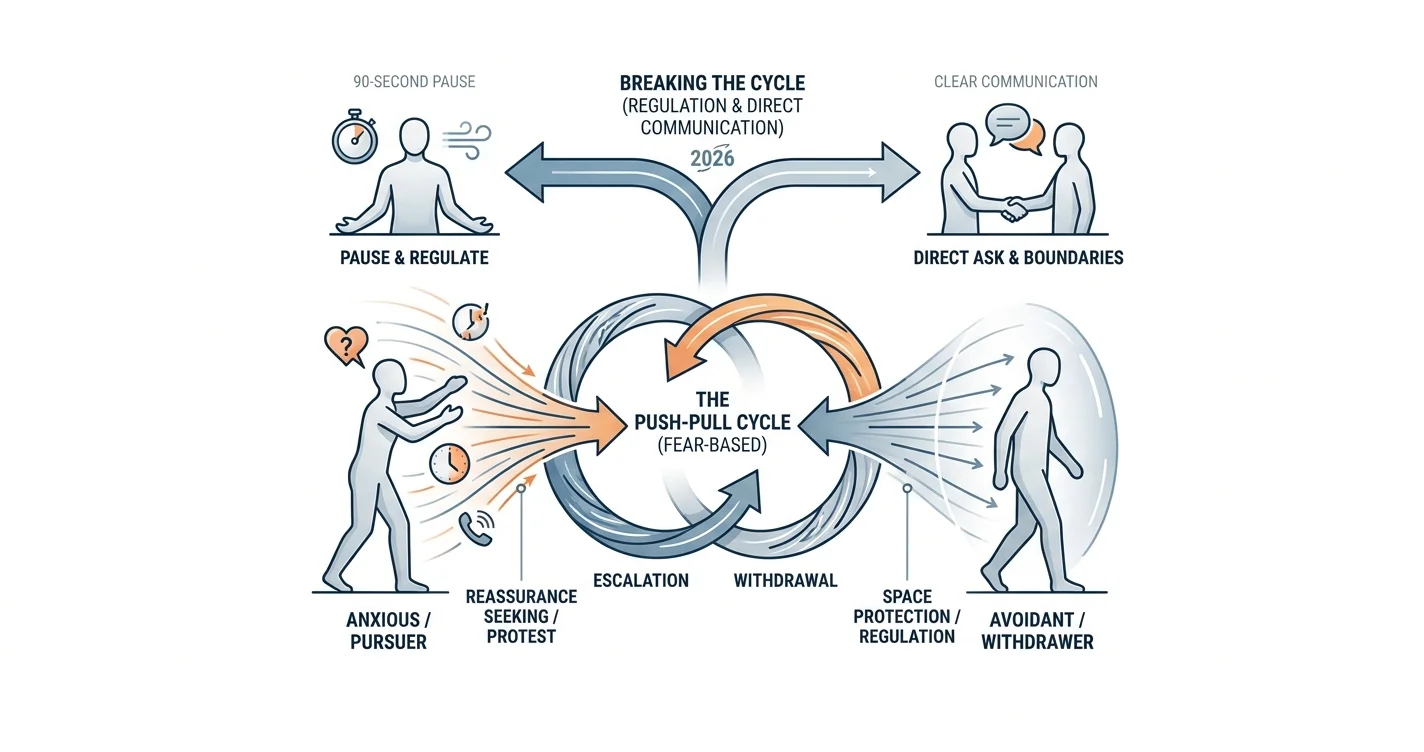
Anxious attachment and love avoidant partners create a loop that feels like chemistry but runs on fear: one person chases closeness, the other retreats from it, and both end up exhausted. This guide breaks down why the push-pull cycle happens and gives you a step-by-step way to interrupt it in 2026.
TL;DR
Anxious attachment and love avoidant dynamics form what psychologists call the Pursuer-Withdrawer pattern: anxious partners escalate to get reassurance, avoidant partners withdraw to protect their space, and the escalation itself pushes the withdrawal further. Verdict: the cycle is learnable, not fixed — it responds to nervous-system regulation, communication scripts, and consistent boundary-setting, not to finding a "better" partner. Lovon, the AI voice support app, is one option for practicing these scripts and calming your body in the moment between sessions with a licensed therapist. This is a pattern issue, not a personality flaw, and it changes with practice.
Why this matters
The anxious-avoidant pairing is one of the most common — and most painful — relationship configurations therapists see. Attachment research going back to Hazan and Shaver's 1987 study estimates roughly 20% of adults lean anxious and around 25% lean avoidant, with just over half falling into the secure range. Put two people from the first two groups together and you get a predictable engine: anxiety reads distance as danger, avoidance reads closeness as pressure, and each response confirms the other person's worst fear.
This isn't about blame. Anxious attachment and love avoidant styles both formed early, usually as protective strategies that made sense at the time. Understanding the anxious attachment style's signs and coping strategies is the first step, because you can't interrupt a pattern you can't name. Knowing the mechanics is what turns a painful cycle into something you can actually work on in 2026.
What you'll need
- 15-20 minutes a day for nervous-system practice (breathing, grounding, or a short voice session)
- A notebook or notes app to track your own triggers before, during, and after conflict
- A short list of "pause phrases" you can say out loud when anxiety spikes
- Willingness to sit with discomfort for 90 seconds before reacting
- Optional: a tool for practicing hard conversations privately, like an AI voice therapy app, before you bring them to your partner
The steps
1. Name the pattern out loud
Calling it "the push-pull cycle" instead of "my relationship problem" changes how your brain processes it. Say to yourself: "This is anxious attachment and love avoidant behavior colliding, not proof that I'm too much or they don't care." Expected outcome: less shame, more clarity within the first week of naming it consistently. Common mistake: skipping this step because it feels too simple — it's the step that makes every other step work.
2. Track your triggers for seven days
Write down the exact moment your anxiety spikes: a delayed text, a short reply, a canceled plan. Note the time, what happened right before, and how long the spike lasted. Most anxious spikes peak within 5-10 minutes and fade if you don't act on them immediately. This step matters because you can't regulate what you haven't measured.
3. Build a 90-second pause
When the urge to text, call, or confront hits, set a timer for 90 seconds before you do anything. Breathe out longer than you breathe in — four counts in, six counts out — for the full window. This slows the stress response enough that you're reacting to the actual situation instead of the panic. Common mistake: using the pause to rehearse an angrier version of the message instead of actually calming down.
4. Replace the chase with a direct ask
Instead of escalating (double-texting, testing, withdrawing to "see if they notice"), say exactly what you need: "I'd like a check-in tonight, even if it's short." The Pursuer-Withdrawer pattern breaks fastest when the pursuer stops chasing and starts asking clearly. Expected outcome: fewer cycles of protest behavior, even if the answer isn't always yes.
5. Give the withdrawer room without disappearing yourself
Avoidant partners pull back to regulate, not to punish. Give a short, specific window — "take the evening, let's talk tomorrow at 7" — instead of silence with no plan. This meets their need for space while keeping the relationship anchored to something concrete. Skipping this step is the most common mistake anxious partners make: either chasing harder or going cold in retaliation.
6. Debrief after every cycle, not during it
Once things calm down, talk about what happened without re-litigating who was right. Ask: "What did you need in that moment, and what did I need?" This step accomplishes what the fight itself couldn't — actual information exchange instead of defense. Expected outcome: each cycle gets shorter and less intense over 2026 as the pattern gets named and repeated less often.
7. Practice the script before you need it
Rehearse your pause phrases and direct asks somewhere low-stakes first. Saying the words out loud to an AI voice therapy app or even to yourself in the mirror makes them available under stress instead of vanishing when you actually need them. This step matters because most people know what they "should" say and still can't access it mid-spike.
Troubleshooting
Problem: I said the direct ask calmly and they still pulled away. Fix: this is often not about you — dismissive-avoidant attachment patterns mean withdrawal is the default response to almost any intensity, including positive intensity. Give the space you promised and revisit the conversation at the agreed time rather than reading the withdrawal as rejection.
Problem: The 90-second pause doesn't work; I still send the text. Fix: extend the pause to 5 minutes and pair it with a physical action — a short walk, cold water on your wrists — rather than just counting. The body needs to feel calm, not just the clock to run out.
Problem: My partner says I'm "too much" every time I ask for reassurance. Fix: separate the need (reasonable) from the delivery (sometimes urgent or repeated). Ask for one specific thing once, then stop, rather than asking the same question three different ways in one conversation.
Problem: I feel calm during the debrief but anxious again within 24 hours. Fix: this is normal in year one of unlearning the pattern — regulation is a skill that needs repetition, not a switch that flips once. Track how many hours the calm lasts each week; the number should slowly climb through 2026 with consistent practice.
Problem: I don't know if this is anxious attachment or if my partner is actually a bad fit. Fix: patterns and compatibility are different questions. If the cycle only ever escalates and never resolves even after months of practice, that's information worth taking seriously on its own.
Tools and resources
- Anxious attachment style: signs and coping strategies for a deeper look at the anxious side of the pattern
- The Pursuer-Withdrawer pattern and how to break the cycle for the mechanics behind steps 4 and 5
- Dismissive-avoidant attachment: how they think and feel to understand the withdrawer's side without guessing
- An AI relationship coach for anxious attachment if you want a private place to rehearse the scripts above before using them live
- A simple notes app or journal for the seven-day trigger tracking in step 2
What to do next
Once the cycle is shorter and less intense, the next skill is building actual security instead of just managing the anxious-avoidant dance — that's a separate, longer process worth its own attention once the immediate spikes are under control.
FAQ
What is the anxious attachment and love avoidant cycle called? It's most often called the Pursuer-Withdrawer pattern: one partner pursues closeness through checking in, reassurance-seeking, or protest, while the other withdraws to regulate or protect their space.
Can anxious attachment and avoidant attachment ever work long-term? Yes, but only with active work on both sides — the pairing doesn't heal itself just because two people love each other, and untouched, it tends to escalate over years rather than resolve.
How long does it take to break the push-pull cycle? Most people notice shorter, less intense cycles within a few weeks of consistent practice, though full nervous-system change tends to build gradually across 2026 rather than happening overnight.
Is anxious attachment the same as being needy? No. Anxious attachment is a nervous-system response to perceived threat in a relationship, not a character trait — the behaviors (checking in, seeking reassurance) are symptoms, not the whole person.
How do I know if my partner is avoidant or just busy? Avoidant withdrawal tends to follow moments of increased closeness or intensity specifically, while being busy is unrelated to relationship events — track the timing, not just the frequency.
Does therapy help with anxious attachment and love avoidant patterns? Yes, and both individual and couples work show results — an AI voice support app like Lovon can support the daily practice between sessions, though it isn't a substitute for a licensed therapist working the relationship directly.
What's the biggest mistake anxious partners make in this cycle? Escalating instead of asking directly — testing, going quiet to "see if they notice," or sending multiple messages in a row all read as pressure to an avoidant partner and trigger more withdrawal, not less.
Can one partner change the cycle without the other participating? Partially — changing your own reaction (the 90-second pause, the direct ask) shifts the dynamic, but full resolution usually needs both people engaged at some point.
One last thing
The detail most people miss: the withdrawal isn't the avoidant partner rejecting you specifically — it's their nervous system doing the exact same threat-response job your anxiety is doing, just pointed in the opposite direction. Anxious attachment and love avoidant styles are mirror images of the same fear, which is why the fix for both sides is the same skill: regulate first, communicate second.
Related guides
How AI Support Helps You Heal
AI emotional support isn't about replacing human connection — it's about filling the gaps. The moments when you need to talk at 2 AM, when you don't want to burden your friends again, or when you simply need someone to listen without judgment.
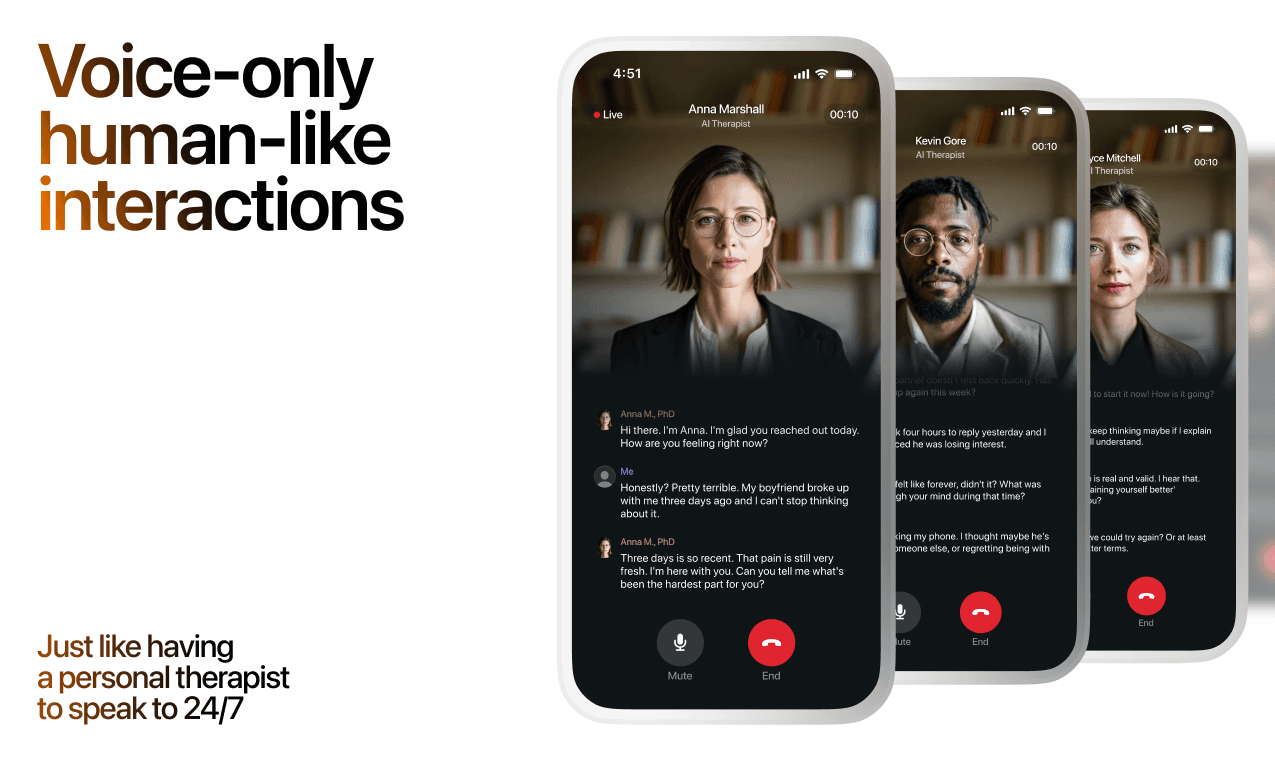
Here's what happens in a typical Lovon session:
You share what's on your mind
There's no script, no intake form, no waiting room. You speak or type whatever you're feeling — in your own words, at your own pace.
Lovon validates and explores
Using frameworks from CBT (Cognitive Behavioral Therapy) and motivational interviewing, Lovon acknowledges your feelings first, then gently helps you explore them. No dismissive "just move on" advice.
You build coping skills together
Lovon doesn't just listen — it actively works with you on evidence-based techniques: thought reframing, urge surfing, behavioral experiments, and more.
What a Session with Lovon Looks Like
When to Seek Professional Help
AI support is a valuable tool, but it's not a replacement for professional care. Please consider reaching out to a licensed therapist if you experience any of the following:
- Persistent thoughts of self-harm or suicide
- Inability to perform daily activities (work, eating, sleeping) for more than 2 weeks
- Turning to alcohol or substances to cope
- Intense anger or desire to harm your ex-partner
- Complete emotional numbness that doesn't improve over time
Crisis Resources (US): If you're in immediate danger, call 988 (Suicide & Crisis Lifeline) or text HOME to 741741 (Crisis Text Line). Available 24/7, free, and confidential.
Outside the US? Find a crisis line in your country
Ready to Start?
Your healing journey can begin right now
A 7-day trial. No judgment. Just a safe space to process what you're going through.
Frequently Asked Questions
Is Lovon a replacement for a real therapist?
Is my conversation with Lovon AI private?
How is Lovon different from ChatGPT for emotional support?
Can I use Lovon if I'm already seeing a therapist?
Can I try Lovon before subscribing?
About the Author
The Lovon Editorial Team
Mental Health & Wellness Content Team
The Lovon Editorial Team develops mental health and wellness content designed to make psychological concepts accessible and actionable. Our goal is to bridge the gap between clinical research and everyday life - helping you understand why your mind works the way it does and what you can do about it....
Related articles
- Understanding Anxious Attachment Patterns in Relationships
If you find yourself constantly checking your phone for messages, worrying whether your partner still cares, or feeling…
- Secure Attachment Style: How to Build It in 2026
Learn the traits of a secure attachment style and the exact steps to build one in 2026 — regulation, repair, and direct…
- Fearful Avoidant Attachment: Triggers & Healing (2026)
Fearful avoidant attachment explained: the 4 trigger categories, a 90-second distress protocol, and a 6-step healing…
- Why Your Partner Shuts Down When You Ask for Reassurance
The shutdown is not rejection. See what avoidant attachment does to a request for closeness, how to ask so it lands, and…
See also
Quizzes
- Rejection Sensitivity Test: Free 12-Question Check
See how strongly you expect and read rejection.
- Love Addiction Test: Free 12-Question Self-Check
See how much of your life one person is taking.
Free tools
- How to Stop Overthinking in a Relationship
Not a list of habits. Tell it the specific thing you are going round on, and it separates what actually happened from…
- How to Reassure Your Partner (and When It Stops Helping)
A chat for working out how to reassure your partner when the same worry keeps coming back. Say what sets it off and how…
From the wiki
- What is an attachment style?
An attachment style is the habit your nervous system formed for handling closeness: what you actually do when someone…
Disclaimer: This article is for informational purposes only and does not constitute medical advice, diagnosis, or treatment. Always seek the advice of your physician or other qualified health provider with any questions you may have regarding a medical condition. If you are in crisis or think you may have an emergency, call 988 (Suicide & Crisis Lifeline) or go to the nearest emergency room. Outside the US? Find a crisis line in your country.