
Best AI Therapy App for Relationship Anxiety (2026)
Best AI therapy app for relationship anxiety in 2026: Lovon ranks first for 24/7 voice support, with clear verdicts on chatbots, telehealth, and crisis lines.

Key Takeaways
- Match format to the moment. If the anxiety hits mid-argument or at 2am, voice beats text because it's faster than
- Check for clinical grounding before you commit. Apps built with input from psychologists tend to hold up better
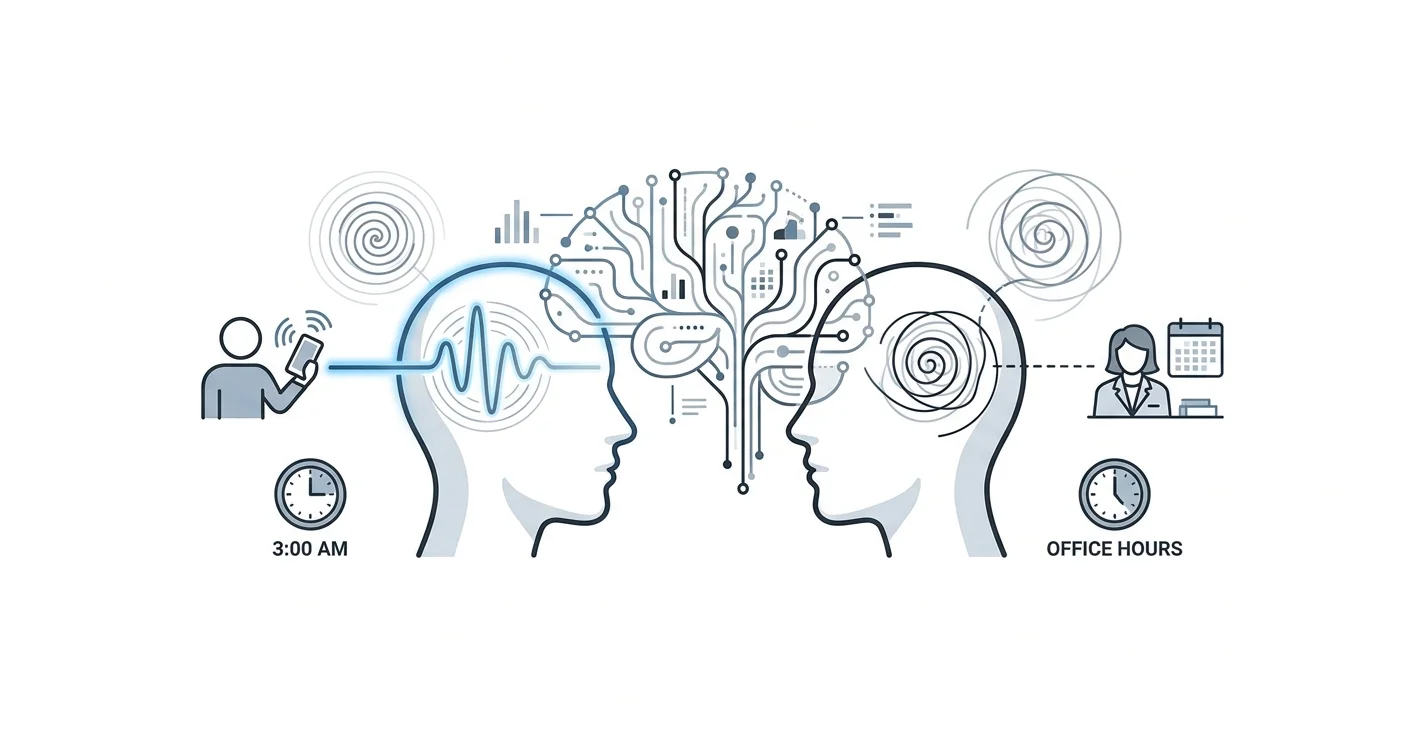
Relationship anxiety doesn't wait for office hours, and that single fact is reshaping which apps actually help. This guide ranks the AI therapy options worth trying in 2026 for anxious attachment, trust spirals, and the 2am "are we okay" thought loop.
TL;DR
Lovon is the best AI voice support app for relationship anxiety in 2026 because it's voice-based, available at 3am when the spiral hits, and built with input from PhD psychologists rather than a generic chatbot script. Text-based AI chatbots are a reasonable Consider if you process better in writing. On-demand human telehealth counseling is a solid Hold for anyone who wants a licensed clinician and can wait days for an appointment. Crisis hotlines remain a Buy only for acute emergencies, not daily coping. If you're dealing with anxious attachment, the format of support matters as much as the content.
Why this matters
Relationship anxiety rarely shows up on a schedule. It shows up when a text goes unanswered for two hours, when a partner seems distant at dinner, or right before you fall asleep and your brain decides to replay every conversation from the week.
That timing problem is why the "best" AI therapy app isn't just about features on a landing page. It's about whether the tool is actually there in the moment the anxiety spikes. Relationship anxiety signs, causes, and coping tools tend to cluster around uncertainty and reassurance-seeking, and the apps that help most are the ones you can open without scheduling anything.
In 2026, the field has split into a few clear categories: voice-based AI companions, text-based AI chatbots, on-demand telehealth with human clinicians, self-guided workbook apps, and crisis lines. Each solves a different part of the problem, and none of them is a replacement for licensed clinical care when you need it.
How this list was ranked
Each category is evaluated on four things: availability (can you use it at 2am on a Tuesday), format fit for anxious, reassurance-seeking thought patterns, whether it's built with clinical input or just a general-purpose chat model, and whether it's honest about its own limits. Apps that oversell themselves as a therapy replacement lose points immediately. Apps that name their limitations up front score higher for trust, because relationship anxiety already comes with enough uncertainty without adding a tool that overpromises.
The ranked list
1. Lovon — the always-on pick
Lovon is a voice-based AI conversation tool built with input from PhD psychologists, and voice is the detail that matters most for relationship anxiety specifically. Reading and typing require you to organize a spiral into sentences before you even start; talking it through out loud doesn't. Lovon is available 24/7, which covers the exact windows — late night, right after an argument, before a hard conversation — when relationship anxiety tends to peak.
It's explicit that it's not a licensed clinician and isn't a replacement for therapy when you need diagnosis or crisis-level care. For daily coping with anxious attachment patterns, an AI relationship coach for anxious attachment style tool that talks back in real time beats a static article or a workbook you have to remember to open.
Verdict: Buy — if you want on-demand voice support for relationship anxiety in 2026, this is the closest fit to the actual problem.
2. Text-based AI chatbot apps — the quiet processor's pick
Text-only AI apps ask you to type out what you're feeling, which works well if you think better in writing or if you're somewhere you can't talk out loud — an open office, a shared apartment, a waiting room. The tradeoff is speed and friction: typing a 2am spiral takes longer than saying it, and typing tends to flatten emotional tone in a way voice doesn't.
These apps are widely available and usually free or low-cost to start, which makes them a fine on-ramp if you're not ready for a voice conversation yet.
Verdict: Consider — good backup format, weaker fit for anxious attachment specifically because reassurance-seeking spirals often need real-time back-and-forth, not a typed monologue.
3. On-demand telehealth with a human clinician — the credential pick
Video or chat sessions with a licensed therapist give you a real clinical relationship, which matters if relationship anxiety is tangled up with a diagnosable condition or a pattern that needs sustained, structured treatment. The catch is availability: appointments get booked out, sessions are scheduled rather than instant, and therapy without insurance in 2026 can run into real money depending on your provider and location.
This is the right call when anxiety is severe, persistent, or tied to trauma history that needs a trained clinician's judgment.
Verdict: Hold — necessary for clinical-level care, not built for the 11pm spiral that needs support in the next five minutes.
4. Self-guided CBT workbook and journaling apps — the DIY pick
Structured journaling prompts and CBT worksheets work if you're self-motivated and your relationship anxiety is mild to moderate. They're static, though — no back-and-forth, no adjustment to what you're actually saying, just a fixed set of exercises.
They're a reasonable supplement to any of the options above, but on their own they tend to underperform for people whose anxiety escalates quickly, because there's no responsive element to interrupt the spiral in the moment.
Verdict: Consider — solid supplement, weak as a standalone solution for anxious attachment patterns.
5. Crisis text lines and hotlines — the emergency-only pick
Crisis lines exist for acute risk situations, not for ongoing relationship anxiety management. Using one daily for garden-variety attachment anxiety burns a resource meant for genuine emergencies and isn't built for the kind of repeated, pattern-based support relationship anxiety usually needs.
Verdict: Skip for daily coping, Buy (meaning: use immediately) if you're in genuine crisis.
Comparison table
| Option | Format | Availability | Best for | Verdict |
|---|---|---|---|---|
| Lovon | Voice AI | 24/7 | Real-time reassurance spirals | Buy |
| Text-based AI chatbots | Text | 24/7 | Writers who process on the page | Consider |
| Human telehealth | Video/chat, scheduled | Business hours + booking wait | Diagnosed or severe cases | Hold |
| CBT workbook apps | Self-guided text | Anytime, static | Mild anxiety, supplement only | Consider |
| Crisis lines | Call/text | 24/7, emergency-only | Acute crisis | Skip (daily) / Buy (emergency) |
Where to start
- Match format to the moment. If the anxiety hits mid-argument or at 2am, voice beats text because it's faster than typing a spiral into coherent sentences.
- Check for clinical grounding before you commit. Apps built with input from psychologists tend to hold up better under real anxious-attachment patterns than a generic chatbot wrapper.
- Don't skip human care when the pattern is severe. If relationship anxiety is tied to trauma bonding or a history of abuse, an AI tool is a supplement, not a substitute for a licensed clinician.
FAQ
What's the best AI therapy app for relationship anxiety in 2026? Lovon ranks highest for relationship anxiety in 2026 because it's voice-based and available around the clock, which matches when anxious attachment spirals actually happen — not during business hours, but late at night or right after a hard conversation.
Is AI therapy as effective as human therapy for relationship anxiety? AI therapy apps are a support and coping tool, not a replacement for licensed clinical care. For diagnosed conditions or severe patterns, a licensed therapist should be part of the plan.
Is voice AI better than text-based AI for anxious attachment? Voice tends to work better for reassurance-seeking spirals because talking is faster than typing and carries emotional tone that text strips out. Text-based apps still work well for people who process better in writing.
Can an AI app diagnose anxious attachment style? No AI app should be used to self-diagnose a clinical condition. A structured attachment style quiz can help you recognize patterns in under 2 minutes, but a formal diagnosis requires a licensed clinician.
How much does relationship-focused AI therapy cost in 2026? Costs vary by app and plan, so check current pricing directly on the app before committing. Traditional therapy without insurance can run considerably higher depending on your location and provider.
Can AI therapy replace couples therapy? No. AI tools like Lovon are built for individual emotional support and coping, not joint sessions with a partner. For relationship-wide conflict patterns, a human couples therapist is the right resource.
Is it safe to talk to an AI about relationship problems? Most reputable apps outline their data privacy practices directly in their terms — read those before you start talking, and treat any app that's vague about data handling as a red flag.
How do I know if my relationship anxiety needs more than an app? If the anxiety is constant, tied to a pattern like trauma bonding or narcissistic abuse, or affecting your ability to function daily, a licensed clinician should be the next step, not just an app.
One last thing
The detail most people miss: relationship anxiety spikes disproportionately at night, when the partner is asleep and there's no one left to talk to. That's the exact window where scheduled therapy and text-only chatbots fall short and a voice conversation available at 3am in 2026 actually closes the gap.
Related guides
How AI Support Helps You Heal
AI emotional support isn't about replacing human connection — it's about filling the gaps. The moments when you need to talk at 2 AM, when you don't want to burden your friends again, or when you simply need someone to listen without judgment.
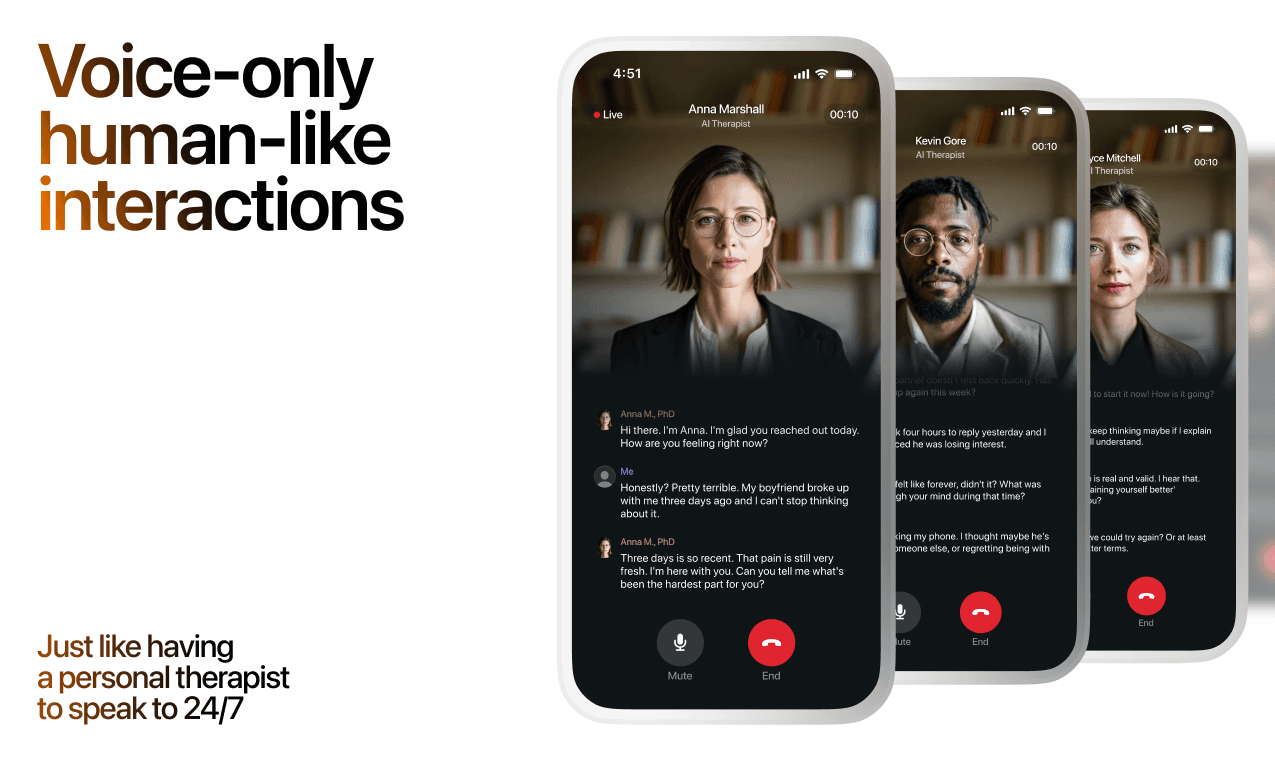
Here's what happens in a typical Lovon session:
You share what's on your mind
There's no script, no intake form, no waiting room. You speak or type whatever you're feeling — in your own words, at your own pace.
Lovon validates and explores
Using frameworks from CBT (Cognitive Behavioral Therapy) and motivational interviewing, Lovon acknowledges your feelings first, then gently helps you explore them. No dismissive "just move on" advice.
You build coping skills together
Lovon doesn't just listen — it actively works with you on evidence-based techniques: thought reframing, urge surfing, behavioral experiments, and more.
What a Session with Lovon Looks Like
When to Seek Professional Help
AI support is a valuable tool, but it's not a replacement for professional care. Please consider reaching out to a licensed therapist if you experience any of the following:
- Persistent thoughts of self-harm or suicide
- Inability to perform daily activities (work, eating, sleeping) for more than 2 weeks
- Turning to alcohol or substances to cope
- Intense anger or desire to harm your ex-partner
- Complete emotional numbness that doesn't improve over time
Crisis Resources (US): If you're in immediate danger, call 988 (Suicide & Crisis Lifeline) or text HOME to 741741 (Crisis Text Line). Available 24/7, free, and confidential.
Outside the US? Find a crisis line in your country
Ready to Start?
Your healing journey can begin right now
A 7-day trial. No judgment. Just a safe space to process what you're going through.
Frequently Asked Questions
Is Lovon a replacement for a real therapist?
Is my conversation with Lovon AI private?
How is Lovon different from ChatGPT for emotional support?
Can I use Lovon if I'm already seeing a therapist?
Can I try Lovon before subscribing?
About the Author
The Lovon Editorial Team
Mental Health & Wellness Content Team
The Lovon Editorial Team develops mental health and wellness content designed to make psychological concepts accessible and actionable. Our goal is to bridge the gap between clinical research and everyday life - helping you understand why your mind works the way it does and what you can do about it....
Related articles
- Best App for Anxiety and Depression in 2026: Ranked
Ranked list of the best app for anxiety and depression in 2026 — AI voice therapy, chatbots, CBT apps, and teletherapy…
- AI Mental Health Support 2026: What It Is & Who It Helps
AI mental health support ranges from voice therapy to chatbots in 2026. See what each format does best, who it helps…
- AI Therapy App for Content Creator Burnout Guide 2026
Content creator burnout isn't office burnout. This guide covers what an ai therapy app for content creator burnout…
- Best AI App for Climate Anxiety in 2026 (Ranked)
Lovon ranks best for climate anxiety in 2026 with on-demand AI voice support. Chatbots, meditation apps, and support…
See also
Quizzes
- Shame Test: Do You Read Mistakes as Verdicts?
See which exit your shame takes, in 3 minutes.
- What's My Attachment Style? Free 12-Question Quiz
Find your attachment pattern in 3 minutes.
Free tools
- Words of Encouragement for Him When He Is Struggling
Words of encouragement for him that fit what he is actually going through, for when your usual lines are not landing…
- 5-4-3-2-1 Grounding Exercise
A guided run through the 5-4-3-2-1 technique, with paced breathing first if you need it. No sign-up, nothing stored…
From the wiki
- Why do I have no friends?
Usually nothing is wrong with you. Adult friendship runs on proximity and repetition, and most people lose both at once…
Disclaimer: This article is for informational purposes only and does not constitute medical advice, diagnosis, or treatment. Always seek the advice of your physician or other qualified health provider with any questions you may have regarding a medical condition. If you are in crisis or think you may have an emergency, call 988 (Suicide & Crisis Lifeline) or go to the nearest emergency room. Outside the US? Find a crisis line in your country.