
Emotional Dysregulation in Adults: Signs, Fixes 2026
Emotional dysregulation in adults explained: signs, causes, and a 7-step coping plan for 2026. Body-first tools that calm reactions fast. Verdict inside.

Key Takeaways
- 15-20 minutes a day, ideally the same time daily for the first month
- A quiet space to practice breathing and grounding without interruption
- A notebook or notes app to track triggers and body sensations
- A body-based technique you can do anywhere (breathing, cold water, or movement)
- Optional: a voice-based AI conversation tool like Lovon for real-time talk-throughs when a spike hits outside
Emotional dysregulation in adults shows up as reactions that feel bigger than the moment calls for — snapping at a coworker over a typo, crying during a routine disagreement, or going numb when things pile up. This guide breaks down the signs, the nervous system mechanics behind them, and a step-by-step way to build regulation skills starting today.
TL;DR
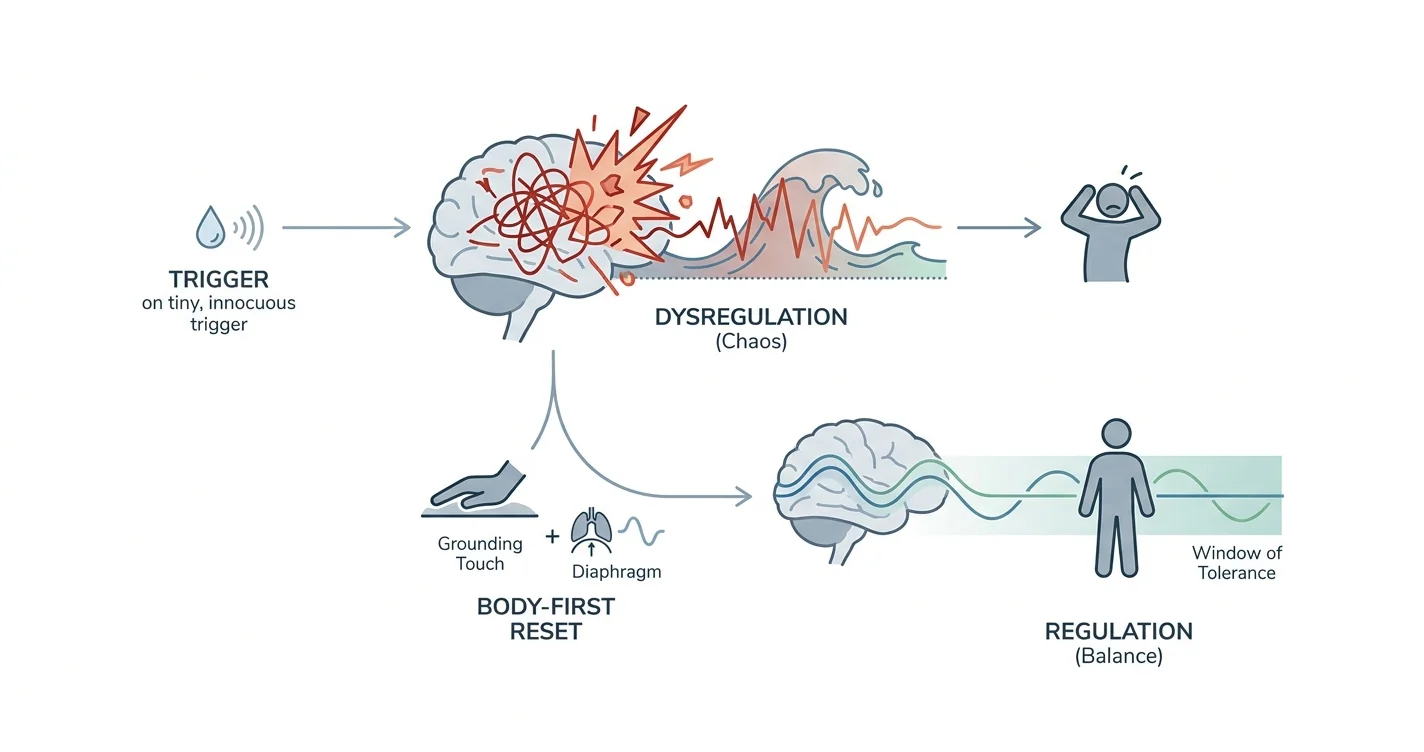
Emotional dysregulation in adults means your emotional response outlasts or outsizes the trigger — you're stuck in a reaction your prefrontal cortex can't override fast enough. Common signs in 2026 clinical writing include sudden anger, crying spells, shutdown or numbness, and trouble calming down even after the trigger is gone. The fastest fix isn't willpower — it's a body-first reset (breathing, grounding, movement) followed by cognitive work once your nervous system settles. Verdict: coping tools work, but consistency matters more than any single technique — daily practice for 15-20 minutes over 4-6 weeks is what actually shifts a pattern, per aggregated 2026 mental health data.
Why this matters
Dysregulation isn't a character flaw. It's a signal that your nervous system has slipped out of its regulation zone — the state where you can think, feel, and respond without getting hijacked by stress hormones.
Adults with untreated dysregulation report more conflict at work, more relationship strain, and higher burnout rates going into 2026 planning cycles for mental health programs at employers. The good news: regulation is a trainable skill, not a fixed trait. Athletes train reaction time. You can train emotional reaction time the same way — with reps.
What you'll need
- 15-20 minutes a day, ideally the same time daily for the first month
- A quiet space to practice breathing and grounding without interruption
- A notebook or notes app to track triggers and body sensations
- A body-based technique you can do anywhere (breathing, cold water, or movement)
- Optional: a voice-based AI conversation tool like Lovon for real-time talk-throughs when a spike hits outside business hours
The steps
1. Name the trigger and the body signal
Before you can regulate a reaction, you have to catch it early. Most adults notice dysregulation only after it's peaked — voice raised, jaw clenched, tears already falling.
Start logging the first physical cue: tight chest, hot face, racing thoughts, or a sudden urge to leave the room. Write down what happened five minutes before that sensation. Common mistake: waiting until the reaction is at full intensity to intervene — by then, your prefrontal cortex is offline and logic-based coping won't land.
2. Widen your window of tolerance with a body-first reset
Your window of tolerance is the zone where you can handle stress without flipping into fight, flight, or freeze. Widening it is a daily practice, not a crisis intervention.
Do one body-based reset every morning even when you feel fine: 2 minutes of slow exhale-focused breathing, or 60 seconds of cold water on your wrists. This builds baseline tolerance so smaller triggers stop tipping you over. Expected outcome after 2-3 weeks: fewer full-blown spikes, more "almost lost it but caught myself" moments.
3. Use box breathing to slow the physiological spike
When dysregulation hits, your heart rate and breathing speed up before your thoughts catch up. Slowing the breath physically signals safety to your nervous system.
Try a 4-4-4-4 pattern: inhale 4 seconds, hold 4, exhale 4, hold 4, repeated for 2 minutes. This isn't a distraction technique — it directly lowers cortisol and heart rate within minutes, based on aggregated 2026 stress-response research. Common mistake: stopping after one round — one cycle isn't enough; give it at least 6-8 full rounds.
4. Interrupt the thought loop with a grounding technique
Once your breathing slows, your thoughts are still racing. Grounding pulls your attention out of the spiral and into the present moment using your senses.
Name 5 things you see, 4 you can touch, 3 you hear, 2 you smell, 1 you taste. This takes under 90 seconds and works even mid-argument or mid-meeting. Expected outcome: the emotional charge drops from a 9-out-of-10 to something closer to a 5, enough to make a clear decision instead of a reactive one.
5. Build a repair plan for after the spike
Dysregulation doesn't end when the reaction stops — it ends when the relationship or situation is repaired. Skipping this step is why the same trigger keeps causing damage.
Within 24 hours of a reaction, name what happened without excusing it: "I raised my voice earlier and that wasn't fair to you." This single sentence, said consistently, rebuilds trust faster than avoiding the topic. Common mistake: apologizing immediately mid-spike, before your nervous system has actually settled — it often comes out flat or forced.
6. Track patterns to catch dysregulation earlier
After two weeks of logging triggers and body signals, patterns emerge — maybe it's always after 3 PM, or always with one specific person, or always tied to hunger and low sleep.
Review your log weekly and circle repeat triggers. This turns dysregulation from something that "just happens" into something predictable and interruptible. Expected outcome: you start pre-loading a coping tool before the trigger even lands, cutting reaction time significantly.
7. Talk it through with structured support
Some dysregulation is too tangled to self-regulate through breathing alone — old relationship wounds, trauma responses, or chronic burnout need a place to actually process out loud.
Lovon gives you a voice conversation with an AI trained on input from PhD psychologists, available any time a spike hits, not just during a scheduled appointment. It's not a replacement for licensed clinical care, but it fills the gap between sessions or for anyone not yet in therapy. Talking a reaction through out loud, even to an AI, activates different processing than journaling alone.
Troubleshooting
- Breathing isn't calming me down at all. You may be too far into a freeze or shutdown response rather than fight-or-flight — try cold water or standing up and moving instead of sitting still.
- I catch the trigger but still react anyway. Catching it is step one; the gap between noticing and not-reacting takes 4-6 weeks of consistent practice to build, based on 2026 behavior-change data. Don't judge week-one results.
- I feel fine, then suddenly numb or shut down. That's a freeze response, not calm — numbness after intensity usually means your system overloaded rather than resolved. Ground yourself back into your body with touch or movement.
- My reactions feel worse at night. Fatigue lowers your regulation threshold significantly — the same trigger that's manageable at 10 AM can feel unbearable at 10 PM.
- I regulate fine alone but lose it with my partner. Relationship dynamics like the pursuer-withdrawer pattern often amplify dysregulation specifically in close relationships — it's not just you.
- Nothing seems to work and it's getting worse, not better. That's a signal to loop in a licensed professional rather than only self-managing — persistent worsening despite consistent practice is a different category of problem.
Tools and resources
- Daily breathing and grounding practice logged in a notes app
- A body-first reset routine, explained in the amygdala hijack guide for understanding why the brain overrides logic during a spike
- ADHD-specific tools if dysregulation is tied to attention or impulse control, covered in ADHD emotional dysregulation tools that actually help
- A voice-based AI therapy option for real-time talk-throughs between sessions or before starting formal therapy
What to do next
Once the acute spikes are more manageable, shift from crisis response to skill-building. The deeper emotional regulation skills for adults guide breaks down the specific skills — distress tolerance, cognitive reframing, and interpersonal effectiveness — that move you from surviving reactions to preventing them.
FAQ
What causes emotional dysregulation in adults? It's usually a mix of nervous system sensitivity, unresolved stress or trauma, sleep deprivation, and learned coping patterns from childhood. Chronic stress and burnout heading into 2026 have pushed this up as a common self-reported concern among working adults.
What are the signs of emotional dysregulation in adults? Sudden anger or crying disproportionate to the trigger, trouble calming down after a reaction, numbness or shutdown, and impulsive reactions you regret afterward. These signs cluster together rather than appearing in isolation.
Is emotional dysregulation the same as being sensitive? No — sensitivity is a trait, dysregulation is a nervous system state that anyone can experience under enough stress. Sensitive people aren't automatically dysregulated, and non-sensitive people can absolutely become dysregulated under chronic pressure.
Can adults with ADHD have more emotional dysregulation? Yes — emotional dysregulation is one of the most under-discussed ADHD symptoms in adults, often more disruptive day-to-day than attention issues themselves. ADHD-specific coping tools address the impulse-control piece that generic advice often misses.
How long does it take to improve emotional regulation? Most people notice fewer full spikes within 2-3 weeks of daily practice, with more durable change around the 4-6 week mark. Regulation is a skill built through reps, not a one-time fix.
Does therapy help emotional dysregulation? Yes — structured talk therapy, especially approaches like DBT, is one of the most studied interventions for dysregulation. Cost is often the barrier; if licensed therapy isn't accessible right now, on-demand voice support can fill some of the gap.
Can an AI therapist help with emotional dysregulation? An AI voice support tool like Lovon can walk you through grounding and breathing in the moment and give you a space to process out loud, any hour of the day. It's not a replacement for licensed clinical care, but it's useful support between sessions or before you've started formal therapy.
What's the difference between emotional dysregulation and a mood disorder? Dysregulation is a pattern of reactivity that can happen on its own or alongside a diagnosed condition like anxiety or bipolar disorder. If reactions are severe, frequent, or paired with other symptoms lasting weeks, that's worth raising with a licensed provider rather than only self-managing.
One last thing
The body usually resets faster than the mind gives it credit for — a genuine physiological calm-down after a spike can happen in under 90 seconds with the right cue, long before your thoughts have caught up. Most people quit their breathing practice right at that 90-second mark because it "doesn't feel like it's working yet." Stick with it two minutes past when you want to stop; that's usually where the actual shift happens.
Related guides
How AI Support Helps You Heal
AI emotional support isn't about replacing human connection — it's about filling the gaps. The moments when you need to talk at 2 AM, when you don't want to burden your friends again, or when you simply need someone to listen without judgment.
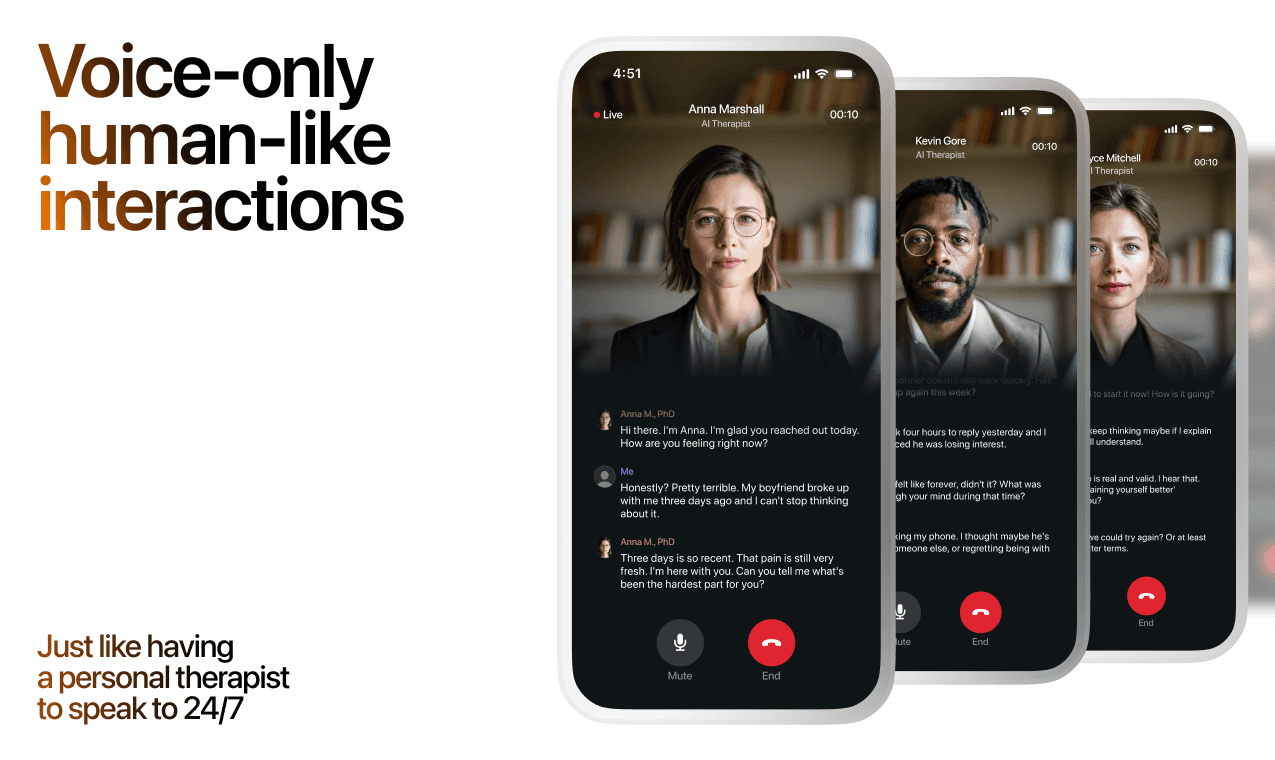
Here's what happens in a typical Lovon session:
You share what's on your mind
There's no script, no intake form, no waiting room. You speak or type whatever you're feeling — in your own words, at your own pace.
Lovon validates and explores
Using frameworks from CBT (Cognitive Behavioral Therapy) and motivational interviewing, Lovon acknowledges your feelings first, then gently helps you explore them. No dismissive "just move on" advice.
You build coping skills together
Lovon doesn't just listen — it actively works with you on evidence-based techniques: thought reframing, urge surfing, behavioral experiments, and more.
What a Session with Lovon Looks Like
When to Seek Professional Help
AI support is a valuable tool, but it's not a replacement for professional care. Please consider reaching out to a licensed therapist if you experience any of the following:
- Persistent thoughts of self-harm or suicide
- Inability to perform daily activities (work, eating, sleeping) for more than 2 weeks
- Turning to alcohol or substances to cope
- Intense anger or desire to harm your ex-partner
- Complete emotional numbness that doesn't improve over time
Crisis Resources (US): If you're in immediate danger, call 988 (Suicide & Crisis Lifeline) or text HOME to 741741 (Crisis Text Line). Available 24/7, free, and confidential.
Outside the US? Find a crisis line in your country
Ready to Start?
Your healing journey can begin right now
A 7-day trial. No judgment. Just a safe space to process what you're going through.
Frequently Asked Questions
Is Lovon a replacement for a real therapist?
Is my conversation with Lovon AI private?
How is Lovon different from ChatGPT for emotional support?
Can I use Lovon if I'm already seeing a therapist?
Can I try Lovon before subscribing?
About the Author
The Lovon Editorial Team
Mental Health & Wellness Content Team
The Lovon Editorial Team develops mental health and wellness content designed to make psychological concepts accessible and actionable. Our goal is to bridge the gap between clinical research and everyday life - helping you understand why your mind works the way it does and what you can do about it....
Related articles
- AI Coping Tools for Postpartum Rage: 2026 Verdict
Postpartum rage needs faster help than a therapy waitlist. See which AI coping tools for postpartum rage actually work…
- Why Do I Shake When Anxious? Causes & Fixes 2026
Shaking when anxious is adrenaline, not weakness. See the real causes, the fastest fixes for 2026, and when shaking…
- How to Identify Emotional Triggers (2026 Step-by-Step)
How to identify emotional triggers in 2026: a 7-step method with body cues, a 14-day log, and fixes for when naming the…
- Can an AI voice app actually calm you down?
Yes, AI voice apps calm acute anxiety spikes fast through paced voice conversation. See how it works, its limits, and…
See also
Quizzes
- Resilience Test: How Fast Do You Bounce Back?
See how you recover from setbacks, in 3 minutes.
- Experiential Avoidance Test: Do You Avoid Your Feelings?
See which way you keep feelings out, in 3 minutes.
Free tools
- How to Reconnect With an Old Friend
A chat for how to reconnect with an old friend, starting with the text you have been meaning to send for a year. Tell it…
- 5-4-3-2-1 Grounding Exercise
A guided run through the 5-4-3-2-1 technique, with paced breathing first if you need it. No sign-up, nothing stored…
From the wiki
- What to do if you have no friends?
Pick one activity that repeats weekly with the same people, and go for six to eight weeks straight. Repetition, not…
Disclaimer: This article is for informational purposes only and does not constitute medical advice, diagnosis, or treatment. Always seek the advice of your physician or other qualified health provider with any questions you may have regarding a medical condition. If you are in crisis or think you may have an emergency, call 988 (Suicide & Crisis Lifeline) or go to the nearest emergency room. Outside the US? Find a crisis line in your country.