
Emotionally Unavailable Partner: Signs & Fixes (2026)
Spot an emotionally unavailable partner fast: signs, a 7-step fix, and when to walk away. Practical 2026 guide with real conversation scripts.

Key Takeaways
- A specific, recent incident to reference (vague complaints like "you're always distant" don't land)
- 20-30 minutes of uninterrupted time, not a rushed conversation before work
- A calm nervous system on your end — dysregulated conversations rarely produce honest answers
- Willingness to hear "I don't know how" instead of "I don't care"
- Optional: a structured space to process your own reaction first, since going in activated usually backfires
An emotionally unavailable partner shows up physically but stays closed off emotionally — no depth, no vulnerability, no real repair after conflict. This guide breaks down the signs, walks through what to actually do about it, and tells you when the pattern is fixable versus when it's time to walk.
TL;DR
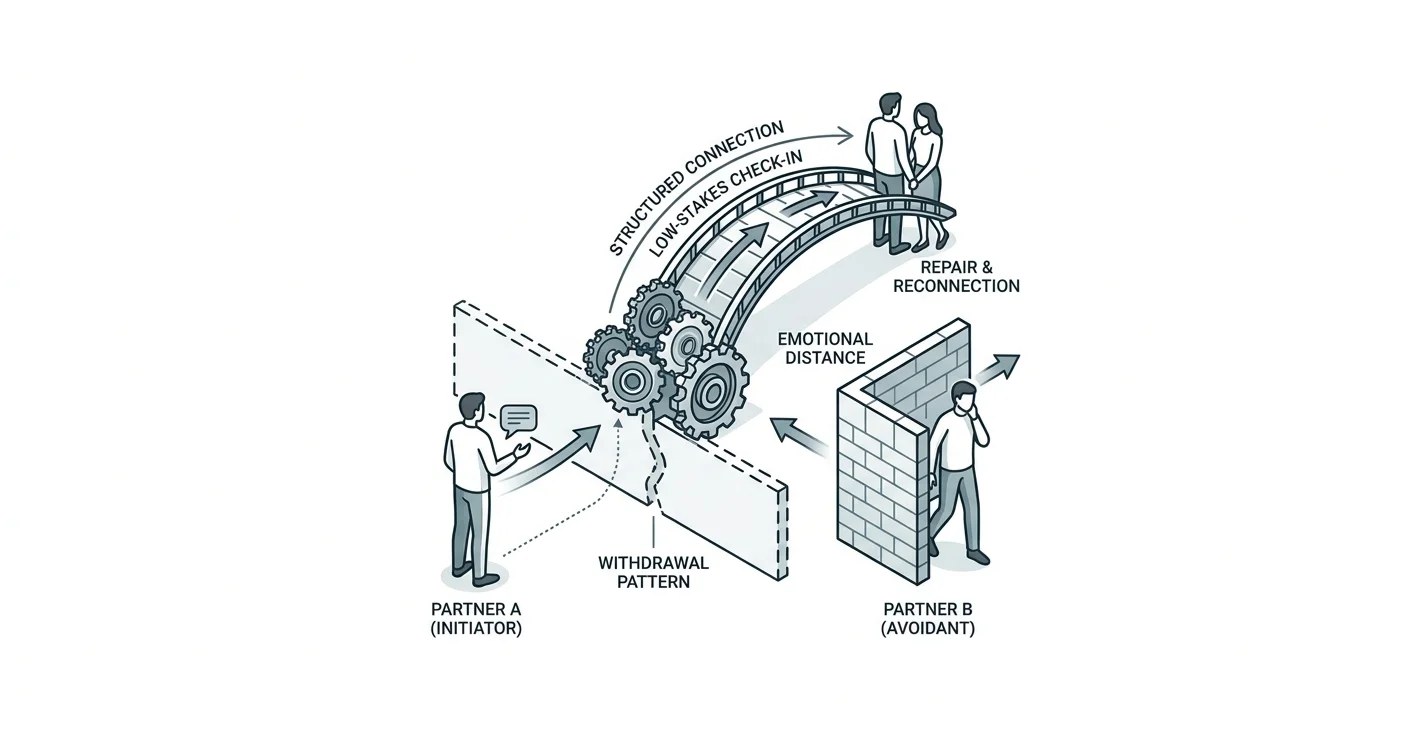
An emotionally unavailable partner deflects intimacy, avoids conflict resolution, and keeps you guessing about where you stand — often without meaning to cause harm. The fix starts with naming the pattern out loud, then testing whether your partner can tolerate a direct, low-stakes conversation about feelings. If they can engage even briefly, the relationship is workable. If every attempt gets met with silence, sarcasm, or a subject change, that's your answer: this needs professional support or an exit plan, not more patience. Recognizing the pursuer-withdrawer pattern early saves years of guessing.
Why this matters
Emotional unavailability isn't a personality quirk you can love your way out of. It's usually a nervous system response — often tied to avoidant attachment — and it shows up as distance right when closeness is needed most.
Left unaddressed, this pattern erodes trust slowly. You stop bringing things up. You start managing your own needs down to a size that won't provoke a shutdown. By 2026, more people are naming this pattern earlier thanks to wider public familiarity with attachment theory, but naming it and changing it are two different jobs.
What you'll need
- A specific, recent incident to reference (vague complaints like "you're always distant" don't land)
- 20-30 minutes of uninterrupted time, not a rushed conversation before work
- A calm nervous system on your end — dysregulated conversations rarely produce honest answers
- Willingness to hear "I don't know how" instead of "I don't care"
- Optional: a structured space to process your own reaction first, since going in activated usually backfires
The steps
Step 1: Name the pattern, not the person
Describe the behavior, not the character flaw. "When I brought up moving in together, you changed the subject twice" lands differently than "you're emotionally unavailable." The first is discussable. The second triggers defense.
This matters because emotionally unavailable partners often already suspect something is off and are braced for blame. A specific, behavioral opener lowers the wall instead of raising it.
Common mistake: leading with a diagnosis ("you have an avoidant attachment style") instead of an example. Save the label for later, if at all.
Step 2: Pick your moment deliberately
Timing decides whether this conversation goes anywhere. Never start it during or right after conflict, when cortisol is already elevated and defenses are up.
Choose a neutral window — a walk, a drive, a quiet evening with no deadline pressing. Give a heads-up: "I want to talk about something later tonight, nothing urgent." That single sentence prevents ambush-shutdown.
Expected outcome: your partner arrives at the conversation regulated instead of already bracing. Common mistake: bringing it up mid-argument because the example is fresh — the timing kills the message.
Step 3: Ask one open question and stop talking
Ask something like "What happens for you when I bring up feelings?" Then wait. Silence feels unbearable but it's doing work — it gives an avoidant nervous system room to find words instead of a script to react to.
Most people fill silence to rescue the other person from discomfort. Resist that. The answer, even if it's "I don't know," tells you something real.
If you get a genuine attempt at an answer, even a clumsy one, that's a workable sign. If you get a joke, a deflection, or "why does this always have to be a thing," write that down mentally — it's data.
Step 4: Watch for repair, not perfection
No partner handles every conversation about feelings well on the first try. What separates a fixable pattern from a fixed one is whether they circle back later — an unprompted "hey, about earlier, I was thinking about what you said."
That circling-back is repair, and it's the single strongest predictor of whether emotional availability can grow. Its total absence after multiple attempts, across weeks or months, is the clearest red flag you'll get.
Common mistake: mistaking an apology for repair. "Sorry I got weird" without any follow-through on the actual issue is not the same thing.
Step 5: Introduce structure, not ultimatums
Instead of "you need to open up or we're done," try something concrete and time-bound: "Can we check in for 10 minutes on Sundays about how we're both doing?" Structure lowers the emotional stakes of any single conversation because it's routine, not a crisis.
This works because emotionally unavailable partners often fear that any emotional conversation will spiral into a relationship-ending confrontation. A small, recurring, low-pressure format proves that's not true.
Expected outcome over 4-6 weeks: shorter check-ins get slightly easier, or they get skipped entirely — both are informative.
Step 6: Get outside support before you're depleted
Don't wait until you're resentful to bring in a third input. A neutral space to process what you're noticing — without your partner in the room — keeps you from either exploding or shutting down yourself.
An AI relationship coach can help you rehearse these conversations or just talk through your own reactions between attempts, especially at 11pm when the spiral starts and no one else is awake. This isn't a replacement for couples counseling if things get serious, but it fills the gap between sessions or before you're ready to involve a professional at all.
Step 7: Decide your timeline
Set a real deadline for yourself — not for them. Something like "if nothing shifts in 3 months of consistent, calm attempts, I need to reassess." Vague patience with no endpoint is how people stay stuck for years.
This step protects you regardless of outcome. If things improve, great, the deadline never gets tested. If they don't, you've already given yourself permission to act instead of waiting for a sign that may never come.
Troubleshooting
Problem: every conversation ends in "you're overthinking this." Fix: stop debating whether the feeling is valid and redirect to the specific behavior. "Maybe I am overthinking it — I still want to understand why you changed the subject."
Problem: they agree to check-ins, then always have a reason to skip. Fix: two skips in a row is your answer. A third scheduling attempt rarely changes the pattern.
Problem: you feel guilty for "pushing." Fix: naming a need directly isn't pushing — it's information. Guilt here often signals your own anxious attachment style reacting to distance, not an actual overstep on your part.
Problem: they open up once, then shut down harder afterward. Fix: this is common and not a failure — it usually means the vulnerability felt exposing. Slow the pace, shorten check-ins, and don't reference the one open moment as proof they "can do it" whenever they want.
Problem: you're the one who ends up comforting them after you bring up your own needs. Fix: that role reversal is worth naming directly: "I notice when I bring something up, I end up taking care of you instead." This flips the dynamic without blame.
Tools and resources
- Pursuer-withdrawer pattern breakdown if the chase-and-retreat cycle sounds familiar
- Avoidant attachment style patterns and how to change for the attachment science behind the behavior
- AI relationship coach for avoidant partners for practicing conversations before you have them for real
- A journal or notes app to track patterns over weeks, not just single incidents
- Lovon's voice-based sessions, useful when you need to talk something through at 1am and no one else is available
What to do next
If the steps above surface more questions about your own reactions — why you keep chasing, why silence feels like rejection — that's worth its own look. Read the anxious attachment style guide next; the two patterns almost always show up together.
FAQ
What does an emotionally unavailable partner look like day to day? They avoid deep conversations, deflect with humor or logistics, and rarely initiate emotional check-ins. Physical presence without emotional presence is the core signature.
Is emotional unavailability the same as avoidant attachment? Not always, but overlap is common. Avoidant attachment is one root cause; others include unprocessed grief, burnout, or simply never having modeled emotional openness growing up.
Can an emotionally unavailable partner change? Yes, with consistent, low-pressure practice and often outside support — but only if they recognize the pattern themselves. Change forced entirely by an ultimatum rarely holds past a few months.
How long should I wait for things to improve? Give it a defined window, 8-12 weeks of real attempts on both sides, not open-ended patience. No movement in that window is meaningful information, not bad luck.
Is it my fault if my partner shuts down when I bring up feelings?" No. You can create ideal conditions — good timing, calm tone, specific language — and still get shut out. That response is about their capacity, not your delivery.
Should I bring up attachment theory directly? Usually not as an opener. Leading with "you're avoidant" reads as diagnosis and triggers defense. Describe behavior first; save the framework for later if it's useful.
Does therapy help with this, or just time? Structured support helps more than time alone in most cases, because it gives both partners language and a safe format instead of relying on willpower during a hard conversation.
What's the biggest mistake people make trying to fix this? Waiting for the other person to bring it up first. Emotionally unavailable partners rarely initiate the conversation that would fix the distance — someone has to name it out loud.
One last thing
The detail most people miss: emotional unavailability often looks like calm. No yelling, no drama, nothing overtly wrong — just a low hum of distance that's easy to explain away for years. That calm is exactly why it goes unaddressed longer than louder relationship problems do. If something feels quietly off, trust that signal before you talk yourself out of it again.
Related guides
How AI Support Helps You Heal
AI emotional support isn't about replacing human connection — it's about filling the gaps. The moments when you need to talk at 2 AM, when you don't want to burden your friends again, or when you simply need someone to listen without judgment.
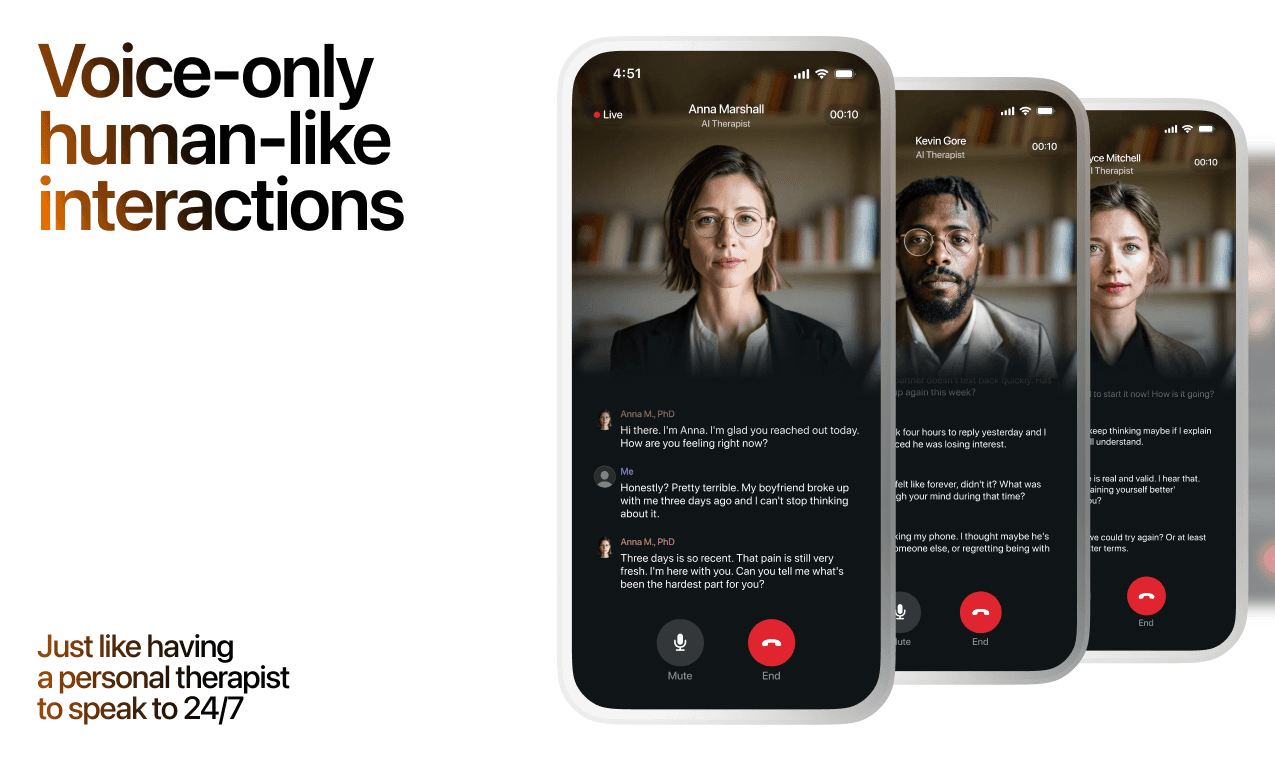
Here's what happens in a typical Lovon session:
You share what's on your mind
There's no script, no intake form, no waiting room. You speak or type whatever you're feeling — in your own words, at your own pace.
Lovon validates and explores
Using frameworks from CBT (Cognitive Behavioral Therapy) and motivational interviewing, Lovon acknowledges your feelings first, then gently helps you explore them. No dismissive "just move on" advice.
You build coping skills together
Lovon doesn't just listen — it actively works with you on evidence-based techniques: thought reframing, urge surfing, behavioral experiments, and more.
What a Session with Lovon Looks Like
When to Seek Professional Help
AI support is a valuable tool, but it's not a replacement for professional care. Please consider reaching out to a licensed therapist if you experience any of the following:
- Persistent thoughts of self-harm or suicide
- Inability to perform daily activities (work, eating, sleeping) for more than 2 weeks
- Turning to alcohol or substances to cope
- Intense anger or desire to harm your ex-partner
- Complete emotional numbness that doesn't improve over time
Crisis Resources (US): If you're in immediate danger, call 988 (Suicide & Crisis Lifeline) or text HOME to 741741 (Crisis Text Line). Available 24/7, free, and confidential.
Outside the US? Find a crisis line in your country
Ready to Start?
Your healing journey can begin right now
A 7-day trial. No judgment. Just a safe space to process what you're going through.
Frequently Asked Questions
Is Lovon a replacement for a real therapist?
Is my conversation with Lovon AI private?
How is Lovon different from ChatGPT for emotional support?
Can I use Lovon if I'm already seeing a therapist?
Can I try Lovon before subscribing?
About the Author
The Lovon Editorial Team
Mental Health & Wellness Content Team
The Lovon Editorial Team develops mental health and wellness content designed to make psychological concepts accessible and actionable. Our goal is to bridge the gap between clinical research and everyday life - helping you understand why your mind works the way it does and what you can do about it....
Related articles
- How to Develop Secure Attachment in 2026: 7 Steps
How to develop secure attachment in 2026: 7 practical steps, a real timeline (8-12 weeks), and fixes for anxious and…
- Why Do I Push People Away? 2026 Fix Guide
Why do I push people away, answered with steps that work in 2026: name the urge, pause 90 seconds, repair fast. Fearful…
- Dismissive Avoidant Attachment: Signs & Fixes (2026)
Dismissive avoidant attachment explained: what drives the withdrawal, how to respond, and when it actually shifts…
- Anxious Preoccupied Attachment: Signs & How to Shift 2026
Anxious preoccupied attachment drives protest behavior like over-texting and reassurance-seeking. Get the signs and a…
See also
Quizzes
- Emotionally Unavailable Test: 12-Question Self-Check
See which part of you closes off, in three minutes.
- Relationship Schema Test: Are Your Feelings Welcome?
See which belief edits what you share, in 3 minutes.
Free tools
- How to Reconnect With Your Partner
Nothing is wrong enough to name, which is why it has gone unaddressed. Tell it what it looks like now and roughly when…
- Deep Conversation Starters That Fit the Person You're Asking
The right question depends on who is across from you and how much history is behind it. Tell it who you are talking to…
From the wiki
- What does clingy mean in a relationship?
Clingy is what people call behavior that asks for more contact or reassurance than the other person wants to give…
Disclaimer: This article is for informational purposes only and does not constitute medical advice, diagnosis, or treatment. Always seek the advice of your physician or other qualified health provider with any questions you may have regarding a medical condition. If you are in crisis or think you may have an emergency, call 988 (Suicide & Crisis Lifeline) or go to the nearest emergency room. Outside the US? Find a crisis line in your country.