
Is My Partner Emotionally Unavailable Quiz: 2026 Verdict
Take the 12-question is my partner emotionally unavailable quiz, score your pattern, and get a 2026 verdict on whether to monitor, talk, or act now.

Key Takeaways
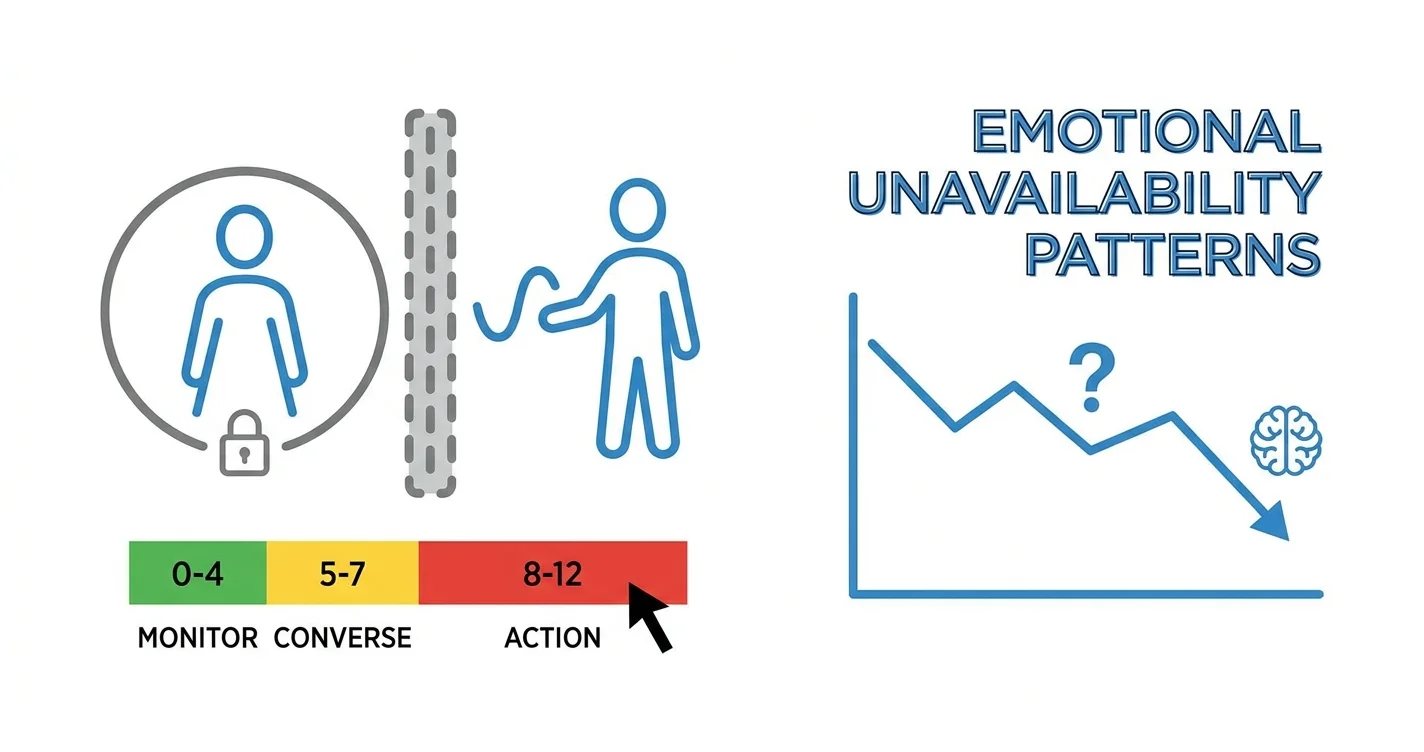
- 0-4 yes answers: Normal relationship friction. Verdict: Monitor, Don't Panic.
- 5-7 yes answers: A real pattern is forming. Verdict: Have the Conversation.
- 8-12 yes answers: Chronic emotional unavailability. Verdict: Take Action.
- Don't diagnose your partner with a label. "Avoidant" and "emotionally unavailable" describe patterns, not fixed
- Don't confuse introversion with unavailability. A quiet partner who still shows up during hard moments and talks
You're not imagining it. If you're searching "is my partner emotionally unavailable quiz," something in your relationship already feels off, and this guide gives you a self-scoring quiz plus the specific patterns that separate a genuinely closed-off partner from someone who's just having a hard month.
TL;DR: The is my partner emotionally unavailable quiz below uses 12 yes/no questions covering communication, conflict response, and future planning. Score 8 or above and the pattern is likely chronic emotional unavailability, not a bad week — Verdict: Take Action. Score under 5 and you're probably dealing with normal relationship friction, not avoidance — Verdict: Monitor, Don't Panic. Attachment style, not personality, usually drives the behavior, and 2026 relationship research keeps circling back to that same finding.
Why this matters
Emotional unavailability isn't a diagnosis — it's a pattern of behavior that leaves the other partner doing all the emotional labor. Left unaddressed, it erodes trust faster than almost any other relationship issue, because the unavailable partner rarely realizes they're doing it.
A quiz won't replace a conversation with your partner or a licensed therapist, but it does something a gut feeling can't: it turns a vague sense of "something's wrong" into a specific, countable pattern you can act on in 2026. That's the whole point of running through this before you decide what to do next.
Who this is for
This quiz is built for people who feel consistently unheard, dismissed, or kept at arm's length by a partner they otherwise love — not for anyone dealing with a single bad fight or a partner going through an obvious hard time (job loss, grief, illness). If your partner is normally warm and has recently gone quiet for a clear reason, that's context, not a pattern. If the distance has been the baseline for months, keep reading.
What to look for before you even take the quiz
How they respond to your bad days
A partner who's emotionally available shows up when you're struggling, even clumsily. One who's unavailable changes the subject, minimizes it, or goes quiet — this matters because it's the clearest real-time test of connection, not what they say when things are calm.
Whether conflict ever resolves
Healthy couples argue and then repair. Emotionally unavailable partners tend to stonewall, disappear for hours or days, or agree just to end the conversation without actually resolving anything. If you notice this stonewalling pattern specifically, what is stonewalling and why partners do it breaks down why it happens and what it isn't.
How they talk about the future
Vague, non-committal answers about next year, moving in, or meeting family aren't shyness — they're often a deliberate way to avoid vulnerability. This one criterion alone predicts a lot of what happens over the next 12 months of a relationship.
Whether affection is consistent or comes in bursts
Intense closeness followed by sudden distance is a specific red flag, distinct from someone who's simply reserved. If the pattern feels like hot-and-cold rather than steady, love bombing: when attention turns into a red flag is worth reading alongside your quiz score.
How they handle your need for reassurance
Everyone needs reassurance sometimes. A partner who treats that need as "too much" or "clingy" repeatedly is signaling discomfort with emotional closeness itself, not with you specifically.
Whether you're the one always initiating depth
If every meaningful conversation happens because you started it, that imbalance is data. Emotionally available partners initiate vulnerability roughly as often as they receive it.
Take the quiz: 12 questions, 2 minutes
Answer yes or no. Count your "yes" answers.
- Does your partner change the subject when you bring up feelings?
- Do arguments end without resolution more often than not?
- Do they avoid using words like "us" or "we" about the future?
- Has affection felt inconsistent — intense, then distant — over the last 3 months?
- Do they seem uncomfortable when you need comfort or reassurance?
- Are you almost always the one who starts serious conversations?
- Do they go silent for hours or days after conflict?
- Do they downplay your feelings as "overreacting"?
- Have they avoided introducing you to close friends or family after 6+ months together?
- Do they deflect with humor or sarcasm when things get emotionally serious?
- Do you feel like you know less about their inner life than they know about yours?
- Have you stopped bringing up certain topics because you know how they'll react?
Scoring:
- 0-4 yes answers: Normal relationship friction. Verdict: Monitor, Don't Panic.
- 5-7 yes answers: A real pattern is forming. Verdict: Have the Conversation.
- 8-12 yes answers: Chronic emotional unavailability. Verdict: Take Action.
What your score actually means
Score 0-4 — the low-concern pick. One or two "yes" answers usually reflect a stressful season, not a fixed pattern. The specific number to watch is consistency over 90 days: if the same answers stay "no" for three months straight, you're fine. Verdict: Monitor.
Score 5-7 — the gray-zone pick. This is the score most people actually land on, and it means the pattern is real but not yet entrenched. The honest move here is a direct, low-blame conversation rather than an ultimatum. For language that doesn't turn into a fight, how to communicate better in a relationship: 9 steps gives you a script. Verdict: Have the Conversation.
Score 8-12 — the hard-truth pick. At this level, the behavior is a pattern, not a phase, and it usually traces back to an attachment style formed long before this relationship. Understanding the mechanism changes how you respond to it — dismissive-avoidant attachment: how they think and feel explains the internal logic behind the distance. Verdict: Take Action.
If the quiz described your partner but also sounds like you — you initiate depth but then pull back yourself, or you've noticed the same pattern in past relationships — the deeper answer might be about your own patterns, not just theirs. Why do I attract emotionally unavailable people? covers that overlap directly. Verdict: Worth Reading Either Way.
What to avoid
- Don't diagnose your partner with a label. "Avoidant" and "emotionally unavailable" describe patterns, not fixed personality types — treating either as a permanent verdict shuts down the conversation before it starts.
- Don't confuse introversion with unavailability. A quiet partner who still shows up during hard moments and talks about the future is available — they're just not chatty.
- Don't skip the direct conversation because the quiz gave you an answer. A score is a starting point for a talk, not a replacement for one.
Score-to-action comparison
| Quiz score | What it likely means | Recommended move | Verdict |
|---|---|---|---|
| 0-4 | Situational stress, not a pattern | Track for 90 days | Monitor |
| 5-7 | Emerging pattern | Direct conversation this week | Have the Conversation |
| 8-12 | Chronic unavailability | Reassess the relationship's trajectory | Take Action |
FAQ
Is there an actual clinical quiz for emotional unavailability? No single validated clinical instrument measures "emotional unavailability" specifically — most self-assessments, including this one, are behavioral checklists based on recognized relationship and attachment patterns, not a diagnostic test.
Can an emotionally unavailable partner change? Yes, but only with consistent effort and usually with outside support — attachment patterns formed early in life are slow to shift, and change requires the partner to recognize the pattern themselves.
Is emotional unavailability the same as avoidant attachment? They overlap heavily but aren't identical — avoidant attachment is a specific psychological framework, while emotional unavailability is a broader behavioral description that can stem from avoidant attachment, past trauma, or an unrelated current stressor.
How is this different from an attachment style quiz? This quiz measures current relationship behavior with a specific partner, while an attachment style quiz measures your own relational tendencies across relationships — the two are related but answer different questions.
Should I show my partner the quiz results? Sharing the specific behaviors that scored "yes" works better than sharing a number — a score can feel like an accusation, while a specific example ("you went quiet for two days after our fight last week") opens a real conversation.
How long should I wait before deciding this is a pattern, not a phase? Most relationship counselors point to roughly 90 days of consistent behavior as the marker between a rough patch and an entrenched pattern — shorter windows are too easily explained by external stress.
Does emotional unavailability always mean the relationship is doomed? No — a high score means a real conversation is overdue, not that the relationship is unsalvageable, and plenty of couples work through this with direct communication or outside support.
Can talking to an AI therapist help me process this before I talk to my partner? Yes — rehearsing what you want to say out loud, with Lovon's AI voice sessions, can help you walk into the real conversation calmer and clearer instead of reactive.
One last thing
The single most predictive question on this quiz isn't about big fights — it's question 6, whether you're always the one initiating depth. Couples where both partners take turns going first emotionally report far fewer of these quiz "yes" answers overall, and that one habit is easier to test for this week than any of the others.
If the quiz landed you in the "Take Action" range and you want a low-pressure way to think out loud before the real conversation, Lovon's AI voice sessions are built for exactly that kind of rehearsal — private, on your schedule, and not a replacement for couples counseling if this pattern runs deep.
Related guides
How AI Support Helps You Heal
AI emotional support isn't about replacing human connection — it's about filling the gaps. The moments when you need to talk at 2 AM, when you don't want to burden your friends again, or when you simply need someone to listen without judgment.
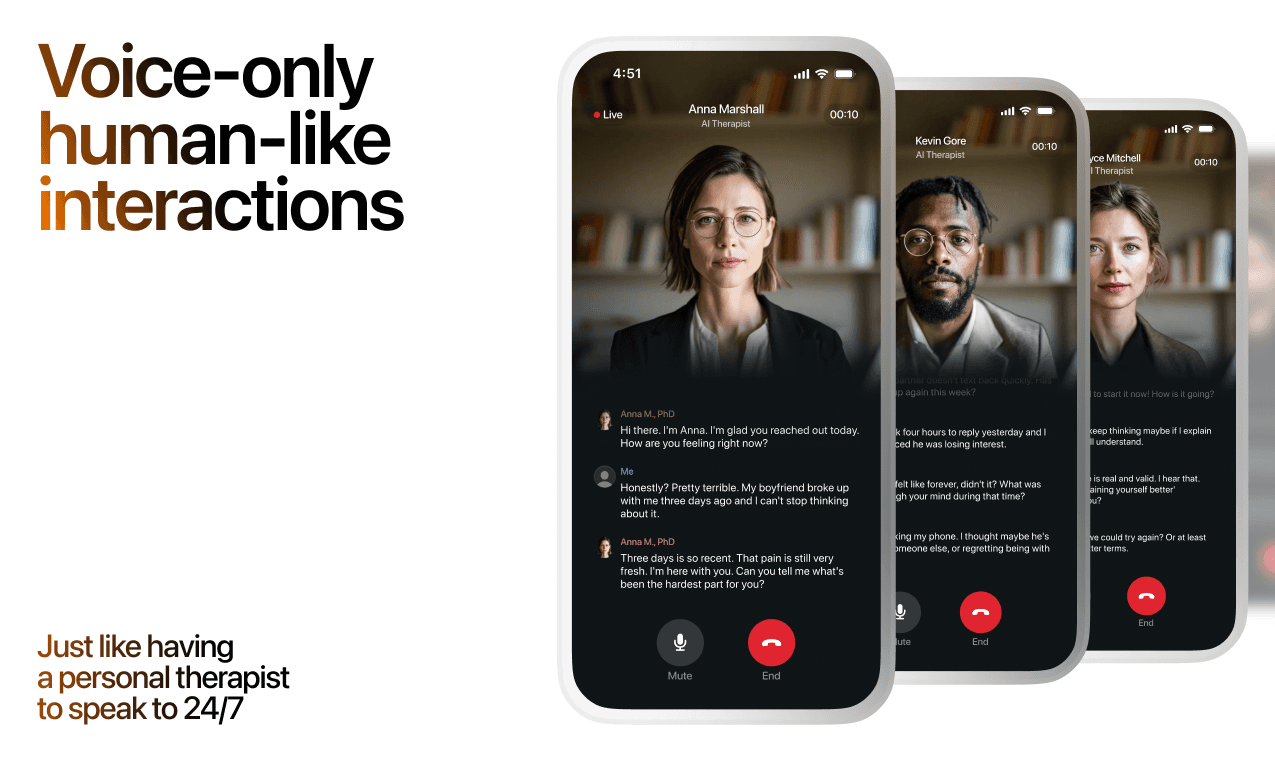
Here's what happens in a typical Lovon session:
You share what's on your mind
There's no script, no intake form, no waiting room. You speak or type whatever you're feeling — in your own words, at your own pace.
Lovon validates and explores
Using frameworks from CBT (Cognitive Behavioral Therapy) and motivational interviewing, Lovon acknowledges your feelings first, then gently helps you explore them. No dismissive "just move on" advice.
You build coping skills together
Lovon doesn't just listen — it actively works with you on evidence-based techniques: thought reframing, urge surfing, behavioral experiments, and more.
What a Session with Lovon Looks Like
When to Seek Professional Help
AI support is a valuable tool, but it's not a replacement for professional care. Please consider reaching out to a licensed therapist if you experience any of the following:
- Persistent thoughts of self-harm or suicide
- Inability to perform daily activities (work, eating, sleeping) for more than 2 weeks
- Turning to alcohol or substances to cope
- Intense anger or desire to harm your ex-partner
- Complete emotional numbness that doesn't improve over time
Crisis Resources (US): If you're in immediate danger, call 988 (Suicide & Crisis Lifeline) or text HOME to 741741 (Crisis Text Line). Available 24/7, free, and confidential.
Outside the US? Find a crisis line in your country
Ready to Start?
Your healing journey can begin right now
A 7-day trial. No judgment. Just a safe space to process what you're going through.
Frequently Asked Questions
Is Lovon a replacement for a real therapist?
Is my conversation with Lovon AI private?
How is Lovon different from ChatGPT for emotional support?
Can I use Lovon if I'm already seeing a therapist?
Can I try Lovon before subscribing?
About the Author
The Lovon Editorial Team
Mental Health & Wellness Content Team
The Lovon Editorial Team develops mental health and wellness content designed to make psychological concepts accessible and actionable. Our goal is to bridge the gap between clinical research and everyday life - helping you understand why your mind works the way it does and what you can do about it....
Related articles
- Signs of Insecure Attachment in Adults (2026 Guide)
Signs of insecure attachment in adults, explained step by step: fear of abandonment, withdrawal, reassurance-seeking…
- Emotional Dependence in Relationships: 6 Signs (2026)
Emotional dependence in relationships shows up in 6 specific patterns. Check the signs, avoid the common mistakes, and…
- Insecure in Your Relationship? Understand Your Insecurity & Feel Secure
Quick Takeaways:
- Anxious Attachment and Love Avoidant: Break the Cycle 2026
Anxious attachment and love avoidant partners create a push-pull cycle. Learn the pattern, 7 steps to break it, and…
See also
Quizzes
- Relationship Schema Test: Are Your Feelings Welcome?
See which belief edits what you share, in 3 minutes.
- Do I Have Abandonment Issues? 12-Question Self-Check
See how loudly the fear of being left runs things.
Free tools
- How to Reconnect With Your Partner
Nothing is wrong enough to name, which is why it has gone unaddressed. Tell it what it looks like now and roughly when…
- 150 Questions to Ask Your Partner
Six sets, from Tuesday-night light to the ones couples put off for years. Deal them one at a time, or read all 150…
From the wiki
- What does clingy mean in a relationship?
Clingy is what people call behavior that asks for more contact or reassurance than the other person wants to give…
Disclaimer: This article is for informational purposes only and does not constitute medical advice, diagnosis, or treatment. Always seek the advice of your physician or other qualified health provider with any questions you may have regarding a medical condition. If you are in crisis or think you may have an emergency, call 988 (Suicide & Crisis Lifeline) or go to the nearest emergency room. Outside the US? Find a crisis line in your country.