
Attachment Style Test for Adults: 2026 Verdict
Which attachment style test for adults actually holds up in 2026? Compare ECR-R, RQ, and Lovon's quiz with clear Buy/Skip verdicts and next steps.

Key Takeaways
- Single-question "which attachment style are you" quizzes. One forced-choice question can't distinguish four patterns
- Tests with no visible scoring method. If a quiz can't explain how your answers turned into a label, the label isn't
- Anything that pathologizes the result. A test that tells you an insecure result means you're "unlovable" or "toxic"
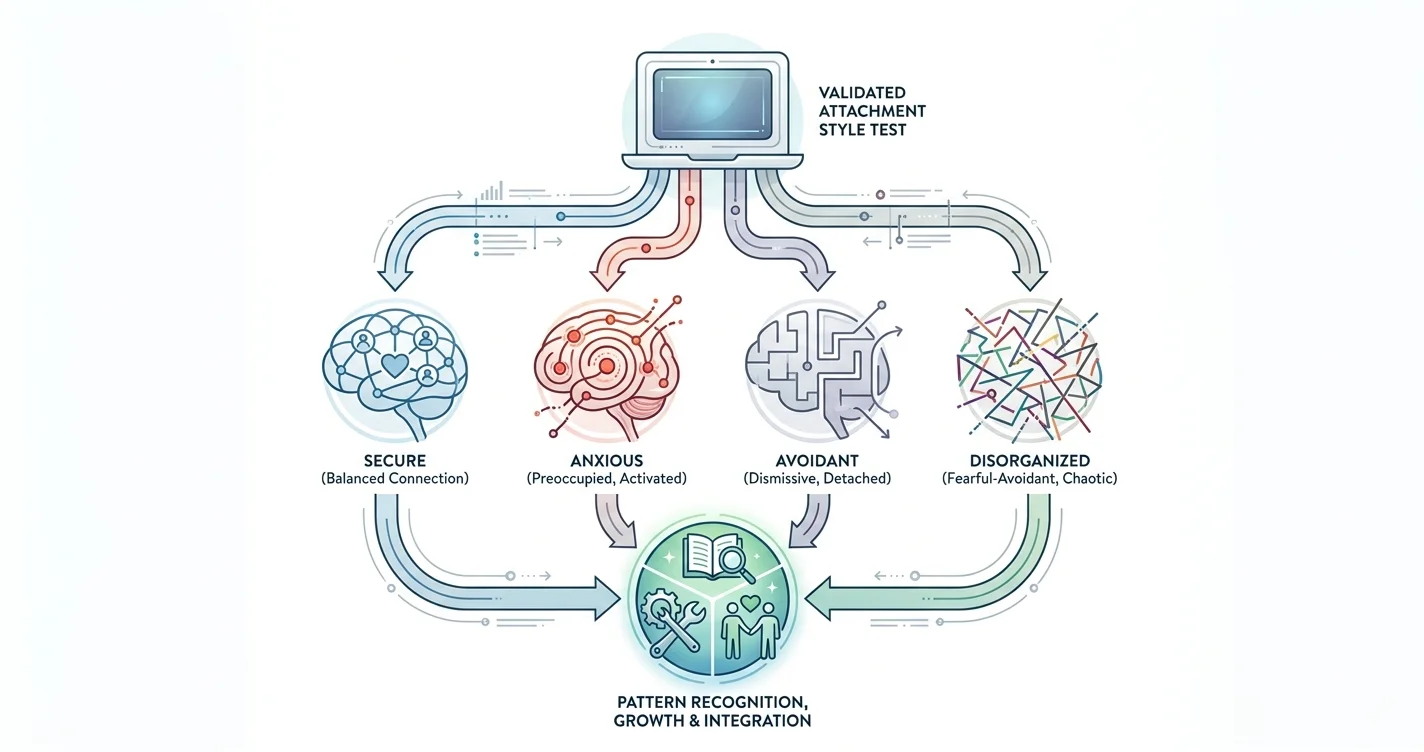
An attachment style test for adults sorts your relationship patterns into one of four categories — secure, anxious, avoidant, or disorganized — based on how you handle closeness, conflict, and distance from a partner. This guide breaks down which tests are worth your time in 2026, what a good one actually measures, and what to do once you have an answer.
TL;DR
The best attachment style test for most adults is a validated four-category quiz, not a one-question pop quiz. Lovon's 2-minute attachment style quiz is the fastest reliable option for a first pass in 2026, the ECR-R remains the researcher's gold standard at 36 items, and anything that labels you "broken" after five questions is a Skip. Your result is a starting point for pattern recognition, not a diagnosis — pair it with reading on your specific style before you act on it.
Who this is for
This is for adults who notice a repeating pattern — pulling away when someone gets close, panicking when a text goes unanswered, or feeling numb during conflict — and want a name for it instead of guessing. It's for people prepping for a new relationship, working through a rough patch in a current one, or trying to figure out why the same dynamic keeps showing up with different partners. If you've read about anxious attachment style signs and thought "that's me," a proper test confirms or challenges that hunch with actual scoring instead of vibes.
Why this matters
Attachment theory didn't start as relationship-quiz content — it came out of decades of developmental psychology research on how infants and later adults regulate closeness and separation. A 1997 U.S. survey by Mickelson, Kessler, and Shaver found roughly 59% of adult respondents identified as secure, 25% as avoidant, and 11% as anxious, with the remainder fearful or disorganized. That distribution matters because it tells you insecure patterns are common, not rare or shameful — you're not an outlier if your result comes back anxious or avoidant.
The problem in 2026 is volume: search "attachment style test" and you get a mix of validated instruments and single-page quizzes built for social shares. The scoring quality varies enormously, and a bad test gives you a bad label that sticks in your head for years.
What to look for in an attachment style test for adults
Validated scoring, not vibes
A real test maps your answers to established categories using a scoring method that's been checked against other measures. If a quiz gives you a result without showing any scoring logic, treat the label as a guess, not a finding.
Four categories, not two
Many quick quizzes only sort you into "secure" or "anxious," collapsing avoidant and disorganized patterns into a vague "other." A useful test separates all four, because the coping strategies for dismissive-avoidant and fearful-avoidant patterns are different from each other, not interchangeable.
Covers more than romance
Attachment shows up with friends, coworkers, and family, not just partners. A test that only asks about dating relationships misses patterns that show up everywhere else in your life.
Gives you a next step, not just a label
The point of the test isn't the badge, it's what you do after. A good result comes with direction — reading on your specific pattern, coping tools, or a way to talk through it — instead of leaving you with a word and nothing else.
Reasonable time investment
Something built for adults with actual schedules should take 2 to 10 minutes for a self-report version. Anything demanding 30-plus minutes for a free online quiz is usually padding, not rigor.
No shame framing
Watch for language that treats insecure attachment as a character flaw. Attachment patterns form early and change with effort — a test that implies you're permanently defective is doing you a disservice.
Top picks
ECR-R (Experiences in Close Relationships-Revised) — the researcher's pick. This 36-item self-report measure scores you on two continuous dimensions, anxiety and avoidance, instead of forcing a single category. It's the version most attachment researchers still cite in 2026, and it takes about 10 minutes to complete. Buy if you want the most academically grounded option and don't mind interpreting a two-axis score yourself.
Relationship Questionnaire (RQ) — the quick sort. This is the short, four-paragraph forced-choice tool descended from the original Hazan and Shaver research, and it takes under 3 minutes. It trades nuance for speed, giving you one clean category instead of a spectrum. Consider it as a fast first check before going deeper.
Lovon's 2-minute attachment style quiz — the conversational pick. It runs through the four core patterns in a plain-language format built for adults who want a same-day answer, not a research protocol, and it connects directly to follow-up reading for whichever style you land on. Buy if you want speed plus a clear next step instead of a bare label.
Dismissive-avoidant self-assessment — the pattern check for the "I'm fine on my own" crowd. If you consistently score high on avoidance and low on anxiety, the deeper read on dismissive-avoidant attachment explains why closeness can feel like a threat even when you logically want connection. Consider this a required second step if your test result skews avoidant, since the raw label alone rarely changes behavior.
Attachment Style Interview (ASI) — the clinical deep dive. This is a semi-structured interview conducted by a trained clinician, built for research and clinical settings rather than self-administration. It's thorough but not something you run on your own in an afternoon. Wait on this one unless you're working with a licensed clinician who administers it directly.
What to avoid
- Single-question "which attachment style are you" quizzes. One forced-choice question can't distinguish four patterns with any reliability — treat these as entertainment, not data.
- Tests with no visible scoring method. If a quiz can't explain how your answers turned into a label, the label isn't trustworthy.
- Anything that pathologizes the result. A test that tells you an insecure result means you're "unlovable" or "toxic" is using shame as engagement bait, not giving you useful information.
Verdict comparison
| Test | Time | Styles measured | Best for | Verdict |
|---|---|---|---|---|
| ECR-R | ~10 min | 2-dimension score (anxiety, avoidance) | Researchers, detail-seekers | Buy |
| Relationship Questionnaire (RQ) | under 3 min | 4 categories, forced-choice | Fast first check | Consider |
| Lovon attachment style quiz | ~2 min | 4 categories, plain language | Adults wanting speed plus follow-up | Buy |
| Attachment Style Interview (ASI) | 45-60 min, clinician-led | 4 categories, in-depth | Clinical settings only | Wait |
| One-question social quizzes | under 1 min | 1-2 categories | Entertainment only | Skip |
FAQ
What's the best attachment style test for adults in 2026? A validated four-category test beats a one-question quiz every time. The ECR-R is the strongest research-grade option, and Lovon's 2-minute attachment style quiz is the fastest self-report version that still separates all four patterns with follow-up guidance.
Is a free online attachment quiz accurate? Accuracy depends entirely on the scoring method behind it, not the price. Free tools like the RQ and Lovon's quiz can be reliable if they use established categories; free tools with no visible scoring logic usually aren't.
How many attachment styles are there? Most current frameworks use four: secure, anxious (preoccupied), avoidant (dismissive), and disorganized (fearful-avoidant). Some tests, like the ECR-R, score you on two continuous dimensions instead of a single category.
Can your attachment style change? Yes. Attachment patterns form early through repeated relationship experiences, but they're not fixed for life — consistent secure relationships, therapy, and self-work shift the pattern over years, not overnight.
Is anxious attachment the same as being needy? No. Anxious attachment describes a nervous system pattern around fear of abandonment, not a personality flaw, and it usually improves with specific coping strategies rather than willpower alone.
How long does an attachment style test take? Self-report versions run from under 1 minute for pop quizzes to about 10 minutes for the ECR-R. Clinician-administered interviews like the ASI take 45 to 60 minutes and aren't self-run.
Do therapists use attachment style tests? Some do, typically as one input among several rather than a standalone diagnosis. A test result is a conversation starter for therapy, not a replacement for it.
What should I do after taking an attachment style test? Read the specific coping guidance for whichever style you land on rather than stopping at the label. A result without follow-up action just sits in your head as a word.
One last thing
Most people who take an attachment style test in 2026 are looking for a label to explain a specific relationship, not a personality diagnosis for life — and that framing matters. The 1997 Mickelson, Kessler, and Shaver survey pegged insecure patterns at roughly 41% of the adult population combined, which means whatever result you get, you're sitting with a huge share of adults, not an outlier group. The test is the easy part; reading what actually shifts your specific pattern is where the work happens.
Related guides
How AI Support Helps You Heal
AI emotional support isn't about replacing human connection — it's about filling the gaps. The moments when you need to talk at 2 AM, when you don't want to burden your friends again, or when you simply need someone to listen without judgment.
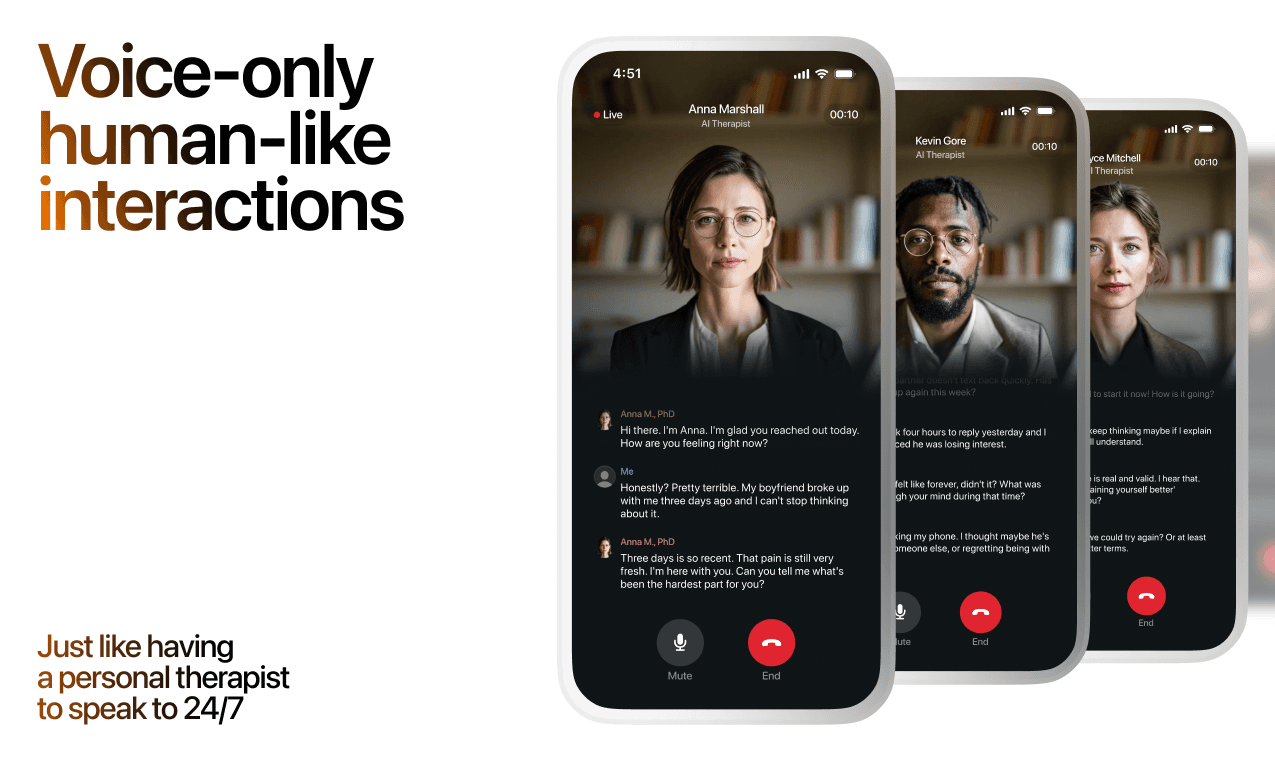
Here's what happens in a typical Lovon session:
You share what's on your mind
There's no script, no intake form, no waiting room. You speak or type whatever you're feeling — in your own words, at your own pace.
Lovon validates and explores
Using frameworks from CBT (Cognitive Behavioral Therapy) and motivational interviewing, Lovon acknowledges your feelings first, then gently helps you explore them. No dismissive "just move on" advice.
You build coping skills together
Lovon doesn't just listen — it actively works with you on evidence-based techniques: thought reframing, urge surfing, behavioral experiments, and more.
What a Session with Lovon Looks Like
When to Seek Professional Help
AI support is a valuable tool, but it's not a replacement for professional care. Please consider reaching out to a licensed therapist if you experience any of the following:
- Persistent thoughts of self-harm or suicide
- Inability to perform daily activities (work, eating, sleeping) for more than 2 weeks
- Turning to alcohol or substances to cope
- Intense anger or desire to harm your ex-partner
- Complete emotional numbness that doesn't improve over time
Crisis Resources (US): If you're in immediate danger, call 988 (Suicide & Crisis Lifeline) or text HOME to 741741 (Crisis Text Line). Available 24/7, free, and confidential.
Outside the US? Find a crisis line in your country
Ready to Start?
Your healing journey can begin right now
A 7-day trial. No judgment. Just a safe space to process what you're going through.
Frequently Asked Questions
Is Lovon a replacement for a real therapist?
Is my conversation with Lovon AI private?
How is Lovon different from ChatGPT for emotional support?
Can I use Lovon if I'm already seeing a therapist?
Can I try Lovon before subscribing?
About the Author
The Lovon Editorial Team
Mental Health & Wellness Content Team
The Lovon Editorial Team develops mental health and wellness content designed to make psychological concepts accessible and actionable. Our goal is to bridge the gap between clinical research and everyday life - helping you understand why your mind works the way it does and what you can do about it....
Related articles
- How to Heal Anxious Attachment on Your Own (2026)
Step-by-step guide to healing anxious attachment solo in 2026: triggers, nervous system work, boundaries, and tools that…
- Attachment Style Compatibility Quiz for Partners 2026
The best attachment style compatibility quiz for partners in 2026 — dual scoring, pairing analysis, and AI coaching…
- BPD Attachment Style: The Push-Pull Cycle Explained 2026
BPD attachment style is almost always disorganized. Learn what drives the push-pull cycle, the 5-step loop, and what…
- Anxious Attachment and Love Avoidant: Break the Cycle 2026
Anxious attachment and love avoidant partners create a push-pull cycle. Learn the pattern, 7 steps to break it, and…
See also
Quizzes
- Do I Miss My Ex or Am I Just Lonely? 12-Question Quiz
Find out what the missing is actually about.
- Do I Have Abandonment Issues? 12-Question Self-Check
See how loudly the fear of being left runs things.
Free tools
- Attachment Trigger Plan for Anxious and Avoidant Patterns
Pick your pattern, tick the moments that set it off, and finish one card for each: your body signal, the thing you will…
- What Did They Actually Mean By That?
A chat for one sentence you cannot stop re-reading. Paste their exact words and what was happening around them, and get…
From the wiki
- What is an attachment style?
An attachment style is the habit your nervous system formed for handling closeness: what you actually do when someone…
Disclaimer: This article is for informational purposes only and does not constitute medical advice, diagnosis, or treatment. Always seek the advice of your physician or other qualified health provider with any questions you may have regarding a medical condition. If you are in crisis or think you may have an emergency, call 988 (Suicide & Crisis Lifeline) or go to the nearest emergency room. Outside the US? Find a crisis line in your country.