
How to Set Boundaries With a Narcissist (2026 Guide)
Learn how to set boundaries with a narcissist without conflict: scripted language, the gray rock method, and follow-through steps that hold up in 2026.

Key Takeaways
- A written-down list of your specific limits (not vague feelings — actual behaviors you won't accept)
- One or two scripted sentences per boundary, memorized in advance
- A consequence you're actually willing to follow through on
- A witness or record for high-stakes boundaries (co-parenting, shared finances)
- A way to decompress after the conversation — a walk, a call to a friend, or a private space to talk it out, which is
Setting a boundary with a narcissist rarely goes the way you rehearsed it in the shower — this guide gives you the exact language, timing, and follow-through that keeps the boundary intact without turning it into a three-hour argument.
TL;DR
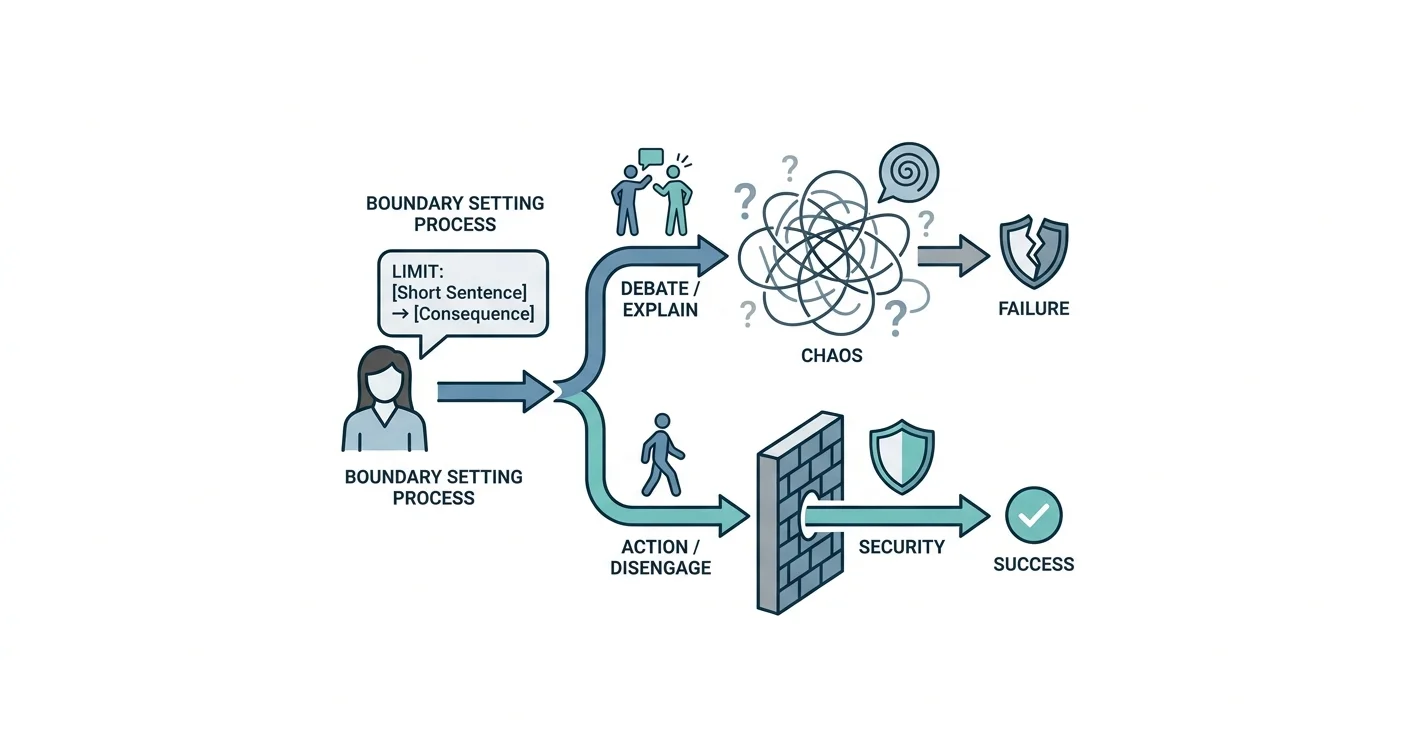
Boundaries with a narcissist work best when they're short, unemotional, and enforced through action instead of debate — the gray rock method paired with a scripted, one-sentence limit is the combination that holds up best in 2026 reporting from relationship therapists. Skip the long explanations; they hand a narcissist material to argue with. If you're learning how to set boundaries with a narcissist, the short version is: decide the limit in advance, state it once, and walk away from the negotiation the moment it starts. This is behavior management, not persuasion — you're not trying to win the conversation.
Why this matters
Most boundary conversations fail with a narcissist because they're treated like a normal disagreement, where explaining yourself is expected to lead to understanding. That's not how it plays out here. A narcissist typically hears a boundary as a threat to control, and responds by escalating, deflecting, or turning the conversation back onto your character — a pattern covered in more depth in narcissistic abuse signs.
The fix isn't a better argument. It's a shorter one. In 2026, the most consistent advice from clinicians working with high-conflict relationships is to remove yourself from the debate entirely and let the boundary be enforced by your actions, not your words. That single shift is what separates boundaries that hold from boundaries that get negotiated away within a week.
Before you set anything, get clear on what a healthy limit actually looks like, since narcissistic dynamics tend to blur the line between a reasonable boundary and being called "controlling" for having one — see healthy relationship boundaries for the baseline.
What you'll need
- A written-down list of your specific limits (not vague feelings — actual behaviors you won't accept)
- One or two scripted sentences per boundary, memorized in advance
- A consequence you're actually willing to follow through on
- A witness or record for high-stakes boundaries (co-parenting, shared finances)
- A way to decompress after the conversation — a walk, a call to a friend, or a private space to talk it out, which is where an app like Lovon fits: a voice-based AI conversation you can use immediately after a hard exchange to process what just happened, without waiting for a scheduled session
- Patience for testing — expect the boundary to be pushed at least once before it sticks
The steps
1. Name the exact behavior, not the person
Write down the specific action you're limiting — "raising your voice during disagreements," not "you're always so aggressive." Narcissists respond to character attacks with counterattacks; a behavior-specific boundary gives them nothing to argue against. This precision is what makes step two possible, because vague boundaries produce vague, endlessly re-negotiable outcomes.
Common mistake: starting the sentence with "you always" — it invites a rebuttal about the one time it wasn't true, and the actual boundary gets lost in that argument.
2. Script the sentence and keep it under 15 words
A workable boundary sentence sounds like: "I'm not continuing this conversation if you raise your voice." No justification, no apology, no "I hope you understand." The shorter the sentence, the fewer hooks it gives someone looking to argue.
Practice saying it out loud before you need it — in the moment, adrenaline shortens your working memory, and a rehearsed line is far easier to hold onto than one you're composing live.
3. Deliver it once, then disengage
State the boundary a single time. If it's met with denial, minimizing, or a counter-accusation, that's your cue to stop talking, not to restate it more forcefully. Repeating yourself signals that the boundary is up for debate, which is exactly the opening a narcissist looks for.
This is where the gray rock method earns its reputation — you become deliberately uninteresting to argue with, offering flat, minimal responses instead of emotional ones.
4. Follow through with the stated consequence
A boundary without a consequence is a suggestion. If you said you'd end the call, end it. If you said you'd leave the room, leave. The consequence needs to happen the first time it's tested — not the fifth time, after you've given three warnings.
Common mistake: threatening a consequence you don't actually follow through on. This teaches the other person that your limits are negotiable with enough pushback, and the next boundary becomes harder to enforce, not easier.
5. Expect testing, not agreement
Don't wait for buy-in or acknowledgment — you likely won't get it. A narcissist testing a new boundary might escalate briefly (louder, colder, more dismissive) before the behavior recalibrates. Track whether the specific behavior decreases over 2-3 weeks rather than judging success by whether they agreed with you in the moment.
6. Keep records for anything involving shared responsibility
If the relationship involves co-parenting, shared housing, or joint finances, write down what was said and agreed to, ideally in text or email rather than verbally. This isn't about building a case against someone — it's protection against gaslighting, where conversations get reframed or denied entirely after the fact, a pattern detailed in narcissistic gaslighting examples and how to respond.
7. Debrief afterward instead of replaying it in your head all night
After a boundary conversation, the urge to over-analyze every word choice is strong. Talking it through out loud — with a friend, a therapist, or an on-demand voice conversation through something like Lovon — interrupts that loop faster than silent rumination does, and helps you notice whether you actually held the line or quietly backed off mid-conversation.
Troubleshooting
They act like the boundary never happened. Restate it once, briefly, the next time the behavior recurs — "same thing I said last week applies here." Don't re-explain the reasoning; you already gave it.
They accuse you of being controlling or unfair. This is a common deflection tactic, not evidence you did something wrong. Compare the accusation against your actual list of behaviors from step one — if the boundary matches something you wrote down calmly, it's still valid.
They apologize, then repeat the behavior within days. An apology without a change in behavior is a pattern worth naming for yourself, even if you don't confront it every time. Repeated apology-then-repeat cycles are a signal covered in more detail in covert narcissist signs and how to protect yourself.
You feel guilty after enforcing the consequence. Guilt after holding a reasonable limit is common and doesn't mean the boundary was wrong — it usually means you're unused to prioritizing your own limits over keeping the peace.
The boundary works for a week, then stops working. Re-testing is normal. Re-deliver the same script, follow through with the same consequence, and don't add new conditions or exceptions mid-cycle — consistency is what eventually makes the behavior expensive enough to stop.
You're not sure if what you're dealing with is actually narcissistic behavior. Before building a full boundary plan, it helps to confirm the pattern first rather than assume — a short self-assessment can clarify this faster than guessing.
Tools and resources
- A written boundary script, kept somewhere you can reference quickly (notes app, not memory alone)
- A journal or voice-note habit for processing conversations after they happen
- Am I dating a narcissist quiz if you're still confirming the pattern before committing to a full strategy
- A support person outside the relationship who can reality-check what happened, since narcissistic dynamics tend to distort your own read on events over time
- An on-demand outlet for the moments right after a hard conversation, when waiting a week for a scheduled therapy slot isn't practical
What to do next
Once the boundary language is solid, the next problem most people run into is the guilt spiral that follows enforcing it — that's worth addressing directly rather than white-knuckling through it, since unresolved guilt is often what causes people to quietly walk back a boundary within a month of setting it.
FAQ
What's the best way to set a boundary with a narcissist without starting a fight? Keep the sentence under 15 words, state the specific behavior instead of a character judgment, and disengage the moment it's met with an argument. Debate is the mechanism through which most boundary conversations fall apart.
Is the gray rock method better than confronting a narcissist directly? Gray rock (staying flat, brief, and emotionally unreactive) tends to work better for reducing conflict in ongoing relationships, while direct confrontation is more useful when you're preparing to exit the relationship entirely. Match the method to your goal.
How do you know if you're actually dealing with narcissistic behavior? Look for a consistent pattern: minimal accountability, frequent blame-shifting, and escalation whenever a limit is introduced. A single argument doesn't confirm the pattern — repetition across months does.
How much does therapy cost if I want outside support for this? Costs vary widely by location and provider type, and options without insurance in 2026 range from sliding-scale community clinics to full private-pay rates — check current details in how much is therapy without insurance in 2026.
Can boundaries actually change a narcissist's behavior? Boundaries change what you'll tolerate, not necessarily what the other person believes about themselves. Some behaviors do decrease when a consequence is consistently enforced, but expecting insight or apology as the outcome usually leads to disappointment.
What should I do if the boundary conversation gets turned around on me? Stop talking and repeat the original sentence once, then disengage. Getting pulled into defending yourself against a counter-accusation is exactly how the original boundary gets buried.
Do I need a therapist to set boundaries with a narcissist, or can I do this on my own? Many people build effective scripts on their own using the steps above, but outside support helps when guilt, self-doubt, or fear of retaliation make it hard to hold the line consistently.
Is it normal to feel anxious before every boundary conversation, even with practice? Yes — anticipatory anxiety before these conversations is common well into 2026 for anyone who's dealt with a long pattern of pushback, and it typically eases as the consequence-and-follow-through cycle proves itself reliable over repeated attempts.
One last thing
The boundary that sticks is almost never the most detailed one — it's the shortest one you actually enforce the first time it's tested. People spend hours perfecting the wording of a boundary and five seconds on whether they'll follow through, when the ratio should be reversed.
Related guides
How AI Support Helps You Heal
AI emotional support isn't about replacing human connection — it's about filling the gaps. The moments when you need to talk at 2 AM, when you don't want to burden your friends again, or when you simply need someone to listen without judgment.
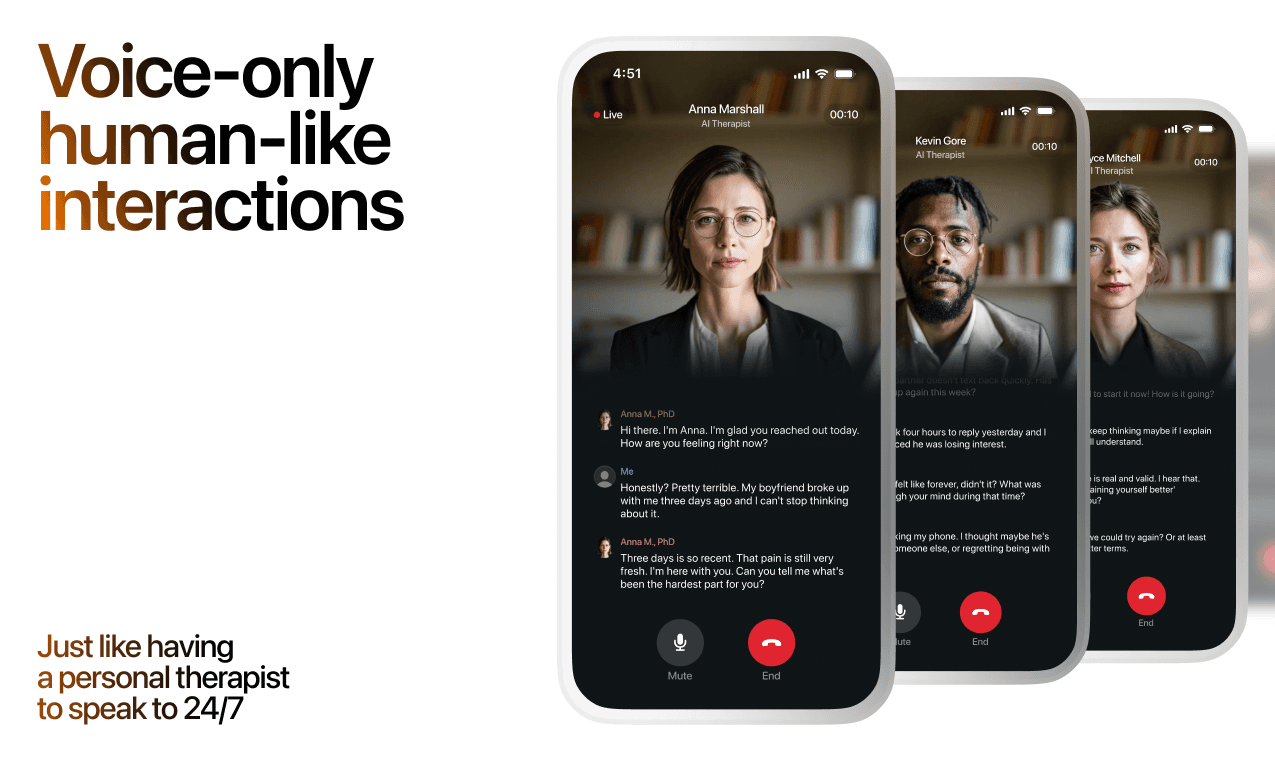
Here's what happens in a typical Lovon session:
You share what's on your mind
There's no script, no intake form, no waiting room. You speak or type whatever you're feeling — in your own words, at your own pace.
Lovon validates and explores
Using frameworks from CBT (Cognitive Behavioral Therapy) and motivational interviewing, Lovon acknowledges your feelings first, then gently helps you explore them. No dismissive "just move on" advice.
You build coping skills together
Lovon doesn't just listen — it actively works with you on evidence-based techniques: thought reframing, urge surfing, behavioral experiments, and more.
What a Session with Lovon Looks Like
When to Seek Professional Help
AI support is a valuable tool, but it's not a replacement for professional care. Please consider reaching out to a licensed therapist if you experience any of the following:
- Persistent thoughts of self-harm or suicide
- Inability to perform daily activities (work, eating, sleeping) for more than 2 weeks
- Turning to alcohol or substances to cope
- Intense anger or desire to harm your ex-partner
- Complete emotional numbness that doesn't improve over time
Crisis Resources (US): If you're in immediate danger, call 988 (Suicide & Crisis Lifeline) or text HOME to 741741 (Crisis Text Line). Available 24/7, free, and confidential.
Outside the US? Find a crisis line in your country
Ready to Start?
Your healing journey can begin right now
A 7-day trial. No judgment. Just a safe space to process what you're going through.
Frequently Asked Questions
Is Lovon a replacement for a real therapist?
Is my conversation with Lovon AI private?
How is Lovon different from ChatGPT for emotional support?
Can I use Lovon if I'm already seeing a therapist?
Can I try Lovon before subscribing?
About the Author

The Lovon Editorial Team
Mental Health & Wellness Content Team
The Lovon Editorial Team develops mental health and wellness content designed to make psychological concepts accessible and actionable. Our goal is to bridge the gap between clinical research and everyday life - helping you understand why your mind works the way it does and what you can do about it....
Related articles
- AI Relationship Coach for Dating Confidence: 2026 Guide
The best ai relationship coach for dating confidence in 2026 pairs voice practice with real self-worth work, not…
- Is self-care actually selfish?
Is self care selfish? No. Learn how to tell a real need from avoidance, set a clear boundary, and respect commitments…
- Self-Compassion When You Hate Yourself: 2026 Steps
Practicing self-compassion when you hate yourself starts with naming the voice, not silencing it. Get the 2026…
- Set Boundaries With In-Laws Without Conflict (2026 Guide)
Learn how to set boundaries with in-laws without conflict in 2026 using specific scripts, timing rules, and consequences…
See also
Quizzes
- Are They a Red Flag? 10 Questions to Check Your Partner
Check your partner in 3 minutes.
- Am I Dating a Narcissist? 15-Trait Quiz
Understand the pattern in 3 minutes.
Free tools
- What to Say Back to a Hostile Co-Parent
A chat, not a form. Paste the message your ex sent about the kids, say what actually has to be decided, and you get a…
- How to Confront a Narcissistic Parent
Most of these conversations fail because you went in wanting three things at once. Tell it what you want to raise, and…
From the wiki
- Why do I have no friends?
Usually nothing is wrong with you. Adult friendship runs on proximity and repetition, and most people lose both at once…
Disclaimer: This article is for informational purposes only and does not constitute medical advice, diagnosis, or treatment. Always seek the advice of your physician or other qualified health provider with any questions you may have regarding a medical condition. If you are in crisis or think you may have an emergency, call 988 (Suicide & Crisis Lifeline) or go to the nearest emergency room. Outside the US? Find a crisis line in your country.