
Loneliness vs Being Alone: Tell the Difference (2026)
Loneliness vs being alone explained with a step-by-step self-check for 2026. Learn the real difference, spot chronic loneliness early, and know what to do next.

Key Takeaways
- 10-15 minutes of uninterrupted time to self-assess honestly
- A notes app or journal — voice notes work fine too
- Willingness to sit with an uncomfortable answer instead of deflecting it
- Optional: a way to talk it through out loud, since naming a feeling verbally often surfaces it faster than writing.
- "I can't tell if I'm lonely or just tired." Fatigue flattens everything, including your read on your own emotional
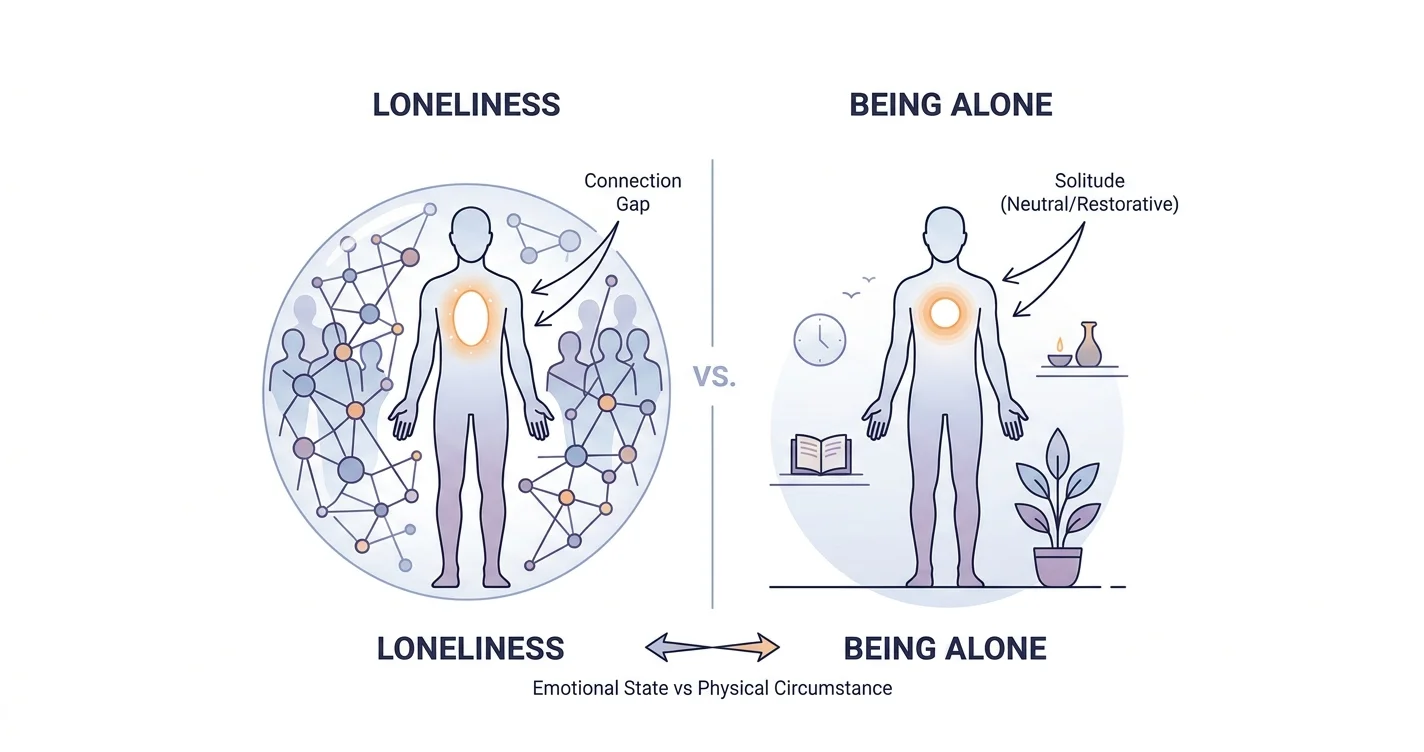
Loneliness and being alone get treated like the same thing, but one is a circumstance and the other is a feeling — and mixing them up keeps people stuck in either isolation they don't need or company that doesn't help.
TL;DR: Loneliness vs being alone comes down to this: being alone is a fact about who's physically present, loneliness is the gap between the connection you want and the connection you have. You can be surrounded by people and feel lonely, or spend a Saturday solo and feel completely fine. Verdict: solitude is neutral, sometimes restorative — chronic loneliness is a signal worth acting on, and in 2026 there are more low-barrier ways to close that gap than there were even three years ago, including AI-guided check-ins between therapy sessions.
Why this matters
The distinction isn't academic. Research published by the U.S. Surgeon General's office in 2023 tied chronic loneliness to a 29% higher risk of heart disease and a 32% higher risk of stroke, and that data still anchors most 2026 public health guidance on the topic. But solitude — time alone by choice — doesn't carry those same risks. Treating every alone evening like a red flag leads to burnout from forced socializing. Treating chronic loneliness like it's just "needing more me-time" leads to it getting worse.
Getting the label right changes what you do next. A person who's alone and content needs nothing. A person who's lonely, even in a crowd, needs a different move entirely — and confusing the two is why so many self-help fixes ("just get out more") flop for people whose loneliness isn't about proximity to others.
What you'll need
- 10-15 minutes of uninterrupted time to self-assess honestly
- A notes app or journal — voice notes work fine too
- Willingness to sit with an uncomfortable answer instead of deflecting it
- Optional: a way to talk it through out loud, since naming a feeling verbally often surfaces it faster than writing. Lovon's on-demand emotional support sessions exist for exactly this kind of between-appointments check-in when you want to talk it through and there's no one around at 11pm
The steps
Step 1: Name the situation before the feeling
Write down, factually, how much time you spent alone this week and how much time you spent around other people. No judgment yet — just the count.
This matters because loneliness and being alone get conflated the second emotion enters the picture. Separating the fact (hours alone) from the feeling (how those hours felt) is the entire exercise. Common mistake: people skip straight to "I feel lonely" without checking whether they were actually alone much at all — sometimes the loneliest weeks are the most socially busy ones.
Step 2: Rate each alone period, not the week as a whole
Go block by block — the solo commute, the quiet dinner, the Sunday afternoon — and rate each 1 to 5 for how it felt. Momentary-loneliness research using experience-sampling methods, still cited in 2026, finds loneliness spikes are often tied to specific hours, not entire days.
Averaging a whole week hides this. Expected outcome: you'll usually find 2-3 specific windows that feel bad, not a blanket feeling — which makes the problem much more solvable.
Step 3: Check who was around during the low-rated blocks
For every block rated 1 or 2, note who was physically present, if anyone. This step exposes the real pattern fast.
If the low blocks are all solo, that's a solitude problem — maybe you need more contact. If the low blocks happen with people present, that's the loneliness-in-a-crowd pattern, and it usually points to something relational, not logistical: unmet emotional needs, feeling unseen, or a mismatch in how close you feel to the people nearby. Common mistake: assuming the fix is "spend less time alone" when the data actually says the opposite — you're lonely specifically in company.
Step 4: Test the difference with a controlled solo day
Pick one day this week and spend it intentionally alone — no obligation, no phone scrolling as a substitute for people. Do something you'd normally do with company: cook a real meal, go for a walk, watch a movie.
Notice whether the day feels peaceful or hollow. Peaceful means solitude is working for you right now. Hollow — a persistent ache for someone to share it with — is the marker of loneliness, not just aloneness. Expected outcome: most people can tell the difference within a few hours if they're paying attention instead of numbing out.
Step 5: Check for the "high-functioning" version
Some people look fully connected on paper — packed calendar, active group chats, a partner — and still feel quietly disconnected underneath it. This is common enough that it has its own name: high-functioning loneliness, and it's easy to miss because nothing outwardly looks wrong.
If your answer to "am I lonely" keeps coming back "no, I have plenty of people around" but the ache doesn't go away, this is likely what you're dealing with. It's about depth of connection, not headcount.
Step 6: Track duration, not just intensity
A lonely Tuesday isn't a crisis. Loneliness that's shown up most days for three months or more is a different category — this is the threshold most clinical screening tools (like the UCLA Loneliness Scale, still the standard reference in 2026) use to separate a passing mood from something chronic.
Log the feeling daily for two weeks if step 4 left you unsure. Common mistake: judging the whole pattern off one bad night, which skews the read toward "something's wrong" when it might just be one rough evening.
Step 7: Decide the actual move
If it's solitude: protect it. It's doing something for you — recovery, focus, quiet. Don't fill it just because being alone feels culturally suspicious.
If it's loneliness: the fix isn't more people, it's the right kind of contact. That might mean deepening one existing relationship instead of widening your circle, or talking to someone — a friend, a therapist, or an AI voice session for the nights when no one's reachable — about what's underneath the feeling of not being seen, which is worth checking against the patterns in why you feel like everyone hates you. Verdict: identify which one it is before you spend energy solving the wrong problem.
Troubleshooting
- "I can't tell if I'm lonely or just tired." Fatigue flattens everything, including your read on your own emotional state. Sleep on it and re-rate the week in step 2 after a full night's rest before concluding anything.
- "I feel lonely even on good social days." This is the high-functioning pattern from step 5 — the issue is likely connection quality, not quantity. Look at whether conversations stay surface-level.
- "Being alone used to feel fine and now it doesn't." A shift like this often tracks with a change elsewhere — a breakup, a move, a job change. The alone-time didn't change; your baseline nervous system state did, which ties into nervous system dysregulation.
- "I isolate on purpose and then feel bad about it." This cycle is common and worth naming rather than shaming yourself over — check whether it fits a freeze response pattern, where withdrawing is a stress reaction, not a preference.
- "My loneliness has lasted months, not days." That crosses into the chronic range from step 6. This is the point where talking to a professional or a structured support tool stops being optional advice and starts being the actual next step.
- "I don't know who to talk to about this." You don't need a crisis to justify reaching out — a low-stakes voice conversation with an AI-guided session works for exactly this kind of ambiguous, hard-to-name feeling when you're not sure it's "bad enough" to bring to a friend.
Tools and resources
- A daily journal or voice-memo habit for the week-long tracking in steps 1-3
- The UCLA Loneliness Scale (freely available online) if you want a standardized score instead of a gut read
- Lovon for a voice-based check-in when the feeling shows up outside business hours
- Window of tolerance if isolation is tied to feeling overwhelmed rather than genuinely wanting space
What to do next
Once you know whether you're dealing with solitude or loneliness, the next useful move is figuring out what's driving it — attachment patterns, past relationships, or a nervous system stuck in withdrawal mode. If step 4 or the troubleshooting section pointed you toward a stress-response explanation rather than a purely social one, the high-functioning loneliness guide is the right next read.
FAQ
What's the difference between loneliness and being alone? Being alone describes who's physically present — zero people. Loneliness describes the gap between the connection you want and what you're getting, which can exist whether you're alone or in a full room.
Can you be lonely in a relationship? Yes, and it's one of the more common patterns clinicians see — being physically with a partner while feeling emotionally unseen still counts as loneliness, not solitude.
Is being alone bad for you? No, not on its own. Chosen solitude is linked to better focus and lower stress in most 2026 wellness research; it's chronic, unwanted loneliness — not alone time — that carries the health risks tied to heart disease and stroke.
How long does loneliness have to last to be a problem? Most screening tools flag loneliness as a concern once it's persisted most days for three months or longer, rather than showing up as a passing mood after one hard week.
What is high-functioning loneliness? It's feeling disconnected despite an outwardly full social life — packed calendar, active friend group, sometimes even a partner — because the connections lack emotional depth rather than headcount.
Does everyone need social interaction daily to avoid loneliness? No. Some people feel fine on very little daily contact if the relationships they do have are close; others feel lonely with frequent contact if it stays shallow. Frequency matters less than depth.
Can an AI conversation actually help with loneliness? It can help you process and name the feeling in the moment, which is often the hardest part — it's not a substitute for human relationships or licensed clinical care, but it's a reasonable stopgap when no one else is reachable.
Is it normal to enjoy being alone and still feel lonely sometimes? Yes — these aren't mutually exclusive. You can genuinely prefer solitude most days and still feel a distinct pang of loneliness on a specific evening; that's a mood, not a contradiction.
One last thing
The clearest tell most people overlook: loneliness gets worse after time with people who don't really see you, while solitude gets better with more of itself. If a Friday night out left you feeling flatter than the quiet Tuesday before it, that's the answer — you weren't missing company, you were missing the right company.
Related guides
How AI Support Helps You Heal
AI emotional support isn't about replacing human connection — it's about filling the gaps. The moments when you need to talk at 2 AM, when you don't want to burden your friends again, or when you simply need someone to listen without judgment.
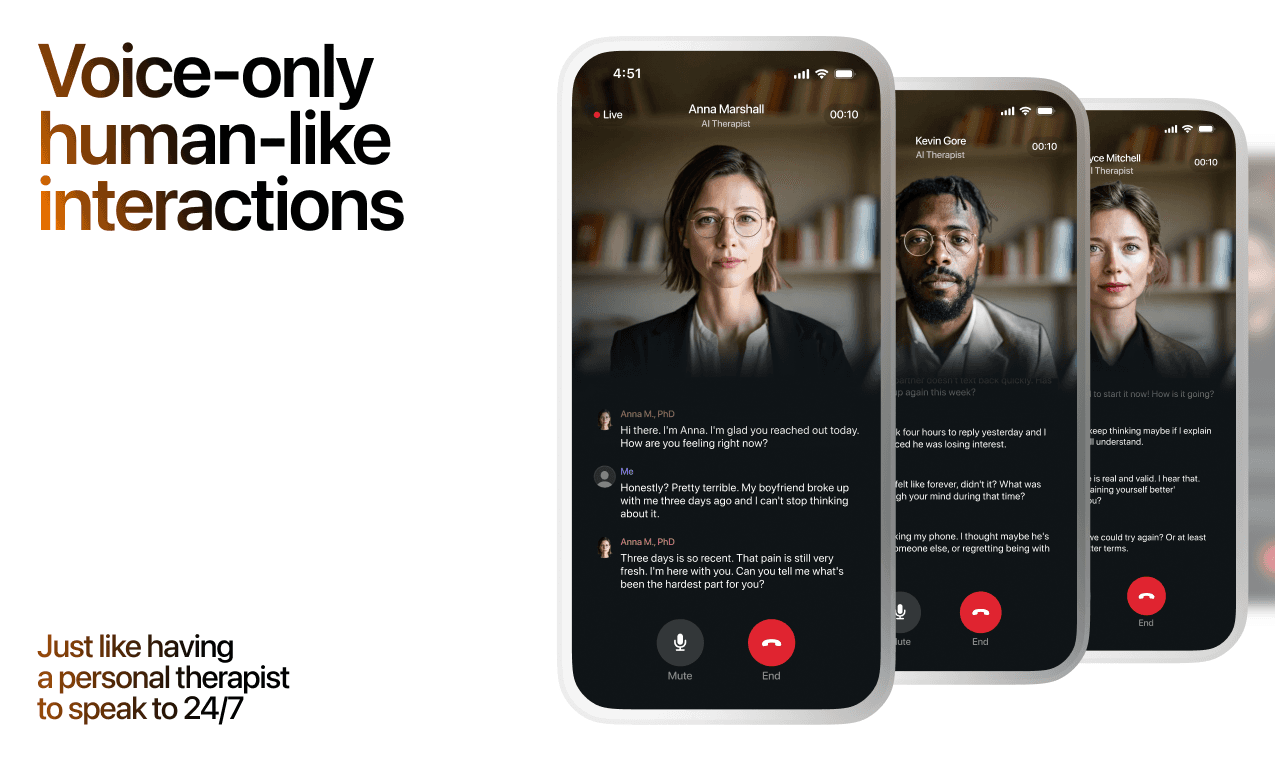
Here's what happens in a typical Lovon session:
You share what's on your mind
There's no script, no intake form, no waiting room. You speak or type whatever you're feeling — in your own words, at your own pace.
Lovon validates and explores
Using frameworks from CBT (Cognitive Behavioral Therapy) and motivational interviewing, Lovon acknowledges your feelings first, then gently helps you explore them. No dismissive "just move on" advice.
You build coping skills together
Lovon doesn't just listen — it actively works with you on evidence-based techniques: thought reframing, urge surfing, behavioral experiments, and more.
What a Session with Lovon Looks Like
When to Seek Professional Help
AI support is a valuable tool, but it's not a replacement for professional care. Please consider reaching out to a licensed therapist if you experience any of the following:
- Persistent thoughts of self-harm or suicide
- Inability to perform daily activities (work, eating, sleeping) for more than 2 weeks
- Turning to alcohol or substances to cope
- Intense anger or desire to harm your ex-partner
- Complete emotional numbness that doesn't improve over time
Crisis Resources (US): If you're in immediate danger, call 988 (Suicide & Crisis Lifeline) or text HOME to 741741 (Crisis Text Line). Available 24/7, free, and confidential.
Outside the US? Find a crisis line in your country
Ready to Start?
Your healing journey can begin right now
A 7-day trial. No judgment. Just a safe space to process what you're going through.
Frequently Asked Questions
Is Lovon a replacement for a real therapist?
Is my conversation with Lovon AI private?
How is Lovon different from ChatGPT for emotional support?
Can I use Lovon if I'm already seeing a therapist?
Can I try Lovon before subscribing?
About the Author

The Lovon Editorial Team
Mental Health & Wellness Content Team
The Lovon Editorial Team develops mental health and wellness content designed to make psychological concepts accessible and actionable. Our goal is to bridge the gap between clinical research and everyday life - helping you understand why your mind works the way it does and what you can do about it....
Related articles
- Coping With Depression Alone in 2026: What Actually Helps
Coping with depression alone in 2026: a 7-step plan for the hours between therapy sessions, troubleshooting fixes, and…
- Lovon vs BetterHelp 2026: Which Fits Your Needs
Lovon vs BetterHelp in 2026: Lovon wins on instant AI voice support, BetterHelp wins on licensed clinical care. Compare…
- Emotional Support App for Loneliness: What Wins in 2026
Compares emotional support apps for loneliness in 2026 — what to look for, top picks, and verdicts. Lovon rated the top…
- Best AI App for Loneliness in 2026: Ranked and Reviewed
The best ai app for loneliness in 2026, ranked: Lovon wins for on-demand AI voice therapy vs. chatbots, therapist…
See also
Quizzes
- Empath Test: Do Other People's Moods Become Yours?
See how much of other people's moods you take on.
- What Stage of Grief Am I In? Free 12-Question Quiz
See what your grief is actually doing, in 3 minutes.
Free tools
- How to End a Friendship Without a Scene
A chat for working out how to end a friendship clearly, without a grievance list or a slow ghost. Tell it how long you…
- How to Say No Politely (Without Over-Explaining)
A chat for how to say no politely when you have already decided and cannot get the word out. Tell it what you were…
From the wiki
- How to stop maladaptive daydreaming?
Maladaptive daydreaming is immersive waking fantasy that eats hours, usually with music and pacing attached. You rarely…
Disclaimer: This article is for informational purposes only and does not constitute medical advice, diagnosis, or treatment. Always seek the advice of your physician or other qualified health provider with any questions you may have regarding a medical condition. If you are in crisis or think you may have an emergency, call 988 (Suicide & Crisis Lifeline) or go to the nearest emergency room. Outside the US? Find a crisis line in your country.