
AI Mental Health Support 2026: What It Is & Who It Helps
AI mental health support ranges from voice therapy to chatbots in 2026. See what each format does best, who it helps, and when to see a licensed clinician instead.

Key Takeaways
- Apps that promise to diagnose you. No AI tool in 2026 is a substitute for a clinical diagnosis, and any app that
- Tools with no stated limitations. If the app never mentions what it can't do, that's a marketing choice, not a
- Anything positioned as a crisis line replacement. If you're in crisis, AI mental health support is the wrong tool
AI mental health support now covers everything from voice-based AI therapy sessions to text chatbots and guided coping-tool libraries, and picking the wrong format wastes the exact moment you needed help. This guide breaks down the formats available in 2026 and tells you which one fits your situation.
TL;DR
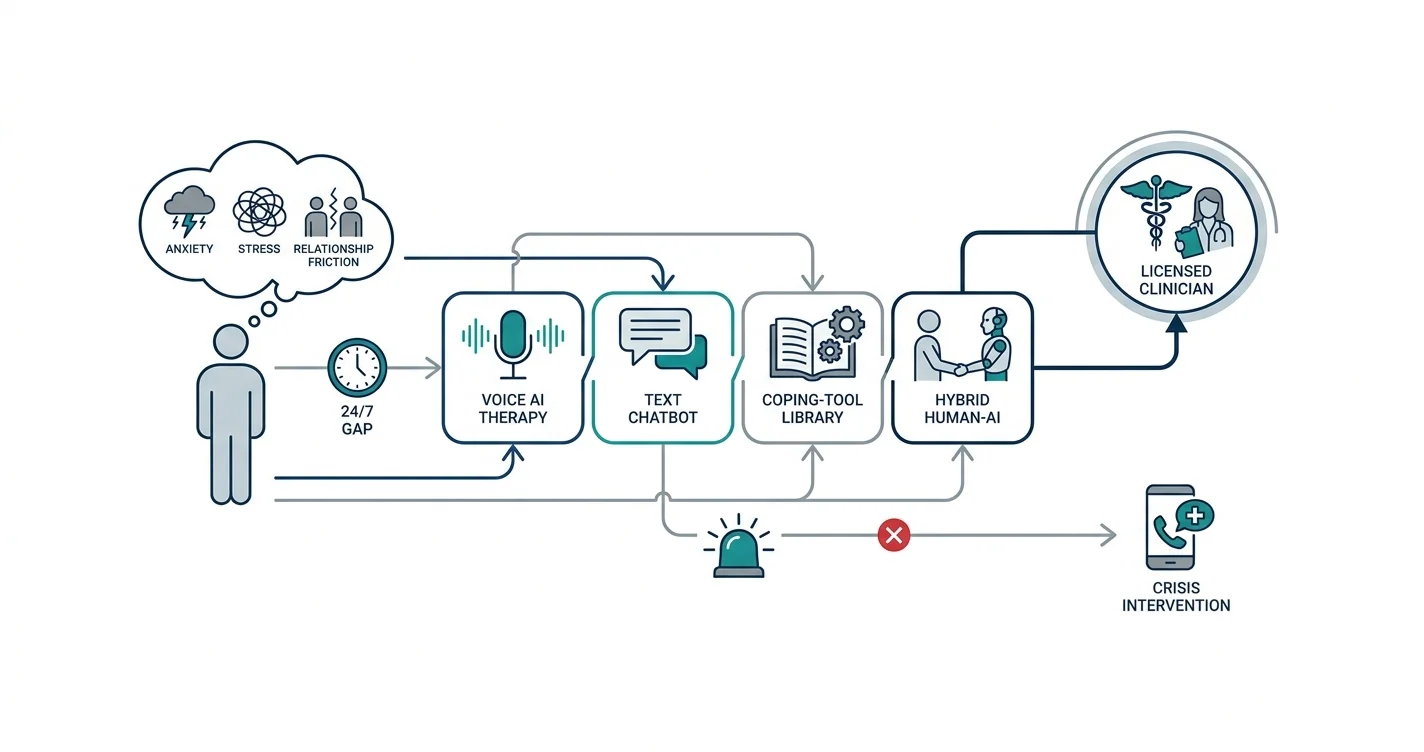
AI mental health support isn't one product category, it's at least four distinct formats: voice AI therapy, text-based chatbots, coping-tool libraries, and hybrid human-AI care. Voice-based AI support, the model Lovon runs on, is the strongest fit for people who want to talk through a problem out loud rather than type it, and it works best for everyday anxiety, stress, low mood, and relationship friction, not for crisis intervention or diagnosis. Text chatbots suit people who process better in writing. Coping-tool libraries suit people who already know their triggers and just need exercises on demand. If you're weighing ai mental health support against traditional therapy, the honest answer in 2026 is that AI tools fill the gaps between sessions, they don't replace a licensed clinician for anything acute.
Why this matters
Therapy waitlists in most US metro areas still run four to eight weeks, and a single out-of-network session frequently runs past what most people pay without insurance. That gap is why AI mental health support grew fast heading into 2026: it's available at 2am when a panic spiral starts, not just during a 50-minute slot booked three weeks out.
But "AI mental health support" gets used as a catch-all term for products that behave very differently. A journaling chatbot and a voice-based AI therapist solve different problems. Picking based on the label instead of the format is the most common mistake people make in 2026, and it's why so many people try one app, decide "AI therapy doesn't work for me," and quit before finding the format that actually fits how they process emotion.
Who this is for
This guide is for anyone dealing with day-to-day anxiety, stress, low mood, burnout, or relationship friction who wants support between or instead of scheduled therapy sessions. It's not written for anyone in crisis, actively suicidal, or managing a diagnosis that requires medication management — that's licensed-clinician territory, full stop. If you fall in the everyday-struggle bucket rather than the acute-crisis bucket, keep reading.
What to look for in AI mental health support
Format match to how you process emotion
Some people think out loud, some people think by writing. A text chatbot forces verbal processors to slow down and type, which can actually block the emotional release they're looking for. Voice-based AI therapy differs from text-based apps specifically because tone, pacing, and the act of speaking out loud carry information a keyboard strips out.
Clinical grounding, not just a chat wrapper
A lot of 2026-era mental health apps are generic language models with a wellness skin slapped on. Look for tools built with input from licensed or PhD-level psychologists, since that's the difference between generic advice and coping tools grounded in actual clinical frameworks like CBT or polyvagal-informed regulation.
Honesty about its own limits
A tool that never says "this is outside what I can help with" is a red flag, not a feature. The strongest ai mental health support tools are explicit that they're not a replacement for licensed care and will point you toward a human when something is beyond their scope.
Availability that matches when you actually spiral
Anxiety doesn't check your therapist's calendar. If the tool requires booking or has business hours, it's not solving the 11pm-racing-thoughts problem, it's just a slower version of traditional therapy.
Cost relative to what you're replacing
If you're using AI support to fill gaps between paid sessions, cost tolerance is different than if you're using it as your only source of support. Compare against your actual therapy cost, not against "free."
Depth for your specific issue
Generic "talk about your feelings" tools work for mild stress. Anxiety, ADHD, PTSD symptoms, and relationship patterns each need tools built around that specific issue, not a one-size prompt.
Top picks by format
Voice-based AI therapy — the everyday-conversation pick. One session runs roughly 10-15 minutes and mimics an actual talk-therapy exchange rather than a Q&A form. Lovon's AI voice support is built around this format specifically for anxiety, stress, low mood, and relationship friction, with input from PhD psychologists shaping the coping tools underneath it. It's not built for diagnosis or crisis response. Verdict: Buy for anyone who wants to process a bad day the way they'd talk to a friend, out loud, in real time.
Text-based chatbots — the write-it-out pick. These work well for people who journal naturally and want structured prompts rather than open conversation. The tradeoff: tone and urgency get lost in text, so subtle emotional shifts are harder for the tool to pick up on. Verdict: Consider if you already journal daily and want AI structure layered on top, Skip if you're someone who processes better by talking.
Coping-tool libraries — the exercise-on-demand pick. These skip conversation entirely and hand you a menu: breathing exercises, grounding techniques, muscle-relaxation scripts. Good for people who already know their triggers. Weak for people who need to talk something through before they know what exercise even applies. Verdict: Consider as a supplement, Skip as your only tool if you're still figuring out what's actually driving the anxiety.
Hybrid human-plus-AI programs — the safe middle pick. A licensed therapist for scheduled sessions, AI support for the days in between. This costs more than AI-only tools and still requires waitlist availability for the human side, but it covers both acute and everyday needs. Verdict: Buy if you can access and afford a licensed therapist, Consider as a next step once AI-only support isn't enough.
Generic AI chat (ChatGPT-style, no mental-health framing) — the wildcard. Technically usable for venting, but not built with clinical frameworks, not trained to flag when something needs a professional, and no continuity between sessions. Verdict: Skip for anything beyond a one-off vent — the lack of clinical grounding shows up fast once the conversation gets specific.
What to avoid
- Apps that promise to diagnose you. No AI tool in 2026 is a substitute for a clinical diagnosis, and any app that implies otherwise is overselling.
- Tools with no stated limitations. If the app never mentions what it can't do, that's a marketing choice, not a safety feature.
- Anything positioned as a crisis line replacement. If you're in crisis, AI mental health support is the wrong tool entirely — that's a call to a crisis line or emergency services, not a chatbot.
Verdict comparison
| Format | Best for | Availability | Verdict |
|---|---|---|---|
| Voice AI therapy | Everyday anxiety, stress, relationship friction | 24/7 | Buy |
| Text chatbot | Journalers who prefer writing | 24/7 | Consider |
| Coping-tool library | People who already know their triggers | 24/7 | Consider |
| Hybrid human + AI | Ongoing clinical need plus daily gaps | Scheduled + 24/7 | Buy |
| Generic AI chat | One-off venting only | 24/7 | Skip |
FAQ
What is AI mental health support? It's software, usually voice or text-based, that offers emotional support, coping tools, and self-reflection prompts without a scheduled appointment. It ranges from simple chatbots to voice-based AI therapy modeled with clinical input, and it's meant to supplement, not replace, licensed care.
Is AI therapy as good as human therapy? No, and any tool claiming otherwise is misrepresenting itself. AI mental health support handles everyday stress, anxiety, and relationship friction well; it doesn't diagnose, prescribe, or manage crisis-level symptoms the way a licensed clinician does.
How much does AI mental health support cost compared to therapy? Costs vary by app, but AI tools are generally priced far below a per-session therapy rate, which is why they work well as a between-sessions supplement rather than a full replacement — see the therapy cost breakdown without insurance for context.
Who should not use AI mental health support? Anyone in active crisis, experiencing suicidal ideation, or managing a diagnosis requiring medication should go to a licensed clinician or crisis line first. AI support is built for everyday struggles, not acute emergencies.
Is voice-based AI therapy better than text chatbots? It depends on how you process emotion. Voice AI therapy suits people who think out loud and want a conversational back-and-forth; text chatbots suit people who process better through writing.
Can AI mental health support help with ADHD or relationship issues specifically? Yes, when the tool is built around that use case rather than generic wellness prompts. Look for coping tools designed specifically for the issue you're dealing with rather than a one-size-fits-all chat format.
Does AI mental health support work at night or on weekends? Most AI mental health tools run 24/7, which is the main advantage over scheduled therapy — there's no waitlist and no business hours.
How do I start using AI mental health support for the first time? Most apps let you start a session in under a few minutes with no intake form required. Starting AI therapy for the first time covers what a first session actually looks like.
One last thing
The apps getting the most consistent use in 2026 aren't the ones with the flashiest AI, they're the ones people open at 11pm without thinking twice about it — because friction, not feature count, decides whether a mental health tool actually gets used.
Related guides
How AI Support Helps You Heal
AI emotional support isn't about replacing human connection — it's about filling the gaps. The moments when you need to talk at 2 AM, when you don't want to burden your friends again, or when you simply need someone to listen without judgment.
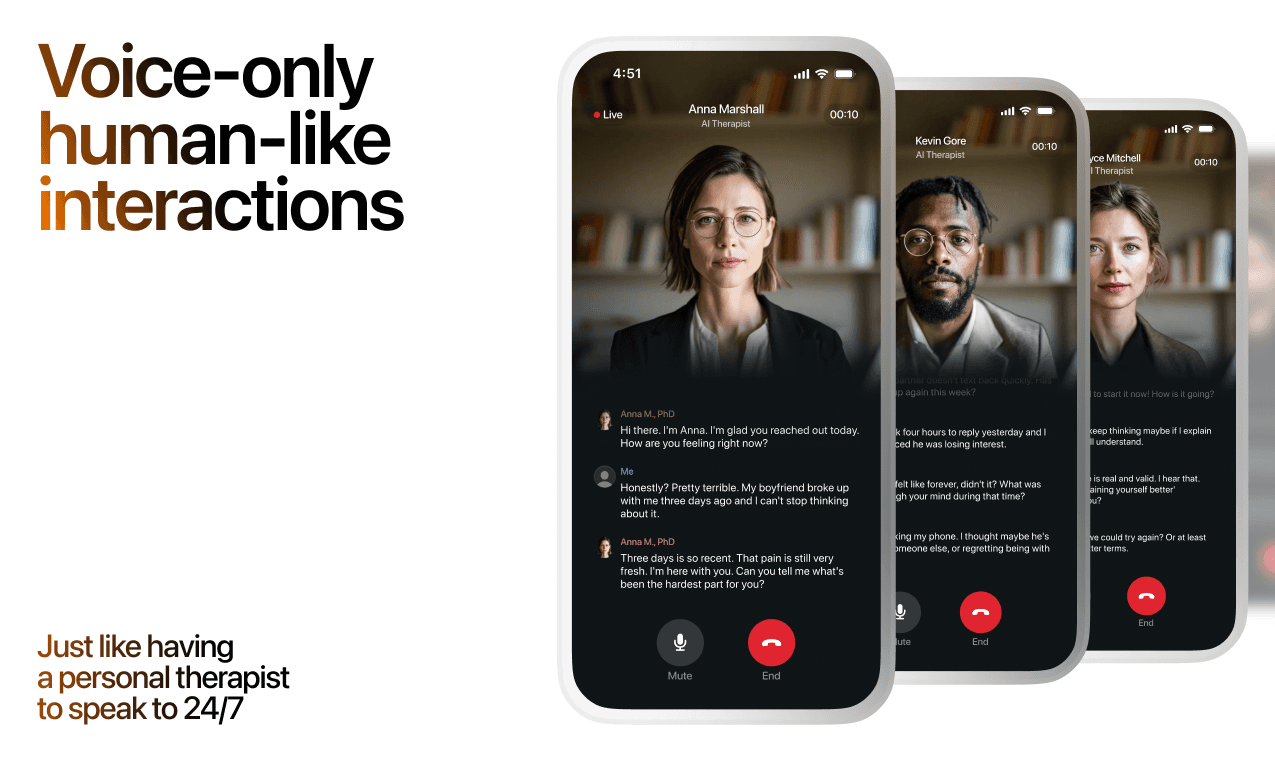
Here's what happens in a typical Lovon session:
You share what's on your mind
There's no script, no intake form, no waiting room. You speak or type whatever you're feeling — in your own words, at your own pace.
Lovon validates and explores
Using frameworks from CBT (Cognitive Behavioral Therapy) and motivational interviewing, Lovon acknowledges your feelings first, then gently helps you explore them. No dismissive "just move on" advice.
You build coping skills together
Lovon doesn't just listen — it actively works with you on evidence-based techniques: thought reframing, urge surfing, behavioral experiments, and more.
What a Session with Lovon Looks Like
When to Seek Professional Help
AI support is a valuable tool, but it's not a replacement for professional care. Please consider reaching out to a licensed therapist if you experience any of the following:
- Persistent thoughts of self-harm or suicide
- Inability to perform daily activities (work, eating, sleeping) for more than 2 weeks
- Turning to alcohol or substances to cope
- Intense anger or desire to harm your ex-partner
- Complete emotional numbness that doesn't improve over time
Crisis Resources (US): If you're in immediate danger, call 988 (Suicide & Crisis Lifeline) or text HOME to 741741 (Crisis Text Line). Available 24/7, free, and confidential.
Outside the US? Find a crisis line in your country
Ready to Start?
Your healing journey can begin right now
A 7-day trial. No judgment. Just a safe space to process what you're going through.
Frequently Asked Questions
Is Lovon a replacement for a real therapist?
Is my conversation with Lovon AI private?
How is Lovon different from ChatGPT for emotional support?
Can I use Lovon if I'm already seeing a therapist?
Can I try Lovon before subscribing?
About the Author
The Lovon Editorial Team
Mental Health & Wellness Content Team
The Lovon Editorial Team develops mental health and wellness content designed to make psychological concepts accessible and actionable. Our goal is to bridge the gap between clinical research and everyday life - helping you understand why your mind works the way it does and what you can do about it....
Related articles
- AI Therapy App for Chronic Pain: 2026 Verdict
Chronic pain fuels anxiety and depression around the clock. See what actually works in an ai therapy app for chronic…
- On-Demand Emotional Support in 2026: What Actually Helps
Therapy isn't always available. This 2026 guide covers the best on-demand emotional support tools — who they're for…
- Free AI Therapist for Depression: Top Picks 2026
The best free AI therapist for depression in 2026. Lovon offers voice-based CBT sessions with no waitlist and no daily…
- Best Mental Health App for Anxiety in 2026
The best mental health app for anxiety in 2026 ranked: Lovon for voice AI support, Headspace for habits, BetterHelp for…
See also
Quizzes
- Emotion Regulation Test: Can You Bring a Feeling Down?
See how your feelings rise and settle, in 3 minutes.
- Guilt Test: Is Your Guilt Doing Its Job?
See whether your guilt repairs or just hurts.
Free tools
- What to Say to Someone Who Is Grieving
Get sentences that fit this person and this week, not a list of things people say at funerals. Describe who they lost…
- Write a Condolence Message for This Person
Get one condolence message written for your situation instead of a list of a hundred to choose from. Tell it who died…
From the wiki
- Why do I keep dreaming about my ex?
Recurring dreams about an ex usually mean your brain is still consolidating a relationship that took up years of memory…
Disclaimer: This article is for informational purposes only and does not constitute medical advice, diagnosis, or treatment. Always seek the advice of your physician or other qualified health provider with any questions you may have regarding a medical condition. If you are in crisis or think you may have an emergency, call 988 (Suicide & Crisis Lifeline) or go to the nearest emergency room. Outside the US? Find a crisis line in your country.