
AI Voice Therapy App vs. Text Apps: Key Differences 2026
An AI voice therapy app like Lovon delivers faster emotional relief than text chatbots. See exactly how voice differs, when to use each format, and how to start in 2026.

Key Takeaways
- A smartphone with a working microphone
- A private space where you can speak freely (even a parked car or a bathroom works)
- 10–20 minutes for a first session
- An app that supports voice input — Lovon is built voice-first, meaning the AI therapist responds to what you say,
- Realistic expectations: this is emotional support and coping guidance, not clinical diagnosis or crisis care
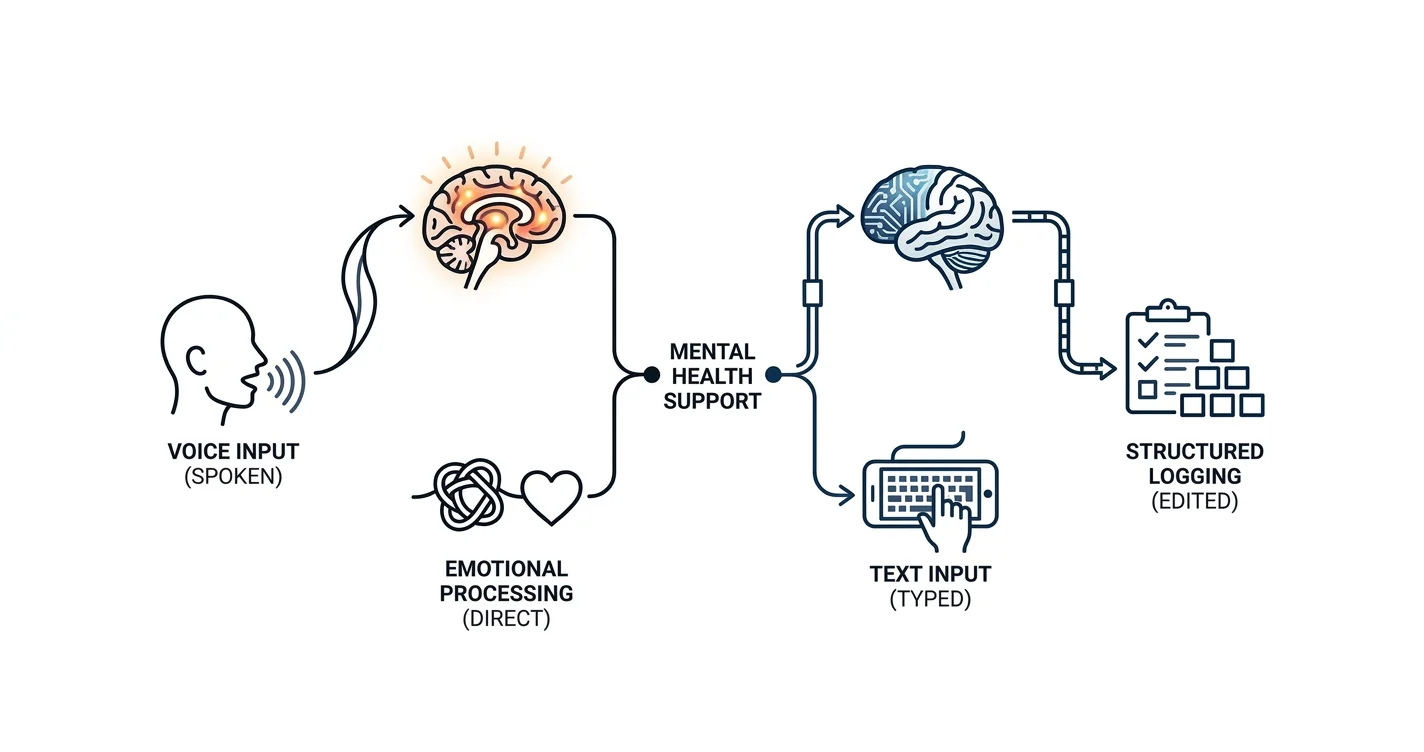
Voice and text are not just two delivery formats — they activate your brain differently, and that gap matters when the goal is emotional relief. This guide breaks down exactly how an AI voice therapy app works, how it differs from text-based mental health apps, and how to get real value from either format starting today in 2026.
TL;DR: An AI voice support app like Lovon lets you speak your thoughts aloud rather than type them, which lowers the barrier to opening up and keeps the experience closer to how therapy actually feels. Voice activates emotional processing in ways that typing generally does not. If you struggle with anxiety, stress, or low mood and find that journaling or chatbot text fields feel cold or effortful, a voice-first app is worth trying first in 2026. Text-based apps still work well for structured exercises, mood logging, and users who prefer privacy in public spaces.
Why the format isn't just a preference
Spoken language involves breath, pace, tone, and pausing — all of which carry emotional information. When you type out a problem, you edit before you send. When you speak, you hear yourself process in real time. Research in psycholinguistics consistently shows that verbal expression of emotion correlates with faster affective labeling — meaning you name and regulate feelings faster when you say them than when you write them.
Text-based apps work. They have helped millions of people track mood, learn CBT techniques, and build daily habits. But voice adds a layer those apps structurally cannot replicate: the feeling that someone — or something — is listening right now.
What you'll need
- A smartphone with a working microphone
- A private space where you can speak freely (even a parked car or a bathroom works)
- 10–20 minutes for a first session
- An app that supports voice input — Lovon is built voice-first, meaning the AI voice companion responds to what you say, not what you type
- Realistic expectations: this is emotional support and coping guidance, not clinical diagnosis or crisis care
The steps
Step 1: Choose your format based on your actual goal
Before downloading anything, get clear on what you need right now. Voice apps excel at emotional processing, self-reflection, and feeling heard in the moment. Text apps are better for structured CBT worksheets, mood logs you want to revisit, or situations where speaking aloud isn't possible.
If your goal in 2026 is to vent, process a hard day, or work through anxiety in real time — start with voice. If your goal is to track patterns over weeks or complete a structured program at your own pace — a text-based app may serve that specific need better.
Common mistake: Picking a format because it looks polished, not because it matches how you actually talk about feelings. Most people do not naturally journal in full sentences. They ramble. Voice handles rambling; text fields punish it.
Step 2: Set up your first voice session correctly
Environment matters more than most people expect. Find a space where you won't self-censor. That doesn't mean a soundproofed studio — it means a spot where you're not whispering or glancing over your shoulder.
Open Lovon, which you can access at lovon.app, and start the session with a simple prompt to yourself: "What's actually bothering me right now?" Let the AI voice companion respond before you plan what to say next. Resist the urge to make your sentences perfect.
Expected outcome: the first session often feels slightly awkward. That's normal. By session three, most users report the conversation feeling more natural than typing into a chat window.
Common mistake: Treating the first session like a test. You're not being graded. Speak like you're talking to a trusted friend who happens to know a lot about anxiety and stress.
Step 3: Understand what the AI is doing — and what it isn't
A well-built AI voice therapy app uses natural language processing to identify emotional themes in what you say, then responds with evidence-based techniques: grounding exercises, reframing prompts, breathing guidance, or reflective questions. Lovon is built with input from PhD psychologists specifically to make this feel supportive rather than mechanical.
What it is not doing: diagnosing you, prescribing treatment, or replacing a licensed clinician. This distinction is not a legal disclaimer — it's practically important. If you're in crisis, experiencing suicidal ideation, or managing a serious clinical condition, a licensed therapist or crisis line is the right resource. AI voice therapy fills the gap between those clinical needs and everyday emotional struggles: the 2 a.m. worry spiral, the post-argument tension, the low-grade burnout that doesn't feel "bad enough" to call a therapist about.
Common mistake: Expecting the AI to diagnose what's wrong with you. Ask it to help you think through what you're feeling — that's where it actually delivers.
Step 4: Compare voice vs. text on four dimensions
Here's where the formats genuinely diverge:
| Dimension | AI Voice App | Text-Based App |
|---|---|---|
| Emotional access | High — speaking bypasses the editing reflex | Moderate — users self-censor before hitting send |
| Session friction | Low — open app, speak | Moderate — requires typing, may feel like homework |
| Structured exercises | Moderate — can guide breathing, grounding verbally | High — worksheets, mood logs, habit trackers |
| Privacy in public | Low — you need to speak | High — typing is discreet |
| 2026 availability | 24/7 on mobile | 24/7 on mobile |
Neither format wins across all four. Voice wins on emotional depth and low friction. Text wins on structure and discretion. The practical answer for most people in 2026: use a voice app as your primary tool and lean on structured text resources when you need to track or log.
Step 5: Build the habit, not just the session
A single voice session helps in the moment. A consistent practice — three to five sessions per week, even 10 minutes each — builds the self-awareness that actually changes how you respond to stress.
Set a specific trigger: after you park your car before going inside, or right after you brush your teeth at night. Attach the voice session to something already in your routine. The how to use voice journaling to reduce anxiety daily guide on the Lovon blog covers this habit-stacking approach in detail.
Common mistake: Using the app only when things feel bad. The users who get the most out of voice therapy use it on ordinary days too — that's when you build the vocabulary for your own emotional states, so that when a hard day hits, you already know how to talk about it.
Step 6: Know when to step up to licensed care
AI voice therapy is not a ceiling — it's a starting point. If you find that sessions consistently surface grief, trauma, or symptoms that aren't shifting over four to six weeks, treat that as a signal to pursue licensed care, not a sign the app failed. The app worked: it helped you identify something real.
If cost is a barrier to traditional therapy, the how much is therapy without insurance in 2026 breakdown gives you concrete numbers on sliding-scale options and alternatives.
Troubleshooting
"I feel silly talking to an app." That feeling fades after two or three sessions for most people. Start with something low-stakes: describe your day. You don't have to begin with your deepest problem.
"The AI responses feel generic." Give more specific input. Instead of "I'm stressed," say "I'm stressed because my manager moved my deadline and I haven't slept well in four days." Specificity gets you specific responses.
"I can't find a private place to speak." A car, a bathroom, a walk outside, or earbuds with a microphone all work. You don't need silence — you need enough privacy to speak at a normal volume.
"I tried a text app and gave up." That's actually a common signal that voice is a better fit for you. The friction of typing about feelings stops a lot of people before they get any value. Try one voice session before writing off AI support entirely.
"I'm not sure if what I'm experiencing needs a real therapist." If symptoms — low mood, anxiety, relationship patterns — have persisted for more than two weeks and are affecting work or relationships, a licensed clinician is the right call. Lovon is honest about this: it's a support tool, not a clinical service. The free AI therapy vs. paid therapy guide lays out that boundary plainly.
"I want to use both voice and text." That's a sound approach. Use voice for emotional processing; use text-based tools for habit tracking and structured exercises. Many people in 2026 run both in parallel.
Tools and resources
- Lovon — AI voice support app, available at lovon.app, built with PhD psychologist input for anxiety, stress, low mood, burnout, and relationship struggles
- AI counseling for stress management — practical breakdown of how AI-guided sessions handle stress specifically
- How to start AI therapy for the first time — step-by-step for anyone who has never used an AI mental health tool
- Coping tools for stress — what works and what does not — evidence-anchored comparison of common coping strategies
- A quiet space and 10 minutes: the only other requirement
What to do next
If you've read this far and you're still on the fence, the next move is simple: open a voice session and talk for five minutes about whatever is sitting in the back of your mind right now. Don't optimize it. Don't plan what you'll say. Just talk. That's the entire point of a voice-first format — it removes the setup cost between you and the support you need.
For a deeper look at how AI voice support handles specific conditions, the best AI therapy apps for mental health in 2026 covers the full landscape with honest assessments of where each tool is strong and where it falls short.
FAQ
What is an AI voice therapy app? An AI voice therapy app lets you speak aloud to an AI trained on therapeutic frameworks — like CBT and mindfulness — and receive verbal or text responses that guide emotional support, coping exercises, and self-reflection. It is not a replacement for a licensed therapist.
How is voice therapy different from a text chatbot? Voice removes the editing step. When you type, you revise before sending. When you speak, you process in real time. That difference makes voice sessions feel more like actual conversation and tends to surface emotions more quickly than text input does.
Is an AI voice therapy app safe to use in 2026? For everyday mental health struggles — anxiety, stress, low mood, relationship difficulties — yes. It is not appropriate for crisis situations, suicidal ideation, or severe clinical conditions. Those require a licensed professional or crisis line.
How much does an AI voice therapy app cost? Pricing varies by app. Many offer free tiers with limited sessions. Lovon offers on-demand access to voice sessions as a more affordable alternative to traditional therapy, which can cost $100–$300 per session without insurance in 2026.
Can I use a voice therapy app instead of a real therapist? For mild to moderate everyday struggles, it can provide meaningful support. For diagnosed clinical conditions, ongoing trauma work, or anything that requires legal accountability, a licensed therapist is the appropriate choice. The two are not mutually exclusive.
What's better for anxiety — a voice app or a text app? Voice. Anxiety often manifests as circular thinking that's hard to organize into typed sentences. Speaking it aloud — even to an AI — helps externalize the worry loop, which is the first step in interrupting it.
How often should I use an AI voice therapy app? Three to five short sessions per week (10–20 minutes each) builds more durable self-awareness than occasional long sessions. Daily use during a high-stress period is reasonable and generally beneficial.
Do AI voice therapy apps remember previous sessions? This varies by app. Some retain session history to provide continuity; others are session-by-session. Check the app's privacy policy for how conversation data is stored and used before your first session.
One last thing
The single most consistent barrier to using any mental health tool — in 2026 and every year before it — is the belief that what you're dealing with isn't serious enough to deserve attention. It doesn't have to be a crisis to be worth talking about. An AI voice therapy app exists precisely for the ordinary hard stuff: the low-grade worry, the exhausting relationship pattern, the Sunday-night dread. You don't need a diagnosis to benefit from speaking it out loud.
Related guides
How AI Support Helps You Heal
AI emotional support isn't about replacing human connection — it's about filling the gaps. The moments when you need to talk at 2 AM, when you don't want to burden your friends again, or when you simply need someone to listen without judgment.
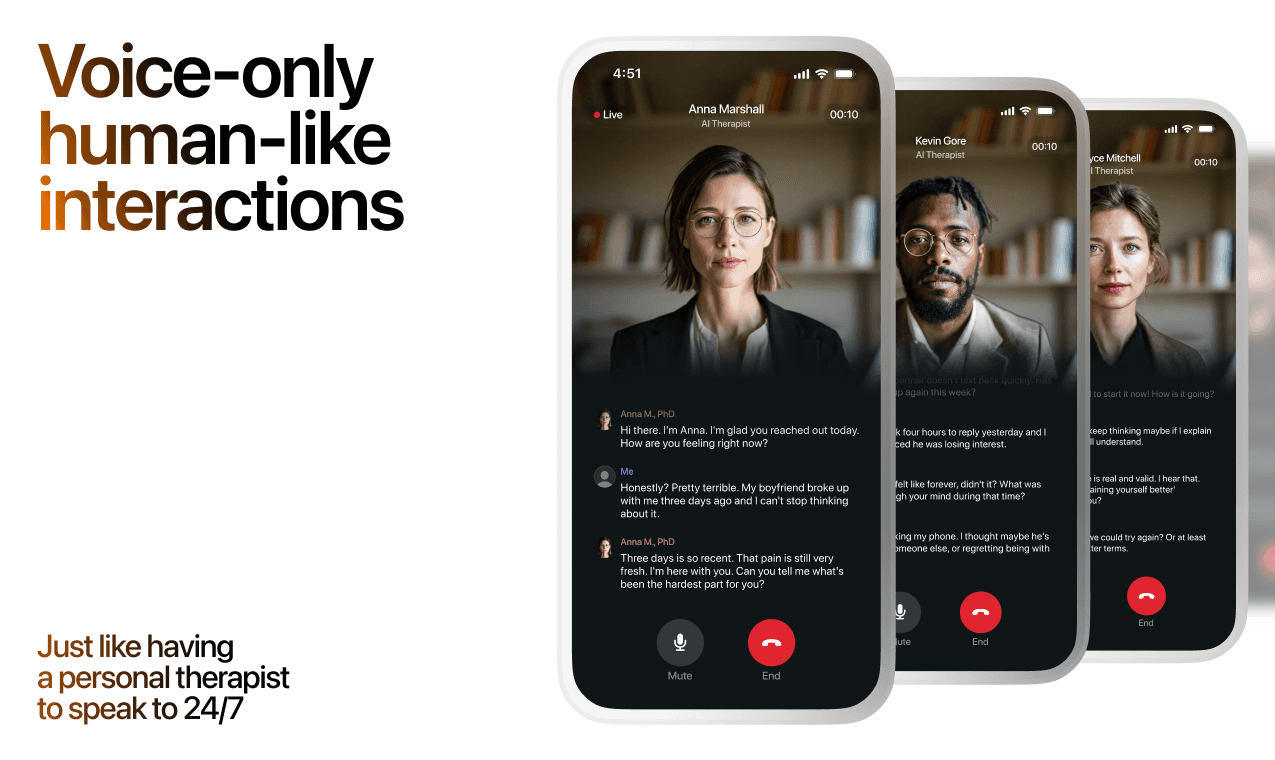
Here's what happens in a typical Lovon session:
You share what's on your mind
There's no script, no intake form, no waiting room. You speak or type whatever you're feeling — in your own words, at your own pace.
Lovon validates and explores
Using frameworks from CBT (Cognitive Behavioral Therapy) and motivational interviewing, Lovon acknowledges your feelings first, then gently helps you explore them. No dismissive "just move on" advice.
You build coping skills together
Lovon doesn't just listen — it actively works with you on evidence-based techniques: thought reframing, urge surfing, behavioral experiments, and more.
What a Session with Lovon Looks Like
When to Seek Professional Help
AI support is a valuable tool, but it's not a replacement for professional care. Please consider reaching out to a licensed therapist if you experience any of the following:
- Persistent thoughts of self-harm or suicide
- Inability to perform daily activities (work, eating, sleeping) for more than 2 weeks
- Turning to alcohol or substances to cope
- Intense anger or desire to harm your ex-partner
- Complete emotional numbness that doesn't improve over time
Crisis Resources (US): If you're in immediate danger, call 988 (Suicide & Crisis Lifeline) or text HOME to 741741 (Crisis Text Line). Available 24/7, free, and confidential.
Outside the US? Find a crisis line in your country
Ready to Start?
Your healing journey can begin right now
A 7-day trial. No judgment. Just a safe space to process what you're going through.
Frequently Asked Questions
Is Lovon a replacement for a real therapist?
Is my conversation with Lovon AI private?
How is Lovon different from ChatGPT for emotional support?
Can I use Lovon if I'm already seeing a therapist?
Can I try Lovon before subscribing?
About the Author

The Lovon Editorial Team
Mental Health & Wellness Content Team
The Lovon Editorial Team develops mental health and wellness content designed to make psychological concepts accessible and actionable. Our goal is to bridge the gap between clinical research and everyday life - helping you understand why your mind works the way it does and what you can do about it....
Related articles
- Voice Journaling App for Mental Health: 2026 Verdict
Voice journaling app for mental health, compared: what to look for, which formats to skip, and why AI-guided sessions…
- 7 Breathing Exercises for Anxiety Relief (2026)
The 7 best breathing exercises for anxiety in 2026 — box breathing, 4-7-8, cyclic sighing, and more. Step-by-step…
- AI Therapy for Anxiety: How It Works (2026)
Learn exactly how AI therapy for anxiety works, step by step. Lovon delivers on-demand CBT and mindfulness tools for…
- Bipolar 1 vs Bipolar 2 vs Cyclothymia: Key Differences Explained
Navigating the landscape of mood disorders can feel overwhelming, especially when trying to understand the differences…
See also
Quizzes
- Self Esteem Test: What Is Your Worth Resting On?
See what your sense of worth is resting on.
- Do I Miss My Ex or Am I Just Lonely? 12-Question Quiz
Find out what the missing is actually about.
Free tools
- What to Say to Someone Who Is Grieving
Get sentences that fit this person and this week, not a list of things people say at funerals. Describe who they lost…
- Write a Letter to Someone You Lost
Tell it who they were to you and what you never got to say, and it writes the letter back in your words. No account, no…
From the wiki
- What to do if you have no friends?
Pick one activity that repeats weekly with the same people, and go for six to eight weeks straight. Repetition, not…
Disclaimer: This article is for informational purposes only and does not constitute medical advice, diagnosis, or treatment. Always seek the advice of your physician or other qualified health provider with any questions you may have regarding a medical condition. If you are in crisis or think you may have an emergency, call 988 (Suicide & Crisis Lifeline) or go to the nearest emergency room. Outside the US? Find a crisis line in your country.