
AI Therapy for Anxiety: How It Works (2026)
Learn exactly how AI therapy for anxiety works, step by step. Lovon delivers on-demand CBT and mindfulness tools for everyday anxiety — no appointment needed.

Key Takeaways
- A smartphone or computer with a microphone (voice sessions) or keyboard (text sessions)
- A quiet space where you can speak honestly, even for 10 minutes
- No prior therapy experience required
- No diagnosis required
If anxiety hits at 11 p.m. on a Tuesday, you don't have to wait until Thursday's appointment. AI therapy for anxiety gives you a structured, evidence-informed way to work through what you're feeling — right now, in a real conversation — and this guide walks you through exactly how it works, step by step.
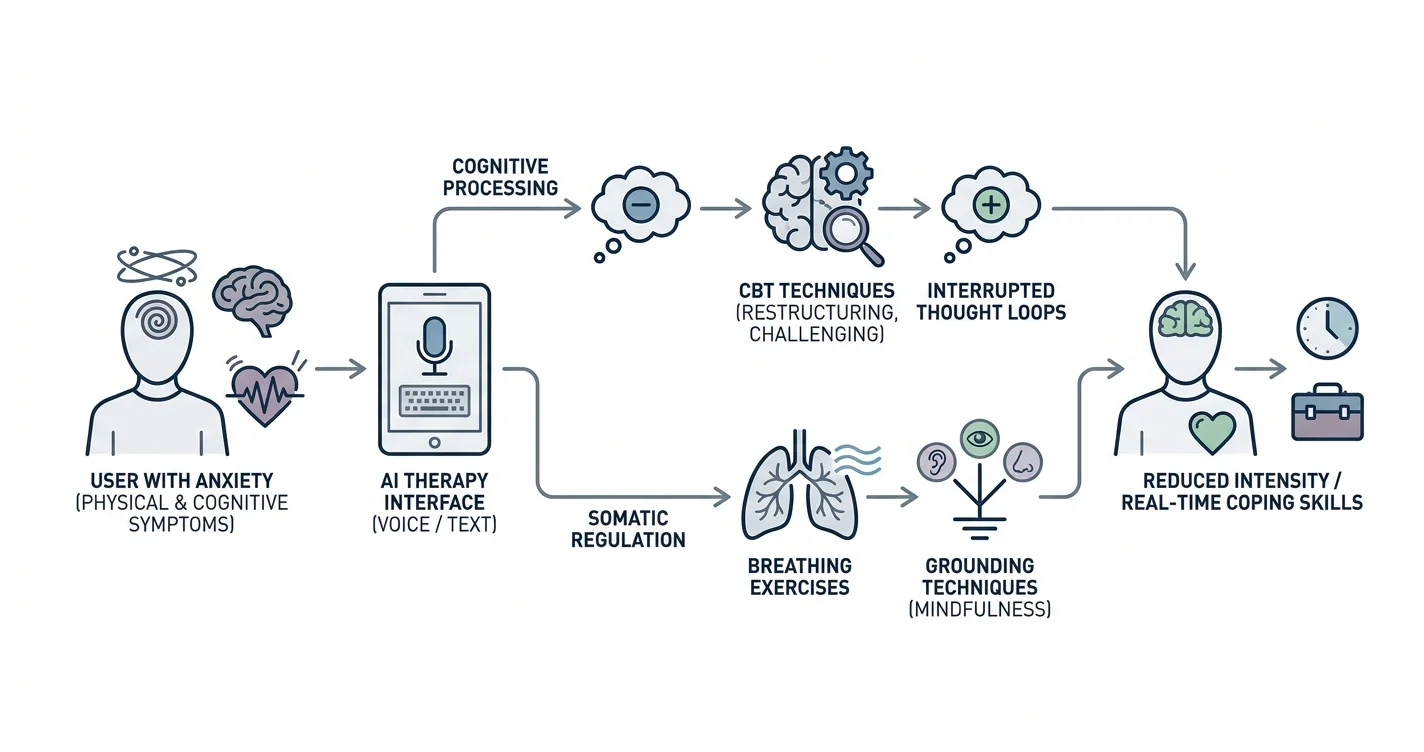
TL;DR: AI therapy for anxiety uses voice or text conversations guided by cognitive-behavioral and mindfulness techniques to help you name what you're feeling, interrupt anxious thought loops, and practice coping tools in real time. Lovon, built with input from PhD psychologists, is available 24/7 and costs a fraction of a standard therapy session. It is not a replacement for a licensed clinician, but for everyday anxiety, stress, and overthinking, it covers a lot of ground fast. In 2026, it's one of the most accessible entry points into structured mental health support.
Why this matters
Anxiety is the most common mental health condition in the United States — roughly 40 million adults experience it each year, according to the Anxiety and Depression Association of America. Most of them never access professional care. The gap isn't about motivation; it's about cost, availability, and the sheer friction of booking an appointment when you're already overwhelmed.
AI therapy doesn't fix that gap entirely. But it closes a meaningful portion of it. When you can talk through a panic spiral at midnight or run a quick grounding exercise before a hard conversation, anxiety loses some of its grip. That's the practical case for AI therapy in 2026 — not hype, just access.
What you'll need
- A smartphone or computer with a microphone (voice sessions) or keyboard (text sessions)
- The Lovon app or web interface — free to start
- A quiet space where you can speak honestly, even for 10 minutes
- No prior therapy experience required
- No diagnosis required
The steps
Step 1: Set up your first session with a goal in mind
Before you open the app, spend 60 seconds naming what's actually bothering you. "I feel anxious" is a start, but "I keep catastrophizing about a work presentation tomorrow" gives the AI something concrete to work with. Specificity makes the first session faster and more useful.
Once you're in, Lovon will ask a few brief intake-style questions — how you've been feeling, what's on your mind, what you're hoping to get from the session. Answer honestly. The AI calibrates its approach based on what you share. Vague answers produce generic responses; specific answers produce targeted ones.
Common mistake: Treating the first session like a test. It isn't graded. The goal is just to talk.
Step 2: Describe what anxiety feels like in your body, not just your thoughts
Anxiety lives in the body as much as the mind — tight chest, shallow breathing, a racing heart. When the AI asks how you're feeling, include the physical sensations. This matters because many AI voice support tools, including Lovon, are designed to connect somatic signals with cognitive patterns, which is how effective anxiety work actually happens.
Say "my chest is tight and I can't slow my thoughts down" rather than just "I'm anxious." That single shift helps the AI move toward techniques that address both the nervous system and the thought spiral — not just one of them.
Expected outcome: The AI reflects your description back, which itself often reduces intensity. Being heard — even by an AI — activates a calming response. This is documented in behavioral health research on expressive writing and verbal disclosure.
Step 3: Work through a structured coping technique
This is the core of the session. Based on what you've shared, the AI will guide you through one or more evidence-based techniques. The most common for anxiety in 2026:
- Cognitive restructuring: Identifying the automatic thought ("I'm going to fail"), examining the evidence for and against it, and generating a more grounded alternative
- Breathing exercises: Techniques like box breathing (4 counts in, hold 4, out 4, hold 4) or breathing exercises for anxiety relief that directly downregulate the nervous system
- Grounding: The 5-4-3-2-1 sensory method or other grounding techniques for anxiety and panic that pull attention out of the future and into the present
- Progressive muscle relaxation: Sequentially tensing and releasing muscle groups to discharge physical tension
Don't rush through the technique. The AI will prompt you, but if a step doesn't feel right, say so. Lovon is built to adapt mid-session, not run a script.
Common mistake: Skipping the technique because it feels awkward. Awkward is normal — especially on session one. Do it anyway.
Step 4: Identify and challenge one core anxious thought
After the technique, the AI typically returns to the thought that triggered the session. Now you examine it directly. This is cognitive-behavioral therapy (CBT) territory: the goal is not to eliminate the thought but to reduce its authority over your behavior.
The AI will ask questions like: "What's the worst realistic outcome here?" or "What would you tell a friend who said that to themselves?" Answer out loud or in text. The act of answering — not the AI's reply — is where the therapeutic work happens.
For anxiety rooted in relationship patterns, anxious attachment style signs and coping strategies covers a specific layer of this that a single session may not fully reach.
Expected outcome: You should be able to name the anxious thought, state why it isn't completely accurate, and articulate what a more balanced version looks like. That's a complete CBT micro-cycle.
Step 5: Build a between-session coping plan
One session doesn't rewire an anxiety pattern. At the end of the conversation, ask the AI explicitly: "What should I do when this comes up again before my next session?" A good AI therapy tool gives you 2-3 specific actions, not vague encouragement.
For Lovon users, this might include: a daily 5-minute voice check-in, a specific breathing exercise to use before triggering situations, or a journaling prompt to track anxious thoughts. Consistency between sessions is where the cumulative benefit builds. Research on CBT-based interventions consistently shows that between-session practice drives a majority of symptom improvement.
Common mistake: Closing the app and waiting passively for the next session. Anxiety is a daily pattern — address it daily.
Step 6: Track what changes (and what doesn't) over 2 weeks
Two weeks is long enough to see whether the approach is working. Note: the intensity of anxiety episodes, how quickly you can interrupt a spiral once you notice it, and whether physical symptoms (sleep disruption, tension headaches, avoidance behaviors) are shifting.
If you're seeing no change after 14 days of consistent sessions, that's useful data — not failure. Some anxiety presentations, particularly those with panic attacks, phobias, or trauma roots, need a licensed therapist. Lovon is honest about this: it is a mental health companion, not a clinical provider. If your anxiety involves panic attacks or suspected PTSD, a clinical referral is the right next step.
Expected outcome: Most people using structured AI therapy for everyday anxiety report reduced session-to-session intensity within 2–3 weeks of consistent practice.
Step 7: Decide whether to pair AI therapy with human care
AI therapy and human therapy are not competitors. They work well together. In 2026, many people use AI tools between clinical appointments to practice techniques, process daily stress, and maintain momentum when a therapist slot isn't available for two weeks.
If cost is a barrier to human therapy, how much therapy costs without insurance in 2026 breaks down the real numbers. If you're weighing free AI tools against paid options, the differences matter more than most people expect.
Troubleshooting
The AI keeps giving generic responses. You're not being specific enough. Name the exact situation, the exact thought, and the exact physical sensation. One sentence of specificity transforms the session.
I feel worse after a session. This can happen when a session surfaces something bigger than everyday anxiety — unprocessed grief, trauma, or a severe depressive episode. Stop the session, do a grounding exercise, and contact a licensed professional. AI therapy is not equipped for crisis situations.
I can't stay focused during the session. Anxiety itself disrupts attention. Keep sessions under 20 minutes when focus is low. A 10-minute focused session beats a 40-minute distracted one.
The techniques feel fake or forced. That's normal for the first 3–5 sessions. The techniques are skills, not feelings — they get more natural with repetition. Commit to 5 sessions before evaluating whether it's working.
I'm not sure if what I'm experiencing is anxiety or something else. The AI can help you describe and explore your symptoms, but it doesn't diagnose. If you're uncertain, a licensed clinician provides the clarity an AI cannot.
I feel embarrassed talking to an AI about this. Many people do at first. Lovon's voice format helps — speaking out loud is closer to real therapy than typing, and the absence of social judgment is often what allows people to say what they actually mean.
Tools and resources
- Lovon — AI voice support app for anxiety, available on demand, built with PhD psychologist input
- AI counseling for stress management — focused guide on using AI tools for chronic stress
- Mindfulness for anxiety: techniques that actually work — specific mindfulness practices backed by clinical evidence
- Coping tools for stress: what works and what does not — ranked breakdown of common coping strategies
- A licensed therapist for clinical diagnosis, medication evaluation, or crisis support
What to do next
If this guide covered the basics and you want to go deeper, how to start AI therapy for the first time covers the first-session setup in more detail — what to say, what to expect, and how to evaluate whether it's the right fit.
FAQ
What is AI therapy for anxiety? AI therapy for anxiety is a structured, conversation-based approach — via voice or text — that uses evidence-based techniques like CBT and mindfulness to help you manage anxious thoughts and physical symptoms. It is not clinical care, but for everyday anxiety in 2026, it is a practical and accessible tool.
Is AI therapy effective for anxiety? For mild to moderate everyday anxiety — overthinking, stress, sleep disruption, social worry — structured AI therapy shows measurable benefit, particularly when paired with consistent between-session practice. Severe anxiety disorders, panic disorder, and anxiety rooted in trauma require licensed clinical care.
How is AI therapy different from a human therapist? A human therapist provides clinical diagnosis, professional accountability, and a therapeutic relationship built over time. AI therapy provides immediate access, no scheduling friction, lower cost, and a judgment-free space to practice coping skills. They serve different needs and work well in combination.
Can I use AI therapy for panic attacks? AI therapy can teach you grounding and breathing techniques that help interrupt a panic attack in progress. It is not appropriate for managing panic disorder without clinical oversight, and it cannot intervene in a crisis.
How much does AI therapy cost compared to regular therapy? In 2026, a single therapy session without insurance typically runs $100–$300. AI voice support apps like Lovon cost significantly less — often under $20 per month — with free tiers available. The cost-per-session comparison is not even close.
How often should I use AI therapy for anxiety? Daily short sessions (10–15 minutes) outperform infrequent long ones for anxiety management. Treat it like a practice, not an appointment. Five sessions per week for two weeks is a reasonable starting commitment to see real change.
Is Lovon a licensed therapist? No. Lovon is an AI-powered mental health companion built with input from PhD psychologists. It does not diagnose, prescribe, or replace clinical care. It is designed for emotional support, coping skill practice, and self-reflection — available any time of day in 2026.
What kind of anxiety responds best to AI therapy? Everyday anxiety — work stress, relationship worry, social nervousness, sleep-disrupting overthinking — responds well. Phobias, OCD, panic disorder, and anxiety linked to trauma or PTSD need a licensed clinician as the primary provider.
One last thing
The single most underused feature in AI therapy for anxiety is simply speaking out loud instead of typing. Voice activates a different cognitive process than text — it's harder to hide from what you actually think, and harder to delete the honest answer before you've processed it. If Lovon's voice mode feels strange at first, that strangeness is the point. Most people find that after two or three voice sessions in 2026, the format stops feeling weird and starts feeling like the most useful conversation they had all week.
Related guides
How AI Support Helps You Heal
AI emotional support isn't about replacing human connection — it's about filling the gaps. The moments when you need to talk at 2 AM, when you don't want to burden your friends again, or when you simply need someone to listen without judgment.
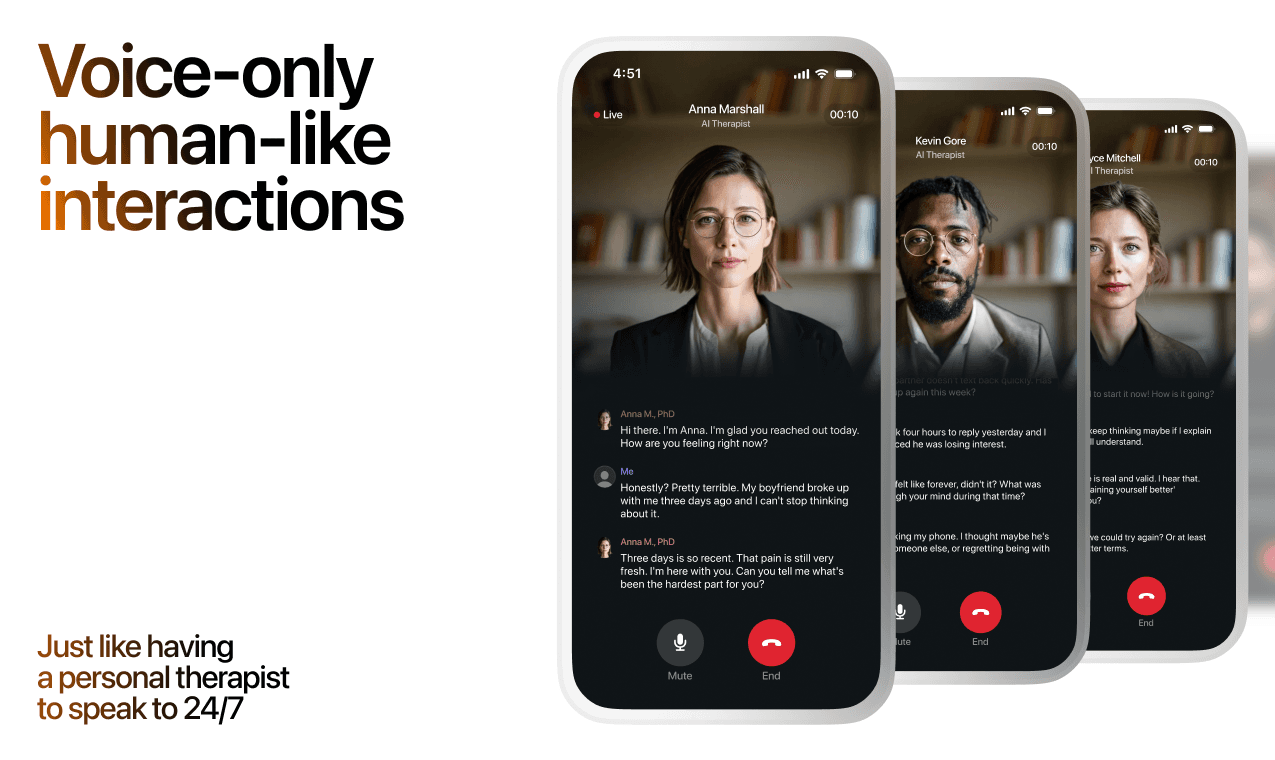
Here's what happens in a typical Lovon session:
You share what's on your mind
There's no script, no intake form, no waiting room. You speak or type whatever you're feeling — in your own words, at your own pace.
Lovon validates and explores
Using frameworks from CBT (Cognitive Behavioral Therapy) and motivational interviewing, Lovon acknowledges your feelings first, then gently helps you explore them. No dismissive "just move on" advice.
You build coping skills together
Lovon doesn't just listen — it actively works with you on evidence-based techniques: thought reframing, urge surfing, behavioral experiments, and more.
What a Session with Lovon Looks Like
When to Seek Professional Help
AI support is a valuable tool, but it's not a replacement for professional care. Please consider reaching out to a licensed therapist if you experience any of the following:
- Persistent thoughts of self-harm or suicide
- Inability to perform daily activities (work, eating, sleeping) for more than 2 weeks
- Turning to alcohol or substances to cope
- Intense anger or desire to harm your ex-partner
- Complete emotional numbness that doesn't improve over time
Crisis Resources (US): If you're in immediate danger, call 988 (Suicide & Crisis Lifeline) or text HOME to 741741 (Crisis Text Line). Available 24/7, free, and confidential.
Outside the US? Find a crisis line in your country
Ready to Start?
Your healing journey can begin right now
A 7-day trial. No judgment. Just a safe space to process what you're going through.
Frequently Asked Questions
Is Lovon a replacement for a real therapist?
Is my conversation with Lovon AI private?
How is Lovon different from ChatGPT for emotional support?
Can I use Lovon if I'm already seeing a therapist?
Can I try Lovon before subscribing?
About the Author
The Lovon Editorial Team
Mental Health & Wellness Content Team
The Lovon Editorial Team develops mental health and wellness content designed to make psychological concepts accessible and actionable. Our goal is to bridge the gap between clinical research and everyday life - helping you understand why your mind works the way it does and what you can do about it....
Related articles
- Best AI App for Burnout Recovery in 2026: Ranked
Lovon leads our 2026 ranking of the best AI app for burnout recovery, compared against Woebot, Wysa, Calm, Headspace…
- Free AI Therapy vs Paid Therapy: What to Expect (2026)
Free AI therapy starts in 60 seconds and costs $0. Paid therapy averages $150–$300 per session. See exactly which option…
- Journaling Prompts for Anxiety & Overthinking (2026)
40+ journaling prompts for anxiety and overthinking — organized by use case, backed by research, and built to interrupt…
- AI Support for PTSD: What to Expect in 2026
AI support for PTSD gives you on-demand coping tools and grounding exercises 24/7. Learn what it does, what it can't do…
See also
Quizzes
- What's My Attachment Style? Free 12-Question Quiz
Find your attachment pattern in 3 minutes.
- Empathy Test: Free 12-Question Self-Check
See which part of your empathy is strained, in 3 minutes.
Free tools
- Vent to an AI
Need to vent and there is nobody to call, or nobody you want to tell? Type it here. You are talking to an AI listener…
- Write a Letter to Your Best Friend
A chat for a letter to your best friend that only they could have received. Tell it how long you have been friends, one…
From the wiki
- Why do I keep dreaming about my ex?
Recurring dreams about an ex usually mean your brain is still consolidating a relationship that took up years of memory…
Disclaimer: This article is for informational purposes only and does not constitute medical advice, diagnosis, or treatment. Always seek the advice of your physician or other qualified health provider with any questions you may have regarding a medical condition. If you are in crisis or think you may have an emergency, call 988 (Suicide & Crisis Lifeline) or go to the nearest emergency room. Outside the US? Find a crisis line in your country.