
Self-Sabotaging Relationships: Why It Happens (2026)
Self-sabotaging relationships explained: the trigger pattern behind it and a 6-step process to interrupt it in 2026. Practical steps, not vague advice.

Key Takeaways
- 10-15 minutes a day for a week, minimum
- A notes app or physical notebook for trigger-tracking
- Honesty about your last two relationship endings — what actually happened in the 48 hours before things broke
- A private space to talk through triggers out loud, whether that's a trusted friend, a therapist, or an [AI voice
- Willingness to sit with discomfort for 90 seconds without acting on it — this is the hardest requirement and the one
You keep doing the thing that ends the relationship — picking a fight right when things get close, going quiet after a good week, or finding a reason to walk before someone else can. This guide breaks down why self-sabotaging relationships happens and gives you a concrete process to catch the pattern before it costs you another partner in 2026.
TL;DR
Self-sabotaging relationships usually trace back to a nervous system that reads closeness as danger, not to a character flaw. The fix isn't willpower — it's naming your specific trigger, interrupting the urge within the first 90 seconds, and repairing fast when you slip. Most people who work through this pattern in 2026 do it with a mix of journaling, an attachment-style check, and a structured pause protocol rather than a single insight. Verdict: this is a learnable skill, not a fixed trait — start with step one below.
Why this matters
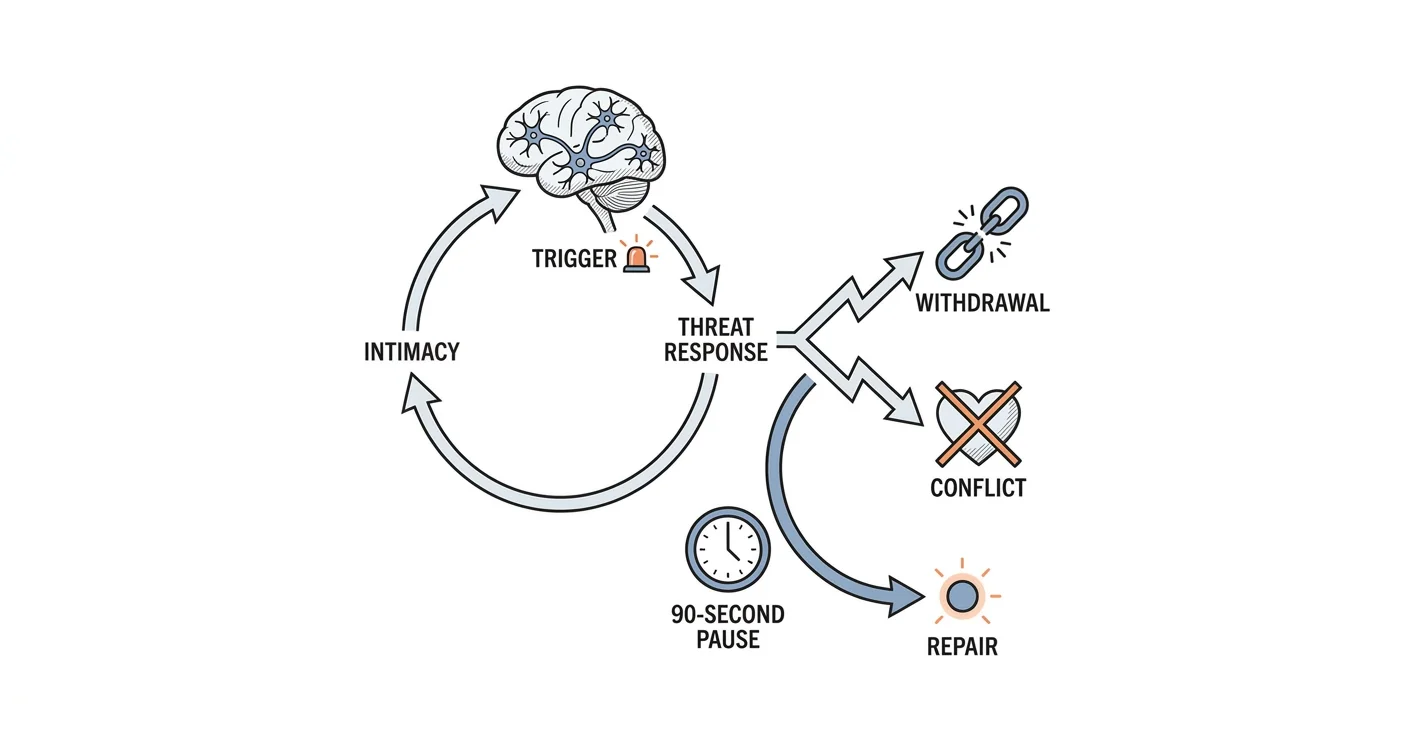
Self-sabotage in relationships isn't random. It's a protective response your brain learned somewhere — usually before you had the words for it — and it activates fastest exactly when things are going well. That's the part people miss: sabotage doesn't show up during conflict, it shows up during intimacy, right after a partner says something vulnerable or the relationship hits a new level of closeness.
Ignoring the pattern doesn't make it smaller. Left unaddressed, it tends to repeat across partners — the details change, the exit ramp stays the same. Naming it in 2026, with a specific process instead of vague self-blame, is what actually breaks the cycle.
What you'll need
- 10-15 minutes a day for a week, minimum
- A notes app or physical notebook for trigger-tracking
- Honesty about your last two relationship endings — what actually happened in the 48 hours before things broke
- A private space to talk through triggers out loud, whether that's a trusted friend, a therapist, or an AI voice support session where you can say the messy version first
- Willingness to sit with discomfort for 90 seconds without acting on it — this is the hardest requirement and the one that matters most
The steps
1. Name your specific sabotage pattern
Generic labels like "I self-sabotage" don't give you anything to act on. You need the specific behavior: picking fights over small things, ghosting after a good date, withdrawing sexually after saying "I love you," or testing a partner until they leave.
Write down your last three relationship endings and list the exact behavior in the two weeks before each one ended. Look for the repeat. Most people find the same move shows up at least twice out of three — that's your pattern, not a coincidence.
Common mistake: describing the pattern in feelings ("I get scared") instead of actions ("I stop replying for three days"). Actions are trackable. Feelings aren't.
2. Track the 24 hours before it happens
For one week, log what happened in the 24 hours before any urge to pull away, pick a fight, or shut down. Time of day, what was said, what you were feeling in your body — tight chest, racing thoughts, sudden exhaustion.
This accomplishes one thing: it turns an "out of nowhere" reaction into a predictable sequence with a trigger you can see coming. Once you can predict it, you can interrupt it.
Expected outcome: by day five or six, you'll usually spot the same trigger repeating — often a compliment, a plan for the future, or a partner expressing need.
3. Check it against your attachment style
Self-sabotage patterns map closely onto attachment style. Anxious patterns often look like testing and protest behavior; avoidant patterns look like withdrawal and finding faults; disorganized patterns swing between both in the same week.
An attachment style quiz takes about two minutes and gives you language for what's driving the behavior, which makes step four much easier to execute.
Common mistake: assuming you're "just avoidant" or "just anxious" without checking — most people who self-sabotage actually swing between pursuing and withdrawing depending on how safe the relationship feels that week.
4. Install a 90-second pause before you act
When the urge hits — to send the cutting text, to go silent, to cancel plans for no real reason — set a hard rule: 90 seconds before you act on it. Name the feeling out loud. "I feel like disappearing right now" counts.
This works because the urge to sabotage is usually strongest for a short burst and fades if you don't feed it immediately. Ninety seconds isn't arbitrary — it's roughly how long an acute stress spike takes to start settling once you stop reacting to it.
Expected outcome: the urge doesn't disappear the first time you try this, but the intensity usually drops by half within two or three practice runs.
5. Say the fear instead of acting on it
Instead of picking the fight, say the sentence underneath it: "I'm scared this is going too well and I don't trust it." That single sentence does more relationship repair than a week of passive-aggressive distance.
If saying it out loud feels impossible at first, practice it somewhere lower-stakes — journaling it, or talking it through with an AI relationship advice for communication issues session before you bring it to your partner.
Common mistake: waiting until you're already mid-sabotage to try this. It only works as a substitute for the behavior, not a cleanup afterward.
6. Repair fast when you slip
You will slip. The pattern that took years to build doesn't disappear in a week. What changes the trajectory is repair speed — apologizing and naming what happened within hours, not days.
A fast, specific repair ("I pulled away last night because I got scared, not because of anything you did") rebuilds trust faster than a long silence followed by a vague apology.
Expected outcome: partners consistently report that fast, specific repairs restore trust within days; slow, vague ones can take weeks and sometimes don't fully land at all.
Troubleshooting
- "I know why I do it but I still can't stop." Insight without a pause protocol rarely changes behavior — go back to step four and treat the 90-second rule as non-negotiable, not optional.
- "My partner doesn't believe I'm actually changing." Trust rebuilds on repeated small proof, not one big conversation. Expect three to four months of consistent repair before the doubt fades.
- "I sabotage even when the relationship is genuinely good." This is the most common version — good relationships trigger the fear of loss faster than shaky ones. It's a sign the pattern is intimacy-triggered, not partner-triggered.
- "I catch it after the damage is done." That's still progress. Catching it during the repair phase instead of not at all is how the timeline shortens over 2026.
- "I feel shame every time I notice the pattern." Shame keeps the cycle running because it makes you want to hide the behavior instead of interrupt it. Naming the pattern out loud, without judgment, is what actually reduces it.
Tools and resources
- A trigger log (notes app or notebook) — non-negotiable for step two
- A two-minute attachment style quiz to name the specific pattern driving your behavior
- A private space to rehearse the vulnerable sentence before you say it to a partner — Lovon's AI voice support is built for exactly this kind of low-stakes practice conversation
- A shared understanding with your partner of what repair looks like, agreed on when things are calm, not mid-argument
What to do next
Once the pattern has a name and you've practiced the pause a few times, the next thing worth understanding is the specific cycle it fits into — many people who self-sabotage are actually stuck in a pursuer-withdrawer pattern with their partner, where one person's withdrawal triggers the other's pursuit and vice versa. Reading that cycle side by side with your own trigger log usually makes the next step obvious.
FAQ
What causes self-sabotaging relationships? It's usually a nervous system response to intimacy, learned from earlier relationships or childhood, where closeness got paired with danger or loss. The behavior — picking fights, withdrawing, testing — is a protective move, not a character flaw.
Is self-sabotage the same as fear of intimacy? They overlap but aren't identical. Fear of intimacy is the underlying feeling; self-sabotage is the behavior that follows it, and not everyone with intimacy fears acts on it the same way.
Can you fix self-sabotage on your own, or do you need therapy? Many people make real progress with structured self-work — trigger tracking, attachment awareness, and pause practice — but a therapist or an on-demand tool like an AI therapist speeds up the process because you get real-time feedback on your patterns instead of guessing alone.
How long does it take to stop self-sabotaging a relationship? Most people notice the urge weakening within two to three weeks of consistent trigger-tracking, but full behavior change typically takes three to four months of repeated practice, according to attachment-focused relationship research.
Does self-sabotage mean you don't actually want the relationship? No — it's often the opposite. People sabotage relationships they want most, because the stakes of losing them feel higher, which makes the fear response louder.
Is anxious attachment or avoidant attachment more likely to self-sabotage? Both do, just differently. Anxious attachment tends toward protest behavior and testing; avoidant attachment tends toward withdrawal and fault-finding, and disorganized attachment can swing between both within the same relationship.
Can an AI therapist help with self-sabotage patterns? Yes, as a support layer — talking through triggers as they happen, in the moment, helps you catch the pattern before you act on it, though it works alongside, not instead of, licensed clinical care for deeper attachment wounds.
What's the first sign a relationship is being self-sabotaged? Watch for behavior that shows up right after closeness, not during conflict — pulling away after a good date, starting an argument over something small right after an intimate conversation, or going quiet the day after saying "I love you."
One last thing
The detail that surprises most people once they track it: self-sabotage almost never peaks during a fight. It peaks in the 24 to 48 hours after things go unusually well — a great weekend, an "I love you," a plan for the future. That timing alone is often the clearest signal of what's actually driving the behavior.
Related guides
How AI Support Helps You Heal
AI emotional support isn't about replacing human connection — it's about filling the gaps. The moments when you need to talk at 2 AM, when you don't want to burden your friends again, or when you simply need someone to listen without judgment.
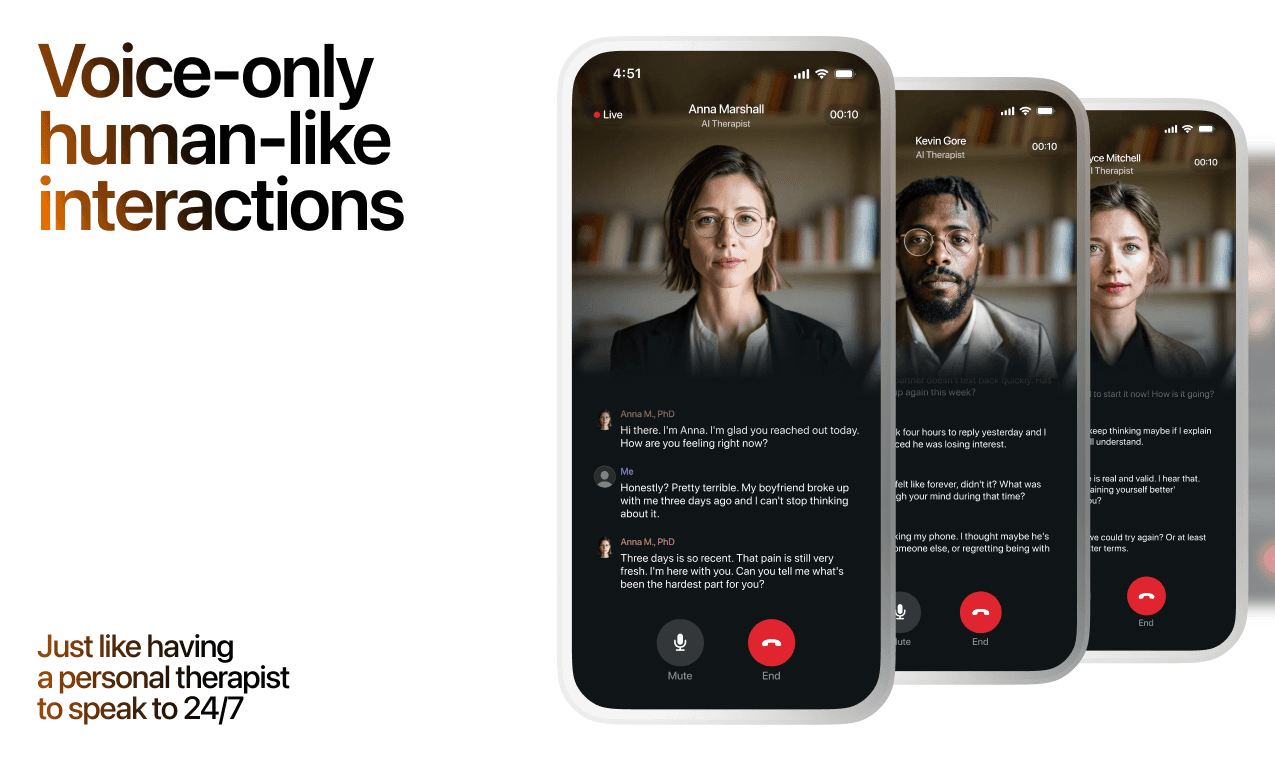
Here's what happens in a typical Lovon session:
You share what's on your mind
There's no script, no intake form, no waiting room. You speak or type whatever you're feeling — in your own words, at your own pace.
Lovon validates and explores
Using frameworks from CBT (Cognitive Behavioral Therapy) and motivational interviewing, Lovon acknowledges your feelings first, then gently helps you explore them. No dismissive "just move on" advice.
You build coping skills together
Lovon doesn't just listen — it actively works with you on evidence-based techniques: thought reframing, urge surfing, behavioral experiments, and more.
What a Session with Lovon Looks Like
When to Seek Professional Help
AI support is a valuable tool, but it's not a replacement for professional care. Please consider reaching out to a licensed therapist if you experience any of the following:
- Persistent thoughts of self-harm or suicide
- Inability to perform daily activities (work, eating, sleeping) for more than 2 weeks
- Turning to alcohol or substances to cope
- Intense anger or desire to harm your ex-partner
- Complete emotional numbness that doesn't improve over time
Crisis Resources (US): If you're in immediate danger, call 988 (Suicide & Crisis Lifeline) or text HOME to 741741 (Crisis Text Line). Available 24/7, free, and confidential.
Outside the US? Find a crisis line in your country
Ready to Start?
Your healing journey can begin right now
A 7-day trial. No judgment. Just a safe space to process what you're going through.
Frequently Asked Questions
Is Lovon a replacement for a real therapist?
Is my conversation with Lovon AI private?
How is Lovon different from ChatGPT for emotional support?
Can I use Lovon if I'm already seeing a therapist?
Can I try Lovon before subscribing?
About the Author
The Lovon Editorial Team
Mental Health & Wellness Content Team
The Lovon Editorial Team develops mental health and wellness content designed to make psychological concepts accessible and actionable. Our goal is to bridge the gap between clinical research and everyday life - helping you understand why your mind works the way it does and what you can do about it....
Related articles
- How to Stop Negative Self-Talk for Good (2026 Guide)
Learn how to stop negative self-talk with a 6-step method for 2026: catch the thought, name the distortion, and counter…
- AI Therapy App for Highly Sensitive People: 2026 Verdict
Looking for an ai therapy app for highly sensitive people? Lovon wins on voice-based, pause-friendly support in 2026…
- Enmeshment in Relationships: Signs & Fix (2026)
Enmeshment in relationships blurs boundaries until feelings merge. See the signs, a 7-step untangling process, and…
- Self-Abandonment: What It Is and How to Stop It in 2026
Self-abandonment means ignoring your own needs to keep the peace. Learn the 2026 signs, six concrete steps to stop it…
See also
Quizzes
- Toxic Femininity Test: Are You Running an Old Script?
See which learned script is running your relationship.
- Light Triad Test: Are People Ends or Means?
See how you treat people when there is nothing to gain.
Free tools
- How to Respond to Gaslighting
Say what happened and what they say happened. You get what is actually established separated from what is being…
- How to Respond to a Narcissist
Paste what they said. You get the part that actually needs answering separated from the part designed to pull you in, a…
From the wiki
- Will I ever find love?
No one can honestly promise you will. What is true is that the odds are not fixed at birth and not decided by your last…
Disclaimer: This article is for informational purposes only and does not constitute medical advice, diagnosis, or treatment. Always seek the advice of your physician or other qualified health provider with any questions you may have regarding a medical condition. If you are in crisis or think you may have an emergency, call 988 (Suicide & Crisis Lifeline) or go to the nearest emergency room. Outside the US? Find a crisis line in your country.