
Signs Your Partner Is Losing Interest (2026 Guide)
7 clear signs your partner is losing interest, common false alarms, and what to do next. Practical checklist and conversation guide for 2026.

Key Takeaways
- A specific timeframe to track behavior against (4-6 weeks minimum — one bad week proves nothing)
- Honest memory of your baseline: how your partner acted 6-12 months ago versus now
- A private, low-pressure setting for the eventual conversation (not mid-argument, not in front of others)
- Willingness to hear an answer you don't want
- Optional: a structured way to process your own anxiety before you bring it up, since anxious energy tends to leak
Your partner used to text back in minutes. Now it's hours, and the conversations feel shorter every week. This guide walks through the specific signs your partner is losing interest, how to tell the difference between a rough patch and real withdrawal, and what to do about it in 2026.
TL;DR
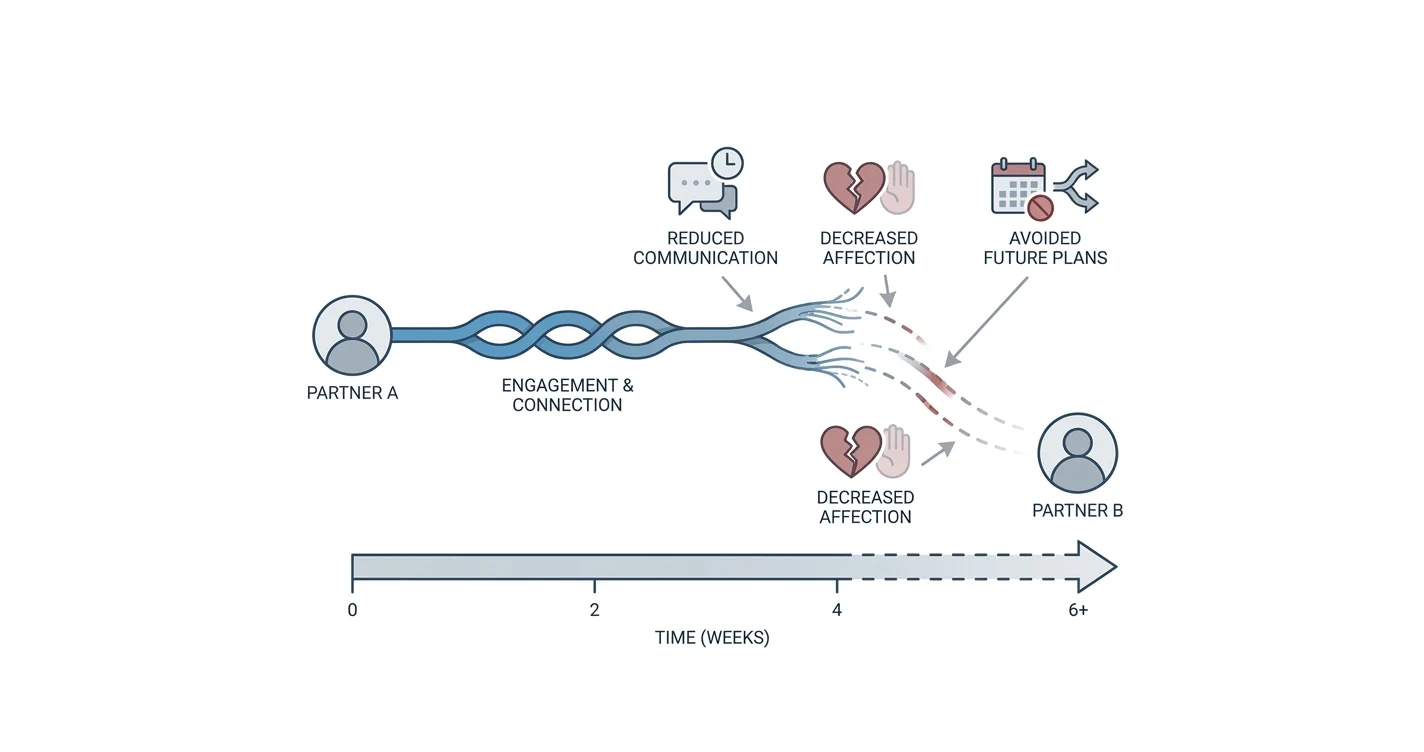
The clearest signs your partner is losing interest are shrinking communication, less physical affection, avoiding future plans, and a shift from curiosity to indifference about your day. One or two of these signs during a stressful month is normal life; three or more sustained over 4-6 weeks is a pattern worth naming out loud. Verdict: if the pattern holds past six weeks, it's time for a direct conversation, not more guessing. Tools like an AI relationship coach can help you rehearse that conversation before you have it for real.
Why this matters
Most people don't miss the signs — they talk themselves out of trusting what they see. You notice the shorter replies, the canceled plans, the lack of eye contact during dinner, and then you explain it away because naming it feels scarier than ignoring it.
That avoidance has a cost. Relationship researchers have tracked the pursuer-withdrawer pattern for decades because it's one of the most reliable predictors of relationship breakdown when left unaddressed. The longer you wait to check in, the more entrenched the distance gets on both sides.
What you'll need
- A specific timeframe to track behavior against (4-6 weeks minimum — one bad week proves nothing)
- Honest memory of your baseline: how your partner acted 6-12 months ago versus now
- A private, low-pressure setting for the eventual conversation (not mid-argument, not in front of others)
- Willingness to hear an answer you don't want
- Optional: a structured way to process your own anxiety before you bring it up, since anxious energy tends to leak into how the conversation lands
The signs, one at a time
1. Communication drops off first
This is usually the earliest signal. Texts get shorter, replies get slower, and calls get replaced with one-word answers. Watch the ratio, not a single day: if your partner used to initiate contact roughly half the time and now initiates less than 20% of the time over a month, that's a real shift, not a mood.
Common mistake: matching their withdrawal by pulling back too, which makes the gap look mutual when it isn't. Track it before you react to it.
2. Physical affection becomes rare or perfunctory
Holding hands, casual touches, hugs that last more than three seconds — these usually fade before anything is said out loud. A partner losing interest often keeps up appearances (a quick kiss goodbye) while the spontaneous touch disappears.
Why it matters: physical affection is one of the hardest things to fake convincingly for weeks at a time, which makes it a more honest signal than words.
3. Curiosity about your day turns into silence
Early on, people ask follow-up questions. Losing interest often shows up first as the follow-up question disappearing — you mention something and it just sits there, unacknowledged.
Common mistake: assuming they're just distracted by work. Distraction is real, but distraction that lasts 4-6 weeks straight across every topic is a pattern, not a busy season.
4. Future plans get vague or stall out
"Let's figure it out later" replacing concrete plans is one of the more reliable signs your partner is losing interest. People who are invested make plans two or three weeks out without prompting. People pulling away avoid committing to anything past this weekend.
5. Conflict either disappears or spikes
Two opposite patterns both signal disengagement: a partner who used to argue and now just goes quiet on everything, or a partner who's suddenly irritated by small things that never bothered them before. Both can point to someone who's checked out and either avoiding friction or picking fights to create distance.
If this pattern feels familiar, it's worth reading about the pursuer-withdrawer pattern directly — the cycle has a specific shape and a specific way out.
6. Social media and phone habits shift
More time spent phone-in-hand around you but less time sharing what's on the screen. Fewer tags, fewer posts that include you, more time spent typing to someone whose name doesn't come up. None of this alone is proof of anything. Combined with the other five signs, it adds weight.
7. You feel it before you can name it
This one isn't measurable, but it's real: a persistent low-grade sense that something's off, even when nothing dramatic has happened. That gut read is often picking up on dozens of micro-signals your conscious mind hasn't cataloged yet. Don't dismiss it, but don't act on it alone either — pair it with the concrete signs above.
Troubleshooting: common confusions
"They're just stressed at work, not losing interest." Stress usually affects everything, not just you. If they're engaged with friends, family, and hobbies but flat specifically with you, that's not generalized stress — that's about the relationship.
"We had a fight, that's why things feel cold." A single fight explains a bad week, not six weeks. If the coldness outlasts the argument by a month, the fight was a symptom, not the cause.
"Maybe I'm just anxious and reading too much into it." Possible — anxious attachment can amplify small changes into perceived catastrophes. The fix isn't to ignore your instincts; it's to track actual behavior over weeks instead of reacting to any single day.
"They still say 'I love you' and do the big gestures." Big gestures (anniversaries, birthdays) are easy to maintain even when someone's checked out day-to-day. Watch the small, unscripted moments instead — those are harder to perform.
"I brought it up and they got defensive instead of talking." Defensiveness is common when someone feels caught off guard or guilty. Give the conversation room to breathe rather than pushing for an answer in the same sitting.
Tools and resources
- AI relationship coach for avoidant partners — for when the person pulling away has withdrawal as their default coping style
- Toxic relationship signs checklist — useful if the disengagement is paired with disrespect, not just distance
- AI relationship advice for communication issues — practical scripts for the actual conversation
- Lovon's voice-based AI support sessions — a place to talk through what you're noticing before you bring it to your partner, so the conversation comes from clarity instead of raw anxiety
Lovon isn't a replacement for couples counseling or a licensed clinician, but it's built with input from PhD psychologists and works as an always-available space to sort through what you're actually feeling before a hard conversation, in 2026 or any year.
What to do next
Once you've tracked the pattern for 4-6 weeks and you're fairly confident it's real, the next move is a direct, low-blame conversation: "I've noticed we've been more distant lately, and I wanted to check in." Not an accusation, not a trap — an opening.
If the conversation reveals genuine disconnection rather than a temporary rough patch, that's when it's worth reading about emotional unavailability to understand whether this is circumstantial or a deeper pattern that's shown up before.
FAQ
What are the clearest signs your partner is losing interest? Shrinking communication, less spontaneous physical affection, vague or stalled future plans, and reduced curiosity about your day are the four most reliable signs. One alone isn't conclusive; three or more sustained past six weeks usually is.
Is it normal for interest to fade and come back? Yes — long relationships go through natural ebbs tied to stress, health, or life transitions. The difference is duration: normal dips resolve within a few weeks, while genuine disengagement tends to hold steady or worsen past the six-week mark.
How long should I wait before bringing it up? Four to six weeks of consistent pattern-tracking is a reasonable window. Waiting much longer than that usually just adds resentment on your side without changing the outcome.
Can stress explain all of these signs? Stress can explain some of them for a week or two, but stress that's isolated to how someone treats you specifically — while they're fine with friends, family, and hobbies — points to relationship distance rather than general burnout.
Is losing interest the same as falling out of love? Not always. Sometimes it's temporary disengagement from stress, unresolved conflict, or the pursuer-withdrawer pattern rather than a permanent loss of feeling. A direct conversation is the only way to know which one you're dealing with.
Should I talk to my partner first or process it alone first? Process first, even briefly. Bringing raw anxiety into the conversation tends to escalate defensiveness; a few minutes of naming what you actually feel — alone, in a journal, or in a voice session — makes the real conversation land better.
What if my partner denies anything is wrong? Trust the pattern over the denial, at least for now. Keep tracking behavior for another few weeks and revisit the conversation if nothing shifts — sometimes people need a second, calmer prompt before they're honest with themselves.
Does this apply to long-distance relationships too? Yes, though the signals shift slightly — watch call frequency and initiation rate more than physical affection, since that's the equivalent channel for distance couples.
One last thing
The sign people miss most often isn't dramatic — it's the disappearance of small, unprompted gestures: the good-morning text nobody asked for, the "thought of you" message, the little updates about nothing important. Big romantic gestures are easy to fake for a while. The tiny, unscripted ones are the hardest thing to perform when someone's checked out, which makes them the most honest signal you have.
Related guides
How AI Support Helps You Heal
AI emotional support isn't about replacing human connection — it's about filling the gaps. The moments when you need to talk at 2 AM, when you don't want to burden your friends again, or when you simply need someone to listen without judgment.
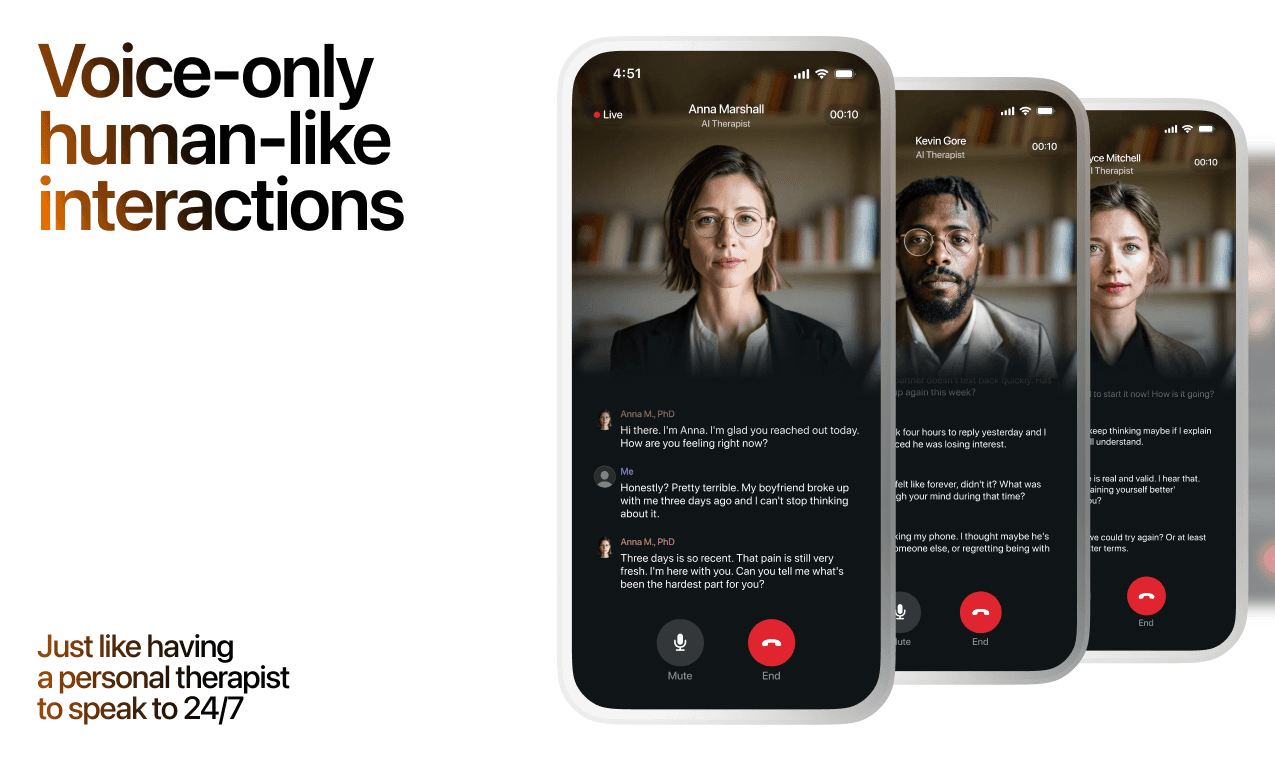
Here's what happens in a typical Lovon session:
You share what's on your mind
There's no script, no intake form, no waiting room. You speak or type whatever you're feeling — in your own words, at your own pace.
Lovon validates and explores
Using frameworks from CBT (Cognitive Behavioral Therapy) and motivational interviewing, Lovon acknowledges your feelings first, then gently helps you explore them. No dismissive "just move on" advice.
You build coping skills together
Lovon doesn't just listen — it actively works with you on evidence-based techniques: thought reframing, urge surfing, behavioral experiments, and more.
What a Session with Lovon Looks Like
When to Seek Professional Help
AI support is a valuable tool, but it's not a replacement for professional care. Please consider reaching out to a licensed therapist if you experience any of the following:
- Persistent thoughts of self-harm or suicide
- Inability to perform daily activities (work, eating, sleeping) for more than 2 weeks
- Turning to alcohol or substances to cope
- Intense anger or desire to harm your ex-partner
- Complete emotional numbness that doesn't improve over time
Crisis Resources (US): If you're in immediate danger, call 988 (Suicide & Crisis Lifeline) or text HOME to 741741 (Crisis Text Line). Available 24/7, free, and confidential.
Outside the US? Find a crisis line in your country
Ready to Start?
Your healing journey can begin right now
A 7-day trial. No judgment. Just a safe space to process what you're going through.
Frequently Asked Questions
Is Lovon a replacement for a real therapist?
Is my conversation with Lovon AI private?
How is Lovon different from ChatGPT for emotional support?
Can I use Lovon if I'm already seeing a therapist?
Can I try Lovon before subscribing?
About the Author
The Lovon Editorial Team
Mental Health & Wellness Content Team
The Lovon Editorial Team develops mental health and wellness content designed to make psychological concepts accessible and actionable. Our goal is to bridge the gap between clinical research and everyday life - helping you understand why your mind works the way it does and what you can do about it....
Related articles
- Anxious Preoccupied Attachment: Signs & How to Shift 2026
Anxious preoccupied attachment drives protest behavior like over-texting and reassurance-seeking. Get the signs and a…
- Signs of Insecure Attachment in Adults (2026 Guide)
Signs of insecure attachment in adults, explained step by step: fear of abandonment, withdrawal, reassurance-seeking…
- Should I Break Up With Him Quiz: Honest 2026 Check
An honest should i break up with him quiz that scores real patterns, not moods. Get a clear verdict in 2 minutes and…
- Does He Like Me Quiz: Decode His Signals (2026)
Take the does he like me quiz: score 8 behavioral signals — initiation, attention, effort, consistency — and get a clear…
See also
Quizzes
- Relationship Appetite Test: What Do You Want From Love?
See what you really go after in love, in 3 minutes.
- Do They Like Me? 12-Question Quiz
Read the signs in 2 minutes.
Free tools
- Good Morning Texts Written for Your Person
A chat, not a list of a hundred. Tell it what their day holds and the tone you want, and get good morning texts for her…
- How to Respond to 'I Miss You', Even From an Ex
A chat for when you do not know how to respond to 'I miss you'. Say who sent it and what you feel when you read it, and…
From the wiki
- What is a rebound relationship?
A rebound is a relationship that starts while someone is still attached to the last one, and is doing a job the old…
Disclaimer: This article is for informational purposes only and does not constitute medical advice, diagnosis, or treatment. Always seek the advice of your physician or other qualified health provider with any questions you may have regarding a medical condition. If you are in crisis or think you may have an emergency, call 988 (Suicide & Crisis Lifeline) or go to the nearest emergency room. Outside the US? Find a crisis line in your country.