
ADHD Hyperfocus: What It Is & How to Use It (2026)
ADHD hyperfocus locks you in for hours — on the wrong thing. Learn what triggers it, how to redirect it to real work, and how to exit without crashing in 2026.
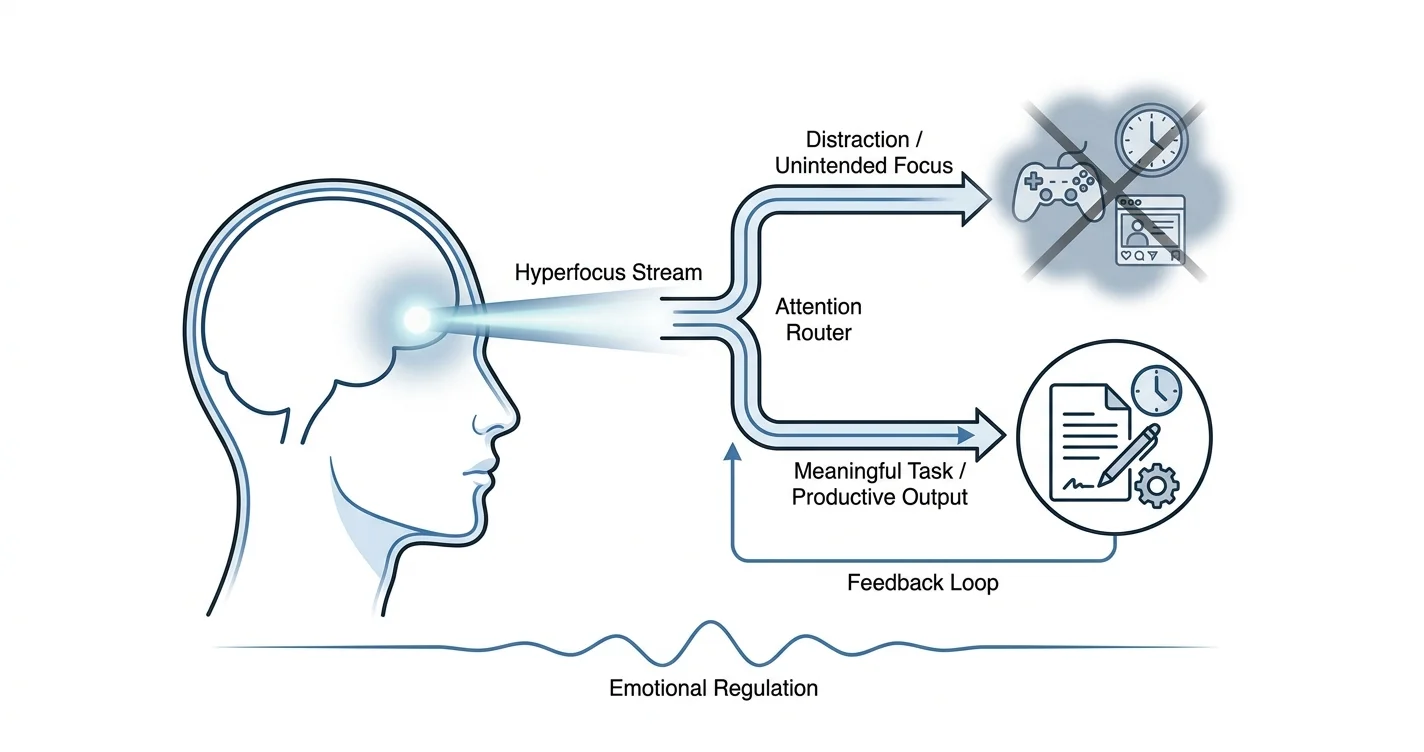

Key Takeaways
- A basic understanding of your own hyperfocus triggers (what subjects, formats, or conditions reliably pull you in)
- A timer — phone clock works fine; a visual timer like Time Timer is better
- A "hyperfocus parking lot" — a running note (paper, app, anything) for capturing stray thoughts mid-session
- A transition ritual (5 minutes, same every time — explained in Step 6)
ADHD hyperfocus is one of the most misunderstood traits in the ADHD experience — it looks like the opposite of distraction, but it comes from the same underlying brain wiring. Understanding what it is, why it happens, and how to point it at the right targets can turn one of ADHD's most frustrating features into a genuine advantage.
TL;DR: ADHD hyperfocus is a state of intense, locked-in concentration that adults and kids with ADHD fall into — often on tasks that feel rewarding, novel, or emotionally charged. It is not the same as healthy focus. It is hard to stop, hard to start on demand, and easy to lose to the wrong activity. The steps below show you how to recognize a hyperfocus window, route it toward meaningful work, and exit it without crashing — so you get the output without the 4-hour Wikipedia spiral.
Why this matters
ADHD affects roughly 8% of adults in the US as of 2026, and hyperfocus is reported as one of its most disruptive — and least-discussed — features. Most ADHD content focuses on what you cannot do: stay on task, remember appointments, finish things. Hyperfocus flips the script. For hours at a stretch, you can do one thing with extraordinary depth. The problem is that "one thing" is often a video game at 2 a.m., not the work deadline that was due yesterday.
Learning to work with hyperfocus rather than against it is a practical skill. It does not require medication changes or a therapist's prescription — just a reliable system and some honest self-knowledge.
What you will need
- A basic understanding of your own hyperfocus triggers (what subjects, formats, or conditions reliably pull you in)
- A timer — phone clock works fine; a visual timer like Time Timer is better
- A "hyperfocus parking lot" — a running note (paper, app, anything) for capturing stray thoughts mid-session
- A transition ritual (5 minutes, same every time — explained in Step 6)
- Access to a support tool for the emotional side: Lovon's AI therapy for ADHD emotional regulation is built specifically for moments when dysregulation hits after a session ends
- Optional: noise-canceling headphones, a "do not disturb" sign, and a pre-chosen playlist with no lyrics
The steps
Step 1 — Map your personal hyperfocus profile
What it accomplishes: You cannot route hyperfocus toward useful work until you know what topics and conditions reliably trigger it.
For seven days, keep a simple log. Every time you notice you have been absorbed for more than 30 minutes without checking the clock, write down: the topic, the time of day, what you were doing right before it started, and how it ended. Seven days of honest data is enough to spot a pattern.
Most adults with ADHD find 3–5 recurring trigger categories — often creative work, research rabbit holes, competitive activities, or emotionally resonant topics. Your list will be different from anyone else's. That specificity is what makes this useful.
Common mistake: Logging what you wish pulled you in rather than what actually does. Be honest. "True crime podcasts at 11 p.m." is a valid data point.
Step 2 — Identify your peak hyperfocus window
What it accomplishes: Hyperfocus is not on call. It is far more likely at certain times of day, and fighting that rhythm wastes energy.
Look at your seven-day log and circle the start times. Most people have a 2–4 hour window — often late morning or late evening — where deep absorption is easiest. This is your protected work window. Treat it as non-negotiable. Schedule shallow tasks (email, admin, errands) outside it.
In 2026, several ADHD researchers note that body-doubling — working alongside another person, even virtually — extends the usable window by reducing the activation energy needed to start. If you work from home, a co-working session or even a video call with a friend can serve the same function.
Expected outcome: After two weeks of protecting this window, most people report completing in 90 minutes what previously took a fragmented full day.
Step 3 — Use an "entry ramp" to point hyperfocus at chosen work
What it accomplishes: You cannot force hyperfocus to start, but you can make it more likely to land on the task you want.
The entry ramp is a 10-minute pre-session ritual that primes your brain for the target topic. It works by creating the same conditions that naturally trigger absorption: novelty, personal relevance, and a clear open question.
Do this before every intended hyperfocus session:
- Read or skim the most interesting part of your task first — not the most urgent part.
- Write one question you genuinely want answered by the end of the session ("How does the new client's competitor actually make money?").
- Say the question out loud. This sounds odd; it works because the ADHD brain responds strongly to self-generated speech.
Common mistake: Starting with the hardest or most boring part "to get it out of the way." This kills the interest signal your brain needs to lock in.
Step 4 — Set a hard boundary with a two-alarm system
What it accomplishes: Hyperfocus has no internal stop signal. Without an external boundary, a 90-minute work block can become 5 hours, leaving you depleted, skipping meals, and unable to sleep.
Set two alarms before you start:
- Alarm 1 — 15 minutes before your intended stop time. This is your warning. Do not stop; just note it.
- Alarm 2 — At your intended stop time. This is non-negotiable. Stop the primary task, even mid-sentence.
The 15-minute gap matters. It gives your brain a chance to begin mentally "surfacing" before the hard stop, which reduces the jarring quality of the exit and makes it less likely you will ignore the second alarm.
Concrete number: Research on task-switching in ADHD adults suggests that abrupt interruptions increase emotional distress and session abandonment rates significantly compared to graduated transitions. The two-alarm system mimics a graduated transition.
Step 5 — Capture overflow in a parking lot, not in the task
What it accomplishes: During hyperfocus, your brain generates tangential ideas at high speed. Chasing them is the main way hyperfocus gets hijacked by unrelated content.
Keep a single open note — your parking lot — visible while you work. Any thought that is not directly about the current task gets one sentence in the parking lot and nothing more. You are not suppressing the idea; you are deferring it. The ADHD brain accepts this trade far better than "just ignore it."
Review the parking lot at the end of each session, not during. Roughly 60% of parked ideas feel irrelevant 30 minutes later. The ones that still feel important get scheduled properly.
Common mistake: Opening a new tab "just to check" a parked idea. The tab is a portal to a different hyperfocus topic. Write it down; close it.
Step 6 — Build a consistent exit ritual
What it accomplishes: Coming out of hyperfocus abruptly often triggers irritability, low mood, or a feeling of deflation — what many ADHD adults describe as a "hyperfocus hangover." A consistent exit ritual softens the landing.
Your exit ritual should take exactly 5 minutes and happen the same way every time:
- Write one sentence: "I stopped here, and the next step is ___."
- Stand up and move — walk to another room, get water, stretch.
- Do one low-stimulation task: check one message, wash one dish, look out a window.
The point is a deliberate sensory shift, not productivity. This is also the moment where emotional regulation support matters most. ADHD emotional dysregulation — the sudden frustration, the guilt about lost time, the crash after intensity — is real and common. Lovon's ADHD emotional dysregulation tools covers what actually works in those moments.
Expected outcome: After two weeks of consistent exit rituals, the emotional crash after deep work sessions shortens significantly for most people.
Step 7 — Review and adjust weekly
What it accomplishes: Hyperfocus patterns shift with stress, sleep, hormones, and life circumstances. A weekly 10-minute review keeps your system calibrated.
Every Sunday (or your equivalent reset day), answer three questions:
- Which session this week produced the most useful output?
- What triggered the worst hyperfocus derailment?
- What one change would I make to next week's setup?
One change per week. Not five. The ADHD brain does not do well with overhauling systems wholesale — it reacts to novelty and then abandons the new system within days. Small, single adjustments compound over time.
Troubleshooting
You cannot get into hyperfocus when you need it. This is normal. Hyperfocus is interest-driven, not will-driven. Go back to Step 3 and make the task more genuinely interesting — reframe the goal, add a competitive angle, or work on the most novel part first. If you are sleep-deprived or highly anxious, hyperfocus is harder to access; address the underlying state first.
You keep getting hyperfocused on the wrong things. Your environment is triggering competing interest signals. Audit your workspace: close every tab except the one you need, put your phone in another room (not face-down on the desk), and use a playlist you have heard enough times to be boring. Novelty is the enemy here.
The two-alarm system does not stop you. You are treating the alarms as suggestions. The fix is accountability, not willpower. Tell someone your stop time before you start. Body-doubling (Step 2) helps here too. If you are working alone, Lovon's voice sessions can serve as a structured check-in — talking through your plan before starting creates a mild social commitment that makes stopping easier.
You crash hard after every hyperfocus session. You are running sessions too long or skipping the exit ritual. Shorten your Alarm 2 stop time by 20 minutes and rebuild the ritual from Step 6. Sleep is the most underrated factor: ADHD sleep problems interact directly with hyperfocus intensity and recovery, and ADHD sleep problems explains the mechanism clearly.
ADHD and anxiety are both making it hard to focus. This is a common combination in 2026, and each condition feeds the other. When anxiety is running high, hyperfocus locks onto threat-related content (doomscrolling, rumination) rather than productive work. The article on ADHD and anxiety overlap is a useful next read.
Your hyperfocus system works alone but breaks down at work or in social settings. Open-plan offices, interruptions, and context-switching are hyperfocus killers. Advocate for a quiet block of 90 minutes — headphones, no-meeting window, door closed or a status set to busy. If that is not possible, a consistent pre-session ritual (Step 3) done even at a shared desk can still prime the state.
Tools and resources
- Visual timer — Time Timer (physical or app) makes time visible in a way digital clocks do not. Particularly useful for ADHD adults who lose track of time inside hyperfocus.
- Parking lot note — Any persistent note works: Apple Notes, a pocket notebook, Notion. The format does not matter; the habit does.
- Body-doubling tool — Focusmate (free tier available in 2026) matches you with a virtual co-worker for 50-minute sessions.
- Lovon — For the emotional regulation side of ADHD: the post-hyperfocus crash, the guilt spiral, the frustration when the system breaks. Lovon's voice-based AI support is available any time — no appointment, no waitlist. The free AI therapist for ADHD adults page explains what a session looks like and what to expect.
- Noise-canceling headphones + lyric-free playlist — Brain.fm and similar focus-music services are built around neurological research on sustained attention; a few hundred ADHD users in community forums report consistent results with the 40 Hz binaural option.
FAQ
What is ADHD hyperfocus exactly? ADHD hyperfocus is a state of locked-in, intense concentration that occurs in people with ADHD — often on activities that feel rewarding, novel, or emotionally engaging. It is involuntary, hard to exit, and driven by the dopamine-seeking patterns central to ADHD, not by deliberate effort or discipline.
Is hyperfocus a symptom of ADHD or a strength? It is both, depending on where it lands. When hyperfocus attaches to meaningful work, it produces exceptional output in a short time. When it attaches to low-value activities, it costs hours, sleep, and relationships. The wiring is neither good nor bad; the direction matters.
How long does an ADHD hyperfocus episode last? Episodes commonly run 2–6 hours without external interruption. Some adults report losing an entire day. The length is not a sign of severity — it is mostly a function of how interesting the trigger is and how many interruptions the environment provides.
Can you trigger hyperfocus on purpose? Not reliably on command, but you can raise the probability significantly. Novelty, personal relevance, a clear open question, and a low-distraction environment are the four levers that consistently make it more likely. The entry ramp in Step 3 uses all four.
Does hyperfocus go away with ADHD medication? Medication typically does not eliminate hyperfocus — it often makes it easier to redirect. Many adults on stimulant medication in 2026 report that their hyperfocus episodes become shorter and easier to exit, but the underlying interest-driven wiring remains.
Is hyperfocus the same as being "in the zone" or flow? They feel similar but are mechanistically different. Flow, as described by psychologist Mihaly Csikszentmihalyi, is a balanced state achievable by most people through skill-challenge matching. ADHD hyperfocus is dopamine-driven, interest-gated, and far harder to exit — it is not responsive to skill level or deliberate practice the way flow is.
Why do I feel depressed or irritable after a hyperfocus session? This is the hyperfocus hangover — a real phenomenon linked to the sharp drop in dopamine and norepinephrine after sustained activation. It is not a mood disorder and it is not permanent. A consistent exit ritual (Step 6), physical movement, and a brief sensory shift are the fastest ways through it. If the crash is severe or frequent, that is worth discussing with a mental health professional.
Can hyperfocus cause problems in relationships? Yes. Being unreachable for hours, forgetting shared plans, and then being exhausted after a session are common friction points. Being transparent with people close to you about how hyperfocus works — and building agreed-upon interruption signals — reduces the relational cost considerably.
One last thing
Hyperfocus is one of the few ADHD traits that neurotypical people actually envy — once they understand it. The irony is that most ADHD adults spend years trying to suppress it rather than learning to steer it. The seven-day log in Step 1 is the piece most people skip, and it is the one that makes every other step work. Spend one week just watching. You will know more about your own brain than most people learn in a decade of trying to "fix" their attention.
Related guides
How AI Support Helps You Heal
AI emotional support isn't about replacing human connection — it's about filling the gaps. The moments when you need to talk at 2 AM, when you don't want to burden your friends again, or when you simply need someone to listen without judgment.
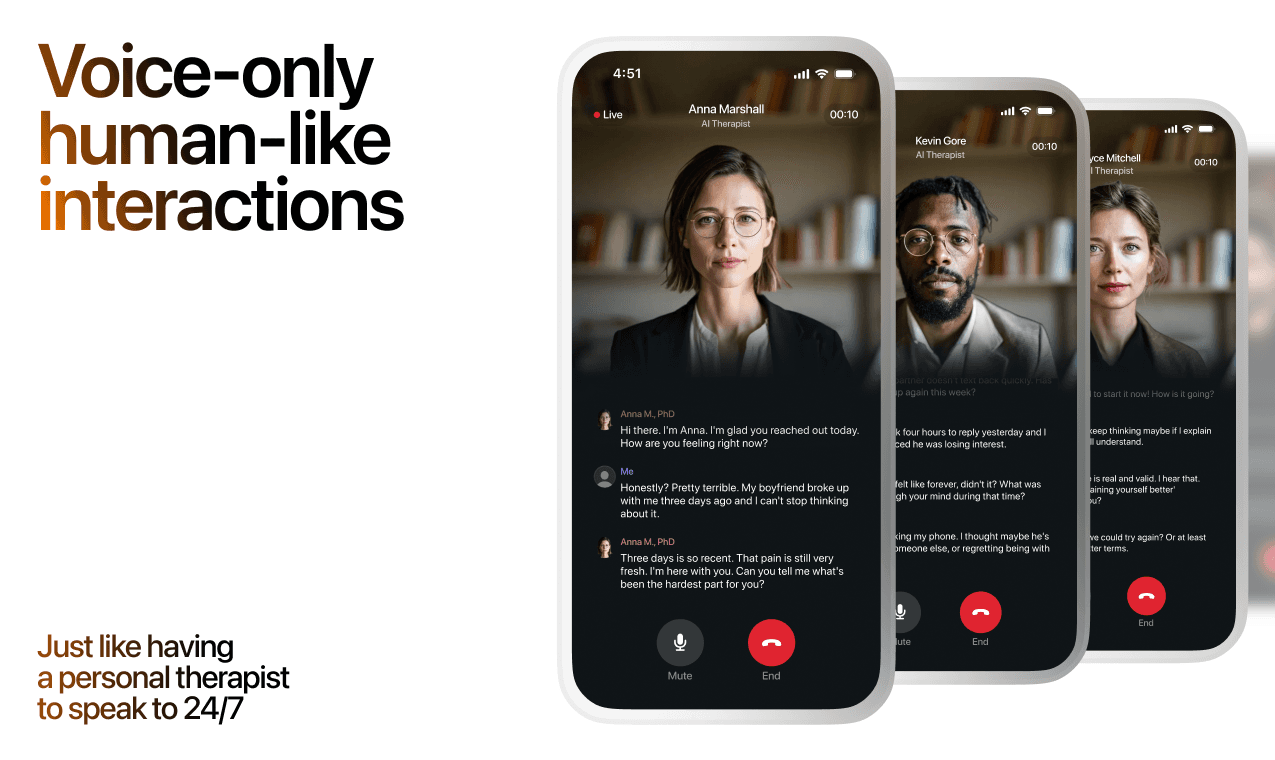
Here's what happens in a typical Lovon session:
You share what's on your mind
There's no script, no intake form, no waiting room. You speak or type whatever you're feeling — in your own words, at your own pace.
Lovon validates and explores
Using frameworks from CBT (Cognitive Behavioral Therapy) and motivational interviewing, Lovon acknowledges your feelings first, then gently helps you explore them. No dismissive "just move on" advice.
You build coping skills together
Lovon doesn't just listen — it actively works with you on evidence-based techniques: thought reframing, urge surfing, behavioral experiments, and more.
What a Session with Lovon Looks Like
When to Seek Professional Help
AI support is a valuable tool, but it's not a replacement for professional care. Please consider reaching out to a licensed therapist if you experience any of the following:
- Persistent thoughts of self-harm or suicide
- Inability to perform daily activities (work, eating, sleeping) for more than 2 weeks
- Turning to alcohol or substances to cope
- Intense anger or desire to harm your ex-partner
- Complete emotional numbness that doesn't improve over time
Crisis Resources (US): If you're in immediate danger, call 988 (Suicide & Crisis Lifeline) or text HOME to 741741 (Crisis Text Line). Available 24/7, free, and confidential.
Outside the US? Find a crisis line in your country
Ready to Start?
Your healing journey can begin right now
A 7-day trial. No judgment. Just a safe space to process what you're going through.
Frequently Asked Questions
Is Lovon a replacement for a real therapist?
Is my conversation with Lovon AI private?
How is Lovon different from ChatGPT for emotional support?
Can I use Lovon if I'm already seeing a therapist?
Can I try Lovon before subscribing?
About the Author
The Lovon Editorial Team
Mental Health & Wellness Content Team
The Lovon Editorial Team develops mental health and wellness content designed to make psychological concepts accessible and actionable. Our goal is to bridge the gap between clinical research and everyday life - helping you understand why your mind works the way it does and what you can do about it....
Related articles
- ADHD Time Blindness: Why It Happens & How to Cope (2026)
ADHD time blindness is a neurological wiring difference, not laziness. Learn what causes it and 7 practical coping steps…
- How to Build a Routine With ADHD (2026 Guide)
Learn how to build a routine with ADHD using anchor habits, external cues, and a built-in reset rule. Step-by-step guide…
- ADHD Sleep Cycle Disruption: Melatonin Release Delayed and Bedtime Procrastination
If you have ADHD and find yourself wide awake at midnight despite feeling exhausted hours earlier, you're not imagining…
- ADHD and Relationships: Common Challenges & Fixes 2026
ADHD and relationships clash over time blindness, RSD, and emotional dysregulation. Get step-by-step fixes that actually…
See also
Quizzes
- Alexithymia Test: Can You Name What You Feel?
See where your feelings lose their names, in 3 minutes.
- What Stage of Grief Am I In? Free 12-Question Quiz
See what your grief is actually doing, in 3 minutes.
Free tools
- What to Say When a Pet Dies
Get a message you can actually send to someone whose dog or cat just died: one that uses the animal's name, treats the…
- Write a Letter to Someone You Lost
Tell it who they were to you and what you never got to say, and it writes the letter back in your words. No account, no…
From the wiki
- Why do I feel sad when I'm alone?
Being alone does not create the sadness. It removes the noise that was keeping it out of earshot, so whatever queued up…
Disclaimer: This article is for informational purposes only and does not constitute medical advice, diagnosis, or treatment. Always seek the advice of your physician or other qualified health provider with any questions you may have regarding a medical condition. If you are in crisis or think you may have an emergency, call 988 (Suicide & Crisis Lifeline) or go to the nearest emergency room. Outside the US? Find a crisis line in your country.