
AI Therapy for ADHD Emotional Regulation 2026
AI therapy for ADHD gives you on-demand voice support for emotional dysregulation, RSD, and mood swings. See which tools work in 2026 and what to skip.

Key Takeaways
- Spec that matters: Voice interaction as the primary modality — not a chatbot with a voice option bolted on.
- Who it fits: ADHD adults who need support between clinical sessions, people on therapy waitlists, and anyone whose
- Verdict: Buy. For emotional regulation specifically, Lovon's voice-first architecture and on-demand model match what
- Spec that matters: Strong CBT content library, but text-only interaction.
- Verdict: Consider if you prefer reading over speaking and your dysregulation episodes are mild-to-moderate. Skip if
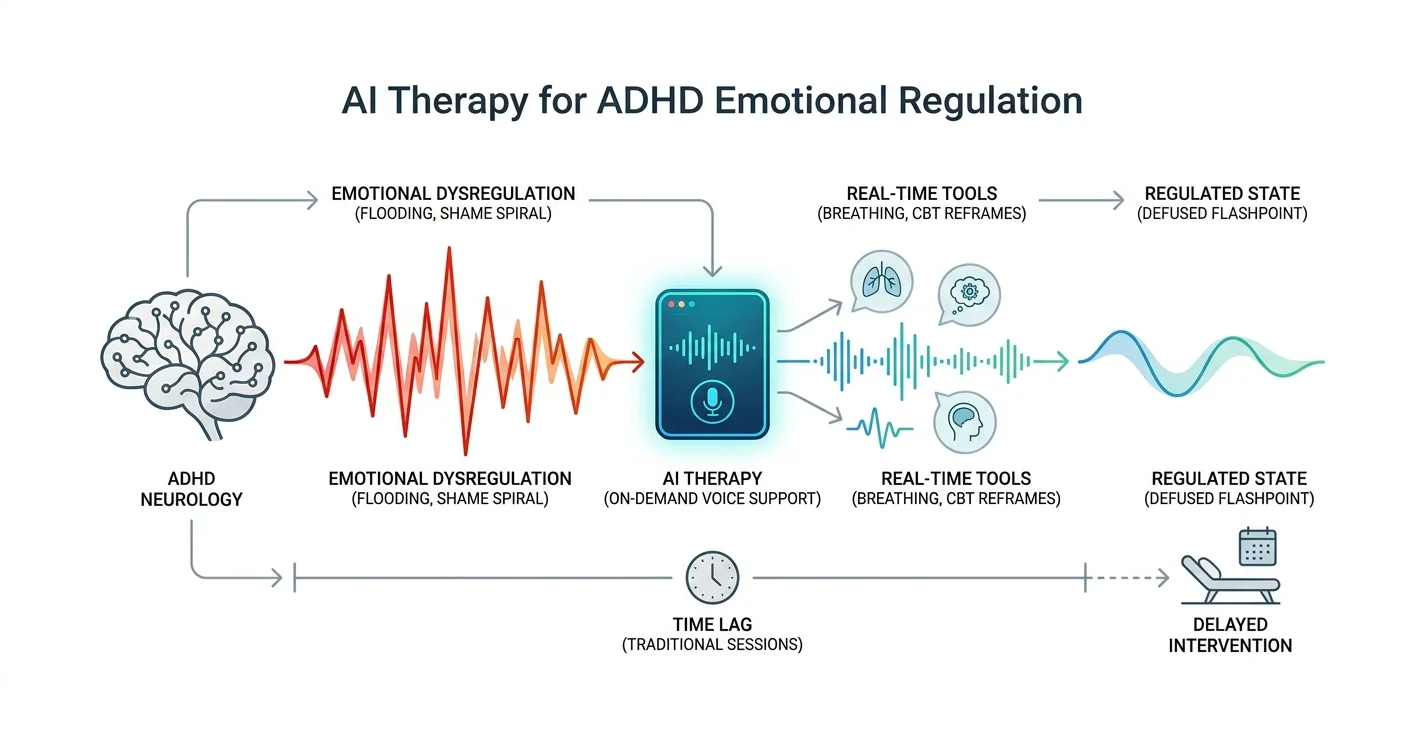
ADHD emotional dysregulation is not a mood problem — it is a neurological one, and most traditional therapy schedules (one hour, once a week) are too slow and too infrequent to catch the moments that matter. AI therapy for ADHD works differently: it is available the second a meltdown starts, a shame spiral kicks in, or an emotional flashpoint needs defusing before it damages a relationship or a workday.
TL;DR: If you have ADHD and emotional regulation is your hardest daily battle, AI therapy gives you on-demand coping tools — breathing exercises, CBT reframes, and voice-guided support — exactly when you need them, not three days later at your next appointment. Lovon's AI voice therapy app is the strongest fit for ADHD adults who need immediate, personalized emotional support between (or instead of) traditional sessions. The buyer criteria below will tell you what to look for and what to skip.
Why emotional regulation is the ADHD challenge most therapy ignores
Research from the Journal of Attention Disorders estimates that up to 70% of adults with ADHD experience significant emotional dysregulation — rejection sensitive dysphoria, rapid mood shifts, and disproportionate frustration responses. Yet most clinical treatment plans focus on executive function and task management. Emotional regulation coaching is underserved in weekly therapy, where a practitioner has 50 minutes to cover everything.
AI therapy fills a specific gap: the 11 p.m. rage spiral, the post-rejection shame crash, the panic before a meeting. Lovon's AI therapy platform is built for exactly this pattern — voice-led, available on demand, and personalized to your emotional state in real time.
Who this is for
This guide is for adults (18+) diagnosed with ADHD — or strongly suspecting it — whose primary daily struggle is emotional, not logistical. You are not looking for a productivity system. You are looking for something that helps you stop a shame spiral at 2 p.m. on a Tuesday, process rejection before it ruins your evening, and communicate with partners or colleagues without blowing up. You may already see a therapist, or you may be on a six-month waitlist. Either way, you need support between sessions, and you want it on your phone, in your voice, without scheduling anything.
What to look for in AI therapy for ADHD
Voice-first interaction
ADHD brains frequently resist typing during emotional peaks — the friction is enough to abandon the tool entirely. Voice interaction bypasses that barrier. An AI therapy app that speaks with you (not just texts at you) fits how an ADHD brain actually functions under stress. Lovon is voice-led by design, which is a direct structural advantage for this population.
On-demand availability, no scheduling
Emotional dysregulation in ADHD is not a planned event. It hits when it hits. Any tool that requires booking a slot 48 hours out is useless for acute emotional support. The minimum bar for AI therapy for ADHD is 24/7 access with zero scheduling friction — open the app, start talking.
CBT and DBT-grounded techniques
Cognitive Behavioral Therapy and Dialectical Behavior Therapy have the strongest evidence base for emotional dysregulation. Specifically, DBT's distress tolerance and emotion regulation modules map directly onto ADHD symptom clusters. An AI therapy platform that surfaces these techniques contextually — not just as a static library — is meaningfully more useful than one that delivers generic relaxation prompts.
Personalization across sessions
A tool that treats every session as session one is a tool that will never understand your patterns. For ADHD adults, pattern recognition is critical — knowing that Thursday afternoons are your highest-dysregulation window, or that conflict with a specific person triggers rejection sensitivity, helps you build anticipatory coping strategies. Look for platforms that retain context and adapt over time.
Low-friction coping tools built in
Breathing exercises, grounding scripts, and guided self-compassion prompts should be reachable in under 30 seconds. If you have to navigate three menus to find a breathing exercise during a panic moment, you will not use it. The tool's UI is part of its clinical value for an ADHD user.
Privacy and confidentiality standards
AI therapy platforms handle sensitive mental health data. Check whether the platform stores voice data, whether sessions are used for model training, and what their data deletion policy looks like. This is not a minor UX concern — it is the reason many users avoid mental health apps entirely. Platforms with explicit HIPAA-aligned or equivalent privacy commitments earn more sustained use.
Top picks for AI therapy for ADHD emotional regulation in 2026
Lovon — the voice-first specialist
The safe pick. Lovon's core product is an AI-powered voice therapy app built specifically for emotional support across anxiety, depression, stress, and ADHD. Sessions are on-demand, voice-led, and personalized. The platform covers coping tools, guided mental health sessions, and ongoing emotional support without scheduling.
- Spec that matters: Voice interaction as the primary modality — not a chatbot with a voice option bolted on.
- Who it fits: ADHD adults who need support between clinical sessions, people on therapy waitlists, and anyone whose dysregulation peaks at hours when no therapist is available.
- Verdict: Buy. For emotional regulation specifically, Lovon's voice-first architecture and on-demand model match what ADHD users actually need in a dysregulation moment. Start with the free therapist access to test the format before committing.
Text-based chatbot apps (Woebot, Wysa-style)
The workaround. Apps in this category deliver CBT techniques through text-based conversation. They are well-studied — Woebot's 2017 RCT in JMIR Mental Health showed significant anxiety and depression reduction over two weeks — but text interaction is a friction point for ADHD users in acute emotional states.
- Spec that matters: Strong CBT content library, but text-only interaction.
- Verdict: Consider if you prefer reading over speaking and your dysregulation episodes are mild-to-moderate. Skip if your emotional peaks are intense and fast-moving.
General mindfulness apps (Calm, Headspace)
The wrong tool for this job. These platforms are prevention tools, not acute intervention tools. A 20-minute sleep meditation does not address rejection sensitive dysphoria mid-afternoon. They have value as a daily practice, but they are not AI therapy for ADHD — they are digital wellness products.
- Verdict: Skip as a primary emotional regulation tool. Use as a supplement to something purpose-built.
What to avoid
Apps that require daily streaks. Streak mechanics punish the ADHD brain's inconsistency and convert a missed day into a shame trigger — the exact emotion you are trying to regulate. Any platform that leans on gamified streaks as its primary engagement mechanic is misaligned with how ADHD works.
Platforms with no human escalation path. AI therapy for ADHD is a support layer, not a replacement for clinical care in crisis. If a platform has no mechanism to signal when a user should speak to a licensed professional, it is not built responsibly for a mental health use case.
Tools that require 10+ minutes to get useful output. Long intake questionnaires, onboarding flows that take four sessions before getting to actual support, or platforms that need extensive setup before delivering value will not survive contact with an ADHD user's attention span under stress. If the tool is not useful in under two minutes from launch, an ADHD user will abandon it permanently after one bad experience.
2026 comparison: AI therapy options for ADHD emotional regulation
| Criterion | Lovon | Text chatbots | Mindfulness apps |
|---|---|---|---|
| Voice-first interaction | Yes | No | Partial |
| On-demand, no scheduling | Yes | Yes | Yes |
| CBT/DBT techniques | Yes | Yes | No |
| Personalization across sessions | Yes | Partial | No |
| Acute dysregulation support | Yes | Partial | No |
| ADHD-specific design | Yes | Partial | No |
| Streak-based engagement | No | Varies | Yes |
FAQ
What is AI therapy for ADHD? AI therapy for ADHD is on-demand emotional and mental health support delivered through an AI-powered app — using voice or text — that provides coping tools, CBT-based techniques, and personalized sessions for ADHD-related challenges like emotional dysregulation, rejection sensitivity, and impulsivity. It is not a clinical diagnosis service; it is a between-session or standalone support layer.
Is AI therapy effective for ADHD emotional dysregulation? AI therapy tools grounded in CBT and DBT techniques address the same skills-based content that licensed therapists use for emotional regulation. The 2022 APA Technology in Psychology review found digital CBT interventions produced meaningful symptom reduction across anxiety and mood categories. Effectiveness depends heavily on the platform's design and whether it matches how the ADHD brain responds under stress.
How is AI therapy different from a regular therapy app? Traditional therapy apps (BetterHelp, Talkspace) connect you with licensed human therapists on a scheduled basis. AI therapy replaces or supplements the scheduling constraint with instant availability — no waiting, no booking. The trade-off is that AI does not provide clinical diagnosis, prescribe medication, or carry the legal responsibility of a licensed practitioner.
What is rejection sensitive dysphoria and can AI therapy help? Rejection sensitive dysphoria (RSD) is an intense emotional response to perceived or real rejection, common in ADHD adults. AI therapy can provide immediate DBT-based distress tolerance techniques — grounding, cognitive reframing, self-compassion scripts — during an RSD episode. It does not treat the neurological root, but it can significantly reduce the duration and intensity of an episode.
Is Lovon safe to use for ADHD emotional regulation? Lovon provides emotional support tools and AI-guided sessions. It is appropriate for adults managing ADHD-related emotional challenges who are not in acute psychiatric crisis. Users in crisis — suicidal ideation, self-harm, psychosis — should contact a licensed crisis service (988 Suicide and Crisis Lifeline in the US) rather than an AI therapy platform.
How much does AI therapy for ADHD cost in 2026? Costs vary by platform. Lovon offers free-tier access at lovon.app/therapist-free, making it accessible without a financial commitment upfront. Premium tiers across AI therapy platforms generally range from $10 to $40 per month, compared to $150 to $300 per traditional therapy session without insurance.
Can AI therapy replace my ADHD therapist? No. AI therapy is a supplement or a bridge — it is most valuable for on-demand support between clinical sessions, during waitlist periods, or for users who cannot access traditional therapy. A licensed therapist who specializes in ADHD can address diagnostic nuance, medication decisions, and complex co-occurring conditions in ways AI cannot.
Does ADHD make traditional therapy harder to use? Frequently. Weekly scheduling, 50-minute structured sessions, and homework assignments between sessions all create friction that ADHD executive function deficits make worse. On-demand AI therapy removes three of those barriers simultaneously — no scheduling, no fixed session length, and no external accountability structure required.
One last thing
Emotional dysregulation in ADHD often peaks in the 90 minutes after a major frustration — researchers call it "emotional flooding" and it is the window where most relationship damage and impulsive decisions happen. An AI therapy tool you can reach in that 90-minute window, before the flood recedes into shame and avoidance, is categorically more useful than a weekly session that reviews what happened four days later. That timing gap is the entire case for AI therapy for ADHD in 2026.
Related guides
How AI Support Helps You Heal
AI emotional support isn't about replacing human connection — it's about filling the gaps. The moments when you need to talk at 2 AM, when you don't want to burden your friends again, or when you simply need someone to listen without judgment.
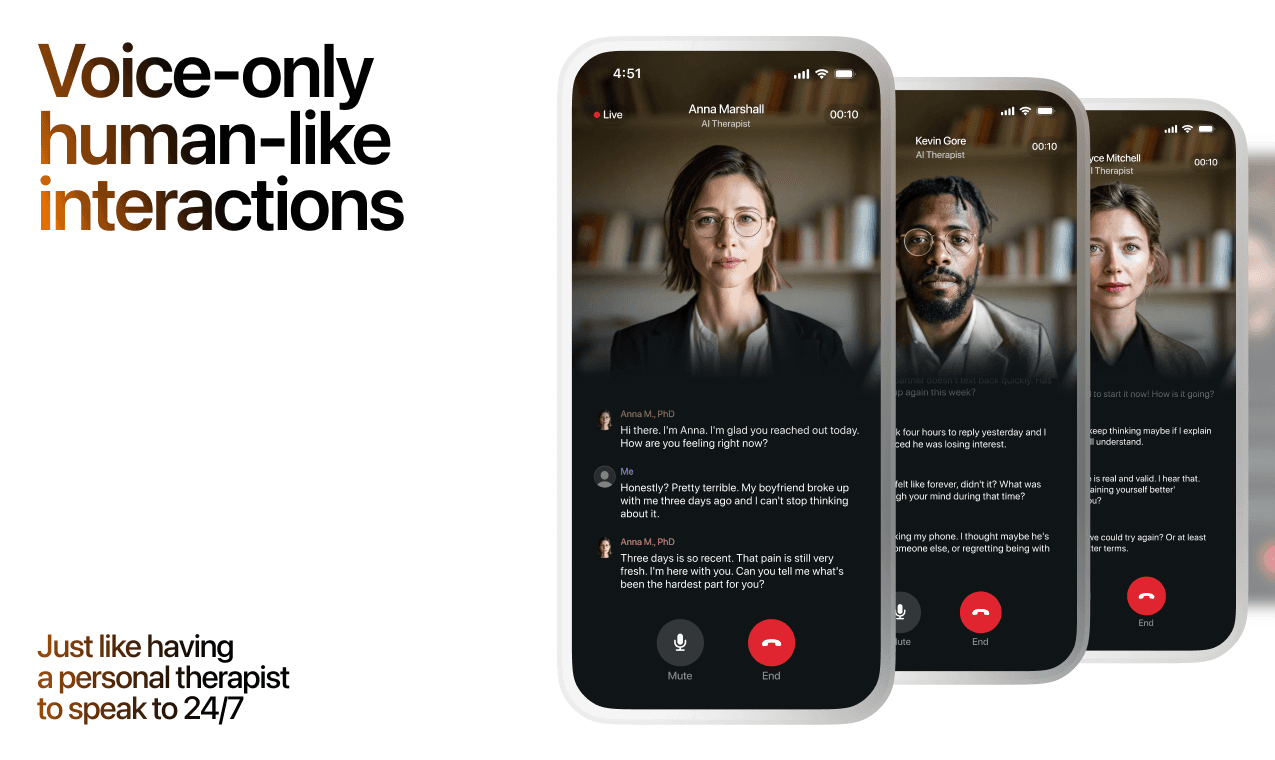
Here's what happens in a typical Lovon session:
You share what's on your mind
There's no script, no intake form, no waiting room. You speak or type whatever you're feeling — in your own words, at your own pace.
Lovon validates and explores
Using frameworks from CBT (Cognitive Behavioral Therapy) and motivational interviewing, Lovon acknowledges your feelings first, then gently helps you explore them. No dismissive "just move on" advice.
You build coping skills together
Lovon doesn't just listen — it actively works with you on evidence-based techniques: thought reframing, urge surfing, behavioral experiments, and more.
What a Session with Lovon Looks Like
When to Seek Professional Help
AI support is a valuable tool, but it's not a replacement for professional care. Please consider reaching out to a licensed therapist if you experience any of the following:
- Persistent thoughts of self-harm or suicide
- Inability to perform daily activities (work, eating, sleeping) for more than 2 weeks
- Turning to alcohol or substances to cope
- Intense anger or desire to harm your ex-partner
- Complete emotional numbness that doesn't improve over time
Crisis Resources (US): If you're in immediate danger, call 988 (Suicide & Crisis Lifeline) or text HOME to 741741 (Crisis Text Line). Available 24/7, free, and confidential.
Outside the US? Find a crisis line in your country
Ready to Start?
Your healing journey can begin right now
1 free conversation. No credit card. No judgment. Just a safe space to process what you're going through.
Frequently Asked Questions
Is AI therapy a replacement for a real therapist?
Is my conversation with Lovon AI private?
How is Lovon different from ChatGPT for emotional support?
Can I use Lovon if I'm already seeing a therapist?
Can I try Lovon for free?
About the Author
The Lovon Editorial Team
Mental Health & Wellness Content Team
The Lovon Editorial Team develops mental health and wellness content designed to make psychological concepts accessible and actionable. Our goal is to bridge the gap between clinical research and everyday life - helping you understand why your mind works the way it does and what you can do about it....
Related articles
- AI Coping Tools for Sensory Overload: 2026 Buyer's Guide
AI coping tools for sensory overload in neurodivergent adults, ranked by speed and setup time. See what to buy…
- On-Demand Emotional Support in 2026: What Actually Helps
Therapy isn't always available. This 2026 guide covers the best on-demand emotional support tools — who they're for…
- AI Therapy for Perimenopause Mood Swings: 2026 Verdict
AI therapy for perimenopause mood swings in 2026: what to look for, the top picks worth trying, and what to avoid before…
- ADHD in College Students: Deadlines and Focus in 2026
ADHD in college students means missed deadlines and scattered focus — see what actually works in 2026, from…
See also
Quizzes
- Loneliness Test: Free 12-Question Self-Check
See which kind of loneliness is thin, in 3 minutes.
- Guilt Test: Is Your Guilt Doing Its Job?
See whether your guilt repairs or just hurts.
Free tools
- What to Say When They Are Struggling
A chat, not a list. Tell the coach who this person is to you, what they are going through, and what you already said…
- Vent to Someone
Say the whole thing. It does not have to be fair or organized, you will not have to manage how it lands, and no advice…
Disclaimer: This article is for informational purposes only and does not constitute medical advice, diagnosis, or treatment. Always seek the advice of your physician or other qualified health provider with any questions you may have regarding a medical condition. If you are in crisis or think you may have an emergency, call 988 (Suicide & Crisis Lifeline) or go to the nearest emergency room. Outside the US? Find a crisis line in your country.