
ADHD Motivation: Why You Freeze and How to Start (2026)
ADHD motivation stalls because of how the brain regulates dopamine, not willpower. Learn 7 steps to break the freeze and build consistent drive in 2026.

Key Takeaways
- A timer (phone timer works fine)
- A notebook or voice memo app for capturing thoughts
- A body-double partner — a person, a video call, or a co-working stream
- An emotional check-in method (more on this below)
- About 10 minutes to read this guide and 2 minutes to start the first step
ADHD motivation problems are not a willpower failure — they are a neurological mismatch between how your brain generates drive and how most tasks demand it.
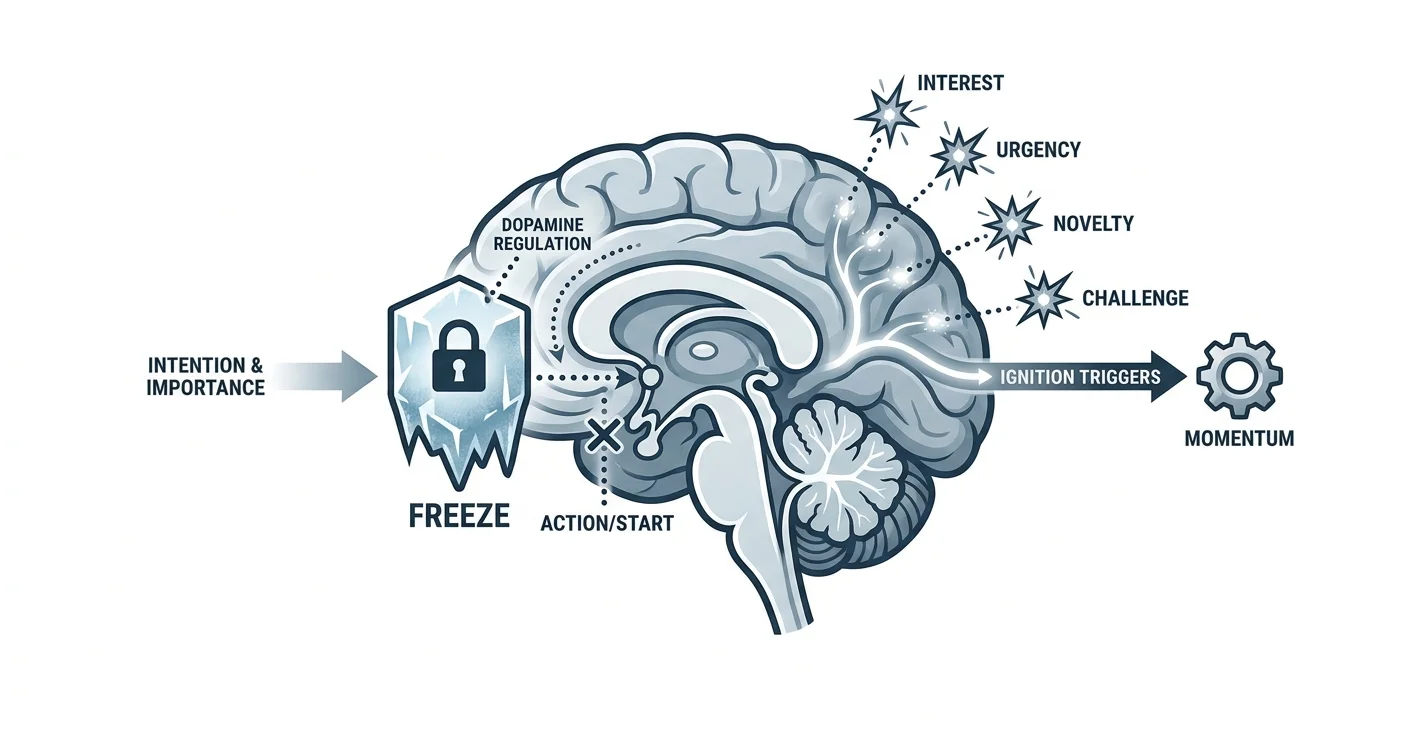
TL;DR: ADHD motivation freezes because the ADHD brain is wired to pursue interest, urgency, and novelty rather than importance or intention. The freeze is a dopamine-regulation problem, not laziness. The 7 steps below break the cycle: body-doubling, micro-tasking, external deadlines, sensory activation, reward-stacking, emotion regulation check-ins, and consistent reflection. Lovon's AI voice app can serve as an on-demand support layer between any of these steps.
Why ADHD motivation works differently
Neurotypical motivation runs on a relatively stable internal reward signal. ADHD motivation runs on four triggers — interest, challenge, urgency, and passion — identified by psychiatrist Dr. William Dodson in his work on ADHD-specific executive function. When none of those four are present, the ADHD brain does not just struggle; it stalls completely. That stall looks like procrastination from the outside. From the inside it feels like paralysis — you know exactly what needs doing, and you still cannot start.
In 2026, this is one of the most common mental health frustrations among adults diagnosed with ADHD, and the questions underneath it are almost always the same: Why can I do things I love for 6 hours straight but cannot send a 3-sentence email? The answer is dopamine availability, not character.
This guide is a practical step-by-step breakdown of what causes the freeze and exactly how to move through it.
What you'll need
- A timer (phone timer works fine)
- A notebook or voice memo app for capturing thoughts
- A body-double partner — a person, a video call, or a co-working stream
- An emotional check-in method (more on this below)
- About 10 minutes to read this guide and 2 minutes to start the first step
The steps
Step 1: Name the freeze before you fight it
What it accomplishes: Labeling the stall reduces its grip. Neuroscience research consistently shows that affect labeling — putting a name to an emotional state — reduces amygdala activation.
Why it matters: When you call the freeze "laziness" you trigger shame, which makes starting harder. When you call it "my dopamine system needs a different entry point," you shift into problem-solving mode.
How to do it: Say out loud or write down: "I am frozen right now. This is an ADHD motivation block, not a character flaw." That is it. One sentence. You are not writing an essay — you are interrupting the shame spiral at the root.
Expected outcome: A small but real reduction in internal pressure. The task does not feel lighter yet, but you feel less stuck inside the stall.
Common mistake: Skipping this step because it "feels too simple." It works precisely because it is fast.
Step 2: Shrink the task to 2 minutes
What it accomplishes: Bypasses the brain's resistance to starting by making the ask so small it cannot be argued with.
Why it matters: ADHD brains treat large tasks as a single overwhelming object. The 2-minute rule — borrowed from productivity research and adapted for ADHD — breaks that object into something the dopamine system can respond to.
How to do it: Take whatever you are frozen on and ask: What is the smallest possible version of this task I can do in exactly 2 minutes? Write one bullet. Open the document and type the title. Send one Slack message. Do only that piece.
Expected outcome: About 60% of the time, starting triggers momentum and you continue past 2 minutes. Even when it does not, you have made measurable progress.
Common mistake: Choosing a 2-minute task that is still too abstract. "Work on the report" is not a 2-minute task. "Type the first sentence of the introduction" is.
Step 3: Add a body-double
What it accomplishes: External social presence regulates the ADHD nervous system and activates accountability circuits without requiring conversation.
Why it matters: Body-doubling is one of the most-reported effective strategies among adults with ADHD. A 2021 survey by CHADD (Children and Adults with Attention-Deficit/Hyperactivity Disorder) found that over 70% of adult ADHD respondents reported working more consistently in the presence of another person, even silently.
How to do it: Call a friend and work on your respective tasks without talking. Join a virtual co-working room. Put on a "study with me" livestream. The other person does not need to know your task — they just need to exist in your space.
Expected outcome: Sustained focus for 15–45 minutes in a single session, compared to 3–7 minutes in isolation for many ADHD adults.
Common mistake: Choosing a social body-double who talks too much. Conversation activates a different brain circuit and breaks the work state.
Step 4: Engineer urgency with an external deadline
What it accomplishes: Creates the neurological conditions that make ADHD motivation fire — urgency is one of the four ADHD drive triggers.
Why it matters: Internal deadlines are nearly invisible to the ADHD brain. External ones — especially those with social stakes — are not.
How to do it: Tell someone else you will finish a specific deliverable by a specific time today. Send a message: "I'll have this done by 3 PM and I'll send it to you then." The social commitment converts a vague intention into a real deadline the brain treats as urgent.
Expected outcome: Motivation activates within minutes of making the commitment public. The fear of letting someone down is a legitimate ADHD fuel source — use it without guilt.
Common mistake: Making the deadline too far away ("by end of week"). ADHD urgency works in hours, not days.
Step 5: Stack an immediate reward
What it accomplishes: Supplies the dopamine hit the ADHD brain needs in order to treat the task as worth doing right now rather than theoretically later.
Why it matters: Future rewards are neurologically weak signals for the ADHD brain. Immediate rewards are strong ones. This is not a preference — it is how dopamine-deficient reward circuits actually function.
How to do it: Choose a reward you genuinely want and pair it directly with task completion — not as a celebration but as a simultaneous experience where possible. Work only while listening to a specific playlist you love. Allow yourself a preferred drink only during focused sessions. The pairing matters; the reward must follow immediately, not an hour later.
Expected outcome: Reduced task aversion and a faster start. Over time, the brain begins associating those tasks with positive rather than neutral or aversive feelings.
Common mistake: Choosing a reward that becomes background noise (e.g., familiar TV). It needs to be something you actually want, not something you are tolerating.
Step 6: Do a mid-session emotional check-in
What it accomplishes: Catches emotional dysregulation before it derails the entire session. ADHD and emotional regulation are deeply connected — unprocessed frustration or anxiety is one of the most common reasons ADHD work sessions collapse.
Why it matters: Many ADHD adults do not realize they have shifted from focused to dysregulated until they are already scrolling social media or picking a fight in a group chat. A structured pause catches the shift early.
How to do it: At the 20-minute mark, stop for 60 seconds. Ask yourself: Am I frustrated, anxious, bored, or overwhelmed right now? If yes, name it — out loud if possible. If the emotion is significant, a short voice check-in with Lovon's AI companion can help you process it fast and return to work rather than spiraling.
Expected outcome: Fewer full session collapses. More consistent task completion across a workday.
Common mistake: Skipping the check-in when things feel "fine." The sessions that feel fine are often the ones where dysregulation is building quietly.
Step 7: Reflect on what worked — out loud
What it accomplishes: Builds a personal motivation map: a record of which strategies fire your specific ADHD brain, so you stop reinventing the wheel every morning.
Why it matters: ADHD motivation strategies are highly individual. What fires one person's dopamine leaves another flat. Voice journaling your wins and misses gives you data about yourself — not generic advice.
How to do it: At the end of each day, spend 3 minutes speaking freely about what moved you and what stalled you. Lovon's voice journaling feature is built for exactly this: no typing, no structure required — just talk. Review your notes at the end of the week and look for patterns.
Expected outcome: Within 2–4 weeks, you will have a clear picture of your 2–3 most effective personal triggers. You stop guessing and start applying what actually works for your brain in 2026.
Common mistake: Waiting until you feel motivated to reflect. Do it immediately after the session ends, even if it was a failure — especially then.
Troubleshooting
You start but crash after 5 minutes. The task is still too large or too abstract. Return to Step 2 and cut it smaller. A 5-minute session that ends cleanly is better than a 45-minute one that ends in overwhelm.
Body-doubling does not help. Try asynchronous accountability instead: send a "starting now" text to someone and a "finished" text when done. The social loop matters more than physical presence.
Urgency stops working after a few days. Deadline fatigue is real. Rotate your accountability partners or change the stakes. The novelty of the commitment matters — a new person triggers urgency more reliably than the same one every day.
Reward-stacking feels manipulative. It is not. The ADHD brain's reward circuit is structured differently, not defectively. Using external rewards is not cheating — it is working with your neurology instead of against it.
You spiral into shame mid-task. This is where emotional support matters most. A short voice session on Lovon can interrupt the shame loop in under 5 minutes so you can return to the task rather than abandoning it for the day.
Nothing works on high-anxiety days. ADHD and anxiety overlap significantly. On those days, treating the anxiety first is not avoidance — it is sequencing correctly. See the guide on ADHD and anxiety overlap for that specific pattern.
Tools and resources
- Timer: Any phone timer. The Pomodoro method (25 minutes on, 5 off) is a widely used starting point for ADHD adults in 2026.
- Body-doubling platforms: Focusmate and similar virtual co-working services offer free sessions.
- Voice journaling and emotional support: Lovon's AI voice therapy app is built with input from PhD psychologists and targets ADHD-specific struggles including motivation, emotional dysregulation, and self-reflection.
- ADHD emotional regulation: The guide on ADHD emotional dysregulation tools goes deeper on the emotional side of motivation blocks.
- Goal-setting structure: If you want a structured framework for setting ADHD-friendly goals, the AI life coach for ADHD goal setting guide covers that in detail.
What to do next
The freeze is not permanent. It is a signal that your brain needs a different entry point, not more willpower. Pick one step from this guide — just one — and apply it in the next 10 minutes. The AI therapy for ADHD emotional regulation guide is the natural next read if emotional dysregulation is the bigger driver for you.
FAQ
What is ADHD motivation and why is it different? ADHD motivation is driven by interest, urgency, novelty, and challenge — not by importance or intention. The brain's dopamine regulation works differently, which means tasks that "should" feel motivating often do not fire any drive signal at all.
Why do I freeze even on tasks I want to do? Freezing happens when the task lacks enough novelty or urgency to trigger dopamine release, even if you genuinely care about the outcome. It is a neurological mismatch, not resistance or laziness.
Does ADHD motivation get better with treatment? Medication helps many people by stabilizing dopamine availability, but behavioral strategies — body-doubling, micro-tasking, reward-stacking — remain effective even with medication and are essential for medication-free periods.
How is ADHD motivation different from depression? Depression flattens drive across all activities, including ones you love. ADHD motivation is selective: you can hyperfocus on a video game for 4 hours on the same day you cannot start a 10-minute work task. If both are happening, ADHD and depression can co-exist — that warrants a clinical evaluation.
Is body-doubling a real strategy or just a trend? It is well-documented in ADHD literature. The presence of another person — even silently, even on video — activates social-accountability circuits that help regulate attention in ADHD brains. CHADD data from 2021 supports its effectiveness in over 70% of adult respondents.
How long does it take to build better ADHD motivation habits? Most people see a consistent pattern of what works within 2–4 weeks of daily reflection. Full habit consolidation typically takes 8–12 weeks, consistent with general habit-formation research.
Can an AI app actually help with ADHD motivation? An AI voice app like Lovon is not a replacement for clinical care or medication management. It serves as an on-demand emotional support and reflection tool — useful for mid-session check-ins, processing shame spirals, and end-of-day voice journaling. That makes it a practical supplement, not a standalone treatment.
What should I do on days when nothing works? Lower the bar to almost nothing: exist near the task. Open the document and close it. That counts. High-resistance days often follow poor sleep or elevated anxiety — both of which are separate ADHD-linked issues worth tracking.
One last thing
ADHD hyperfocus — the ability to lock in for hours on something interesting — uses the same neurological system that causes the freeze. The system is not broken; it is selective. In 2026, the most useful reframe for ADHD motivation is this: you are not someone who cannot focus. You are someone whose focus requires a specific ignition. Find the ignition, and the engine runs.
Related guides
How AI Support Helps You Heal
AI emotional support isn't about replacing human connection — it's about filling the gaps. The moments when you need to talk at 2 AM, when you don't want to burden your friends again, or when you simply need someone to listen without judgment.
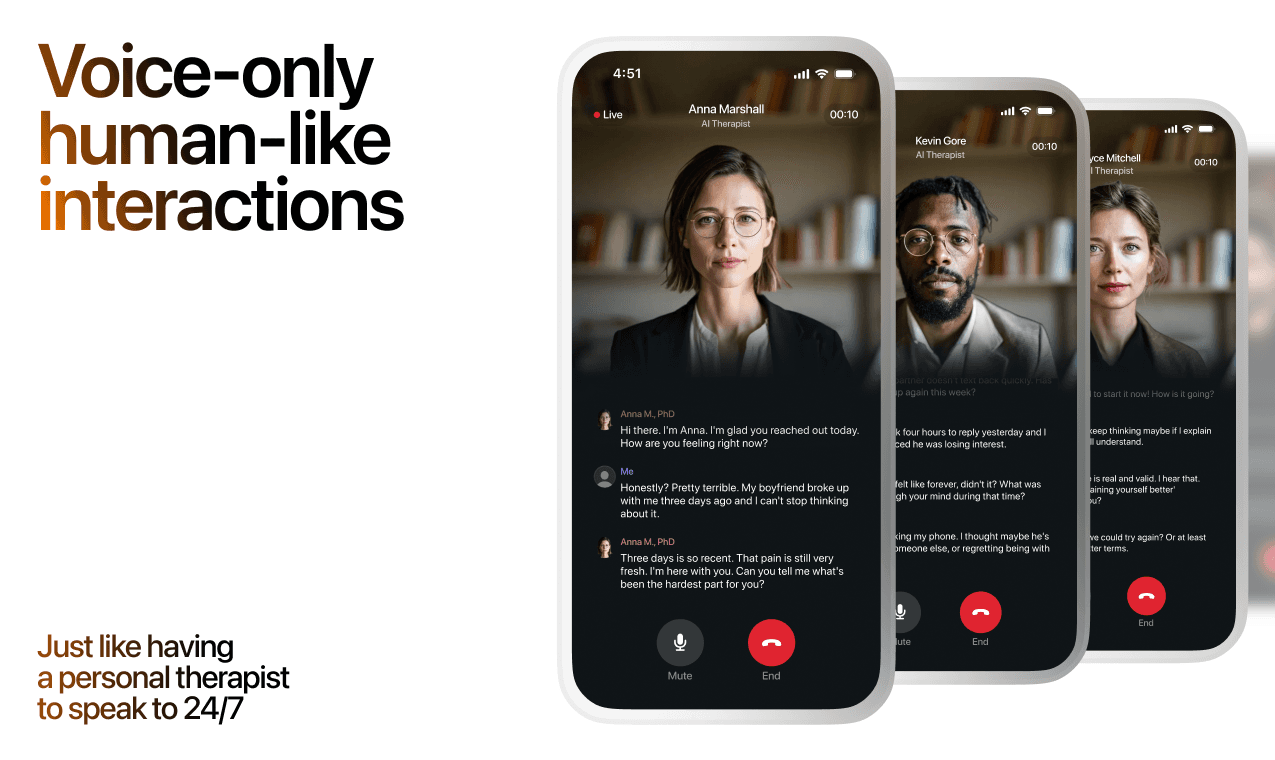
Here's what happens in a typical Lovon session:
You share what's on your mind
There's no script, no intake form, no waiting room. You speak or type whatever you're feeling — in your own words, at your own pace.
Lovon validates and explores
Using frameworks from CBT (Cognitive Behavioral Therapy) and motivational interviewing, Lovon acknowledges your feelings first, then gently helps you explore them. No dismissive "just move on" advice.
You build coping skills together
Lovon doesn't just listen — it actively works with you on evidence-based techniques: thought reframing, urge surfing, behavioral experiments, and more.
What a Session with Lovon Looks Like
When to Seek Professional Help
AI support is a valuable tool, but it's not a replacement for professional care. Please consider reaching out to a licensed therapist if you experience any of the following:
- Persistent thoughts of self-harm or suicide
- Inability to perform daily activities (work, eating, sleeping) for more than 2 weeks
- Turning to alcohol or substances to cope
- Intense anger or desire to harm your ex-partner
- Complete emotional numbness that doesn't improve over time
Crisis Resources (US): If you're in immediate danger, call 988 (Suicide & Crisis Lifeline) or text HOME to 741741 (Crisis Text Line). Available 24/7, free, and confidential.
Outside the US? Find a crisis line in your country
Ready to Start?
Your healing journey can begin right now
A 7-day trial. No judgment. Just a safe space to process what you're going through.
Frequently Asked Questions
Is Lovon a replacement for a real therapist?
Is my conversation with Lovon AI private?
How is Lovon different from ChatGPT for emotional support?
Can I use Lovon if I'm already seeing a therapist?
Can I try Lovon before subscribing?
About the Author
The Lovon Editorial Team
Mental Health & Wellness Content Team
The Lovon Editorial Team develops mental health and wellness content designed to make psychological concepts accessible and actionable. Our goal is to bridge the gap between clinical research and everyday life - helping you understand why your mind works the way it does and what you can do about it....
Related articles
- Inner Child Work for Consistency Issues Through Nervous System Regulation
If you struggle to maintain consistency in your daily routines, relationships, or personal goals, you've likely been…
- ADHD in College Students: Deadlines and Focus in 2026
ADHD in college students means missed deadlines and scattered focus — see what actually works in 2026, from…
- ADHD Time Blindness: Why It Happens & How to Cope (2026)
ADHD time blindness is a neurological wiring difference, not laziness. Learn what causes it and 7 practical coping steps…
- ADHD with Comorbid Anxiety and Depression Cycles Affecting Self-Esteem
Living with ADHD becomes exponentially more challenging when anxiety and depression enter the picture. For many people…
See also
Quizzes
- Insecurity Test: What Are You Bracing Against?
See what your insecurity actually runs on, in 3 minutes.
- Emotional Intelligence Test: Your EQ in a Relationship
Find where your EQ slips when things get tense.
Free tools
- How to End a Friendship Without a Scene
A chat for working out how to end a friendship clearly, without a grievance list or a slow ghost. Tell it how long you…
- How to Say No Politely (Without Over-Explaining)
A chat for how to say no politely when you have already decided and cannot get the word out. Tell it what you were…
From the wiki
- Why do I keep dreaming about my ex?
Recurring dreams about an ex usually mean your brain is still consolidating a relationship that took up years of memory…
Disclaimer: This article is for informational purposes only and does not constitute medical advice, diagnosis, or treatment. Always seek the advice of your physician or other qualified health provider with any questions you may have regarding a medical condition. If you are in crisis or think you may have an emergency, call 988 (Suicide & Crisis Lifeline) or go to the nearest emergency room. Outside the US? Find a crisis line in your country.