
AI Therapist for Stress: What It Can and Can't Do (2026)
An honest breakdown of what an AI therapist for stress handles well in 2026, where it falls short, and how Lovon fits into daily stress management.

Key Takeaways
- Generic mood-tracking apps with no clinical framing. Logging a stress score from 1-10 doesn't teach you what to do
- Text-only bots for acute stress. Typing a full paragraph at 3 a.m. when you're already dysregulated adds friction
- Anything that positions itself as a diagnosis tool. No AI therapist for stress in 2026 is cleared to diagnose
Stress does not clock out at 5 p.m., and neither should the support you use to manage it. This guide breaks down exactly what an AI therapist for stress can realistically do, where it stops, and how to tell if it fits the way you experience stress day to day.
TL;DR
An AI therapist for stress gives you a voice conversation, coping tools, and structured reflection the moment stress spikes, not just during a scheduled 50-minute slot once a week. Lovon works well for daily overwhelm, racing thoughts before bed, and rehearsing a hard conversation before you have it, but it does not diagnose conditions, prescribe medication, or replace licensed care for trauma or crisis situations. Verdict: Buy if you need consistent, judgment-free support between or instead of therapy sessions in 2026. Skip if you're in crisis or need a clinical diagnosis — call a licensed provider or crisis line for that.
Why this matters
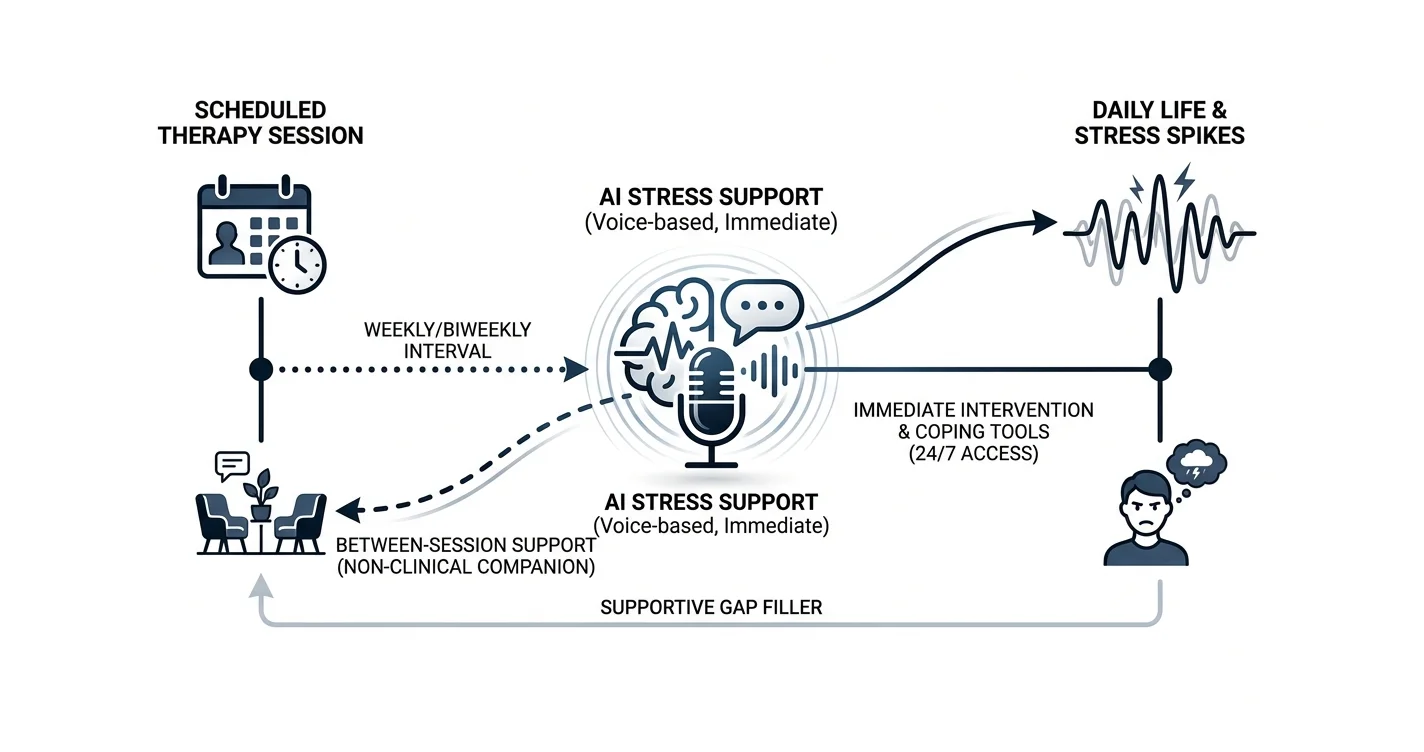
Most people don't get stressed on a therapist's schedule. Stress shows up at 11 p.m. before a big presentation, mid-argument with a partner, or in the fifteen minutes between back-to-back meetings. Lovon was built around that gap — a voice conversation with an AI voice companion you can start in under a minute, with no waitlist and no appointment.
That doesn't make it a replacement for a psychologist. It makes it something different: a tool for the hours when stress hits and no session is scheduled. Knowing the line between the two is the whole point of this guide.
Who this is for
This is for people managing everyday stress, burnout, or racing thoughts who want a low-friction way to talk something through — not a substitute for treating a diagnosed clinical condition or handling a crisis. If you're dealing with work overload, decision fatigue, an argument that won't leave your head, or the kind of stress that keeps you up but doesn't send you to the ER, an AI therapist for stress is built for exactly that middle ground.
It's not built for suicidal ideation, active psychosis, or situations that need immediate human intervention. Lovon is explicit about that boundary — it's designed with input from PhD psychologists as a companion, not a clinician.
What to look for in an AI therapist for stress
Voice, not just text
Stress lives in tone as much as in words. A voice conversation lets an AI therapist for stress pick up on pacing, pauses, and urgency in a way a typed chat window can't replicate, and it lets you talk hands-free during a commute or a bad night instead of typing out a paragraph. This matters more for stress specifically than for, say, journaling-style reflection, because stress often shows up physically before it shows up in coherent sentences.
Availability when stress actually hits
Stress doesn't wait for office hours. A tool worth using has to be available at 2 a.m. the night before a layoff announcement, not just 9-to-5 on weekdays. If the app requires booking a slot 48 hours out, it's solving a different problem than acute stress.
Grounded in real clinical framing
Generic chatbots trained on open internet text can validate feelings but often can't structure a session the way a trained clinician would. Look for tools built with input from licensed or PhD-level psychologists, since that shapes how the conversation is structured — not just what it says back to you.
Actionable coping tools, not just talk
Conversation alone rarely lowers cortisol in the moment. A useful AI therapist for stress pairs conversation with specific techniques — breathing patterns, grounding exercises, body-based relaxation — that you can do in the same five minutes you spent talking.
Honesty about its own limits
The best tools say plainly what they aren't. If an app implies it can diagnose anxiety disorders or replace medication management, that's a red flag, not a selling point. Lovon states directly that it's a companion, not a licensed clinician, and that distinction should show up clearly wherever you use it.
Where an AI therapist for stress actually fits
The daily decompression pick
A short voice session at the end of a hard day — the kind where nothing catastrophic happened but everything felt heavy. One 10 to 15-minute conversation gives you a place to put the day down before it follows you into sleep. Buy for anyone whose stress is chronic-low rather than acute-crisis.
The middle-of-the-night pick
When your mind won't stop at midnight, a structured breathing technique does more in 90 seconds than another hour of scrolling. Box breathing — four counts in, four counts held, four counts out, four counts held — is a specific, teachable pattern you can run through an AI voice session without needing to remember the steps yourself. Buy for pre-sleep racing thoughts.
The body-first pick
Some stress lives in the shoulders and jaw before it reaches conscious thought. Progressive muscle relaxation walks through tensing and releasing muscle groups in sequence, and it's the kind of technique that works better guided out loud than read off a screen. Consider this if talk-based sessions alone haven't cut the physical tension.
The between-sessions pick
If you already see a human therapist but stress spikes on the Tuesday between your Thursday appointments, on-demand emotional support fills that specific gap without replacing the relationship you already have. Buy if your therapy cadence is weekly or biweekly and stress doesn't respect that schedule.
What to avoid
- Generic mood-tracking apps with no clinical framing. Logging a stress score from 1-10 doesn't teach you what to do about it.
- Text-only bots for acute stress. Typing a full paragraph at 3 a.m. when you're already dysregulated adds friction exactly when you have the least capacity for it.
- Anything that positions itself as a diagnosis tool. No AI therapist for stress in 2026 is cleared to diagnose generalized anxiety disorder, PTSD, or major depressive disorder — treat any app that implies otherwise with suspicion.
Verdict comparison
| Criteria | AI voice support (Lovon) | Generic AI chatbot | Text-only wellness app |
|---|---|---|---|
| Available at 2 a.m. | Yes | Yes | Yes |
| Voice conversation | Yes | Rarely | No |
| Built with clinical input | Yes | Not disclosed | Varies |
| Guided coping techniques | Yes, in-session | Sometimes | Static content only |
| States its own limits clearly | Yes | Rarely | Rarely |
| Replaces licensed care | No | No | No |
FAQ
Is an AI therapist for stress as good as real therapy? No — it's a different tool for a different moment. An AI therapist for stress works well for daily overwhelm and between-session support, while a licensed therapist is necessary for diagnosis, trauma processing, and crisis care.
Can Lovon diagnose anxiety or a stress disorder? No. Lovon offers emotional support and coping tools built with input from PhD psychologists, but it does not diagnose conditions and is not a licensed clinician.
How much does an AI therapist for stress cost compared to traditional therapy? Traditional therapy without insurance commonly runs well above what most people can access weekly — see the cost breakdown for therapy without insurance in 2026 for specifics. An AI therapist for stress is designed as a lower-friction, more frequent option, not a dollar-for-dollar swap.
Is voice-based AI therapy private? Voice sessions are handled the same way any sensitive personal data should be — check the specific app's privacy policy before your first session, since practices vary across providers.
Can I use an AI therapist for stress alongside a human therapist? Yes. Many people use it specifically to fill the days between scheduled appointments, when stress doesn't wait for the next session.
What happens if I'm in crisis while using an AI stress app? Stop and contact a crisis line or emergency services immediately. An AI voice companion for stress, including Lovon, is built for everyday stress support, not for acute crisis intervention.
How is AI voice therapy different from text-based mental health apps? Voice conversations carry tone, pacing, and urgency that typed messages strip out, which matters most in the moment stress actually hits rather than hours later when you finally sit down to type.
Does an AI therapist for stress help with panic symptoms specifically? It can walk you through grounding and breathing techniques in the moment, but a racing heart, chest tightness, or shortness of breath that doesn't resolve should always be evaluated by a medical professional first.
One last thing
The single biggest mistake people make with an AI therapist for stress is saving it for the "big" moments. The actual value shows up in the small ones — the five minutes before a hard email, the ten minutes after a tense call, the two minutes of box breathing before you try to fall asleep. Stress compounds quietly in 2026's always-on schedules; the tool works best when you use it before it compounds, not after.
Related guides
How AI Support Helps You Heal
AI emotional support isn't about replacing human connection — it's about filling the gaps. The moments when you need to talk at 2 AM, when you don't want to burden your friends again, or when you simply need someone to listen without judgment.
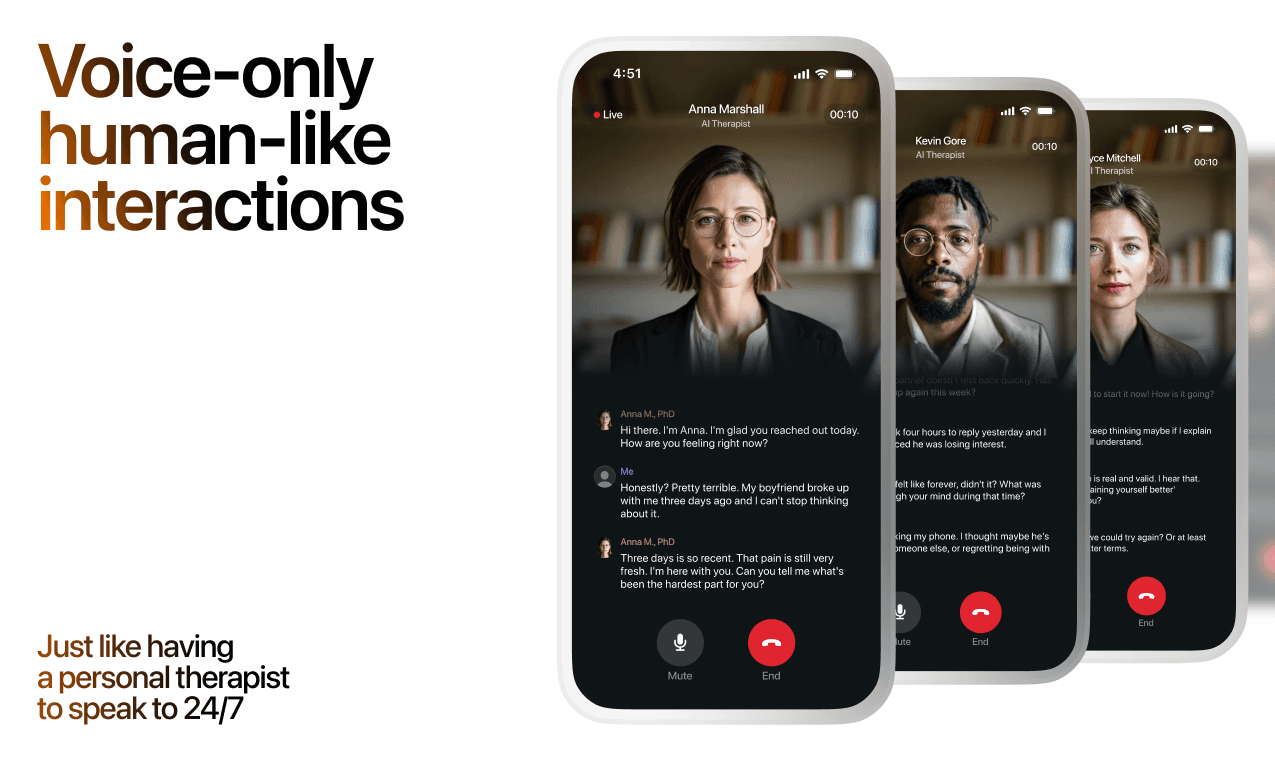
Here's what happens in a typical Lovon session:
You share what's on your mind
There's no script, no intake form, no waiting room. You speak or type whatever you're feeling — in your own words, at your own pace.
Lovon validates and explores
Using frameworks from CBT (Cognitive Behavioral Therapy) and motivational interviewing, Lovon acknowledges your feelings first, then gently helps you explore them. No dismissive "just move on" advice.
You build coping skills together
Lovon doesn't just listen — it actively works with you on evidence-based techniques: thought reframing, urge surfing, behavioral experiments, and more.
What a Session with Lovon Looks Like
When to Seek Professional Help
AI support is a valuable tool, but it's not a replacement for professional care. Please consider reaching out to a licensed therapist if you experience any of the following:
- Persistent thoughts of self-harm or suicide
- Inability to perform daily activities (work, eating, sleeping) for more than 2 weeks
- Turning to alcohol or substances to cope
- Intense anger or desire to harm your ex-partner
- Complete emotional numbness that doesn't improve over time
Crisis Resources (US): If you're in immediate danger, call 988 (Suicide & Crisis Lifeline) or text HOME to 741741 (Crisis Text Line). Available 24/7, free, and confidential.
Outside the US? Find a crisis line in your country
Ready to Start?
Your healing journey can begin right now
A 7-day trial. No judgment. Just a safe space to process what you're going through.
Frequently Asked Questions
Is Lovon a replacement for a real therapist?
Is my conversation with Lovon AI private?
How is Lovon different from ChatGPT for emotional support?
Can I use Lovon if I'm already seeing a therapist?
Can I try Lovon before subscribing?
About the Author
The Lovon Editorial Team
Mental Health & Wellness Content Team
The Lovon Editorial Team develops mental health and wellness content designed to make psychological concepts accessible and actionable. Our goal is to bridge the gap between clinical research and everyday life - helping you understand why your mind works the way it does and what you can do about it....
Related articles
- Best App for Parenting Stress and Burnout in 2026: Lovon
Lovon ranks best overall for parenting stress and burnout in 2026, with picks for co-parenting, meditation, journaling…
- AI therapy for restaurant and hospitality workers: complete 2026 guide
AI therapy for restaurant workers fits after-shift stress and burnout support. See when Lovon helps, where it falls…
- Best AI App for Anxiety: On-Demand Support in 2026
Looking for an AI app for anxiety? See how Lovon and top alternatives deliver 24/7 coping tools and voice support…
- Best App for Pregnancy Anxiety in 2026: Ranked Guide
The best app for pregnancy anxiety in 2026, ranked: Lovon for AI voice therapy, BetterHelp for licensed care, Wysa for…
See also
Quizzes
- Overthinking Test: Am I an Overthinker? 12-Question Quiz
See which overthinking loop runs you, in 3 minutes.
- Defense Mechanisms Test: Which Ones Do You Use Most?
See what your defenses do with hard feelings, in 3 minutes.
Free tools
- Write a Condolence Message for This Person
Get one condolence message written for your situation instead of a list of a hundred to choose from. Tell it who died…
- What to Say to Someone Who Is Grieving
Get sentences that fit this person and this week, not a list of things people say at funerals. Describe who they lost…
From the wiki
- Why do I keep dreaming about the same person?
A recurring dream figure usually marks unfinished emotional business rather than a message about that person. Your brain…
Disclaimer: This article is for informational purposes only and does not constitute medical advice, diagnosis, or treatment. Always seek the advice of your physician or other qualified health provider with any questions you may have regarding a medical condition. If you are in crisis or think you may have an emergency, call 988 (Suicide & Crisis Lifeline) or go to the nearest emergency room. Outside the US? Find a crisis line in your country.