
Box Breathing Technique: Calm Your Nervous System (2026)
The box breathing technique resets your nervous system in under 2 minutes. Learn the exact 4-4-4-4 steps, common mistakes, and when to use it for anxiety and stress.

Key Takeaways
- A quiet spot (preferred but not required — this works in a bathroom, a car, or a meeting hallway)
- No app, no equipment, no prior experience
- A timer on your phone if you want to track holds precisely at first
- Timer app on your phone — set a repeating 4-second interval for the first week
- Wearable HRV tracker (Garmin, Apple Watch, Whoop) — measures whether your HRV actually rises post-session, giving
The box breathing technique is one of the fastest ways to shift your nervous system out of fight-or-flight — and you can do it in under two minutes, anywhere, without any equipment.
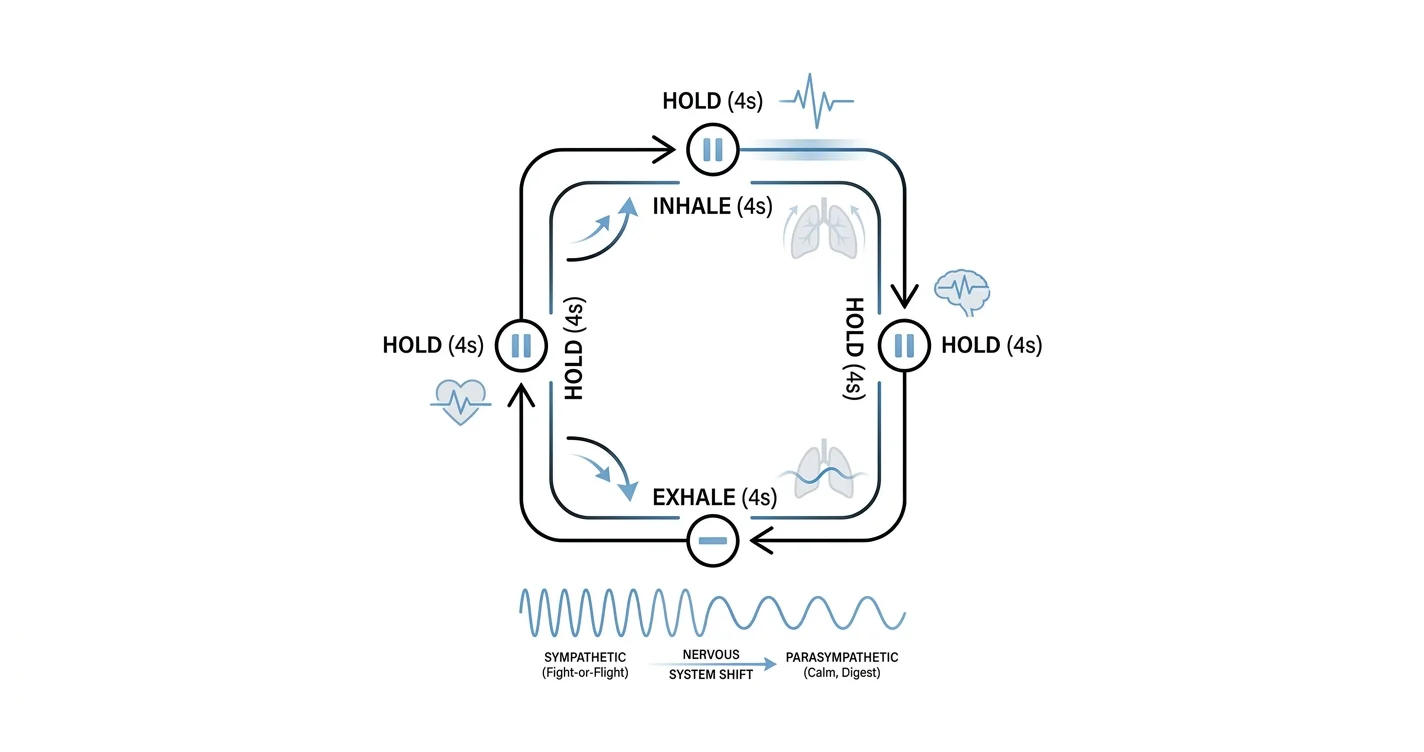
TL;DR: Box breathing (also called 4-4-4-4 breathing or square breathing) is a structured breathwork technique that slows your heart rate and reduces cortisol by activating the parasympathetic nervous system. Inhale for 4 counts, hold for 4, exhale for 4, hold for 4 — repeat 4 to 6 times. It is used by U.S. Navy SEALs, clinical psychologists, and athletes to regulate acute stress in 2026. If anxiety is a recurring problem beyond situational stress, breathing exercises for anxiety relief covers a broader toolkit.
Why the box breathing technique works
Your autonomic nervous system runs two competing modes: sympathetic (stress, alert, reactive) and parasympathetic (calm, digest, recover). When you are anxious, your breathing becomes shallow and fast, which feeds back into the sympathetic loop and keeps cortisol elevated.
Controlled, slow exhalation directly stimulates the vagus nerve — the longest nerve in the body, running from your brainstem to your gut. That vagal signal is the brake pedal on your stress response. Box breathing forces a deliberate rhythm that makes shallow breathing physically impossible. The timed holds add a mild CO2 buffer that further slows heart rate. Clinical research published in peer-reviewed journals consistently shows slow-paced breathing at 5-6 breaths per minute lowers blood pressure and self-reported anxiety within minutes. Box breathing lands you at roughly 3-4 breaths per minute — well inside that therapeutic window.
What you'll need
- A quiet spot (preferred but not required — this works in a bathroom, a car, or a meeting hallway)
- 2 to 5 minutes
- No app, no equipment, no prior experience
- A timer on your phone if you want to track holds precisely at first
The steps
Step 1 — Settle your posture
Sit upright with your feet flat on the floor, or lie down with your spine straight. This opens your diaphragm so you can take a full belly breath instead of a chest breath. Slouching compresses the lungs and cuts your inhale volume by roughly 30%. If you are mid-panic and cannot change position, even sitting forward in a chair with hands on your knees is enough.
Common mistake: Starting the technique while still hunched over a screen. Even a five-second posture reset makes a measurable difference in airway volume.
Step 2 — Exhale fully before you begin
Push all the air out before your first inhale. This clears residual CO2 and gives you a clean baseline. Do not skip this. Most people start an inhale from a half-full chest, which means the first cycle feels wrong and they abandon the technique after one round.
Expected outcome: Slight lightheadedness for 2-3 seconds is normal. It passes immediately.
Step 3 — Inhale through your nose for 4 counts
Breathe in slowly and steadily, expanding your belly first, then your chest. Count silently: one-one-thousand, two-one-thousand, three-one-thousand, four-one-thousand. Nasal breathing warms and filters the air and adds about 50% more nasal resistance than mouth breathing, which naturally slows the breath and increases nitric oxide production — a vasodilator that improves oxygen delivery.
Common mistake: Rushing the count. If 4 seconds feels very short, slow your internal count down before adding more seconds.
Step 4 — Hold at the top for 4 counts
Hold the inhale with your lungs full. Do not clamp your throat — just stop the airflow gently. This hold allows oxygen transfer across the alveoli to catch up and briefly elevates CO2 tolerance, which is what makes the next exhale feel easier instead of panicked. Keep your shoulders relaxed during the hold; tension there signals threat to your nervous system.
Common mistake: Holding by tensing the jaw or raising the shoulders. Stay soft everywhere except the gentle airway closure.
Step 5 — Exhale through your mouth for 4 counts
Release the air slowly and evenly through slightly parted lips. The exhale is where most of the parasympathetic activation happens — do not rush it. Think of fogging a mirror rather than blowing out a candle. If your exhale comes out faster than your inhale, extend it to 5 or 6 counts instead of 4 on this phase only. A longer exhale increases heart rate variability (HRV), a direct marker of nervous system flexibility.
Expected outcome: A noticeable drop in shoulder tension by the end of the first exhale.
Step 6 — Hold at the bottom for 4 counts
Lungs empty, pause before the next inhale. This is the most unfamiliar hold for beginners and the one people most often cut short. It reinforces CO2 tolerance and deepens the parasympathetic signal. Count the same way — slow and deliberate.
Common mistake: Gasping into the next inhale before the count finishes. If that happens, reduce the bottom hold to 2 counts until the pattern feels natural, then build back to 4.
Step 7 — Repeat 4 to 6 cycles
One full box is 16 seconds. Four cycles take just over a minute. Most people feel a measurable shift by cycle 3. Six cycles — roughly 96 seconds — is the standard protocol used in U.S. Navy SEAL training for acute stress management. Stop when you feel regulated, not when you hit a target number.
Expected outcome: Slower pulse, reduced muscle tension in the jaw and neck, clearer thinking, and a sense of having a slightly wider emotional margin.
Troubleshooting
You feel more anxious during the holds. This is breath-holding anxiety, common in people with panic disorder or PTSD. Start with 2-count holds instead of 4 and work up over several days. The polyvagal theory explained article explains why some nervous systems are more sensitized to airway cues.
You get dizzy or tingly in your hands. You are hyperventilating on the inhale — breathing too forcefully. Reduce inhale effort by 30% and breathe less deeply. Dizziness from over-breathing passes within 30 seconds if you stop the technique and breathe normally.
You cannot slow down to 4 counts. Your baseline respiratory rate is too elevated to start at this pace. Spend 60 seconds just breathing naturally, then try again. If you are mid-panic attack, waiting 90 seconds before starting is often more effective than forcing the technique at peak intensity.
The technique stops working after a few sessions. You have habituated the counting cue. Switch to a visual anchor — trace a square in the air or on your palm as you count — to re-engage your attention. Pairing box breathing with a grounding phrase ("I am safe right now") also resets the association.
You fall asleep during practice. This is not a problem — it means the parasympathetic response worked. If you need to stay alert afterward, add a 30-second brisk walk or cold water on your wrists post-session.
You feel no effect after 6 cycles. The technique alone may not be enough when anxiety is chronic rather than situational. In 2026, tools like Lovon pair breathwork with voice-based emotional processing so you can talk through what triggered the stress, not just suppress the symptom.
Tools and resources
- Timer app on your phone — set a repeating 4-second interval for the first week
- Wearable HRV tracker (Garmin, Apple Watch, Whoop) — measures whether your HRV actually rises post-session, giving you objective feedback
- Lovon — when the anxiety behind the stress is relational or ongoing, Lovon's AI voice sessions can help you process the emotional root while using breathwork as an in-the-moment stabilizer. Available at lovon.app
- AI counseling for stress management — covers how AI-supported coping fits into a broader stress toolkit in 2026
- Progressive muscle relaxation for stress — the body-based companion to breathwork; effective when box breathing alone does not reach residual muscle tension
- Coping tools for stress — what works and what does not — evidence-ranked comparison of anxiety coping strategies
What to do next
Once box breathing feels automatic — usually within 7 to 10 days of daily practice — move to mindfulness for anxiety techniques that actually work, which builds on the same physiological foundation and trains attention regulation over longer time windows.
FAQ
What is the box breathing technique? Box breathing is a 4-phase breath control practice: inhale 4 counts, hold 4 counts, exhale 4 counts, hold 4 counts. Each cycle takes 16 seconds. It is used clinically and in military training to reduce acute stress by activating the parasympathetic nervous system.
How long does box breathing take to work? Most people notice a reduction in heart rate and muscle tension within 3 cycles — roughly 48 seconds. Full regulation typically sets in after 4 to 6 cycles, or about 60 to 96 seconds of sustained practice.
Can you do box breathing during a panic attack? Yes, but wait until peak intensity passes — usually 90 seconds into a panic attack — before starting. Forcing controlled holds at maximum panic can briefly intensify symptoms. Start with 2-count holds if 4 seconds feels impossible and work up gradually.
Is box breathing the same as 4-7-8 breathing? No. Box breathing uses equal counts on all four phases (4-4-4-4). The 4-7-8 method has a shorter inhale, a longer hold, and a longer exhale, which makes it slower and more sedating. Box breathing is better for daytime use; 4-7-8 is often preferred at bedtime.
How often should you practice the box breathing technique? Three to four times daily is the most common clinical recommendation — once in the morning to set a calm baseline, once at a known stress trigger (before a meeting, after a difficult call), and once before sleep. Daily repetition in 2026 builds the automatic association so the technique works faster in genuine emergencies.
Does box breathing lower cortisol? Slow-paced breathing at 5 breaths per minute or fewer has been shown in published research to reduce salivary cortisol and self-reported stress. Box breathing operates at 3 to 4 breaths per minute, putting it in that range. Effects are acute, not permanent — you need to practice consistently to build a lasting shift in baseline stress reactivity.
Who should not use box breathing? People with severe COPD, uncontrolled asthma, or certain cardiac arrhythmias should consult a physician before practicing breath holds. If any breathwork causes chest pain, significant dizziness, or worsening symptoms, stop and seek medical guidance.
Is box breathing backed by science? Yes. The mechanism — slow breathing activating the vagus nerve and increasing heart rate variability — is well-documented in peer-reviewed cardiology and psychophysiology literature. The specific 4-4-4-4 pattern has been used in clinical stress-reduction protocols and military training programs, including documented adoption by the U.S. Navy SEALs.
One last thing
The Navy SEAL community did not adopt box breathing because it sounds calming — they adopted it because it works under actual life-threatening conditions. The technique was taught to improve marksmanship: a shooter's heart rate and breath control directly affect shot accuracy. If it is precise enough to steady a hand at peak adrenaline in 2026, it is precise enough to help you through a hard meeting or a 3 a.m. spiral. That is the real argument for taking two minutes to practice it today.
Related guides
How AI Support Helps You Heal
AI emotional support isn't about replacing human connection — it's about filling the gaps. The moments when you need to talk at 2 AM, when you don't want to burden your friends again, or when you simply need someone to listen without judgment.
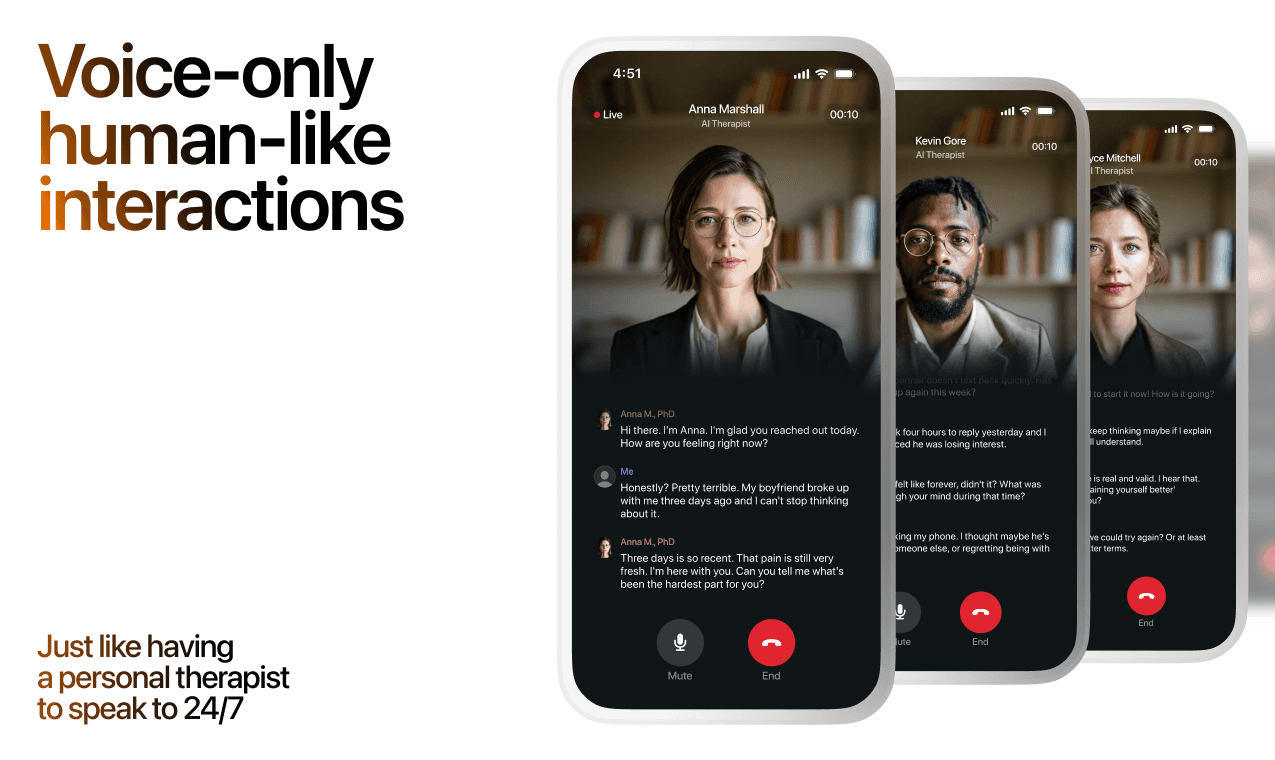
Here's what happens in a typical Lovon session:
You share what's on your mind
There's no script, no intake form, no waiting room. You speak or type whatever you're feeling — in your own words, at your own pace.
Lovon validates and explores
Using frameworks from CBT (Cognitive Behavioral Therapy) and motivational interviewing, Lovon acknowledges your feelings first, then gently helps you explore them. No dismissive "just move on" advice.
You build coping skills together
Lovon doesn't just listen — it actively works with you on evidence-based techniques: thought reframing, urge surfing, behavioral experiments, and more.
What a Session with Lovon Looks Like
When to Seek Professional Help
AI support is a valuable tool, but it's not a replacement for professional care. Please consider reaching out to a licensed therapist if you experience any of the following:
- Persistent thoughts of self-harm or suicide
- Inability to perform daily activities (work, eating, sleeping) for more than 2 weeks
- Turning to alcohol or substances to cope
- Intense anger or desire to harm your ex-partner
- Complete emotional numbness that doesn't improve over time
Crisis Resources (US): If you're in immediate danger, call 988 (Suicide & Crisis Lifeline) or text HOME to 741741 (Crisis Text Line). Available 24/7, free, and confidential.
Outside the US? Find a crisis line in your country
Ready to Start?
Your healing journey can begin right now
A 7-day trial. No judgment. Just a safe space to process what you're going through.
Frequently Asked Questions
Is Lovon a replacement for a real therapist?
Is my conversation with Lovon AI private?
How is Lovon different from ChatGPT for emotional support?
Can I use Lovon if I'm already seeing a therapist?
Can I try Lovon before subscribing?
About the Author
The Lovon Editorial Team
Mental Health & Wellness Content Team
The Lovon Editorial Team develops mental health and wellness content designed to make psychological concepts accessible and actionable. Our goal is to bridge the gap between clinical research and everyday life - helping you understand why your mind works the way it does and what you can do about it....
Related articles
- Nervous System Reset: Daily Practices That Work (2026)
A nervous system reset in 90 seconds: box breathing, cold exposure, and orientation cues that calm fight-or-flight…
- How to Manage Anxiety Without Medication in 2026
Learn how to manage anxiety without medication in 2026: 7 proven steps with breathing, grounding, and muscle relaxation…
- Emotional Regulation Skills for Adults That Work in 2026
Learn which emotional regulation skills for adults actually work in 2026 — step-by-step techniques, common mistakes…
- Nervous System Dysregulation: Signs & Reset Guide 2026
Nervous system dysregulation signs and a 7-step reset for 2026, plus troubleshooting for panic, freeze, and sleep…
See also
Quizzes
- What's My Attachment Style? Free 12-Question Quiz
Find your attachment pattern in 3 minutes.
- Insecurity Test: What Are You Bracing Against?
See what your insecurity actually runs on, in 3 minutes.
Free tools
- Vent to an AI
Need to vent and there is nobody to call, or nobody you want to tell? Type it here. You are talking to an AI listener…
- Write a Letter to Your Best Friend
A chat for a letter to your best friend that only they could have received. Tell it how long you have been friends, one…
From the wiki
- Why do I keep dreaming about the same person?
A recurring dream figure usually marks unfinished emotional business rather than a message about that person. Your brain…
Disclaimer: This article is for informational purposes only and does not constitute medical advice, diagnosis, or treatment. Always seek the advice of your physician or other qualified health provider with any questions you may have regarding a medical condition. If you are in crisis or think you may have an emergency, call 988 (Suicide & Crisis Lifeline) or go to the nearest emergency room. Outside the US? Find a crisis line in your country.