
7 Breathing Exercises for Anxiety Relief (2026)
The 7 best breathing exercises for anxiety in 2026 — box breathing, 4-7-8, cyclic sighing, and more. Step-by-step instructions, timing, and common mistakes fixed.

Key Takeaways
- A quiet place to sit or lie down (though most techniques work standing up)
- 3–5 minutes of uninterrupted time
- No prior experience — every technique below starts from zero
- Optional: a timer on your phone
- Timer app — any basic phone timer works. Set it for 5 minutes and don't check it.
When anxiety spikes, your breath is the fastest dial you can turn. These seven breathing exercises for anxiety are grounded in peer-reviewed research, take under five minutes each, and work whether you're mid-panic or just trying to wind down before bed.
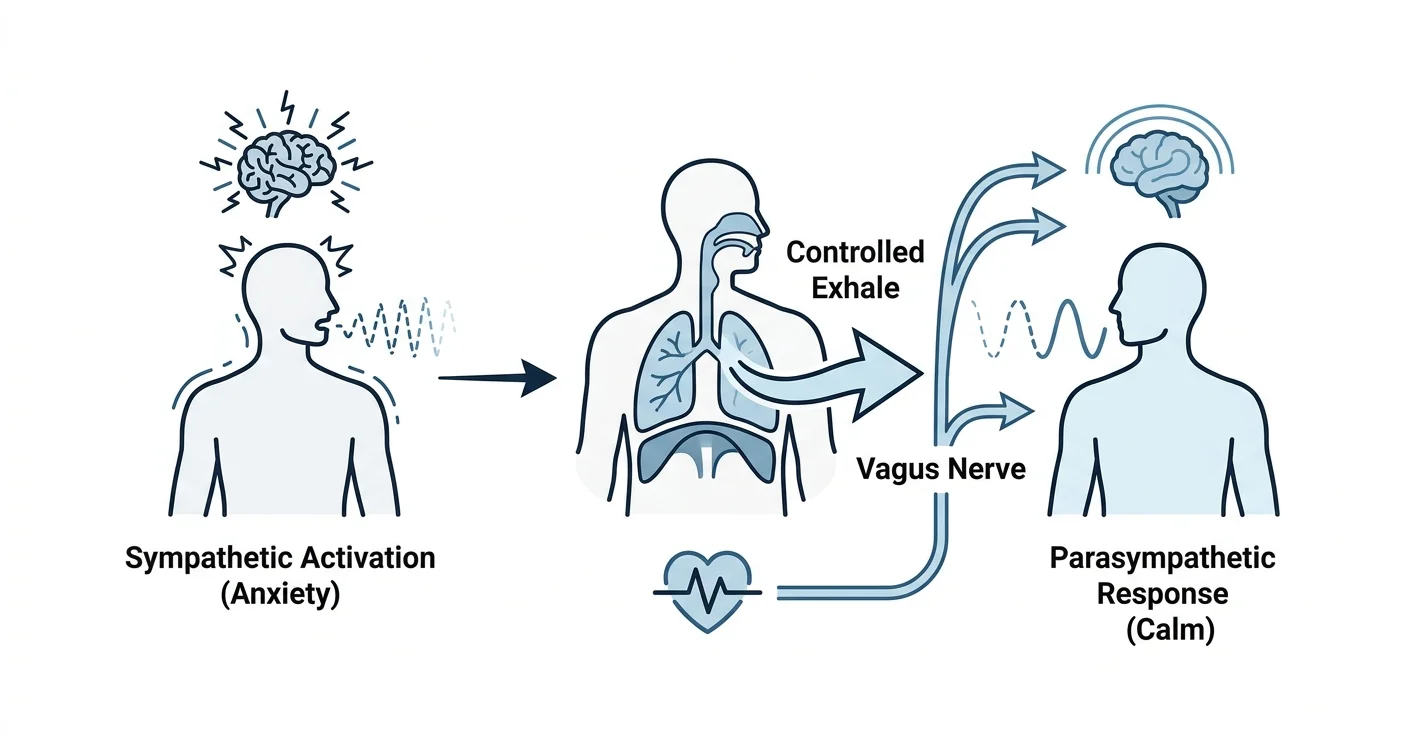
TL;DR: The best breathing exercises for anxiety in 2026 include box breathing, 4-7-8 breathing, and diaphragmatic breathing — each targets the nervous system through slow, controlled exhales that activate the parasympathetic response. Box breathing is the most versatile pick for daily use. 4-7-8 works fastest for acute panic. All seven techniques below are free, require no equipment, and can be practiced anywhere in under five minutes.
Why controlled breathing works on anxiety
Anxiety activates your sympathetic nervous system — the "fight or flight" branch. Your heart rate climbs, breathing shallows, and your body floods with cortisol. Slow, deliberate breathing does the opposite: it stimulates the vagus nerve, which tells your brain the threat is over.
A 2023 study published in Cell Reports Medicine found that five minutes of cyclic sighing — a specific exhale-focused pattern — reduced self-reported anxiety more effectively than mindfulness meditation over a 28-day period. That's not a small difference. It means the technique you choose and how you execute it matters.
If you want deeper support alongside these tools, the free AI therapist for anxiety on Lovon can help you practice them in a guided voice session.
What you'll need
- A quiet place to sit or lie down (though most techniques work standing up)
- 3–5 minutes of uninterrupted time
- No prior experience — every technique below starts from zero
- Optional: a timer on your phone
If you find your mind racing during practice, that's normal the first few times. The goal is not to empty your thoughts. It's to give your nervous system a different signal.
The 7 breathing exercises, step by step
Step 1: Box breathing (4-4-4-4)
Box breathing is used by Navy SEALs and emergency-room clinicians for good reason: it's symmetric, easy to count, and works fast under pressure.
What it accomplishes: Resets your respiratory rhythm and gives your racing mind a concrete pattern to follow.
Instructions:
- Inhale through your nose for 4 counts.
- Hold at the top for 4 counts.
- Exhale through your mouth for 4 counts.
- Hold at the bottom for 4 counts.
- Repeat 4–6 cycles.
Expected outcome: Noticeable heart-rate slowing by the third cycle.
Common mistake: Holding at the top while your chest is tense. Let your shoulders drop before you start the hold.
Step 2: 4-7-8 breathing
Developed by Dr. Andrew Weil, this technique extends the exhale to nearly double the inhale — the key driver of parasympathetic activation in 2026's most-cited breathing research.
What it accomplishes: Drops acute anxiety fast. Best for panic moments, pre-sleep tension, or social anxiety before a difficult conversation.
Instructions:
- Exhale completely through your mouth.
- Close your mouth, inhale through your nose for 4 counts.
- Hold your breath for 7 counts.
- Exhale fully through your mouth for 8 counts.
- Repeat 4 cycles maximum in one sitting.
Expected outcome: A warm, heavy feeling in the limbs — that's your blood vessels relaxing.
Common mistake: Rushing the 7-count hold. If 7 feels too long, start with a 4-5-6 ratio and work up.
Step 3: Diaphragmatic (belly) breathing
Most anxious people are chronic chest breathers. That shallow pattern keeps your sympathetic nervous system primed. Diaphragmatic breathing retrains the default.
What it accomplishes: Builds a lower baseline anxiety level over weeks when practiced daily for 10 minutes.
Instructions:
- Lie flat or sit with your back straight.
- Place one hand on your chest, one on your belly.
- Inhale through your nose for 4 counts — only the belly hand should rise.
- Exhale slowly for 6 counts.
- Practice for 10 minutes daily.
Expected outcome: After two weeks of daily practice, resting breathing becomes naturally deeper.
Common mistake: Forcing the belly out. Let it rise passively as your diaphragm drops — don't push.
Step 4: Cyclic sighing
This is the technique that beat mindfulness meditation in the 2023 Cell Reports Medicine study. It's also the easiest to remember.
What it accomplishes: Deflates accumulated physical tension in the chest faster than any other pattern tested.
Instructions:
- Take a normal inhale through your nose.
- At the top, sniff in a second short burst of air to fully expand your lungs.
- Release both in one long, slow exhale through your mouth — longer than feels necessary.
- Repeat for 5 minutes.
Expected outcome: Shoulders drop naturally. Jaw unclenches. Most people notice the shift within 90 seconds.
Common mistake: Making the second sniff too large. It's a short top-up, not a second full breath.
Step 5: Resonance breathing (6 breaths per minute)
Resonance breathing targets heart-rate variability (HRV) — the marker clinicians use to measure stress resilience. Inhaling for 5 counts and exhaling for 5 counts produces roughly 6 breaths per minute, which research consistently shows maximizes HRV.
What it accomplishes: Trains your nervous system's flexibility over time. A higher HRV means anxiety spikes recover faster.
Instructions:
- Inhale through your nose for exactly 5 seconds.
- Exhale through your nose for exactly 5 seconds.
- Repeat for 10–20 minutes once daily.
Expected outcome: Subtle calm during practice; larger benefits (better stress recovery, lower baseline anxiety) appear after 4–6 weeks.
Common mistake: Switching to mouth breathing when the pace feels slow. Nasal breathing is essential here — it adds resistance that deepens the HRV effect.
Step 6: Alternate nostril breathing (Nadi Shodhana)
Borrowed from pranayama tradition and now studied in clinical settings, alternate nostril breathing balances activity between the left and right hemispheres and reduces blood pressure in anxious subjects.
What it accomplishes: Quiets the mental chatter that makes anxiety feel unmanageable. Particularly effective before high-stakes situations — presentations, difficult conversations, medical appointments.
Instructions:
- Sit comfortably. Rest your left hand on your knee.
- Use your right thumb to close your right nostril.
- Inhale slowly through your left nostril for 4 counts.
- Close both nostrils. Hold for 2 counts.
- Release your thumb, close your left nostril with your ring finger.
- Exhale through your right nostril for 4 counts.
- Inhale through your right nostril for 4 counts.
- Close both, hold 2 counts, then exhale through the left.
- That's one round. Complete 5–10 rounds.
Expected outcome: Mental clarity and reduced physical restlessness.
Common mistake: Applying too much pressure to the nostrils. Light touch — you're guiding air, not blocking it.
Step 7: Extended exhale breathing
The single rule that underlies most of the techniques above: make your exhale longer than your inhale. This step is a standalone practice for anyone who finds complex ratios hard to remember mid-anxiety.
What it accomplishes: Activates the vagal brake — the mechanism that slows your heart rate on each exhale.
Instructions:
- Inhale for any comfortable count (try 4).
- Exhale for double that count (try 8).
- Don't hold. Just breathe in a continuous wave.
- Continue for 5 minutes.
Expected outcome: Physical calm within 2–3 minutes. This is the technique to use when you can't remember the others.
Common mistake: Counting too fast. Slow the count to one number per second — use your pulse as a metronome.
Troubleshooting
You feel dizzy or lightheaded. You're overbreathing — exhaling too forcefully or too fast. Ease off. Breathe through your nose only and slow everything down.
Your mind keeps wandering. That's not failure. It's what minds do. Gently return to counting. Every return is practice, not a reset.
You can't feel any effect. Start with the extended exhale technique — it's the most forgiving. Give it 5 full minutes before judging.
Breathing makes your anxiety worse. A small percentage of people with panic disorder find breath-focused exercises temporarily increase anxiety. If that's you, try grounding techniques first (5-4-3-2-1 sensory method) and return to breathing once your nervous system settles.
You can't find a consistent time to practice. Anchor it to something you already do — morning coffee, brushing teeth, or the commute. Consistency at a lower dose beats occasional perfect sessions.
Your chest tightens during the hold phases. Skip the holds entirely. Go straight to in-and-out cycles with a longer exhale. The hold phases are optional — the exhale ratio does most of the work.
Tools and resources
- Timer app — any basic phone timer works. Set it for 5 minutes and don't check it.
- Pulse oximeter — optional, but watching your heart rate drop in real time is motivating.
- Voice journaling — after a breathing session, speaking out loud about how you feel cements the physiological shift. The voice journaling to reduce anxiety guide on Lovon walks you through exactly how to do this.
- AI-guided support — if you want to practice these techniques with real-time guidance or talk through what's driving your anxiety, Lovon's voice AI can run a session with you anytime. It's built with PhD psychologist input and doesn't require scheduling.
What to do next
Breathing exercises address the physical signal of anxiety — the fast heartbeat, shallow breath, and tight chest. But if anxiety is showing up repeatedly, it's worth understanding what's feeding it beneath the surface. The high-functioning anxiety signs you might be missing guide covers the patterns that keep anxiety running even when everything looks fine on the outside.
FAQ
What is the best breathing exercise for anxiety? Box breathing is the most versatile for daily anxiety management. For acute panic, 4-7-8 breathing works fastest because the extended exhale activates the parasympathetic nervous system within two to three cycles.
How long does it take for breathing exercises to reduce anxiety? Most people notice physical calm within 2–5 minutes of any technique that extends the exhale. Long-term baseline reduction — lower resting anxiety — appears after 4–6 weeks of daily 10-minute practice.
Can breathing exercises stop a panic attack? Yes, for many people. The extended exhale and cyclic sighing techniques are the most effective during active panic. Start with the simplest version: inhale for 4 counts, exhale for 8, repeat continuously.
Is 4-7-8 breathing scientifically proven? The underlying mechanism — extended exhales activating vagal tone — is well-supported. The specific 4-7-8 ratio itself has less controlled-trial data than box breathing, but the exhale-dominance principle it uses is consistent across multiple peer-reviewed studies from 2021–2026.
How often should I practice breathing exercises for anxiety? Once daily for 5–10 minutes builds the baseline benefit. Use individual techniques on-demand during stressful moments. There is no upper limit — unlike medication, you cannot overdose on slow breathing.
Can I do breathing exercises lying down? Yes. Diaphragmatic breathing actually works better lying down because it's easier to feel your belly rise. Box breathing and 4-7-8 work in any position.
Why does holding my breath make me more anxious? Breath holds can trigger a mild CO2 reflex — your body interprets the buildup as a threat signal. If holds worsen your anxiety, skip them entirely and focus on extended exhale patterns, which produce most of the same benefit.
Are breathing exercises a replacement for therapy? No. They're a coping tool that manages the physical symptoms of anxiety in the moment. For the underlying causes — thought patterns, trauma, relationship stress — working with a therapist or a guided support tool gives you more to work with.
One last thing
The exhale is where the calm actually lives. Every technique above works because a long exhale slows your heart rate through the vagal brake — a mechanism so reliable that cardiologists have used exhale-based maneuvers to stop certain types of arrhythmias for decades. If you only remember one thing from this page in 2026: breathe out slowly, for longer than you breathe in. That single shift, done consistently, changes how your nervous system responds to stress.
Related guides
How AI Support Helps You Heal
AI emotional support isn't about replacing human connection — it's about filling the gaps. The moments when you need to talk at 2 AM, when you don't want to burden your friends again, or when you simply need someone to listen without judgment.
Here's what happens in a typical Lovon session:
You share what's on your mind
There's no script, no intake form, no waiting room. You speak or type whatever you're feeling — in your own words, at your own pace.
Lovon validates and explores
Using frameworks from CBT (Cognitive Behavioral Therapy) and motivational interviewing, Lovon acknowledges your feelings first, then gently helps you explore them. No dismissive "just move on" advice.
You build coping skills together
Lovon doesn't just listen — it actively works with you on evidence-based techniques: thought reframing, urge surfing, behavioral experiments, and more.
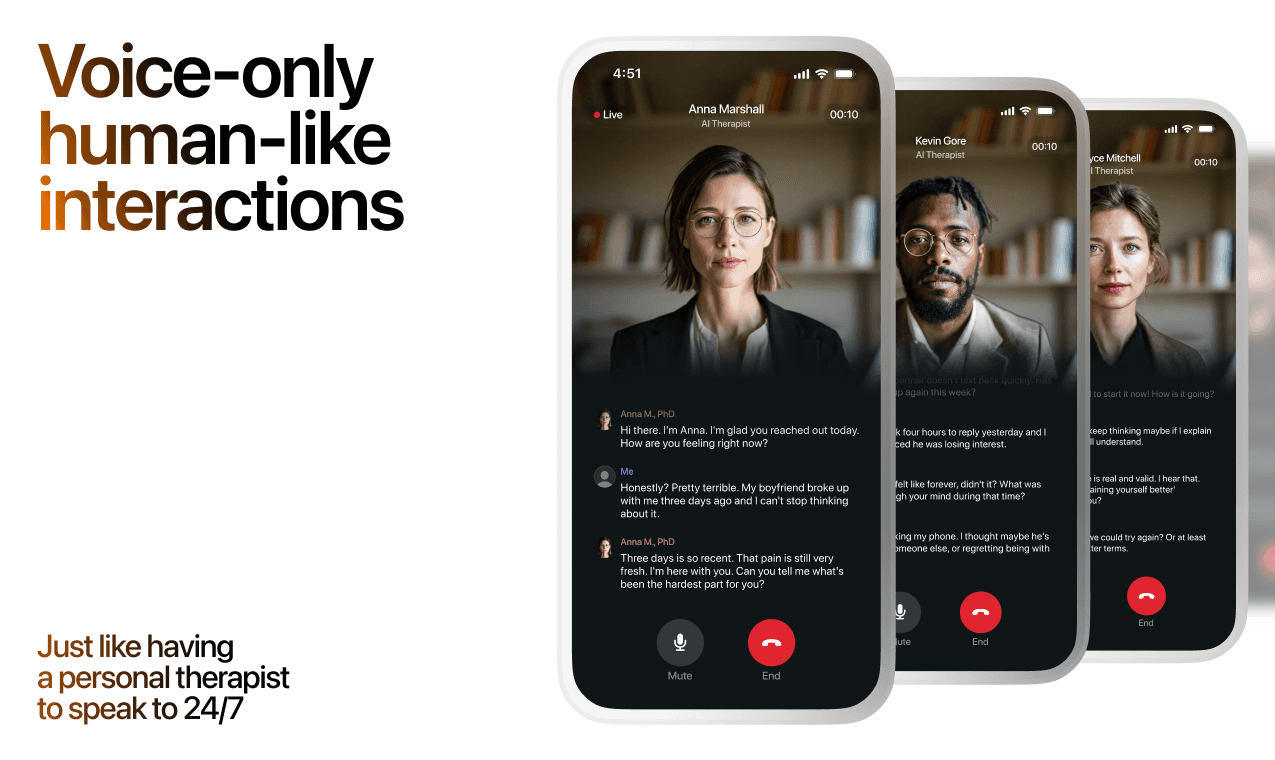
What a Session with Lovon Looks Like
When to Seek Professional Help
AI support is a valuable tool, but it's not a replacement for professional care. Please consider reaching out to a licensed therapist if you experience any of the following:
- Persistent thoughts of self-harm or suicide
- Inability to perform daily activities (work, eating, sleeping) for more than 2 weeks
- Turning to alcohol or substances to cope
- Intense anger or desire to harm your ex-partner
- Complete emotional numbness that doesn't improve over time
Crisis Resources (US): If you're in immediate danger, call 988 (Suicide & Crisis Lifeline) or text HOME to 741741 (Crisis Text Line). Available 24/7, free, and confidential.
Outside the US? Find a crisis line in your country
Ready to Start?
Your healing journey can begin right now
A 7-day trial. No judgment. Just a safe space to process what you're going through.
Frequently Asked Questions
Is Lovon a replacement for a real therapist?
Is my conversation with Lovon AI private?
How is Lovon different from ChatGPT for emotional support?
Can I use Lovon if I'm already seeing a therapist?
Can I try Lovon before subscribing?
About the Author
The Lovon Editorial Team
Mental Health & Wellness Content Team
The Lovon Editorial Team develops mental health and wellness content designed to make psychological concepts accessible and actionable. Our goal is to bridge the gap between clinical research and everyday life - helping you understand why your mind works the way it does and what you can do about it....
Related articles
- How to Stop Anxiety Spirals: 7 Steps for 2026
How to stop anxiety spirals with 7 grounded steps for 2026: paced breathing, grounding, and catching the thought before…
- Emotional Regulation Skills for Adults That Work in 2026
Learn which emotional regulation skills for adults actually work in 2026 — step-by-step techniques, common mistakes…
- How to Stop a Panic Attack in the Moment (2026)
Learn how to stop a panic attack using 4-7-8 breathing, 5-4-3-2-1 grounding, and the dive reflex. Evidence-based steps…
- Nervous System Dysregulation: Signs & Reset Guide 2026
Nervous system dysregulation signs and a 7-step reset for 2026, plus troubleshooting for panic, freeze, and sleep…
See also
Quizzes
- Do I Miss My Ex or Am I Just Lonely? 12-Question Quiz
Find out what the missing is actually about.
- Do I Have Trust Issues? 12-Question Quiz
Check where your guard actually sits, in 2 minutes.
Free tools
- What to Say When They Are Struggling
A chat, not a list. Tell the coach who this person is to you, what they are going through, and what you already said…
- Words of Encouragement for Him When He Is Struggling
Words of encouragement for him that fit what he is actually going through, for when your usual lines are not landing…
From the wiki
- Why do I feel lonely all of a sudden?
Sudden loneliness usually traces back to something that quietly ended in the last few months: a routine, a shared class…
Disclaimer: This article is for informational purposes only and does not constitute medical advice, diagnosis, or treatment. Always seek the advice of your physician or other qualified health provider with any questions you may have regarding a medical condition. If you are in crisis or think you may have an emergency, call 988 (Suicide & Crisis Lifeline) or go to the nearest emergency room. Outside the US? Find a crisis line in your country.