
How to Manage Relationship Anxiety Day to Day (2026)
Learn how to manage relationship anxiety day to day with 7 practical steps, troubleshooting fixes, and tools that work in 2026 — evidence over reassurance-seeking.

Key Takeaways
- 10-15 minutes a day, ideally at a consistent time (morning or before bed works best)
- A notes app or physical journal for thought tracking
- A private space for a 5-minute breathing or grounding exercise
- Honest awareness of your triggers (a late reply, a change in tone, physical distance)
- Optional: a voice-based tool like Lovon for talking through spirals in the moment, since anxious thoughts often lose
Relationship anxiety doesn't show up once and leave — it shows up every time your partner takes an hour to text back, every time an argument feels bigger than it is, every time you're waiting for the other shoe to drop. This guide walks through what to do about it today, not someday.
TL;DR
Managing relationship anxiety day to day means separating the anxious thought from the actual evidence, using a body-based calming technique before you react, and building small daily habits (check-ins, grounding, journaling) instead of relying on reassurance-seeking. Lovon's relationship anxiety guide breaks down the signs and root causes if you're still figuring out whether this is what you're dealing with. Verdict: this is manageable with daily practice, not a one-time fix — most people see a shift in reactivity within two to three weeks of consistent effort in 2026's flood of "anxious attachment" content, but consistency matters more than any single technique.
Why this matters
Relationship anxiety left unmanaged doesn't stay quiet. It leaks into how you text, how you argue, how you interpret a delayed reply at 11pm. Left unchecked for months, it can push partners away through the exact behaviors — checking their phone, needing constant reassurance, picking fights to test loyalty — that the anxiety was trying to prevent in the first place.
The upside: relationship anxiety responds well to structure. Unlike a lot of emotional struggles, this one has clear physical and cognitive levers you can pull daily. If your anxiety traces back to an anxious attachment style, the patterns are well documented, and anxious attachment coping strategies can run alongside the steps below.
What you'll need
- 10-15 minutes a day, ideally at a consistent time (morning or before bed works best)
- A notes app or physical journal for thought tracking
- A private space for a 5-minute breathing or grounding exercise
- Honest awareness of your triggers (a late reply, a change in tone, physical distance)
- Optional: a voice-based tool like Lovon for talking through spirals in the moment, since anxious thoughts often lose intensity once said out loud to something that responds
The steps
1. Name the trigger the moment it hits
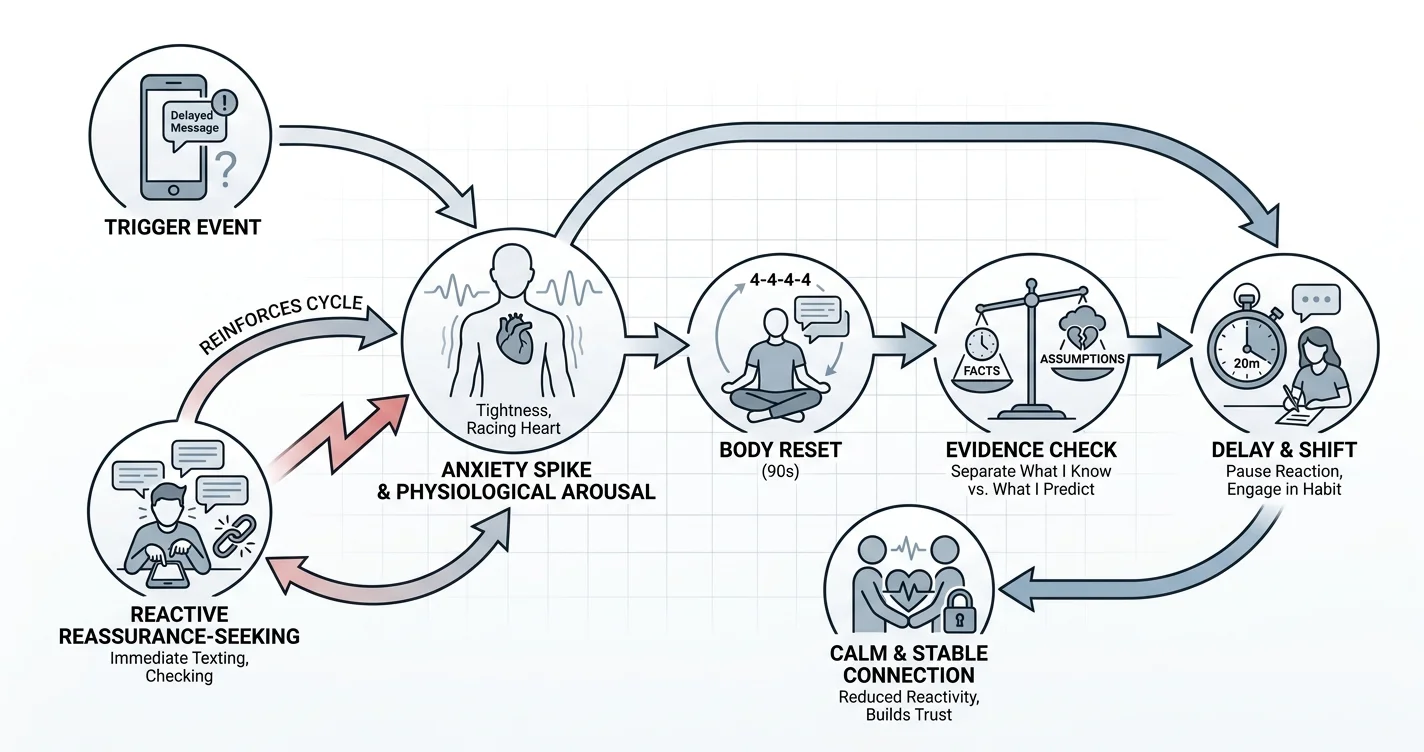
Catch the spike before it turns into a spiral. The second you notice your chest tighten or your thumb hovering over their name, say out loud or write down exactly what happened: "They took 3 hours to reply and I assumed something's wrong." Naming it separates the event from the story you're building on top of it. Common mistake: skipping this step and going straight to a text demanding an explanation — that's the anxiety driving, not you.
2. Run a 90-second body reset before you respond to anything
Anxiety is physical before it's mental — a racing heart and shallow breath convince your brain something's actually wrong. Box breathing works fast: inhale for 4 seconds, hold for 4, exhale for 4, hold for 4, repeat for 6 rounds. This takes under 2 minutes and drops physiological arousal enough that you can think clearly. The box breathing technique works because it slows heart rate variability directly, not through distraction. Expected outcome: your urge to text, call, or check their location app should drop noticeably by round 4 or 5.
3. Write down the evidence, not the story
Once your body's calm, separate what actually happened from what you're predicting will happen. Two columns: "What I know" (they haven't replied in 3 hours) versus "What I'm assuming" (they're losing interest, they're with someone else, this is ending). This is the core move against catastrophizing — jumping from a neutral fact to a worst-case conclusion. If this pattern feels familiar across situations, not just relationships, catastrophizing and how to stop worst-case thinking covers the thinking trap in more depth. Common mistake: treating the assumption column as fact once it's written down — it's still a guess.
4. Delay the reassurance-seeking text by 20 minutes
This is the step that actually breaks the cycle. Reassurance-seeking (texting "are we okay?" or "did I do something wrong?") feels like relief but trains your brain that anxiety only goes down when someone else responds. Set a timer for 20 minutes before you send anything. Use that window for steps 2 and 3. Expected outcome: by 2026 standards in anxiety treatment, most people report the urge drops by half or disappears within that window once the nervous system settles.
5. Do a daily 5-minute check-in, not a crisis check-in
Build one small, low-stakes daily habit with your partner — a "how was your day" text or a 5-minute call — so connection isn't only happening during anxiety spikes. This gives your nervous system regular proof the relationship is stable, instead of only checking in when you're already anxious. Common mistake: turning the daily check-in into an interrogation about their whereabouts, which defeats the purpose.
6. Journal the pattern weekly, not just the spike
Once a week, look back and note what triggered spikes, what helped, and what didn't. Patterns show up fast: maybe it's always after a long gap in texting, or always on days you're already stressed at work. This turns scattered bad days into usable data. If journaling in writing feels like a chore, voice journaling lowers the barrier — voice journaling to reduce anxiety daily walks through how to do it in under 10 minutes.
7. Talk it through out loud when the spiral hits mid-day
Some spikes happen when there's no time for a full journaling session — you're at work, in the car, mid-conversation with someone else. Having a way to talk through the thought in real time, out loud, interrupts the internal loop faster than typing does. This is where a voice-based tool like Lovon fits: you talk through the specific thought ("I think they're pulling away") and get pushed toward the evidence-versus-assumption split from step 3, without needing to schedule anything.
Troubleshooting
- The 20-minute delay doesn't lower the urge at all. Pair it with the breathing exercise from step 2 first — delay alone without a body reset often just prolongs the discomfort instead of reducing it.
- You know the assumption isn't fact but still can't stop believing it. This is common with an anxious attachment style, where the nervous system treats uncertainty as danger regardless of logic. Working through it with a structured guide, like anxious attachment in dating, helps more than logic alone.
- Your partner gets frustrated by the daily check-ins. Scale back to every other day and be explicit about why you're doing it — most partners respond better to "this helps me stay calm" than to check-ins that feel like surveillance.
- The spirals happen mostly at night. Nighttime anxiety has different physiology (cortisol patterns, less distraction) — a targeted approach like calming anxiety at night addresses that specifically.
- You're doing everything right but the anxiety hasn't moved in over a month. That's a signal to bring in more support than self-guided steps, whether that's a licensed therapist or consistent use of a support tool between sessions.
Tools and resources
- Box breathing or another grounding technique for the physical reset
- A journal or voice notes app for the evidence-vs-assumption split and weekly review
- Lovon for talking through spikes out loud in the moment, especially outside therapy hours
- A trigger log (even a simple notes app list) to spot patterns over 2-4 weeks
What to do next
Once the day-to-day spikes are more manageable, the next layer is understanding whether the root cause is attachment-related or situational. Read relationship anxiety: signs, causes, and coping tools for the fuller picture, then decide if a deeper attachment-focused approach makes sense for 2026 and beyond.
FAQ
What's the best way to manage relationship anxiety day to day? Pair a physical calming technique (like box breathing) with a written evidence-check before reacting to any trigger — the combination addresses both the body's alarm response and the anxious thought pattern at the same time.
Is relationship anxiety the same as anxious attachment? Not always — relationship anxiety can be situational (new relationship, past betrayal, current stress), while anxious attachment is a broader pattern rooted in earlier relationships that shows up across most of your close connections.
How long does it take to stop feeling anxious in a relationship? Most people notice reduced reactivity within two to three weeks of consistent daily practice, though full change in attachment-driven anxiety often takes months of steady work.
Should I tell my partner I have relationship anxiety? Yes, in most cases — naming it out loud reduces the guessing games on both sides and lets your partner understand that a delayed reply isn't a crisis, it's a trigger.
Can journaling actually reduce relationship anxiety? Yes — weekly journaling surfaces patterns (specific triggers, times of day, stress overlaps) that daily reacting hides, which makes the anxiety feel less random and more manageable.
Is it normal to feel anxious even in a good relationship? Yes — relationship anxiety often has more to do with your own nervous system's baseline than with anything wrong in the relationship itself, especially if the anxiety predates this specific partner.
What should I avoid doing when relationship anxiety spikes? Avoid immediate reassurance-seeking texts, checking their social media repeatedly, or picking a fight to "test" the relationship — all three reinforce the anxiety cycle instead of calming it.
Does an AI tool actually help with relationship anxiety? A voice-based tool won't replace a licensed therapist, but it can help interrupt an in-the-moment spiral by giving you a place to talk through the thought immediately, which is often when reasoning alone fails.
One last thing
The single biggest shift people report isn't a technique — it's timing. Anxiety spikes are loudest in the first 5 minutes after a trigger and quiet down on their own after 20-30 minutes regardless of what you do. The entire point of steps 2 through 4 above is just buying you that window without doing damage in the meantime. That's the whole game in 2026: not eliminating the spike, just surviving the window it takes to pass.
Related guides
How AI Support Helps You Heal
AI emotional support isn't about replacing human connection — it's about filling the gaps. The moments when you need to talk at 2 AM, when you don't want to burden your friends again, or when you simply need someone to listen without judgment.
Here's what happens in a typical Lovon session:
You share what's on your mind
There's no script, no intake form, no waiting room. You speak or type whatever you're feeling — in your own words, at your own pace.
Lovon validates and explores
Using frameworks from CBT (Cognitive Behavioral Therapy) and motivational interviewing, Lovon acknowledges your feelings first, then gently helps you explore them. No dismissive "just move on" advice.
You build coping skills together
Lovon doesn't just listen — it actively works with you on evidence-based techniques: thought reframing, urge surfing, behavioral experiments, and more.
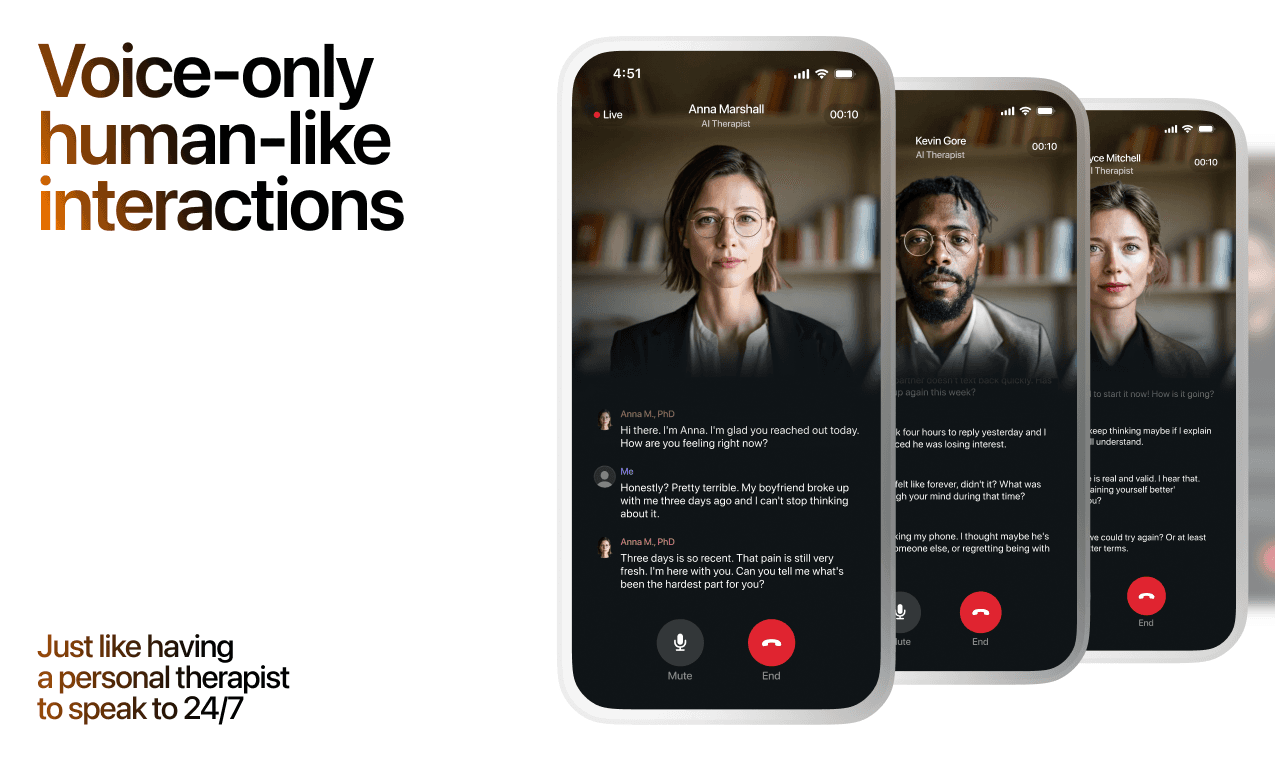
What a Session with Lovon Looks Like
Lovon is AI support, not a replacement for professional care. If things have been hard to get through for weeks, or you are thinking about harming yourself, talk to a doctor or a licensed therapist.
Ready to Start?
Your healing journey can begin right now
A 7-day trial. No judgment. Just a safe space to process what you're going through.
Frequently Asked Questions
Is Lovon a replacement for a real therapist?
Is my conversation with Lovon AI private?
How is Lovon different from ChatGPT for emotional support?
Can I use Lovon if I'm already seeing a therapist?
Can I try Lovon before subscribing?
About the Author
The Lovon Editorial Team
Mental Health & Wellness Content Team
The Lovon Editorial Team develops mental health and wellness content designed to make psychological concepts accessible and actionable. Our goal is to bridge the gap between clinical research and everyday life - helping you understand why your mind works the way it does and what you can do about it....
Related articles
- Signs of Insecure Attachment in Adults (2026 Guide)
Signs of insecure attachment in adults, explained step by step: fear of abandonment, withdrawal, reassurance-seeking…
- Best AI Relationship Coach for Anxious Attachment 2026
Find the best AI relationship coach for anxious attachment in 2026. Lovon offers voice-based, on-demand emotional…
- How to Heal Anxious Attachment on Your Own (2026)
Step-by-step guide to healing anxious attachment solo in 2026: triggers, nervous system work, boundaries, and tools that…
- Catastrophizing About Relationship: How to Stop in 2026
Catastrophizing about your relationship? Get 7 steps to break the spiral in 2026, spot the thinking traps behind it, and…
See also
Quizzes
- Relationship Schema Test: Are Your Feelings Welcome?
See which belief edits what you share, in 3 minutes.
- Am I Codependent? 12-Question Self-Check
See how much of you is left over, in 2 minutes.
Free tools
- Attachment Trigger Plan for Anxious and Avoidant Patterns
Pick your pattern, tick the moments that set it off, and finish one card for each: your body signal, the thing you will…
- Relationship Check-In Questions, and How to Run One
Check-ins fail on structure, not on questions. Tell it whether this would be your first one, what is on your mind, and…
From the wiki
- What does clingy mean in a relationship?
Clingy is what people call behavior that asks for more contact or reassurance than the other person wants to give…
Disclaimer: This article is for informational purposes only and does not constitute medical advice, diagnosis, or treatment. Always seek the advice of your physician or other qualified health provider with any questions you may have regarding a medical condition. If you are in crisis or think you may have an emergency, call 988 (Suicide & Crisis Lifeline) or go to the nearest emergency room. Outside the US? Find a crisis line in your country.