
How to Calm Anxiety at Night in 2026: 7 Steps
Learn how to calm anxiety at night with 7 evidence-based steps — breathing techniques, body scans, and worry dumps that work the same night you try them.
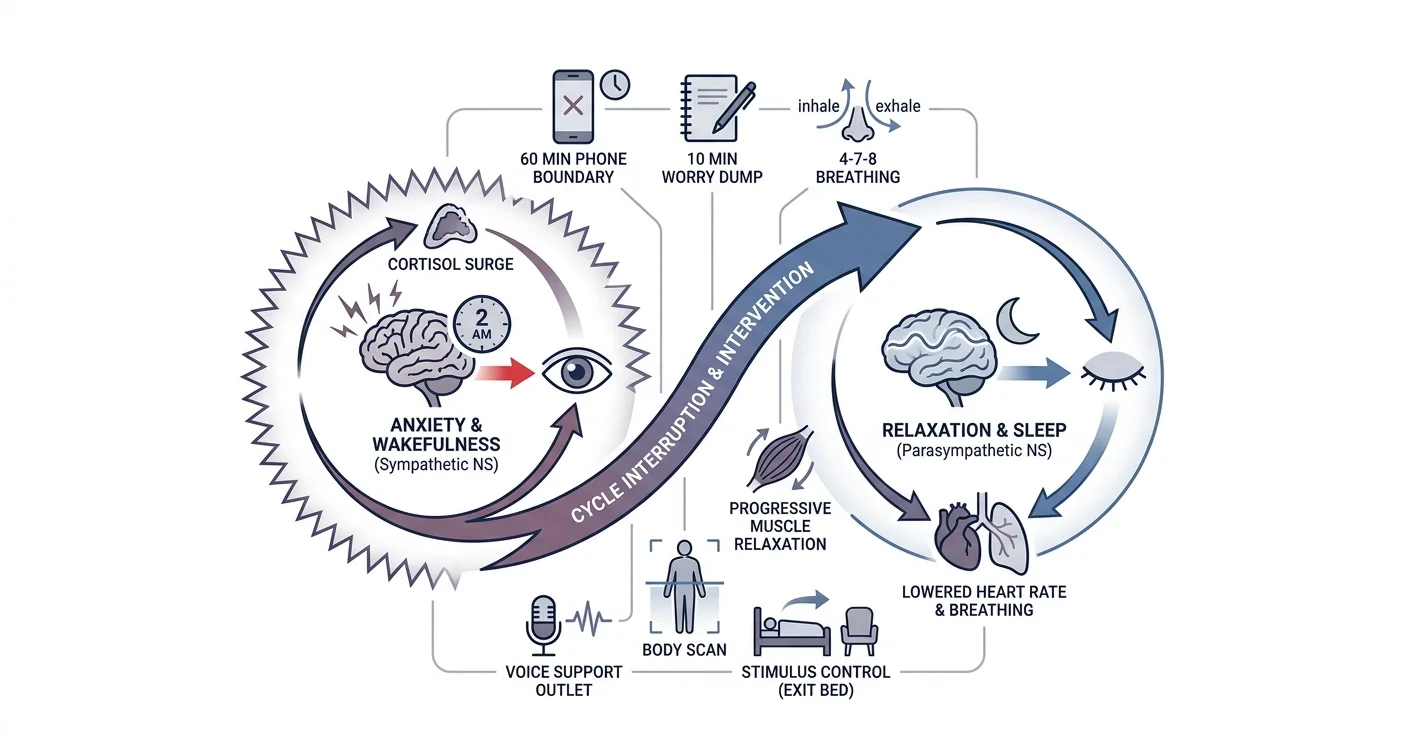

Key Takeaways
- A quiet, dark room (or an eye mask)
- A timer on your phone — screen face-down after you set it
- A notebook or voice memo app for worry dump (Step 2)
- Loose, comfortable clothing
- Optional: a white noise machine or app
Night anxiety is one of the most common sleep disruptors adults face in 2026 — your mind races the moment your head hits the pillow, and the harder you try to stop it, the worse it gets. This guide gives you a step-by-step plan to calm anxiety at night using evidence-based techniques you can start tonight.
TL;DR: The most effective way to calm anxiety at night combines physiological techniques (slow diaphragmatic breathing, progressive muscle relaxation) with cognitive resets (scheduled worry time, body scanning). For immediate relief, the 4-7-8 breathing method slows your heart rate within 60 seconds. If racing thoughts are chronic, using an AI voice support tool like Lovon between therapy sessions gives you a structured outlet at any hour. None of these replace clinical care, but together they interrupt the anxiety-sleep cycle that keeps millions awake every night in 2026.
Why nighttime anxiety hits harder
Daytime distractions mask anxiety. At night, those distractions disappear. Your nervous system, already primed from the day's stressors, shifts into threat-detection mode precisely when you need it to power down. Cortisol — your primary stress hormone — follows a daily curve, but for people with anxiety disorders it stays elevated longer into the evening. The result: a body that feels wired and a mind that won't stop producing worst-case scenarios.
Understanding this cycle is the first step. The techniques below target specific points in it.
What you'll need
- A quiet, dark room (or an eye mask)
- A timer on your phone — screen face-down after you set it
- A notebook or voice memo app for worry dump (Step 2)
- Loose, comfortable clothing
- Optional: a white noise machine or app
- Time: most steps take 5-10 minutes; the full routine runs about 25-30 minutes
The steps
Step 1: Cut the cortisol trigger 60 minutes before bed
Stop scrolling and close work apps 60 minutes before your target sleep time. Blue-light exposure suppresses melatonin production, and emotionally activating content (news, social media arguments, work email) keeps your amygdala firing. Set a physical phone boundary — charger across the room, screen face-down. This single change reduces pre-sleep arousal measurably. It is the foundation every other step builds on. Skipping it weakens the effectiveness of everything that follows.
Common mistake: Swapping the phone for a laptop "just to finish one thing." Screens are the trigger regardless of device.
Step 2: Do a 10-minute worry dump before you lie down
Sit upright with a notebook or open a voice memo. Set a timer for 10 minutes. Write or speak every worry, task, and fear currently in your head — without editing or solving. The act of externalizing anxious thoughts moves them from active working memory into a format your brain perceives as "handled." A 2022 study published in Journal of Experimental Psychology found that writing worries before bed freed up cognitive resources and reduced pre-sleep cognitive arousal.
Once the timer ends, close the notebook. The worries are logged. You are off-duty until morning.
Common mistake: Trying to solve problems during the dump. This is capture, not problem-solving. Solutions go on a separate list for tomorrow.
Step 3: Use 4-7-8 breathing to slow your heart rate
Lie flat. Inhale through your nose for 4 counts, hold for 7 counts, exhale through your mouth for 8 counts. Repeat 4 cycles. The extended exhale activates your parasympathetic nervous system — specifically the vagus nerve — shifting your body from sympathetic "fight or flight" toward rest. Your heart rate and blood pressure drop within the first 2-3 cycles. This is the fastest evidence-backed technique for immediate nighttime anxiety relief in 2026.
If 7-count holds feel uncomfortable at first, start with a 4-4-6 ratio and build up over several nights.
Common mistake: Breathing from the chest instead of the belly. Put one hand on your stomach — it should rise on the inhale.
Step 4: Run a body scan to release physical tension
After breathing, close your eyes and move your attention slowly from feet to head. At each body part — feet, calves, knees, thighs, hips, stomach, chest, shoulders, hands, neck, face — notice any tension without judging it, then consciously relax that muscle group. A full body scan takes 8-12 minutes. It works because anxiety is not only cognitive; it is also somatic. Jaw clenching, shoulder tension, and tight hips are anxiety stored in muscle. Releasing the physical layer interrupts the feedback loop that keeps your mind alert.
For a deeper look at how your nervous system encodes stress physically, the Lovon blog's piece on polyvagal theory explained covers the underlying science in plain language.
Common mistake: Rushing through the scan. Spend at least 10 seconds at each body part. Speed defeats the purpose.
Step 5: Use progressive muscle relaxation if the scan alone isn't enough
If your body refuses to let go with passive scanning, add active tension-release. Squeeze each muscle group hard for 5 seconds, then release. Start at the feet and work upward. The contrast between tension and release teaches your nervous system what "relaxed" actually feels like — useful when chronic anxiety has made baseline tension feel normal. A full PMR session runs 15-20 minutes. Do it in bed; you'll likely be asleep before you finish.
Lovon's progressive muscle relaxation step-by-step guide walks through each muscle group in order if you need a reference.
Common mistake: Tensing muscles around an injury. Skip any area that hurts and move on.
Step 6: If you wake up mid-night, do NOT lie there fighting it
If you wake at 2 or 3 a.m. with racing thoughts, get out of bed after 20 minutes of not sleeping. Lying awake in bed trains your brain to associate bed with wakefulness and anxiety — a conditioning pattern called learned arousal. Go to another room, sit in dim light, and do the worry dump again or try the 4-7-8 breathing sequence. Return to bed only when you feel genuinely sleepy. This approach (stimulus control therapy) is one of the most effective behavioral interventions in chronic insomnia treatment.
Common mistake: Watching TV or scrolling to "pass the time." You are reinforcing wakefulness, not preparing for sleep.
Step 7: Talk it through if the thoughts won't stop
Some nights, the anxiety has a specific shape — a conversation you're dreading, a relationship problem, a work spiral — and breathing techniques alone don't quiet it because the content of the thought is unresolved. On those nights, talking helps more than breathing. Lovon's AI voice support is available at 3 a.m. for exactly this: you speak, it listens and responds with grounding techniques and reflection prompts, built with PhD psychologist input. It is not a licensed therapist, and it is not a crisis line — for emergencies, call 988. But for the specific experience of lying awake needing to process something out loud, on-demand support that you can access immediately covers a gap that scheduled therapy cannot.
Troubleshooting
"My mind speeds up when I try to breathe slowly." This is common in the first 3-4 days. Your brain interprets the breathing shift as unusual and raises alertness briefly. Keep doing it. The response diminishes with repetition.
"I fall asleep fine but wake at 3 a.m. every night." Early-morning waking is often linked to cortisol surging too early. Limit alcohol (even one drink disrupts REM sleep in the second half of the night), keep your bedroom temperature below 68°F, and apply Step 6 consistently.
"The worry dump makes me more anxious because I see how much is wrong." Switch to a gratitude-plus-worry format: start with three specific things from the day that went okay, then move to the worry list. The gratitude primer doesn't erase the worries, but it contextualizes them and lowers baseline emotional activation before you write.
"I've tried all of this and I still can't sleep." Chronic sleep-onset insomnia co-occurring with anxiety often needs Cognitive Behavioral Therapy for Insomnia (CBT-I) from a licensed provider. These techniques are first-line tools, not a substitute for clinical evaluation.
"My anxiety at night is specifically about relationships or a past situation." Rumination tied to specific emotional content — a breakup, conflict, a relationship pattern — is harder to dissolve with body-based techniques alone. Talking through the underlying issue, whether with a therapist or a structured AI support session, addresses the source rather than just the symptom.
"I have ADHD and my brain just won't settle." ADHD and anxiety overlap significantly, and nighttime is when ADHD brains often become most active. The Lovon blog's piece on ADHD sleep problems explains the neurological reasons and adds ADHD-specific strategies to the routine above.
Tools and resources
- 4-7-8 breathing — no tools needed; just a timer
- Worry dump — paper notebook or voice memo app
- Progressive muscle relaxation — step-by-step guide (already linked above; use the guide as a reference)
- White noise — any free app; aim for 60-65 decibels
- Lovon — voice-based AI support at lovon.app for nights when you need to talk rather than just breathe
- Therapist directory — Psychology Today's directory for finding a CBT-I specialist
- Crisis support — 988 Suicide and Crisis Lifeline (call or text 988, US, 2026)
What to do next
Once you have the basics of nighttime anxiety management in place, the next layer is understanding why your nervous system defaults to high alert. The anxious attachment style: signs and coping strategies piece on the Lovon blog connects chronic nighttime anxiety to relational patterns that drive it — worth reading if your racing thoughts are mostly about people and relationships.
FAQ
What is the fastest way to calm anxiety at night? The 4-7-8 breathing method — inhale 4 counts, hold 7, exhale 8 — slows heart rate within 60 seconds by activating the parasympathetic nervous system. It is the fastest evidence-backed technique available without any tools.
Why does anxiety get worse at night? Daytime distractions mask anxiety symptoms. At night, those masks disappear, and your brain shifts into threat-detection mode. Elevated evening cortisol in people with anxiety disorders keeps the nervous system alert when it should be winding down.
Can breathing exercises actually stop a panic attack at night? Breathing exercises can reduce the severity and duration of a panic attack by slowing the physiological cascade. They work best as prevention — started at the first signs of rising anxiety — rather than after a full panic attack is underway.
How long does it take to calm anxiety at night using these techniques? Most people notice improvement within 3-7 consistent nights. The body-scan and 4-7-8 combination produces same-night effects for many people; the behavioral changes (stimulus control, worry dump) take longer to rewire the sleep-anxiety association.
Is it normal to wake up with anxiety at 3 a.m.? Yes — early-morning waking with racing thoughts is one of the most common presentations of nighttime anxiety in 2026. It is often linked to cortisol levels rising too early, disrupted REM sleep (frequently from alcohol), or unresolved stress.
Should I get out of bed when I can't sleep because of anxiety? Yes, after 20 minutes of not sleeping. Lying awake builds a learned association between bed and wakefulness. Leaving the bed, doing a calming activity in dim light, and returning only when sleepy is the core principle of stimulus control therapy.
Does talking help more than breathing techniques for nighttime anxiety? For anxiety tied to specific unresolved content — a conflict, a fear about the future — talking addresses the source in a way breathing alone cannot. Combine both: use breathing to lower physiological arousal first, then process the specific thought content.
When should I see a doctor about nighttime anxiety? If nighttime anxiety significantly disrupts your sleep 3 or more nights per week for longer than a month, consult a licensed provider. Persistent sleep-onset insomnia with anxiety often responds to CBT-I and, in some cases, short-term medication support.
One last thing
The worst thing you can do when you can't sleep is try harder to sleep. Sleep is a passive state — effort actively prevents it. The goal of every technique in this guide is not "make yourself sleep" but "lower your arousal enough that sleep can happen on its own." That reframe alone changes how you relate to the anxiety at 2 a.m., and in 2026, that cognitive shift is one of the most underrated pieces of sleep advice available.
Related guides
How AI Support Helps You Heal
AI emotional support isn't about replacing human connection — it's about filling the gaps. The moments when you need to talk at 2 AM, when you don't want to burden your friends again, or when you simply need someone to listen without judgment.
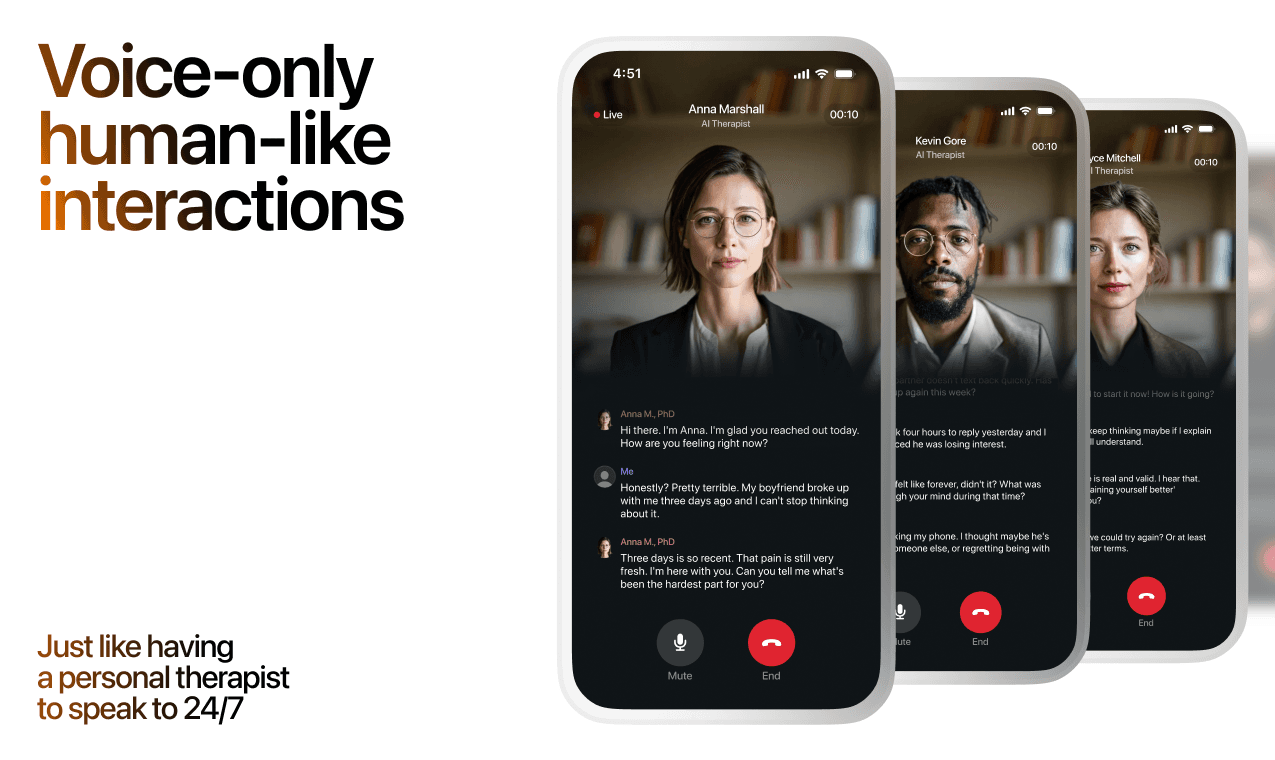
Here's what happens in a typical Lovon session:
You share what's on your mind
There's no script, no intake form, no waiting room. You speak or type whatever you're feeling — in your own words, at your own pace.
Lovon validates and explores
Using frameworks from CBT (Cognitive Behavioral Therapy) and motivational interviewing, Lovon acknowledges your feelings first, then gently helps you explore them. No dismissive "just move on" advice.
You build coping skills together
Lovon doesn't just listen — it actively works with you on evidence-based techniques: thought reframing, urge surfing, behavioral experiments, and more.
What a Session with Lovon Looks Like
When to Seek Professional Help
AI support is a valuable tool, but it's not a replacement for professional care. Please consider reaching out to a licensed therapist if you experience any of the following:
- Persistent thoughts of self-harm or suicide
- Inability to perform daily activities (work, eating, sleeping) for more than 2 weeks
- Turning to alcohol or substances to cope
- Intense anger or desire to harm your ex-partner
- Complete emotional numbness that doesn't improve over time
Crisis Resources (US): If you're in immediate danger, call 988 (Suicide & Crisis Lifeline) or text HOME to 741741 (Crisis Text Line). Available 24/7, free, and confidential.
Outside the US? Find a crisis line in your country
Ready to Start?
Your healing journey can begin right now
A 7-day trial. No judgment. Just a safe space to process what you're going through.
Frequently Asked Questions
Is Lovon a replacement for a real therapist?
Is my conversation with Lovon AI private?
How is Lovon different from ChatGPT for emotional support?
Can I use Lovon if I'm already seeing a therapist?
Can I try Lovon before subscribing?
About the Author
The Lovon Editorial Team
Mental Health & Wellness Content Team
The Lovon Editorial Team develops mental health and wellness content designed to make psychological concepts accessible and actionable. Our goal is to bridge the gap between clinical research and everyday life - helping you understand why your mind works the way it does and what you can do about it....
Related articles
- AI Coping Tools for Wedding Planning Stress (2026)
AI coping tools for wedding planning stress in 2026: box breathing, muscle relaxation, and Lovon's on-demand voice…
- How much sleep do you need to lower anxiety?
How much sleep do you need to lower anxiety? Most adults should aim for 7–9 hours in 2026. Learn why sleep quality…
- AI App for Anxiety Insomnia: Best Picks 2026
The best ai app for anxiety insomnia in 2026 pairs voice sessions with nervous-system tools. See what to buy, consider…
- Can lack of sleep make anxiety worse?
Can lack of sleep make anxiety worse? Yes. Learn how sleep and worry feed each other, what helps tonight, and when to…
See also
Quizzes
- Empathy Test: Free 12-Question Self-Check
See which part of your empathy is strained, in 3 minutes.
- Do I Have Trust Issues? 12-Question Quiz
Check where your guard actually sits, in 2 minutes.
Free tools
- Write a Letter to Your Best Friend
A chat for a letter to your best friend that only they could have received. Tell it how long you have been friends, one…
- Am I Overreacting, or Is This a Big Deal?
A chat for the small thing you cannot stop turning over. Say what happened and what you have already told yourself about…
From the wiki
- How to stop maladaptive daydreaming?
Maladaptive daydreaming is immersive waking fantasy that eats hours, usually with music and pacing attached. You rarely…
Disclaimer: This article is for informational purposes only and does not constitute medical advice, diagnosis, or treatment. Always seek the advice of your physician or other qualified health provider with any questions you may have regarding a medical condition. If you are in crisis or think you may have an emergency, call 988 (Suicide & Crisis Lifeline) or go to the nearest emergency room. Outside the US? Find a crisis line in your country.