
Is He Cheating on Me Quiz: Read the Signs (2026)
Is he cheating on me quiz breaks down 5 real signal clusters, what counts as evidence in 2026, and a verdict framework before you confront anything.

Key Takeaways
- Quizzes that score a single answer as "definitely cheating." No credible relationship researcher claims one behavior
- Treating jealousy from your side as proof of guilt on his. Anxious attachment can generate real physical suspicion
- Confusing depression or burnout symptoms for guilt symptoms. Withdrawal, low libido, and irritability look identical
Wondering if he's cheating usually starts with a feeling before it starts with proof — a gut pull that something's off, followed by three a.m. Google searches. This guide breaks down what an is he cheating on me quiz should actually measure, which signals deserve weight, and what you do with the results once you have them.
TL;DR
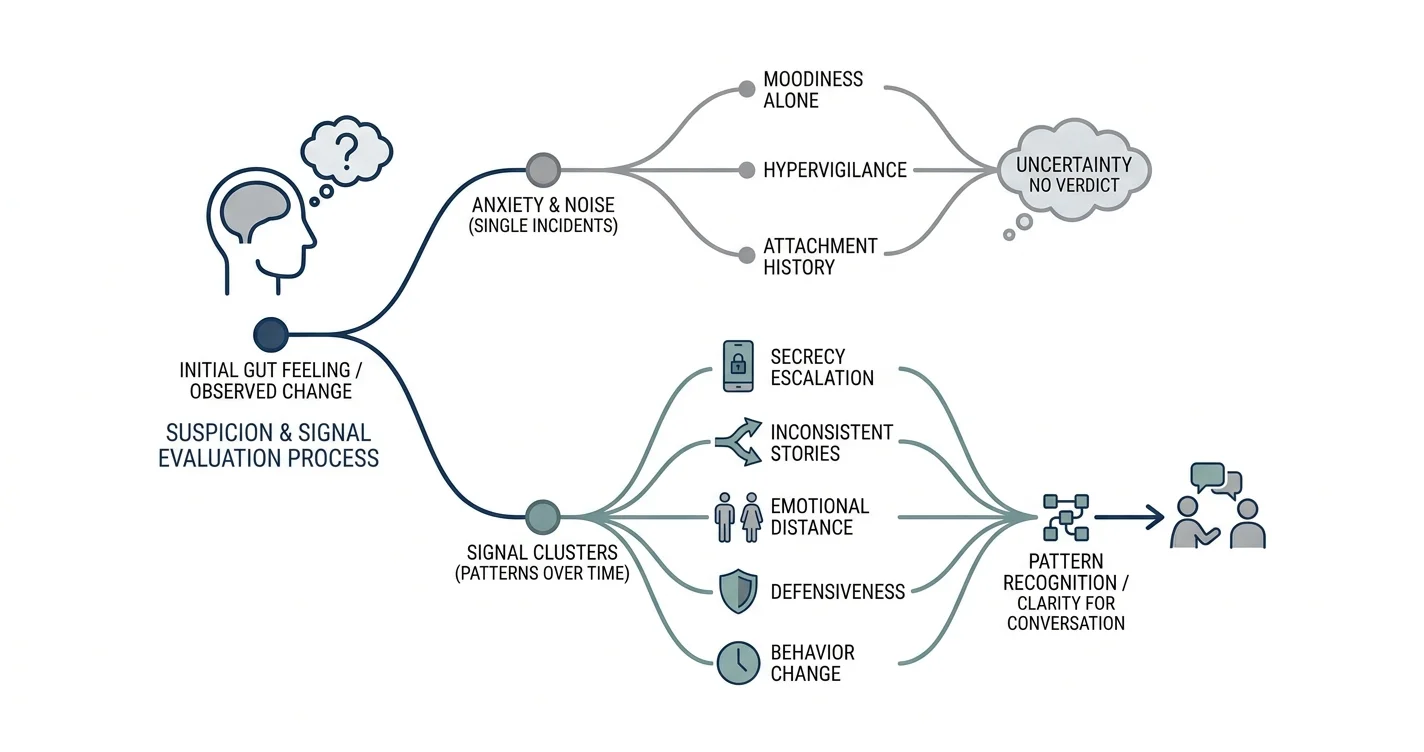
An is he cheating on me quiz can't tell you the truth — only he can — but a good one organizes scattered suspicion into patterns you can actually evaluate. The strongest quizzes score five categories: secrecy, emotional distance, inconsistent stories, changed intimacy, and defensiveness. Verdict: take a quiz for clarity, not for verdicts — if three or more categories score high, that's a conversation, not a Google search. In 2026, this remains one of the most-searched relationship phrases online, which tells you the anxiety is common even when the answer isn't always cheating.
Why this matters
Suspicion left unexamined doesn't go away — it just gets louder. You start reading tone into text messages, timing his showers, checking call logs at midnight. That behavior has a name (hypervigilance), and it's exhausting whether or not he's actually cheating. The am I being cheated on quiz sorts what you have noticed into the five categories below, and it is explicit that it cannot tell you what he did — only what you are living with.
A structured quiz forces you to name specific behaviors instead of a vague dread. That's the real value: it turns "something feels wrong" into a list you can test against reality. If your relationship already feels unsafe or confusing most days, not just this week, it's worth reading through 10 signs your relationship might be toxic alongside this quiz — infidelity is often one symptom of a bigger pattern, not the whole story.
Who this is for
This is for women who've noticed a real shift — not a single weird text, but a pattern over weeks — and want a way to check their own perception before confronting anyone. It's for the person who's replayed the same three moments a hundred times and needs an outside structure to sort real evidence from anxiety spirals. It is not for someone acting on a single suspicious moment with no pattern behind it; one late night home doesn't make a case.
What to look for in an is he cheating on me quiz
Behavior change over time, not a single incident
A useful quiz asks about shifts across weeks or months, not one bad night. Cheating patterns show up as trends: less eye contact during conversation, more time "at work," a sudden interest in his appearance for no occasion. One late text means nothing. Three months of unexplained absences means something.
Secrecy specifically around his phone and schedule
Phone behavior is the single most reliable self-report signal in relationship research on infidelity anxiety: turning the phone face-down, new passcodes, deleting message threads. The quiz should ask about new secrecy, not baseline privacy — some people have always kept their phone private, and that's not evidence of anything.
Inconsistent stories that don't line up on retelling
A real quiz asks whether his account of where he was changes in small details when you ask twice. Liars aren't dumb, but they're inconsistent under repeat questioning because they're not recalling a memory, they're reconstructing a story. This is a stronger tell than any single suspicious text.
Emotional and physical distance
Less intimacy, less conversation, more irritability when you ask basic questions — these track guilt and disengagement, but they also track depression, burnout, and stress that have nothing to do with cheating. A good quiz separates "distant because of an affair" from "distant because he's drowning at work," and if you can't tell the difference from the outside, an AI relationship coach built for trust issues can help you talk it through before you accuse anything.
Defensiveness disproportionate to the question
If a normal "how was your day" gets an angry, over-explained response, that's a signal worth scoring. Guilty people over-answer questions nobody asked. Innocent people who are just tired usually just say "fine" and move on.
Your own anxiety baseline
The best quizzes ask about your attachment history too, because anxious attachment can manufacture suspicion that isn't there. That's not you being crazy — it's a nervous system pattern, and it's worth knowing which parts of the quiz are measuring him and which parts are measuring your own wiring.
The five signal clusters, ranked by reliability
Secrecy escalation — the loudest tell. New phone locks, deleted apps, sudden password changes on accounts he never used to lock. This is the single most commonly reported pre-confession behavior in relationship counseling literature. Verdict: Buy — weight this heavily if it's new behavior, not lifelong habit.
Love bombing followed by withdrawal — the confusing one. A burst of over-the-top attention (gifts, compliments, "I love you" faster than normal) followed by a cold pullback is a known guilt-cycle pattern, and it also shows up in narcissistic relationship dynamics that have nothing to do with cheating. Read how love bombing turns into a red flag before you assume it's affair-related. Verdict: Consider — score it, but don't let it carry the whole case alone.
Story inconsistency under retelling — the courtroom signal. Ask the same question two different ways, two different days. If the timeline shifts, that's stronger evidence than mood or tone. Verdict: Buy — this is the hardest one to fake.
General moodiness or short temper — the noisy one. Irritability alone tracks with burnout, poor sleep, and stress just as often as guilt. If this is the only signal firing, it's not enough on its own, and pushing it into full-blown suspicion can start to look like the same control-and-accusation pattern described in signs of narcissistic abuse — worth a careful read either way. Verdict: Skip as a standalone signal.
Sudden interest in appearance or gym without explanation — the ambiguous one. This one gets over-weighted in online quizzes because it's dramatic, but plenty of people start a fitness kick for self-esteem reasons that have nothing to do with anyone else. Verdict: Consider — pair it with at least one other cluster before it counts for much.
What to avoid
- Quizzes that score a single answer as "definitely cheating." No credible relationship researcher claims one behavior confirms infidelity — a quiz that does this is optimized for clicks, not accuracy.
- Treating jealousy from your side as proof of guilt on his. Anxious attachment can generate real physical suspicion symptoms even with a faithful partner; that's a you-and-your-nervous-system issue, worth separating out honestly.
- Confusing depression or burnout symptoms for guilt symptoms. Withdrawal, low libido, and irritability look identical whether the cause is an affair or a mental health dip — don't let a quiz collapse that distinction for you.
Verdict comparison table
| Signal cluster | What it looks like | Reliability | Verdict |
|---|---|---|---|
| New phone secrecy | Face-down phone, new locks, deleted threads | High | Buy |
| Inconsistent retelling | Story details shift between askings | High | Buy |
| Love bombing then withdrawal | Overattention followed by cold distance | Medium | Consider |
| Sudden appearance changes | New gym habit, wardrobe, grooming | Medium | Consider |
| General moodiness alone | Short temper, low energy, no other signal | Low | Skip |
FAQ
Is a cheating quiz actually accurate? No quiz can confirm cheating with certainty — it can only organize behavioral patterns into something you can evaluate more calmly than a 2 a.m. spiral. Treat the result as a starting point for a conversation, not a verdict.
What's the biggest sign someone is cheating? New, sudden secrecy around a phone or schedule that didn't exist before is the most commonly cited early signal in relationship research on infidelity. A single incident isn't a pattern — look for it repeating over weeks.
Can anxiety make me think he's cheating when he's not? Yes — anxious attachment styles can generate real suspicion and physical alarm even in a stable relationship. If this sounds familiar, an anxious attachment style breakdown can help you tell your own wiring apart from actual evidence.
Should I confront him based on quiz results alone? No — use quiz results to decide whether you have enough of a pattern to raise the topic calmly, not to open with an accusation. Three or more high-reliability signals is worth a direct conversation; one is worth watching, not confronting.
How many signs count as "enough" to worry? Most relationship counselors look for a cluster of at least two or three independent signals sustained over weeks before treating suspicion as evidence-based rather than anxiety-based. One weird night is noise; a two-month pattern is signal.
Does defensiveness mean he's guilty? Disproportionate defensiveness to a mild question is a real signal, but tiredness and past relationship trauma can also produce it. Weigh it alongside other clusters instead of on its own.
Is it normal to feel this anxious about a relationship? It's common, but chronic relationship anxiety that doesn't ease even when nothing concrete happens is worth addressing directly rather than repeatedly quizzing yourself. Talking it through out loud, even to an AI voice session on Lovon, can help you separate the fear from the facts before you say anything to him.
What should I do if the quiz results point to real signs? Bring specific, dated observations to a calm conversation rather than the quiz result itself — "you've been on your phone in the bathroom for three weeks" lands better than "a quiz said you're cheating.” Ask directly, then listen to the answer as carefully as you tracked the signals.
One last thing
The detail that trips people up most isn't the cheating itself — it's that guilt and burnout produce almost identical behavior from the outside. Before you build a case, rule out the boring explanation: is he actually withdrawn because he's stretched thin at work, sleeping badly, or quietly depressed? Lovon's AI voice support exists for exactly this kind of talking-it-through-out-loud moment, when you need to hear your own suspicions said back to you before you decide what they mean.
Related guides
How AI Support Helps You Heal
AI emotional support isn't about replacing human connection — it's about filling the gaps. The moments when you need to talk at 2 AM, when you don't want to burden your friends again, or when you simply need someone to listen without judgment.
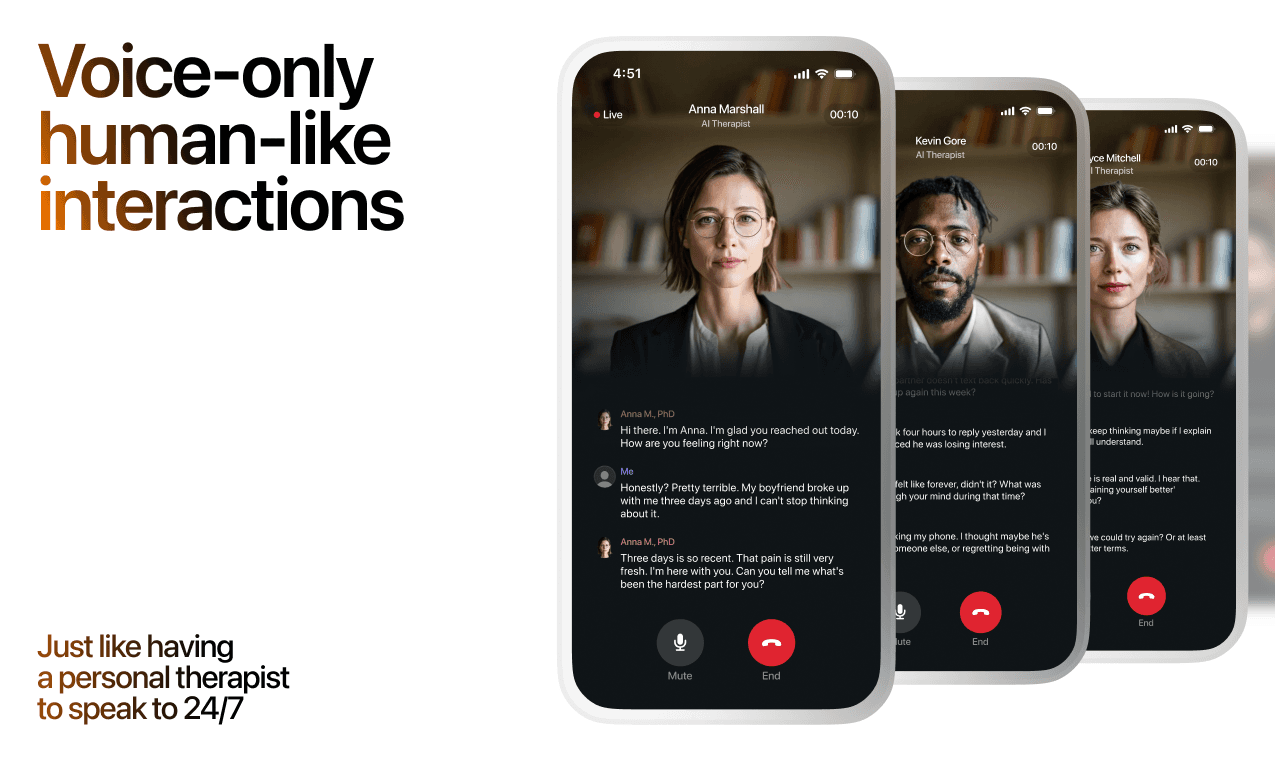
Here's what happens in a typical Lovon session:
You share what's on your mind
There's no script, no intake form, no waiting room. You speak or type whatever you're feeling — in your own words, at your own pace.
Lovon validates and explores
Using frameworks from CBT (Cognitive Behavioral Therapy) and motivational interviewing, Lovon acknowledges your feelings first, then gently helps you explore them. No dismissive "just move on" advice.
You build coping skills together
Lovon doesn't just listen — it actively works with you on evidence-based techniques: thought reframing, urge surfing, behavioral experiments, and more.
What a Session with Lovon Looks Like
When to Seek Professional Help
AI support is a valuable tool, but it's not a replacement for professional care. Please consider reaching out to a licensed therapist if you experience any of the following:
- Persistent thoughts of self-harm or suicide
- Inability to perform daily activities (work, eating, sleeping) for more than 2 weeks
- Turning to alcohol or substances to cope
- Intense anger or desire to harm your ex-partner
- Complete emotional numbness that doesn't improve over time
Crisis Resources (US): If you're in immediate danger, call 988 (Suicide & Crisis Lifeline) or text HOME to 741741 (Crisis Text Line). Available 24/7, free, and confidential.
Outside the US? Find a crisis line in your country
Ready to Start?
Your healing journey can begin right now
A 7-day trial. No judgment. Just a safe space to process what you're going through.
Frequently Asked Questions
Is Lovon a replacement for a real therapist?
Is my conversation with Lovon AI private?
How is Lovon different from ChatGPT for emotional support?
Can I use Lovon if I'm already seeing a therapist?
Can I try Lovon before subscribing?
About the Author
The Lovon Editorial Team
Mental Health & Wellness Content Team
The Lovon Editorial Team develops mental health and wellness content designed to make psychological concepts accessible and actionable. Our goal is to bridge the gap between clinical research and everyday life - helping you understand why your mind works the way it does and what you can do about it....
Related articles
- Should I Break Up With Him Quiz: Honest 2026 Check
An honest should i break up with him quiz that scores real patterns, not moods. Get a clear verdict in 2 minutes and…
- Is jealousy in a relationship ever healthy?
Is jealousy in a relationship ever healthy? Yes, when you respond with respect, not control. Learn the warning signs…
- Communication Compatibility Quiz: Top Picks 2026
Take the right communication compatibility quiz in 2026. Compare top tools, learn what to look for, and turn your…
- Is My Relationship Worth Saving Quiz: 2026 Verdict Guide
Is my relationship worth saving quiz that actually scores repair, effort, and safety. Take the right tests in order and…
See also
Quizzes
- Should I Forgive Him for Cheating? 12-Question Quiz
Twelve questions on whether rebuilding is possible.
- Jealousy Test: Free 12-Question Self-Check
See which part of jealousy runs hottest, in 3 min.
Free tools
- How to Stop Being Jealous in a Relationship
Two very different people search this, and advice that assumes either one is wrong half the time. This sorts what you…
- How to Forgive Someone Who Hurt You
Forgiving, reconciling, and deciding it was fine are three different things, and they get merged. Tell it what happened…
From the wiki
- What is cheating in a relationship?
Cheating is a breach of the agreement you and your partner made about who else gets your body, your attention and your…
Disclaimer: This article is for informational purposes only and does not constitute medical advice, diagnosis, or treatment. Always seek the advice of your physician or other qualified health provider with any questions you may have regarding a medical condition. If you are in crisis or think you may have an emergency, call 988 (Suicide & Crisis Lifeline) or go to the nearest emergency room. Outside the US? Find a crisis line in your country.