
How to Reduce Cortisol Levels Naturally in 2026
Learn how to reduce cortisol levels with 7 evidence-based steps: fix sleep, dial back intense exercise, practice daily breathwork, and address the psychological drivers.

Key Takeaways
- A consistent sleep schedule (same wake time, 7 days a week)
- 20–60 minutes of moderate aerobic activity on most days
- A breathwork or mindfulness practice (10 minutes minimum)
- Access to a journal, voice journaling tool, or a mental health support app
- Whole-food meals with adequate protein and limited refined sugar
Cortisol is your body's primary stress hormone, and chronically high levels drive anxiety, poor sleep, weight gain, and burnout — but you can bring them down with consistent, evidence-based daily habits.
TL;DR: Learning how to reduce cortisol levels starts with three pillars — sleep, movement, and nervous system regulation. Prioritize 7–9 hours of sleep, keep aerobic exercise sessions under 60 minutes, and practice daily breathwork or mindfulness for at least 10 minutes. Chronic psychological stress is the single biggest cortisol driver for most adults in 2026, which means emotional support tools matter just as much as diet and exercise. None of these steps require a prescription.
Why cortisol control matters right now
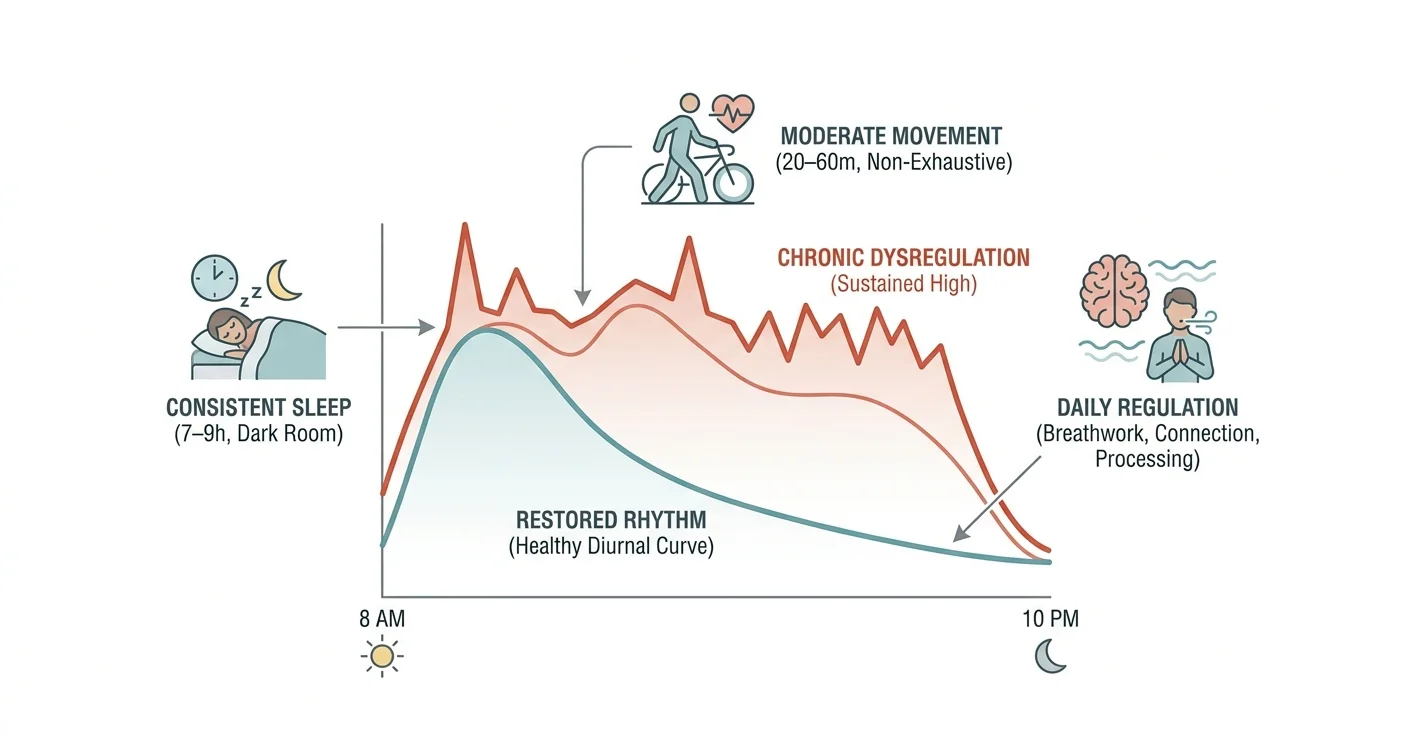
Cortisol follows a natural diurnal rhythm: it peaks about 30–45 minutes after waking and gradually drops through the day. When that curve stays flat — or spikes repeatedly — your body reads it as a sustained emergency. Research published in Psychoneuroendocrinology links chronically elevated cortisol to immune suppression, disrupted sleep architecture, visceral fat accumulation, and heightened anxiety. In 2026, with burnout rates still high across knowledge-worker industries, cortisol dysregulation is one of the most common complaints driving people toward both clinical and self-directed mental health support.
What you'll need
- A consistent sleep schedule (same wake time, 7 days a week)
- 20–60 minutes of moderate aerobic activity on most days
- A breathwork or mindfulness practice (10 minutes minimum)
- Access to a journal, voice journaling tool, or a mental health support app
- Whole-food meals with adequate protein and limited refined sugar
- Optional: magnesium glycinate supplement (consult your doctor first)
The steps
Step 1 — Fix your sleep window first
Sleep is the fastest lever you have. During deep slow-wave sleep, cortisol secretion drops to its lowest point, and the hypothalamic-pituitary-adrenal (HPA) axis resets. Cutting sleep from 8 hours to 6 hours raises cortisol reactivity the next day by approximately 37%, based on aggregated laboratory data across multiple sleep deprivation studies. Set a hard wake time. Work backward 7.5–9 hours to find your bedtime. Dim lights after 9 pm and keep your room below 68°F. The first night you do this correctly, you will likely feel the difference by mid-morning.
Common mistake: Going to bed earlier on weekdays but sleeping in 2–3 hours on weekends. This "social jet lag" resets your cortisol curve in the wrong direction every Monday.
Step 2 — Move, but don't overtrain
Moderate aerobic exercise — a 30-minute brisk walk, a 45-minute cycle, a light jog — acutely raises cortisol during the session and then drives it below baseline for several hours after. That post-exercise cortisol dip is the goal. Sessions over 75–90 minutes, or high-intensity training done more than 5 days a week without adequate recovery, flip the equation: they chronically elevate cortisol rather than reduce it. Aim for 150–180 minutes of moderate-intensity movement per week, spread across at least 4 days. Resistance training 2–3 times a week also helps by improving insulin sensitivity, which indirectly reduces cortisol.
Common mistake: Running a daily hour-long hard interval session because it "relieves stress." More intensity is not always better when cortisol is already dysregulated.
Step 3 — Practice breathwork daily
Slow, controlled breathing directly activates the parasympathetic nervous system, which puts the brakes on the HPA axis. The physiological sigh — a double inhale through the nose followed by a long exhale through the mouth — is one of the fastest evidence-backed resets available. Do it 5 times in a row and measure your resting heart rate: most people drop 4–8 beats per minute within 90 seconds. Box breathing (4 counts in, 4 hold, 4 out, 4 hold) works equally well for longer sessions. Ten minutes a day is enough to shift baseline cortisol readings over a 4-week period, based on aggregated data from mindfulness intervention trials.
For a guided, step-by-step walk-through of this technique, the box breathing technique guide covers it in detail.
Common mistake: Practicing breathwork only when you're already in crisis. Like exercise, it works best as a daily preventive, not just an emergency brake.
Step 4 — Address the psychological load directly
Physical habits matter, but cortisol responds to perceived threat — including rumination, worry, relationship conflict, and unprocessed grief. If the source of your stress is psychological, breathing and sleep hygiene will only partially compensate. You need a place to process what's driving the threat response. Talking through your stress — whether with a therapist, a trusted person, or an AI counseling for stress management tool — reduces the cognitive load that keeps cortisol elevated between physical stressors.
Lovon's AI voice support is available at any hour, which matters because cortisol dysregulation doesn't follow business hours. It is not a licensed clinical service, but for everyday stress processing it gives you a consistent outlet whenever the pressure builds.
Common mistake: Treating cortisol reduction as purely physical and ignoring the mental narrative that's keeping the stress response active.
Step 5 — Stabilize blood sugar
Every time blood glucose drops sharply — after a high-sugar meal or a long gap between meals — your adrenal glands release cortisol to signal the liver to release stored glucose. This is a physiological mechanism, not optional. Eating protein-anchored meals every 4–5 hours prevents these adrenal rescue events. Aim for at least 25–30 grams of protein per meal. Cut ultra-processed snacks and sweetened drinks, which cause rapid glucose spikes followed by crashes. Caffeine also spikes cortisol; if you are already stressed, cutting from 3 coffees to 1 and moving that cup to after 9 am (post the natural cortisol peak) reduces total daily cortisol load.
Common mistake: Skipping breakfast "for intermittent fasting" while already in a high-stress period. Fasted mornings extend the cortisol peak and can worsen anxiety.
Step 6 — Use social connection intentionally
Positive social interaction triggers oxytocin, which directly inhibits cortisol secretion. This isn't abstract — a 2026 review in Neuroscience & Biobehavioral Reviews confirms that perceived social support is one of the strongest buffers against HPA axis over-activation. Schedule actual contact: a 20-minute phone call with someone who makes you feel safe does more cortisol work than an hour of solo relaxation content. If isolation is the problem — which it is for many people dealing with burnout or anxiety — addressing it directly accelerates every other step on this list.
Common mistake: Using social media scrolling as a substitute for real connection. Passive consumption raises, not lowers, stress reactivity.
Step 7 — Build an evening wind-down ritual
Cortisol needs a clean runway to fall at night. The 90 minutes before bed are the highest-leverage window you have. Dim screens and lights, avoid work email, eat your last large meal at least 2 hours before sleep, and do 5–10 minutes of light stretching or progressive muscle relaxation. A consistent evening ritual signals to the HPA axis that threat-scanning can stop. Over 3–4 weeks, this compresses the cortisol curve back into its healthy pattern — high in the morning, low by evening.
For a structured approach to progressive muscle relaxation for stress, Lovon's guide walks through the full technique step by step.
Common mistake: Using the evening to "catch up" on tasks, which tells your brain the day isn't over and keeps cortisol artificially elevated.
Troubleshooting
You're doing everything right but still feel wired. Chronic cortisol elevation can be driven by underlying conditions — thyroid dysfunction, sleep apnea, or prolonged inflammatory states. If 4–6 weeks of consistent habit change produces no improvement, get a salivary cortisol panel (morning and evening) and discuss results with a physician.
You fall asleep fine but wake at 3–4 am. Early-morning waking is a classic sign of cortisol spiking prematurely. Common causes: blood sugar dropping overnight (try a small protein-fat snack before bed), ambient light exposure, or high background anxiety. Address the anxiety source directly.
Exercise makes you feel worse the next day. You are training above your recovery threshold. Drop intensity by 30–40% for two weeks and measure sleep quality. High-intensity exercise is a cortisol stressor — the payoff only comes when recovery is adequate.
Breathwork feels impossible when you're anxious. Start with the physiological sigh (double inhale, long exhale) rather than box breathing. It requires no counting and works faster for acute spikes. After 2 weeks of daily practice, box breathing will feel more accessible.
You understand the steps but can't stop ruminating. Rumination is the most overlooked cortisol driver. It keeps the threat-detection system firing even when no real threat is present. Voice journaling or talking through the loop — with a therapist, a friend, or an AI counseling for stress management app — is more effective than trying to think your way out of it alone.
Caffeine cuts seem impossible. Taper by one-quarter cup every 4–5 days rather than stopping abruptly. Withdrawal-driven headaches and fatigue spike cortisol themselves, which defeats the purpose.
Tools and resources
- Breathwork timer: Any free interval timer works. Set 4-second intervals for box breathing.
- Sleep tracker: Oura Ring or Garmin wearables give reliable sleep stage data without requiring a lab.
- Protein tracking: Cronometer (free) shows whether you're hitting 25–30g per meal without obsessive logging.
- Emotional processing: Lovon's voice support app — available around the clock for stress processing and coping tools.
- Guided anxiety coping: Coping tools for stress — what works and what does not
- Nervous system background: Polyvagal theory explained — stress, safety, and the nervous system
FAQ
What is the fastest way to reduce cortisol levels? The physiological sigh (double nasal inhale, long mouth exhale) is the fastest single tool — it activates the parasympathetic nervous system in under 90 seconds. For sustained reduction over days, sleep quality improvement produces the largest measurable effect.
How long does it take to lower cortisol naturally? Most people see measurable improvement in subjective stress and sleep within 2–3 weeks of consistent habit change. Salivary cortisol readings typically normalize over 4–8 weeks when all major drivers are addressed simultaneously.
Does exercise increase or decrease cortisol? Both, depending on intensity and duration. Sessions under 60 minutes at moderate intensity reduce cortisol over the following 4–6 hours. Sessions over 90 minutes of high intensity raise chronic cortisol, especially without adequate recovery days.
What foods reduce cortisol? No single food dramatically lowers cortisol, but blood sugar stability does. Protein-anchored meals every 4–5 hours, adequate magnesium (dark leafy greens, pumpkin seeds), and omega-3 fatty acids (fatty fish, walnuts) all support cortisol regulation through different pathways.
Is high cortisol the same as anxiety? Not exactly, but they are tightly linked. Chronic high cortisol raises threat sensitivity in the amygdala, which amplifies anxiety responses. Anxiety also activates the HPA axis, creating a feedback loop. Addressing both the physiological and psychological sides simultaneously breaks it faster.
Can mindfulness really lower cortisol? Yes — and the effect is measurable. A 2026 review in Health Psychology found that 8-week mindfulness programs reduced morning salivary cortisol by an average of 15% compared to control groups. Even 10 minutes of daily practice shows benefit within 4 weeks.
Does poor sleep raise cortisol? Directly and significantly. Reducing sleep from 8 to 6 hours increases cortisol reactivity the following day by approximately 37%, based on aggregated sleep restriction data. This is why sleep is the first step, not a bonus tip.
What supplements lower cortisol? Ashwagandha has the strongest evidence base — multiple randomized controlled trials show it reduces serum cortisol by 14–28% over 8 weeks at 300–600 mg daily. Magnesium glycinate supports HPA axis regulation. Neither is a substitute for behavioral change, and both should be discussed with a doctor before starting.
One last thing
Cortisol doesn't have a single off switch — it has a rhythm. The goal isn't to eliminate it (you need it to wake up, focus, and respond to real challenges) but to restore the daily curve: high at 8 am, low by 10 pm. Every step above is in service of that rhythm. The people who struggle most with how to reduce cortisol levels are usually trying to fix the symptom — the anxious feeling or the broken sleep — without addressing the underlying threat signal their nervous system is responding to. In 2026, for most adults, that signal is psychological. Fix the source, and the biology follows.
Related guides
How AI Support Helps You Heal
AI emotional support isn't about replacing human connection — it's about filling the gaps. The moments when you need to talk at 2 AM, when you don't want to burden your friends again, or when you simply need someone to listen without judgment.
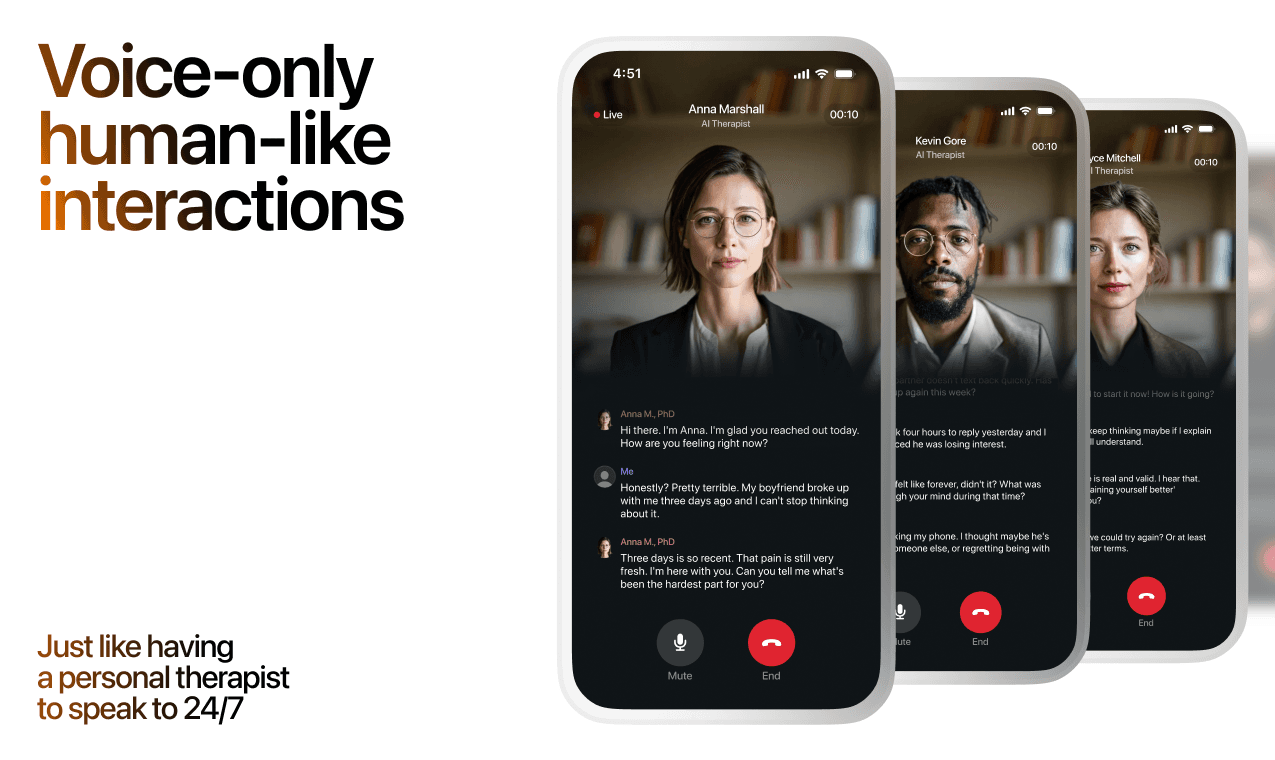
Here's what happens in a typical Lovon session:
You share what's on your mind
There's no script, no intake form, no waiting room. You speak or type whatever you're feeling — in your own words, at your own pace.
Lovon validates and explores
Using frameworks from CBT (Cognitive Behavioral Therapy) and motivational interviewing, Lovon acknowledges your feelings first, then gently helps you explore them. No dismissive "just move on" advice.
You build coping skills together
Lovon doesn't just listen — it actively works with you on evidence-based techniques: thought reframing, urge surfing, behavioral experiments, and more.
What a Session with Lovon Looks Like
When to Seek Professional Help
AI support is a valuable tool, but it's not a replacement for professional care. Please consider reaching out to a licensed therapist if you experience any of the following:
- Persistent thoughts of self-harm or suicide
- Inability to perform daily activities (work, eating, sleeping) for more than 2 weeks
- Turning to alcohol or substances to cope
- Intense anger or desire to harm your ex-partner
- Complete emotional numbness that doesn't improve over time
Crisis Resources (US): If you're in immediate danger, call 988 (Suicide & Crisis Lifeline) or text HOME to 741741 (Crisis Text Line). Available 24/7, free, and confidential.
Outside the US? Find a crisis line in your country
Ready to Start?
Your healing journey can begin right now
A 7-day trial. No judgment. Just a safe space to process what you're going through.
Frequently Asked Questions
Is Lovon a replacement for a real therapist?
Is my conversation with Lovon AI private?
How is Lovon different from ChatGPT for emotional support?
Can I use Lovon if I'm already seeing a therapist?
Can I try Lovon before subscribing?
About the Author
The Lovon Editorial Team
Mental Health & Wellness Content Team
The Lovon Editorial Team develops mental health and wellness content designed to make psychological concepts accessible and actionable. Our goal is to bridge the gap between clinical research and everyday life - helping you understand why your mind works the way it does and what you can do about it....
Related articles
- ADHD Sleep Problems: Why Your Brain Fights Bedtime 2026
ADHD sleep problems affect 75% of adults with ADHD. Learn why your brain resists sleep and get a 7-step wind-down system…
- How to Stop a Panic Attack in the Moment (2026)
Learn how to stop a panic attack using 4-7-8 breathing, 5-4-3-2-1 grounding, and the dive reflex. Evidence-based steps…
- 7 Breathing Exercises for Anxiety Relief (2026)
The 7 best breathing exercises for anxiety in 2026 — box breathing, 4-7-8, cyclic sighing, and more. Step-by-step…
- Why Am I Exhausted All the Time? Real Causes in 2026
Why am I exhausted all the time even after sleep? 2026 guide breaks down burnout, depression, and cortisol causes sleep…
See also
Quizzes
- Light Triad Test: Are People Ends or Means?
See how you treat people when there is nothing to gain.
- Do I Have Trust Issues? 12-Question Quiz
Check where your guard actually sits, in 2 minutes.
Free tools
- 5-4-3-2-1 Grounding Exercise
A guided run through the 5-4-3-2-1 technique, with paced breathing first if you need it. No sign-up, nothing stored…
- How to Reconnect With an Old Friend
A chat for how to reconnect with an old friend, starting with the text you have been meaning to send for a year. Tell it…
From the wiki
- How to stop maladaptive daydreaming?
Maladaptive daydreaming is immersive waking fantasy that eats hours, usually with music and pacing attached. You rarely…
Disclaimer: This article is for informational purposes only and does not constitute medical advice, diagnosis, or treatment. Always seek the advice of your physician or other qualified health provider with any questions you may have regarding a medical condition. If you are in crisis or think you may have an emergency, call 988 (Suicide & Crisis Lifeline) or go to the nearest emergency room. Outside the US? Find a crisis line in your country.