
Limerence vs Love in 2026: How to Tell the Difference
Limerence vs love explained: 6 steps to spot obsessive infatuation vs real love in 2026, plus fixes for the anxious checking loop that keeps you stuck.

Key Takeaways
- A notebook or notes app to track your thought patterns for at least 7 days
- 10-15 minutes a day for a grounding practice (breathing, walking, journaling)
- Honesty about how much of your day goes to thinking about this person
- A way to check the pattern against a second source — a quiz, a friend, or a session with an AI voice therapist like
- Willingness to sit with discomfort instead of texting to resolve it immediately
Limerence feels like love, but it runs on a different fuel: uncertainty, obsession, and a nervous system that can't relax until it gets a signal back. This guide breaks down what separates limerence from real love, how to tell which one you're in, and what to actually do about it in 2026.
TL;DR
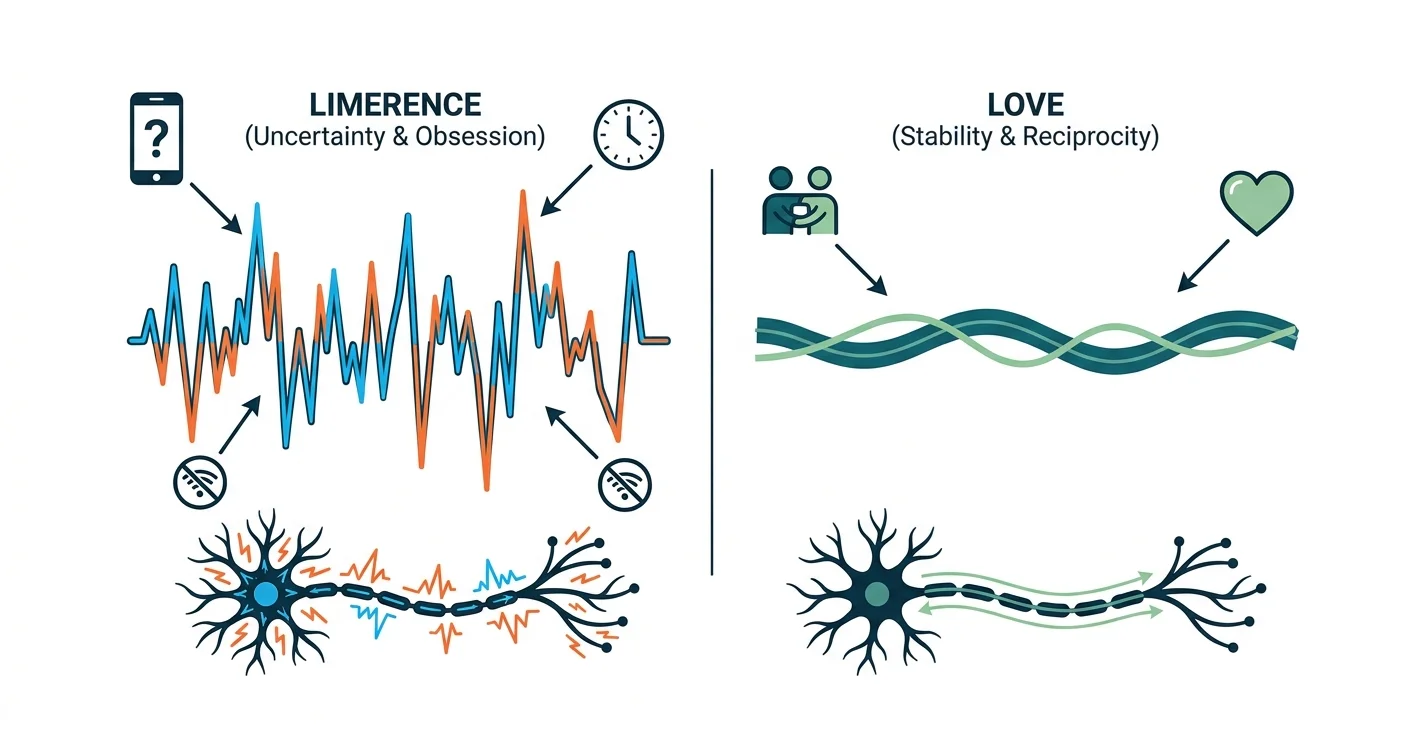
Limerence is an involuntary, obsessive infatuation built around uncertainty and intermittent reinforcement — you replay texts, invent meaning in silence, and feel a spike of anxiety when there's no reply. Love, by contrast, is calmer, reciprocal, and stable even when the other person isn't paying attention to you. Verdict: if your peace depends entirely on someone else's response, you're likely in limerence, not love. Working through it takes structured coping tools (breathing, journaling, reframing obsessive thoughts) and sometimes outside support — an attachment style quiz can help you spot the pattern behind it. Confusing limerence with love is common, not shameful.
Why this matters
Limerence was named by psychologist Dorothy Tennov in 1979, and the pattern she described hasn't changed in 2026: intrusive thinking about one person, fear of rejection, and a mood that rises and falls entirely based on whether they respond. The problem isn't that limerence feels intense — it's that people mistake the intensity for depth. Real love has intensity too, but it doesn't collapse the moment someone takes six hours to text back.
Misreading limerence as love keeps people stuck in one-sided dynamics, chasing emotionally unavailable partners, or staying in situations that read as "passionate" but function more like anxious attachment on a loop. Knowing the difference changes what you do next — whether that's setting a boundary, walking away, or actually building something stable.
What you'll need
- A notebook or notes app to track your thought patterns for at least 7 days
- 10-15 minutes a day for a grounding practice (breathing, walking, journaling)
- Honesty about how much of your day goes to thinking about this person
- A way to check the pattern against a second source — a quiz, a friend, or a session with an AI voice companion like Lovon
- Willingness to sit with discomfort instead of texting to resolve it immediately
The steps
1. Name what you're feeling without judgment
Start by writing down, honestly, how much of your mental space this person occupies. Limerence typically eats up 50% or more of a person's waking thoughts, according to Tennov's original research and repeated observations since. Real love leaves room for the rest of your life — work, friends, hobbies — without constant intrusion.
Common mistake: people skip this step because naming it as "limerence" feels like it cheapens the feeling. It doesn't. Naming it accurately is what lets you respond to it accurately.
2. Track the highs and lows for one week
Every time your mood shifts because of this person — a text, a like, a look — write down the trigger and the swing. Limerence produces sharp spikes and drops tied directly to their behavior. Love produces a steadier baseline that doesn't crash just because someone didn't respond by 9pm.
By day 7 you'll usually have 10-20 logged entries. If most of them trace back to "did they text me" or "did they notice me," that's a strong signal you're dealing with an obsessive cycle, not mutual affection.
3. Check for reciprocity, not just chemistry
Ask plainly: does this person show up for you the way you show up for them? Limerence can exist with zero reciprocity — you can be limerent for someone who barely knows your last name. Love requires two people building something together over time, not one person constructing an entire relationship in their head.
If you're unsure how to read the signals, a structured check like the am I in love quiz can separate genuine connection from projection.
4. Interrupt the obsessive loop deliberately
When you catch yourself replaying a conversation for the fifth time, stop and do something physical: a short walk, five minutes of box breathing, or texting a friend instead of them. This breaks the reward loop that limerence runs on — the brain gets a hit of relief every time you check for a reply, and that's exactly the cycle you need to interrupt.
The how to stop obsessing over someone guide has eight specific techniques for this exact moment, including thought-stopping and scheduled "worry windows."
5. Compare against codependency patterns
Limerence and codependency overlap more than people expect — both involve a self-worth that's outsourced to another person's mood or attention. If your sense of okay-ness rises and falls with their behavior toward you, it's worth reading the breakdown at codependency vs love to see which pattern actually fits.
Expected outcome by this point: you should have a clearer sense of whether this is a crush that's spiraled, an unhealthy attachment pattern, or something with real mutual footing.
6. Decide what to do with the answer
If it's limerence with no reciprocity: reduce contact, redirect your attention, and give it 4-6 weeks — most acute limerent episodes fade in intensity within that window when starved of the intermittent reinforcement that fuels them. If it's a real, mutual relationship with some limerent intensity mixed in, that's normal early-stage chemistry and doesn't need "fixing," just time.
If you're actively trying to move on from someone the feelings won't let go of, how to get over someone you love lays out an evidence-based path rather than just "give it time."
Common mistake: trying to logic your way out of limerence by listing the person's flaws. It rarely works because limerence isn't driven by accurate perception — it's driven by uncertainty and reward-seeking. Behavior change (reducing contact, redirecting attention) works faster than argument.
Troubleshooting
- "I know it's limerence but I can't stop checking my phone." Turn off read receipts and notifications for that specific contact for 72 hours. The compulsive checking is the mechanism, not a side effect.
- "They seem interested sometimes, which keeps me hooked." That's intermittent reinforcement — the same mechanism that makes slot machines addictive. Occasional attention doesn't equal mutual investment; track the ratio of their effort to yours over two weeks, not two days.
- "I feel guilty for having these obsessive feelings." Guilt about the intensity of a feeling isn't useful — if it's recurring, look at whether it connects to a broader pattern of chronic guilt rather than this one situation.
- "This keeps happening with different people." A repeating pattern across relationships often points to attachment style, not bad luck. The anxious attachment in dating guide covers why some people default to limerent intensity with almost anyone new.
- "I can't tell if my current relationship is healthy or if I'm just limerent about them too." Run the check from step 3 again after 90 days together — real relationships still pass the reciprocity test months in; limerence usually doesn't survive consistent, low-drama attention because the uncertainty disappears.
Tools and resources
- A daily 10-minute journaling habit tracking triggers and mood swings
- The attachment style quiz to identify the pattern underneath the obsession
- A grounding technique you can do anywhere — box breathing, a short walk, cold water on your wrists
- Voice conversations with an AI voice companion like Lovon when you need to talk through the spiral in real time, not just journal about it after the fact
- A trusted friend who will tell you the truth about what they're observing, not just validate the excitement
FAQ
What's the main difference between limerence and love? Limerence is obsessive, uncertainty-driven, and often one-sided; love is calmer, reciprocal, and stable regardless of whether the other person responds immediately. Limerence spikes with attention and crashes with silence — love doesn't swing that hard.
Can limerence turn into real love? Yes, but only if it becomes mutual and the relationship survives past the uncertainty phase — once both people are consistently available, the anxious intensity of limerence naturally settles into something steadier. If reciprocity never shows up, limerence tends to fade rather than convert.
How long does limerence usually last? Most acute phases run from a few weeks up to about two years, though the intensity typically peaks and fades faster once contact is reduced. Ongoing contact with intermittent reinforcement can stretch it out much longer.
Is limerence a mental health condition? No, limerence itself isn't a diagnosis, but the obsessive thought loops it produces overlap with anxiety patterns and sometimes with underlying attachment issues. If it's disrupting sleep, work, or daily functioning, that's worth addressing directly rather than waiting it out.
How do I know if my partner is limerent about me rather than in love with me? Watch whether their attention depends on your responsiveness — if they pull back the moment you're less available and intensify when you pull away, that's limerent behavior, not stable affection. Genuine love holds steady through normal ups and downs.
Does limerence always involve someone unavailable? Not always, but unavailability — emotional or physical — feeds limerence because it maintains the uncertainty the pattern depends on. Fully available, mutual partners are less likely to trigger the obsessive spiral in the first place.
What's the fastest way to reduce limerent obsession? Reducing contact and interrupting the compulsive-checking loop works faster than trying to reason your way out of the feeling. Pair that with a grounding practice you do daily, not just when the anxiety spikes.
Should I talk to someone about it? If the obsessive thinking is affecting sleep, work, or your other relationships, talking it through — with a friend, a licensed therapist, or an AI voice therapist for daily support — helps more than sitting with it alone. Lovon isn't a replacement for licensed clinical care, but it's built for exactly this kind of on-demand processing between bigger conversations.
One last thing
The detail people miss: limerence doesn't require the other person to do much of anything. Tennov's original interviews found people fully limerent over someone they'd barely spoken to — the brain fills in the gaps with imagined meaning far more than with actual information. If you notice you know surprisingly little concrete detail about this person compared to how much you think about them, that gap itself is a signal.
Related guides
How AI Support Helps You Heal
AI emotional support isn't about replacing human connection — it's about filling the gaps. The moments when you need to talk at 2 AM, when you don't want to burden your friends again, or when you simply need someone to listen without judgment.
Here's what happens in a typical Lovon session:
You share what's on your mind
There's no script, no intake form, no waiting room. You speak or type whatever you're feeling — in your own words, at your own pace.
Lovon validates and explores
Using frameworks from CBT (Cognitive Behavioral Therapy) and motivational interviewing, Lovon acknowledges your feelings first, then gently helps you explore them. No dismissive "just move on" advice.
You build coping skills together
Lovon doesn't just listen — it actively works with you on evidence-based techniques: thought reframing, urge surfing, behavioral experiments, and more.
What a Session with Lovon Looks Like
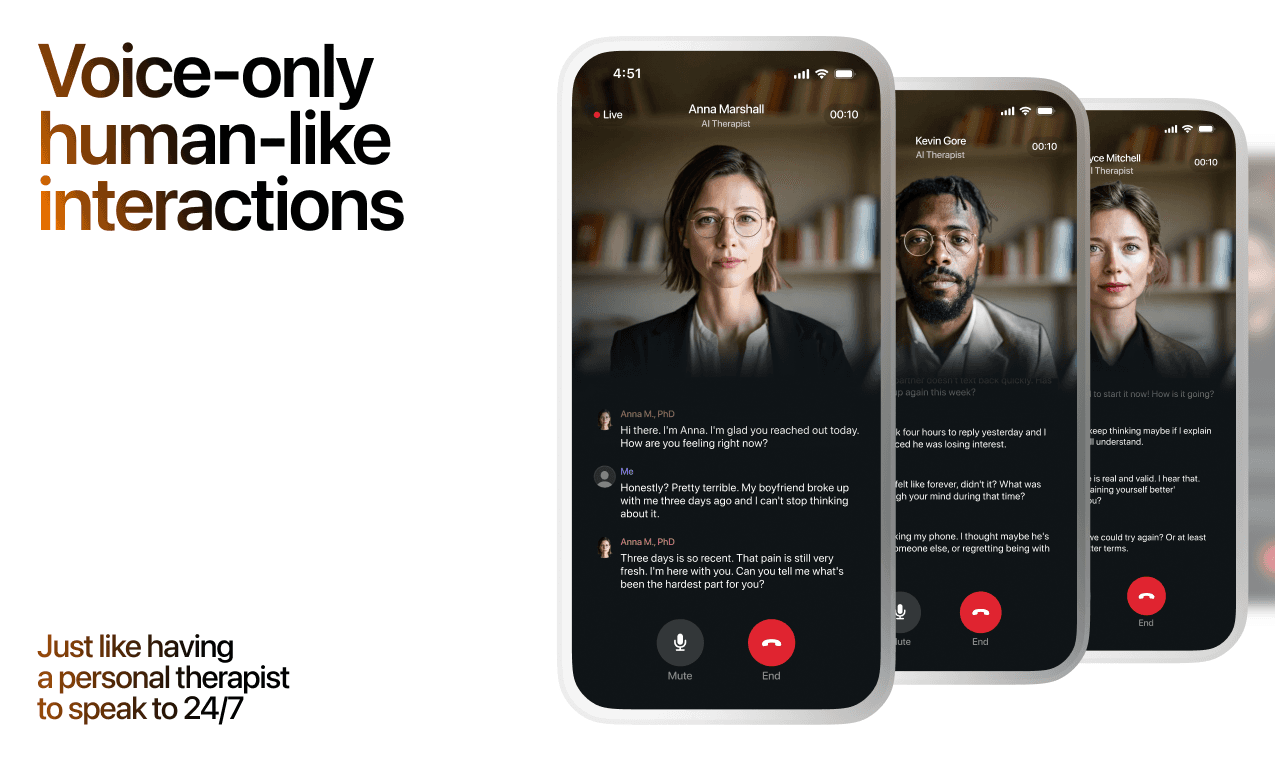
Lovon is AI support, not a replacement for professional care. If things have been hard to get through for weeks, or you are thinking about harming yourself, talk to a doctor or a licensed therapist.
Ready to Start?
Your healing journey can begin right now
A 7-day trial. No judgment. Just a safe space to process what you're going through.
Frequently Asked Questions
Is Lovon a replacement for a real therapist?
Is my conversation with Lovon AI private?
How is Lovon different from ChatGPT for emotional support?
Can I use Lovon if I'm already seeing a therapist?
Can I try Lovon before subscribing?
About the Author
The Lovon Editorial Team
Mental Health & Wellness Content Team
The Lovon Editorial Team develops mental health and wellness content designed to make psychological concepts accessible and actionable. Our goal is to bridge the gap between clinical research and everyday life - helping you understand why your mind works the way it does and what you can do about it....
Related articles
- Signs of Insecure Attachment in Adults (2026 Guide)
Signs of insecure attachment in adults, explained step by step: fear of abandonment, withdrawal, reassurance-seeking…
- Best AI Relationship Coach for Anxious Attachment 2026
Find the best AI relationship coach for anxious attachment in 2026. Lovon offers voice-based, on-demand emotional…
- Anxious Preoccupied Attachment: Signs & How to Shift 2026
Anxious preoccupied attachment drives protest behavior like over-texting and reassurance-seeking. Get the signs and a…
- Relationship Anxiety: Signs, Causes, Fixes (2026)
Relationship anxiety explained: signs, causes like anxious attachment, and coping tools that work in 2026. Practical…
See also
Quizzes
- Rejection Sensitivity Test: Free 12-Question Check
See how strongly you expect and read rejection.
- Abandonment Issues Quiz: Do I Have Abandonment Issues?
See how loudly the fear of being left runs things.
Free tools
- How to Tell Someone You Love Them
How to tell someone you love them is rarely about the words, which are short. It is about the moment and the answer…
- Love Messages for Her or Him That Say Something Specific
Love messages for her or him, written from your story instead of a list of two hundred lines. Tell it what you love…
From the wiki
- What is an attachment style?
An attachment style is the habit your nervous system formed for handling closeness: what you actually do when someone…
Disclaimer: This article is for informational purposes only and does not constitute medical advice, diagnosis, or treatment. Always seek the advice of your physician or other qualified health provider with any questions you may have regarding a medical condition. If you are in crisis or think you may have an emergency, call 988 (Suicide & Crisis Lifeline) or go to the nearest emergency room. Outside the US? Find a crisis line in your country.