
PTSD Triggers 2026: How to Identify and Manage Them Daily
PTSD triggers explained: spot patterns in 14 days, use a 90-second grounding response, and build a daily routine that works in 2026. Practical steps inside.

Key Takeaways
- A notebook, notes app, or voice memo tool for trigger tracking
- 10-15 minutes a day for the first two weeks
- One grounding technique you've practiced before you need it (not during a crisis)
- A short list of safe people or resources you can reach on short notice
- Optional: an AI voice therapy app like Lovon for judgment-free processing between sessions
PTSD triggers show up as sudden spikes in fear, anger, or shutdown that feel disproportionate to what's actually happening around you. This guide breaks down how to spot your specific triggers, what to do in the moment they hit, and how to build a daily routine that shrinks their power over time.
TL;DR
PTSD triggers are sensory or situational cues — a smell, a tone of voice, a date on the calendar — that pull your nervous system back into a past trauma response. The fix isn't avoiding every trigger for the rest of your life; it's building a repeatable identify-and-manage routine: track patterns for two weeks, use a grounding technique within the first 90 seconds of activation, and pair that with ongoing support such as an AI therapist between sessions with a licensed clinician. Verdict: daily tracking plus a rehearsed grounding response cuts reaction time and intensity for most people within 3-4 weeks, based on trauma-focused clinical literature on exposure and nervous-system regulation.
Why this matters
An estimated 6% of U.S. adults will meet criteria for PTSD at some point in their lives, according to the National Center for PTSD. That's not a small, rare condition — it's roughly 12 million adults dealing with it in any given year. Left unmanaged, triggers don't just cause bad moments. They shape which streets you drive down, which songs you skip, which relationships you avoid.
The nervous system doesn't distinguish well between "then" and "now" once a trigger fires — that's the whole mechanism. AI support for PTSD can give you a place to talk through a trigger the moment it happens, at 2 a.m. or during a lunch break, which matters because trigger responses rarely wait for your next scheduled appointment.
What you'll need
- A notebook, notes app, or voice memo tool for trigger tracking
- 10-15 minutes a day for the first two weeks
- One grounding technique you've practiced before you need it (not during a crisis)
- A short list of safe people or resources you can reach on short notice
- Optional: an AI voice support app like Lovon for judgment-free processing between sessions
- A licensed therapist or psychiatrist if you don't already have one — this guide supports that care, it doesn't replace it
The steps
1. Log every trigger for 14 days
Write down what happened right before the reaction, what you felt in your body, and how intense it was on a 1-10 scale. Patterns hide in details you'll forget by dinner. Most people find their triggers cluster around 3-5 recurring categories — certain sounds, anniversaries, physical closeness, specific words, or particular locations.
Common mistake: logging only the big, obvious triggers and skipping the low-level 2-out-of-10 moments. Those small ones are often the early warning signs of a bigger spike coming.
2. Sort triggers into categories
Group your two-week log into buckets: sensory (smells, sounds, textures), situational (crowds, arguments, medical settings), and calendar-based (anniversaries, holidays). This turns a vague sense of "I'm on edge lately" into something specific you can actually plan around.
Calendar-based triggers are worth flagging in advance on your phone. Knowing a hard date is coming three weeks out gives you time to line up support instead of getting blindsided.
3. Build a 90-second grounding response
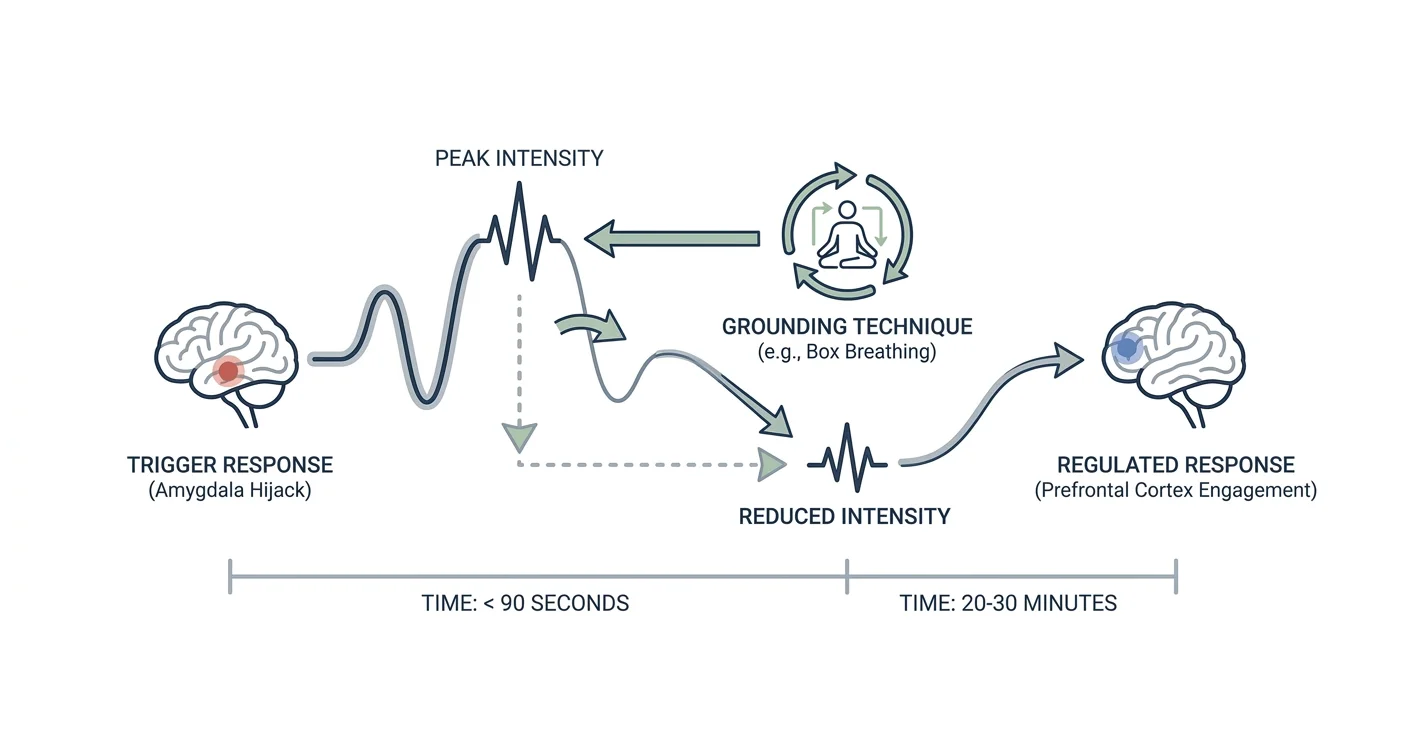
When a trigger fires, the amygdala can hijack your reasoning brain within seconds — that reaction window is short, which is why you need a technique rehearsed in advance, not improvised. Box breathing (4 counts in, 4 hold, 4 out, 4 hold) run for 90 seconds is one of the fastest ways to signal safety back to your nervous system. Practice the box breathing technique daily when you're calm so it's automatic when you're not.
Common mistake: trying to think your way out of a trigger response first. Regulate the body, then reason with the mind — doing it in the reverse order rarely works in the moment.
4. Name it out loud or in writing
Saying "this is a trigger response, not the actual danger" activates the prefrontal cortex and interrupts the loop. It sounds simple because it is — the research on labeling emotional states shows this single step measurably lowers amygdala activity within moments.
Do this even if it feels silly. Whisper it, text it to yourself, or say it into a voice memo. The goal is externalizing the thought, not perfecting the phrasing.
5. Reduce your baseline stress load
Triggers land harder when your nervous system is already running hot from poor sleep, skipped meals, or unmanaged daily stress. Sleep debt alone lowers your threshold for what counts as a trigger — something that was a 3-out-of-10 on a rested day can hit as a 7 when you're exhausted.
Build in one non-negotiable regulation habit daily: a walk, a stretch routine, or a 10-minute check-in with an AI voice conversation to process the day before it piles up.
6. Debrief after every trigger event
Within a few hours of a trigger response, write down what happened, what helped, and what you'd do differently. This turns each incident into data instead of just another bad day to survive.
Over 3-4 weeks, this debrief habit shows you which grounding techniques actually work for you specifically — not which ones work in a general article.
7. Loop in your support system on a schedule
Don't wait for a crisis to tell your therapist, partner, or close friend what your trigger patterns look like. Share your two-week log with a licensed clinician at your next session; it gives them real data instead of a vague "I've been struggling."
Common mistake: only mentioning triggers when they're actively firing, which means your therapist only ever hears about the worst moments, not the pattern underneath them.
Troubleshooting
- Grounding techniques stop working after a while. Rotate 2-3 different techniques (box breathing, 5-4-3-2-1 senses, cold water on wrists) so your brain doesn't habituate to a single script.
- You can't identify a clear trigger, just a bad mood. Check your sleep and caffeine intake from the last 24 hours first — a diffuse mood dip without an obvious trigger is often a baseline-stress problem, not a trauma response.
- The trigger response lasts hours, not minutes. That's a signal to bring it to a licensed therapist directly rather than managing it solo — persistent multi-hour activation is outside what daily coping tools are built to handle.
- You're avoiding so much that your life is shrinking. Avoidance feels protective short-term and costs you long-term. Bring this specifically to a trauma-focused clinician; targeted exposure work (done with professional guidance, never alone) is the evidence-based fix.
- Triggers spike around a specific relationship. Map whether the pattern connects to an unhealthy dynamic, not just trauma history — trauma bonding can reactivate old triggers inside a current relationship.
- Nighttime is worse than daytime. Fewer distractions at night mean rumination has more room to run. A wind-down routine an hour before bed, done consistently through 2026, tends to blunt this more than any single nighttime fix.
Tools and resources
- Two-week trigger log (paper, notes app, or voice memo — whatever you'll actually use)
- Box breathing technique for the 90-second window after activation
- Grounding techniques as a rotating backup when box breathing isn't enough
- A licensed trauma-informed therapist for ongoing clinical care
- Lovon for on-demand voice conversations between appointments, for processing a trigger the moment it happens rather than waiting days for a session
What to do next
Once daily tracking feels routine, the next layer is understanding the biology underneath the trigger response — why your body reacts before your mind catches up. AI therapy for PTSD and trauma recovery walks through what that kind of ongoing support actually looks like day to day.
FAQ
What are the most common PTSD triggers? Sounds (sirens, raised voices), smells, specific dates or anniversaries, physical touch, crowded spaces, and certain phrases or tones of voice top most clinical lists. The exact combination is individual — that's why a personal two-week log matters more than a generic list.
How long does a PTSD trigger response usually last? Most acute trigger responses peak within the first few minutes and ease within 20-30 minutes with grounding support. Responses lasting several hours or longer are a signal to bring the pattern to a licensed clinician directly.
Can PTSD triggers change over time? Yes. New triggers can develop after additional stress or a new traumatic event, and old triggers can lose intensity with consistent, guided processing. Tracking over months, not just weeks, shows this shift clearly.
Is it possible to eliminate PTSD triggers completely? Complete elimination isn't the realistic goal for most people; reduced frequency and intensity is. Evidence-based trauma therapies aim to change your relationship to the trigger, not erase the memory itself.
What's the fastest way to calm down during a PTSD trigger? A rehearsed grounding technique — box breathing or 5-4-3-2-1 senses — run within the first 90 seconds works faster than trying to reason yourself calm. Practice it when you're not triggered so it's automatic when you are.
Should I avoid all my known PTSD triggers? Selective avoidance of genuinely dangerous or unnecessary situations is reasonable; blanket avoidance of anything trigger-adjacent tends to shrink your life without reducing the underlying sensitivity. That distinction is worth discussing with a trauma-informed clinician.
Can an AI therapist help manage PTSD triggers? An AI voice companion like Lovon can give you a space to talk through a trigger right after it happens, practice grounding techniques, and track patterns between clinical sessions — it's not a replacement for a licensed clinician treating PTSD, but it fills the gap when professional support isn't available at 3 a.m.
Do PTSD triggers ever come from things unrelated to the original trauma? Yes — the nervous system generalizes. A trigger can be tied to a sensory detail (a specific song, a certain lighting) that was simply present during the traumatic event, not connected to the event's actual content.
One last thing
The two-week trigger log is the single highest-leverage step in this whole guide, and it's the one most people skip because it feels too simple to matter. It isn't. Patterns that feel random in the moment almost always turn out to be specific and predictable once you've written them down for 14 straight days — and predictable is something you can actually plan for.
Related guides
How AI Support Helps You Heal
AI emotional support isn't about replacing human connection — it's about filling the gaps. The moments when you need to talk at 2 AM, when you don't want to burden your friends again, or when you simply need someone to listen without judgment.
Here's what happens in a typical Lovon session:
You share what's on your mind
There's no script, no intake form, no waiting room. You speak or type whatever you're feeling — in your own words, at your own pace.
Lovon validates and explores
Using frameworks from CBT (Cognitive Behavioral Therapy) and motivational interviewing, Lovon acknowledges your feelings first, then gently helps you explore them. No dismissive "just move on" advice.
You build coping skills together
Lovon doesn't just listen — it actively works with you on evidence-based techniques: thought reframing, urge surfing, behavioral experiments, and more.
What a Session with Lovon Looks Like

When to Seek Professional Help
AI support is a valuable tool, but it's not a replacement for professional care. Please consider reaching out to a licensed therapist if you experience any of the following:
- Persistent thoughts of self-harm or suicide
- Inability to perform daily activities (work, eating, sleeping) for more than 2 weeks
- Turning to alcohol or substances to cope
- Intense anger or desire to harm your ex-partner
- Complete emotional numbness that doesn't improve over time
Crisis Resources (US): If you're in immediate danger, call 988 (Suicide & Crisis Lifeline) or text HOME to 741741 (Crisis Text Line). Available 24/7, free, and confidential.
Outside the US? Find a crisis line in your country
Ready to Start?
Your healing journey can begin right now
A 7-day trial. No judgment. Just a safe space to process what you're going through.
Frequently Asked Questions
Is Lovon a replacement for a real therapist?
Is my conversation with Lovon AI private?
How is Lovon different from ChatGPT for emotional support?
Can I use Lovon if I'm already seeing a therapist?
Can I try Lovon before subscribing?
About the Author

The Lovon Editorial Team
Mental Health & Wellness Content Team
The Lovon Editorial Team develops mental health and wellness content designed to make psychological concepts accessible and actionable. Our goal is to bridge the gap between clinical research and everyday life - helping you understand why your mind works the way it does and what you can do about it....
Related articles
- Nervous System Reset: Daily Practices That Work (2026)
A nervous system reset in 90 seconds: box breathing, cold exposure, and orientation cues that calm fight-or-flight…
- Emotional Sobriety: What It Is & How to Build It (2026)
Emotional sobriety explained: a 7-step method to feel hard emotions without reacting, plus tools and troubleshooting to…
- Emotional Dysregulation in Adults: Signs, Fixes 2026
Emotional dysregulation in adults explained: signs, causes, and a 7-step coping plan for 2026. Body-first tools that…
- Nervous System Dysregulation: Signs & Reset Guide 2026
Nervous system dysregulation signs and a 7-step reset for 2026, plus troubleshooting for panic, freeze, and sleep…
See also
Quizzes
- Alexithymia Test: Can You Name What You Feel?
See where your feelings lose their names, in 3 minutes.
- Self-Acceptance Test: What Are You Still Arguing With?
See where you are still fighting yourself, in 3 minutes.
Free tools
- 5-4-3-2-1 Grounding Exercise
A guided run through the 5-4-3-2-1 technique, with paced breathing first if you need it. No sign-up, nothing stored…
- Write a Letter to Your Best Friend
A chat for a letter to your best friend that only they could have received. Tell it how long you have been friends, one…
From the wiki
- What is inhibited grief?
Inhibited grief is grief that never gets out. The loss happened, you kept functioning, and the feeling stayed sealed…
Disclaimer: This article is for informational purposes only and does not constitute medical advice, diagnosis, or treatment. Always seek the advice of your physician or other qualified health provider with any questions you may have regarding a medical condition. If you are in crisis or think you may have an emergency, call 988 (Suicide & Crisis Lifeline) or go to the nearest emergency room. Outside the US? Find a crisis line in your country.