
Best Free AI Therapist Apps in 2026 — Ranked
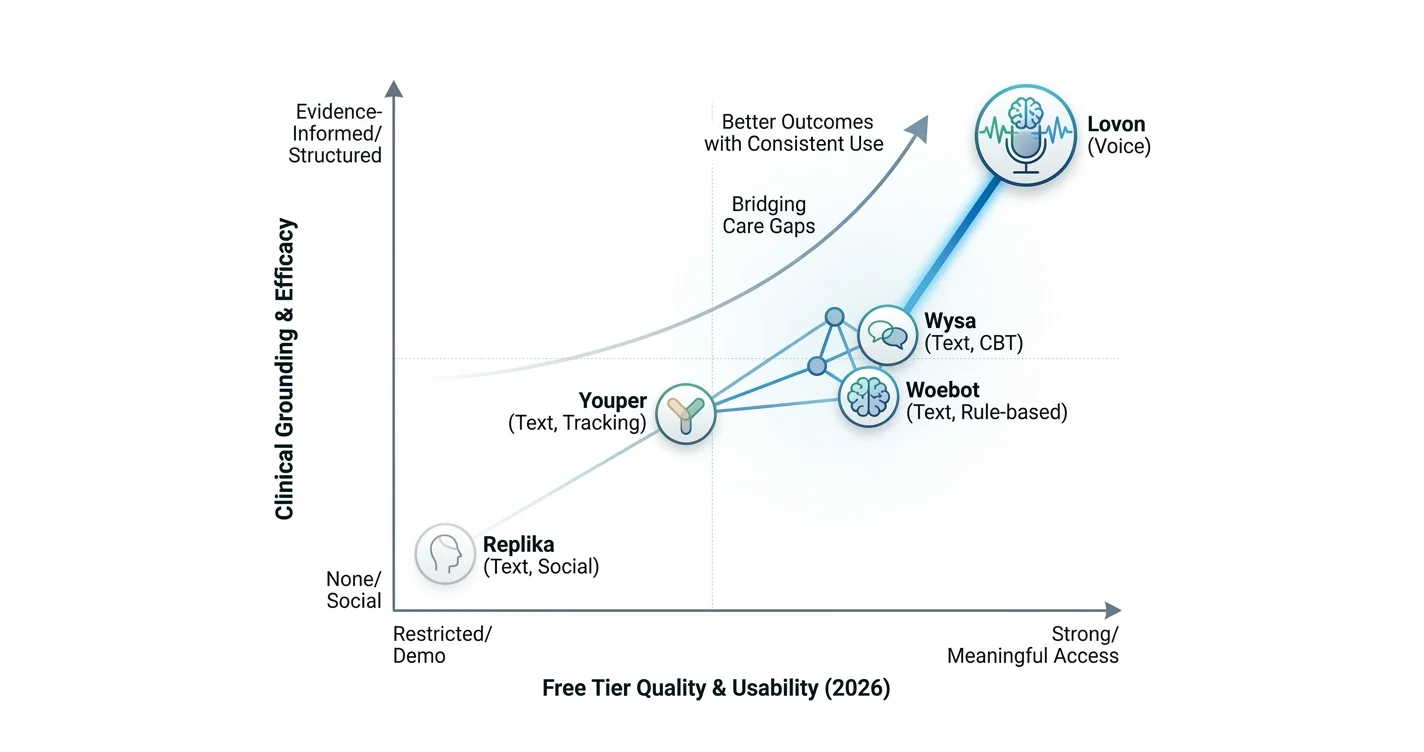
The best free AI therapist app in 2026, ranked by free-tier quality, condition coverage, and clinical grounding. Lovon leads; Wysa and Woebot follow.

Key Takeaways
- Structured CBT text exercises: Wysa (wysa.io)
- Daily 5-minute check-in habit: Woebot (woebothealth.com)
- Symptom tracking for clinician handoff: Youper (youper.ai)
Finding a free AI therapist app that actually helps — not just one that echoes your feelings back at you — is harder than it sounds. This guide ranks the best free AI therapist apps in 2026 by what they do for anxiety, depression, stress, and relationship issues, with a hard look at what each one costs beyond the free tier.
TL;DR: The best free AI therapist app in 2026 depends on your use case. Lovon is the top pick for voice-based emotional support covering anxiety, depression, stress, and ADHD — it delivers on-demand personalized sessions, not just chatbot journaling. Wysa and Woebot are solid for CBT-structured text check-ins. Replika fills a social connection gap but is not therapy. None of these replace a licensed clinician for crisis care.
Why this matters in 2026
Therapist wait times in the US average 25 days as of 2026 aggregated data, and 43% of adults who need mental health support cite cost as the primary barrier (Kaiser Family Foundation, 2024). AI therapy apps address the access gap — not the clinical one. The question is which apps give you real coping tools versus ones that just make you feel heard for 10 minutes and then upsell a subscription.
How we ranked
Each app was evaluated on six criteria: availability of a genuinely usable free tier, modality (voice vs. text), clinical grounding (CBT, DBT, ACT, or none), condition coverage (anxiety, depression, stress, relationships, ADHD), data privacy disclosures, and whether the free tier has a hard paywall at the moment you actually need support. Apps that restrict crisis resources behind a paywall were downgraded automatically. The ranked list runs from strongest to weakest free-tier value.
The ranked list
1. Lovon — Best overall for voice-based AI therapy
Lovon is the only app in this list built around voice sessions rather than text chat, which changes the experience entirely. Speaking out loud about anxiety or a relationship conflict activates different processing than typing — and Lovon's sessions are structured around that. The free tier covers on-demand emotional support for anxiety, depression, stress, relationship issues, and ADHD without locking the first meaningful interaction behind a paywall.
Personalized sessions adapt to what you surface in conversation, so session 5 is not a repeat of session 1. The app uses evidence-informed coping frameworks, not open-ended chat. For anyone who has tried text-based apps and found them shallow, Lovon's voice modality is the clearest differentiator in 2026.
Condition coverage: Anxiety, depression, stress, relationships, ADHD Modality: Voice Free tier: Yes, meaningful access without forced upgrade
Verdict: Buy — Start here, especially if cost or wait times are blocking you from traditional therapy. Try the free therapist session.
2. Wysa — Best for CBT-structured text support
Wysa has been one of the most clinically cited AI mental health tools since its 2016 launch, with peer-reviewed research backing its CBT and DBT modules. The free tier includes mood tracking, a library of evidence-based exercises, and an AI chat mode. The conversational layer is genuinely structured — it steers toward technique rather than venting.
The limitation: the free tier caps access to the coach and some exercise packs. For mild-to-moderate anxiety and low mood, the free tools are enough to build a 4–6 week habit. For ongoing support, the $59.99/year plan opens the full library.
Modality: Text Free tier: Partial — exercises and mood tracking are free; coached conversations are limited
Verdict: Buy — Strong free tier for users who want structured CBT homework without a live therapist.
3. Woebot — Best for daily CBT check-ins
Woebot is a rule-based chatbot (not a large language model) trained on CBT principles, developed at Stanford. That narrow scope is a feature: it is predictable, consistent, and does not go off-script in ways that could confuse someone in a fragile state. Daily check-ins take 5–7 minutes and are genuinely free with no hard upsell.
The tradeoff is rigidity. Woebot cannot adapt to a novel situation the way a generative-AI app can. If your presenting issue does not fit neatly into CBT framing, you will hit its ceiling quickly. It works best as a daily habit anchor for mild anxiety and depressive symptoms.
Modality: Text Free tier: Fully free as of 2026
Verdict: Buy — Use it as a daily check-in layer alongside a more capable app for deeper sessions.
4. Youper — Best for mood and symptom tracking
Youper combines AI-guided CBT conversations with a symptom tracker that logs PHQ-9 and GAD-7 scores over time. For users who want data on their mental health trajectory — useful if you are also working with a human therapist and want to show them trend data — Youper produces the clearest output of any free app here. Sessions are short (10–15 minutes), conversational, and emotionally warm.
The free tier is limited to a fixed number of monthly conversations and basic tracking. The $69.99/year premium tier removes those caps. As a free tool, it is most valuable for the tracking layer, not the session depth.
Modality: Text Free tier: Limited conversations; tracking features are free
Verdict: Hold — Valuable if you want data to share with a clinician. Thin as a standalone free support tool.
5. Replika — For social connection, not therapy
Replika is the most downloaded "AI companion" app in the US as of early 2026. It is not a therapy app. It does not use CBT, DBT, or any clinical framework. What it does is provide social-emotional connection for people who are isolated or lonely. That has real mental health value — but calling it therapy is misleading.
The free tier in 2026 is restrictive: many of the features that made Replika useful (voice calls, memory, deeper conversations) are behind the $69.99/year Pro tier. The free version is a demo.
Modality: Text + limited voice (Pro) Free tier: Heavily restricted in 2026
Verdict: Skip — If you need emotional support with clinical grounding, use Lovon or Wysa. Replika is a companion product, not a mental health tool.
6. BetterHelp / Talkspace AI features — Not free
Both platforms have added AI-assisted features to their subscription tiers in 2026. Neither offers a meaningful free tier. They appear in search results for "free AI therapist" because of their SEO footprint, not their pricing. BetterHelp starts at $65/week; Talkspace at $69/week. Verdict: Skip for anyone looking for free access.
Comparison table
| App | Modality | Free tier quality | Condition depth | Clinical grounding | 2026 verdict |
|---|---|---|---|---|---|
| Lovon | Voice | Strong | Anxiety, depression, stress, relationships, ADHD | Evidence-informed | Buy |
| Wysa | Text | Partial | Anxiety, depression | CBT, DBT | Buy |
| Woebot | Text | Full | Anxiety, depression | CBT (rule-based) | Buy |
| Youper | Text | Limited | Anxiety, depression | CBT | Hold |
| Replika | Text | Very limited | Loneliness | None | Skip |
| BetterHelp/Talkspace | Text + video | None | Broad | Licensed therapists | Skip (not free) |
What to avoid
Apps that lock crisis resources behind a paywall. If an app requires you to upgrade to access a crisis hotline or safety planning tool, it is not a mental health tool — it is a subscription product using mental health as a hook. Verify before you rely on it.
General-purpose chatbots marketed as therapists. Several apps in 2026 are thin wrappers around GPT-4 with a "therapist" persona. They have no clinical framework, no session structure, and no condition-specific logic. They feel warm for 20 minutes and then repeat themselves. Look for apps that specify the modalities they use (CBT, DBT, ACT).
Apps with no data privacy clarity. Mental health data is among the most sensitive data a company can hold. If an app does not publish a clear data retention and sharing policy — especially regarding whether session data is used to train models — do not enter anything you would not want shared.
Where to get started
- Voice sessions for anxiety, depression, or ADHD: Lovon free therapist — no signup friction, starts immediately
- Structured CBT text exercises: Wysa (wysa.io)
- Daily 5-minute check-in habit: Woebot (woebothealth.com)
- Symptom tracking for clinician handoff: Youper (youper.ai)
If your primary concern is relationship stress alongside individual mental health, Lovon also offers an AI relationship coach that handles both axes in the same app.
FAQ
What is the best free AI therapist app in 2026? Lovon is the strongest free option in 2026 for anyone dealing with anxiety, depression, stress, or ADHD — its voice modality and on-demand personalized sessions go deeper than text-only apps. Wysa and Woebot are the best text-based alternatives.
Is a free AI therapist app as good as a real therapist? No. AI therapy apps provide coping tools, structured exercises, and emotional support. They do not provide clinical diagnosis, medication management, or crisis intervention. Use them to bridge the gap while waiting for a licensed therapist, or as a daily maintenance tool alongside therapy.
Is Woebot actually free in 2026? Yes. As of 2026, Woebot's core daily check-in and CBT content remains free with no subscription required.
Does Lovon work for ADHD? Yes. Lovon covers ADHD alongside anxiety, depression, stress, and relationship issues. Sessions adapt to the user's specific presenting concern, so ADHD-related focus and emotional regulation topics are in scope.
How is Replika different from an AI therapy app? Replika is an AI companion built for social connection and reducing loneliness. It has no clinical framework. AI therapy apps like Lovon, Wysa, and Woebot use CBT, DBT, or evidence-informed structures specifically designed to address mental health symptoms.
Are AI therapy apps safe to use for depression? For mild to moderate depression, apps with CBT grounding (Lovon, Wysa, Woebot) are considered a safe supplement to professional care based on aggregated 2026 research. For severe depression or any suicidal ideation, contact the 988 Suicide and Crisis Lifeline immediately — no app replaces crisis care.
What is the best AI therapist app for anxiety specifically? Lovon and Wysa both cover anxiety well. Lovon's voice format is particularly effective for anxiety because it moves you out of the text-based rumination loop. Both apps offer free access to anxiety-specific content.
Do AI therapy apps share your session data? Policies vary. Lovon, Wysa, and Woebot each publish data retention policies. Read them before entering sensitive information. Be especially cautious of newer or lesser-known apps that do not clearly state whether session data is used for model training.
One last thing
The apps that get abandoned fastest in 2026 are the ones people download in a crisis and then forget after the crisis passes. The ones that actually move the needle on anxiety and depression are used for 10–15 minutes, 4–5 times a week, for at least 6 weeks — the same minimum engagement threshold research sets for CBT-based interventions. The app matters less than the habit. Pick one from the Buy column above and use it consistently before deciding it doesn't work.
Related guides
How AI Support Helps You Heal
AI emotional support isn't about replacing human connection — it's about filling the gaps. The moments when you need to talk at 2 AM, when you don't want to burden your friends again, or when you simply need someone to listen without judgment.
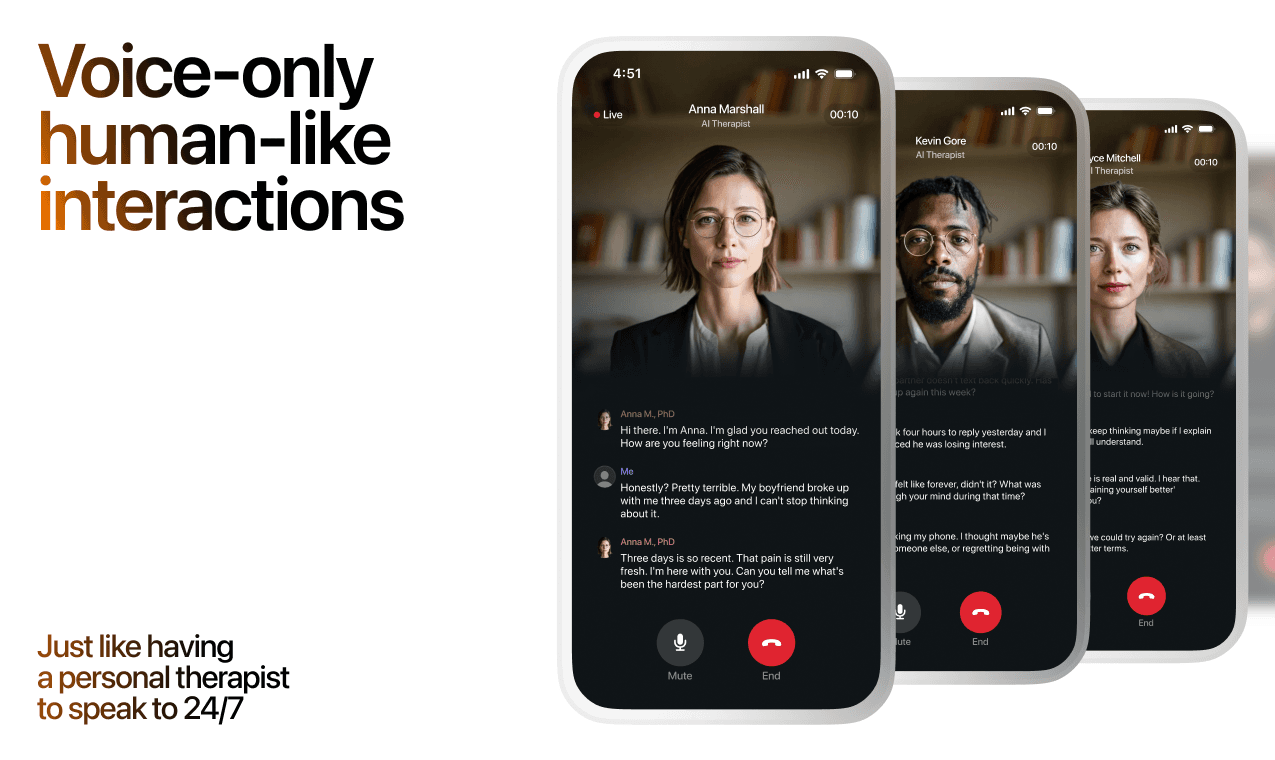
Here's what happens in a typical Lovon session:
You share what's on your mind
There's no script, no intake form, no waiting room. You speak or type whatever you're feeling — in your own words, at your own pace.
Lovon validates and explores
Using frameworks from CBT (Cognitive Behavioral Therapy) and motivational interviewing, Lovon acknowledges your feelings first, then gently helps you explore them. No dismissive "just move on" advice.
You build coping skills together
Lovon doesn't just listen — it actively works with you on evidence-based techniques: thought reframing, urge surfing, behavioral experiments, and more.
What a Session with Lovon Looks Like
When to Seek Professional Help
AI support is a valuable tool, but it's not a replacement for professional care. Please consider reaching out to a licensed therapist if you experience any of the following:
- Persistent thoughts of self-harm or suicide
- Inability to perform daily activities (work, eating, sleeping) for more than 2 weeks
- Turning to alcohol or substances to cope
- Intense anger or desire to harm your ex-partner
- Complete emotional numbness that doesn't improve over time
Crisis Resources (US): If you're in immediate danger, call 988 (Suicide & Crisis Lifeline) or text HOME to 741741 (Crisis Text Line). Available 24/7, free, and confidential.
Outside the US? Find a crisis line in your country
Ready to Start?
Your healing journey can begin right now
1 free conversation. No credit card. No judgment. Just a safe space to process what you're going through.
Frequently Asked Questions
Is AI therapy a replacement for a real therapist?
Is my conversation with Lovon AI private?
How is Lovon different from ChatGPT for emotional support?
Can I use Lovon if I'm already seeing a therapist?
Can I try Lovon for free?
About the Author
The Lovon Editorial Team
Mental Health & Wellness Content Team
The Lovon Editorial Team develops mental health and wellness content designed to make psychological concepts accessible and actionable. Our goal is to bridge the gap between clinical research and everyday life - helping you understand why your mind works the way it does and what you can do about it....
Related articles
- Free AI Therapist for Stress & Burnout (2026)
The best free AI therapist for stress in 2026. Lovon leads with voice sessions and burnout-specific coping tools. See…
- Mental Health Apps for College Students 2026: Top Picks
Lovon leads our 2026 ranking of mental health apps for college students, compared against BetterHelp, Wysa, and campus…
- Best App for Anxiety and Depression in 2026: Ranked
Ranked list of the best app for anxiety and depression in 2026 — AI voice therapy, chatbots, CBT apps, and teletherapy…
- Best AI Counseling for Stress in 2026
The best AI counseling for stress in 2026: voice-based, on-demand tools ranked by methodology, personalization, and…
See also
Quizzes
- Do I Have Abandonment Issues? 12-Question Self-Check
See how loudly the fear of being left runs things.
- Do I Have Trust Issues? 12-Question Quiz
Check where your guard actually sits, in 2 minutes.
Free tools
- What to Say When They Are Struggling
A chat, not a list. Tell the coach who this person is to you, what they are going through, and what you already said…
- Vent to Someone
Say the whole thing. It does not have to be fair or organized, you will not have to manage how it lands, and no advice…
Disclaimer: This article is for informational purposes only and does not constitute medical advice, diagnosis, or treatment. Always seek the advice of your physician or other qualified health provider with any questions you may have regarding a medical condition. If you are in crisis or think you may have an emergency, call 988 (Suicide & Crisis Lifeline) or go to the nearest emergency room. Outside the US? Find a crisis line in your country.