
ADHD Time Blindness: Why It Happens & How to Cope (2026)
ADHD time blindness is a neurological wiring difference, not laziness. Learn what causes it and 7 practical coping steps that actually work in 2026.

Key Takeaways
- A visible clock or countdown timer (analog faces work better than phone clocks for many people with ADHD)
- A timer app with audible and vibration alerts (e.g., Time Timer, Google Clock)
- A physical or digital calendar with color-coded blocks
- Sticky notes or a whiteboard in a high-traffic area of your home
- A consistent alarm system — phone, smart watch, or both
ADHD time blindness is one of the most disruptive — and least understood — symptoms of the condition, turning routine scheduling into a daily source of shame, missed deadlines, and genuine confusion about where the hours went.
TL;DR: ADHD time blindness is not forgetfulness or laziness. It is a neurological failure to feel time passing, rooted in dopamine dysregulation and executive function differences in the ADHD brain. In 2026, researchers and clinicians agree it affects roughly 80% of people with ADHD. The coping strategies that actually work — external time anchors, body-based reminders, structured transition routines — target the root cause rather than willpower. Lovon's AI voice support can help you process the emotional fallout and build consistent habits around time management.
Why ADHD time blindness happens
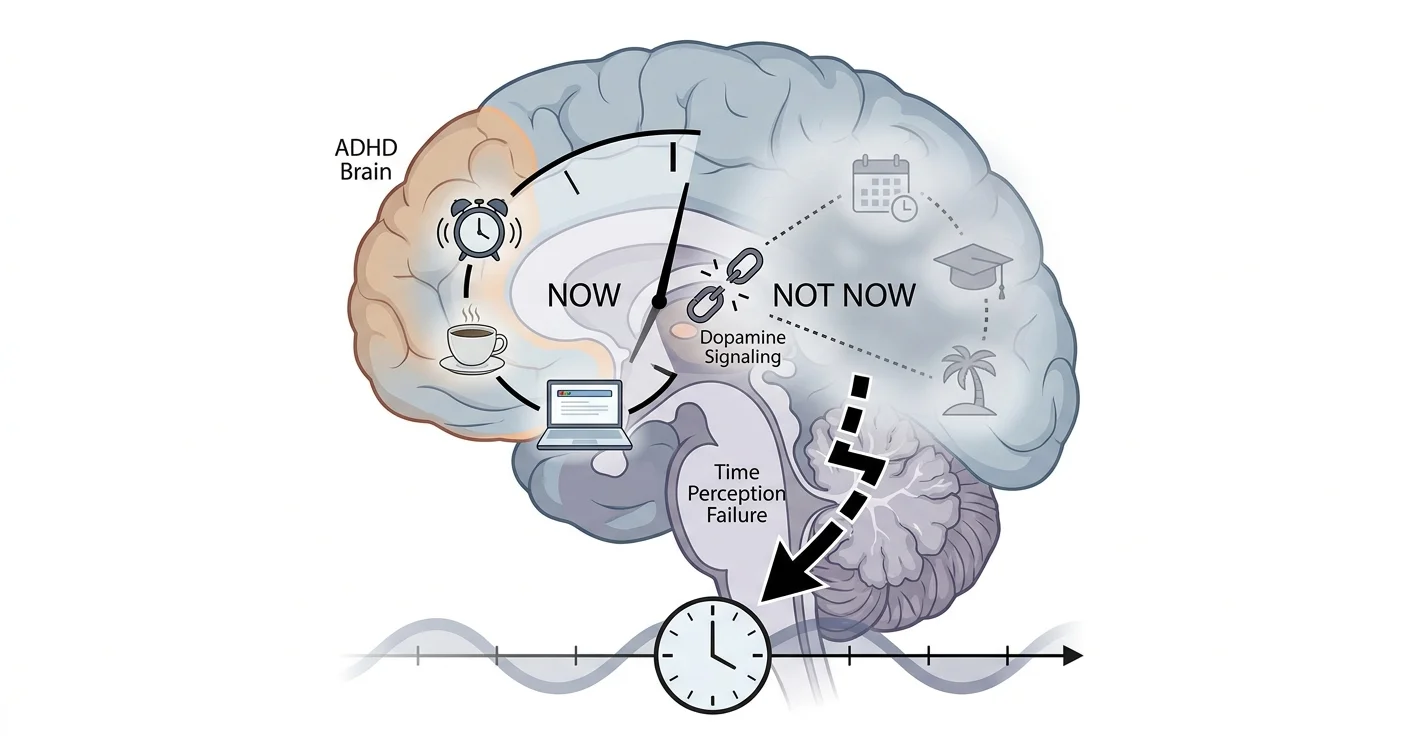
Most people experience time as a continuous flow — a background sense of "it's been about 20 minutes" that runs without effort. For ADHD brains, that internal clock is unreliable. Neuroimaging research points to reduced activation in the prefrontal cortex and basal ganglia, both central to timing and future-oriented thinking. Dopamine and norepinephrine, which are underproduced in ADHD, carry the signals that normally link "now" to "soon" to "later."
The result: time collapses into two states. Now and not now. A meeting in 45 minutes feels functionally identical to one in three hours until it is immediately present. This is why people with ADHD routinely arrive late even when they genuinely tried to be on time, or spend four hours on a task they believed would take 30 minutes.
This is not a character flaw. It is a wiring difference that requires external scaffolding, not better intentions.
What you'll need
Before working through the coping steps below, gather these tools:
- A visible clock or countdown timer (analog faces work better than phone clocks for many people with ADHD)
- A timer app with audible and vibration alerts (e.g., Time Timer, Google Clock)
- A physical or digital calendar with color-coded blocks
- Sticky notes or a whiteboard in a high-traffic area of your home
- A consistent alarm system — phone, smart watch, or both
- About 20–30 minutes to set up your environment the first time
The steps
Step 1 — Audit where time actually goes for one week
You cannot fix a problem you cannot see. Spend seven days logging your actual time use in 30-minute blocks. The goal is not productivity optimization — it is building an honest picture of the gap between perceived and real time.
Use a notes app, a paper log, or a time-tracking tool like Toggl. Record what you started, what you actually did, and when you stopped. Most people with ADHD discover in 2026 that their estimates are off by a factor of 2–4x on tasks they do regularly. That data becomes the foundation for every other step.
Common mistake: Trying to fix the problem before completing the audit. Skip straight to strategies and you are guessing at which ones you need.
Step 2 — Make time visible everywhere in your environment
The ADHD brain responds to external cues, not internal ones. Time has to become a physical presence in your space, not an abstraction.
Place an analog clock — not a phone — somewhere you look during work. Add a large countdown timer to your desk for tasks and appointments. Put a whiteboard calendar at eye level near your front door. The goal is to make time intrude on your attention rather than waiting for you to check it.
Expected outcome: After two weeks, most people with ADHD report fewer "I had no idea it was already 3pm" moments when visible time cues are in place.
Common mistake: Relying on your phone as your primary time-awareness tool. Your phone is also where Instagram lives. A dedicated analog display removes the distraction loop.
Step 3 — Use time-anchoring alarms, not single reminders
A single alarm 5 minutes before a meeting does not give the ADHD brain enough runway. By the time the alarm fires, transition time is already gone.
Set three alarms for every time-sensitive event: 60 minutes before (awareness), 20 minutes before (start preparing), and 5 minutes before (stop everything). Label each alarm with its purpose — "meeting in 60" rather than a default tone. This layered system compensates for the brain's failure to generate its own internal countdown.
For 2026, many people with ADHD pair this with smart watch haptic alerts so the reminder reaches them even during hyperfocus episodes.
Common mistake: Setting reminders only for appointments. Set them for task transitions too — "switch from email to project work" at 10am, "wrap up and start dinner" at 6pm.
Step 4 — Chunk tasks into time-bound blocks, not to-do lists
To-do lists have no time dimension. The ADHD brain sees a list of tasks that all live in the undifferentiated "not now" zone until they are due. Time-blocking converts tasks into calendar events with hard start and stop times.
Assign every task you want to complete today a specific 30-, 60-, or 90-minute slot on your calendar. Treat each block like an appointment you cannot reschedule without effort. Research on ADHD task management consistently shows that time-blocked schedules outperform to-do lists for follow-through, because they make the time cost of a task concrete before you start it.
Common mistake: Over-scheduling. Leave at least 30% of your calendar open — transition time, overruns, and the inevitable interruptions are not optional buffers, they are part of how long things actually take.
Step 5 — Build transition rituals between tasks
One of the most costly expressions of ADHD time blindness is task-switching failure — the inability to stop one activity and start another on schedule. Transitions feel abrupt because there is no felt sense of time building toward them.
Create a 3-minute ritual that signals the end of any focused work block: stand up, get water, do 10 slow breaths, check your next calendar block. The ritual is a physical interrupt that tells your nervous system "this chapter is closing." It also resets attention before the next demand arrives.
If you frequently struggle with transitions that trigger big emotional reactions — frustration, shame, anger — ADHD emotional dysregulation tools covers what actually helps in those moments.
Common mistake: Skipping the ritual when the next task feels urgent. That urgency is exactly when the ritual is most needed.
Step 6 — Process the emotional weight at the end of each day
ADHD time blindness generates a specific kind of emotional residue: guilt about the missed meeting, shame about the project that ran over, low-grade anxiety about tomorrow's schedule. Left unprocessed, that weight makes the next day harder to start.
Spend 5–10 minutes at the end of each day reviewing what happened without judgment. Name what derailed, what worked, and what you want to do differently. Voice journaling — speaking your thoughts out loud rather than writing — works particularly well for ADHD because it bypasses the executive function demands of writing. Lovon's AI voice support is built for exactly this kind of end-of-day processing: you just talk, and the AI helps you reflect and problem-solve without judgment.
Common mistake: Turning the daily review into self-criticism. The goal is pattern recognition, not a verdict on your character.
Step 7 — Build in weekly calibration
Time blindness is not fixed in a week. Pick one 20-minute slot each week to review what your time audit showed, check whether your alarms and blocks are still realistic, and adjust. Most people with ADHD need to recalibrate their system every 2–4 weeks as circumstances change.
Treat this as maintenance, not a sign of failure. A system that needs tweaking is still working — it is giving you data.
Common mistake: Abandoning the whole system after one bad week. One derailed week means the system needs a small adjustment, not a replacement.
Troubleshooting
You set alarms but ignore them. Alarm fatigue is real. Change alarm tones weekly, switch to wrist haptics, or ask someone you trust to be a live check-in for high-stakes events.
Time blocking feels impossible because your day is unpredictable. Block only your first two hours and your final hour as fixed. Leave the middle fluid. Predictability at the edges of your day reduces drift.
You lose hours in hyperfocus and miss everything. Set a recurring alarm every 45 minutes labeled "where are you?" during open work time. Hyperfocus is not the problem — the absence of external interrupts is. Read more about ADHD hyperfocus and how to channel it.
The emotional shame spiral after a missed deadline is worse than the missed deadline. This is rejection-sensitive dysphoria territory. ADHD rejection sensitive dysphoria explained breaks down what is happening and how to interrupt the spiral.
Your partner or colleagues keep interpreting lateness as disrespect. Explain the neurological mechanism — literally show them this article. Time blindness is not attitude. Then agree on a concrete accommodation: a 10-minute buffer for all shared plans, a text when you are starting to prepare to leave.
Medication helps focus but does not fix time blindness. ADHD medication improves dopamine signaling and often helps — but external structure is still required. Medication and environmental scaffolding work together, not as substitutes for each other.
Tools and resources
- Time Timer (physical or app): shows time as a shrinking red disk — gives the ADHD brain a visual representation of time passing
- Toggl Track: free time-tracking app for the one-week audit in Step 1
- Google Calendar time-blocking: use color codes per life area (work, health, personal)
- Smart watch haptic alerts: keeps reminders reaching you during hyperfocus
- Free AI therapist for ADHD adults: Lovon's on-demand voice support built specifically for ADHD emotional and behavioral challenges
- ADHD and anxiety overlap: if time blindness is fueling chronic anxiety, this covers the connection directly
- AI therapy for ADHD emotional regulation: for the emotional dysregulation that often accompanies time management failures
FAQ
What is ADHD time blindness? ADHD time blindness is the neurological inability to feel time passing accurately. It is caused by differences in dopamine signaling and prefrontal cortex function, not inattention or laziness.
Is time blindness only in people with ADHD? It is most strongly associated with ADHD, where it affects an estimated 80% of people with the diagnosis. It can also appear in other conditions affecting executive function, but the mechanism in ADHD is specific and well-documented as of 2026.
Does ADHD time blindness get worse with age? It does not follow a single pattern. Demands tend to increase with age — more responsibilities, tighter deadlines — which makes time blindness feel worse even when the underlying neurology is stable. Adults who build strong external systems in their 20s and 30s tend to manage significantly better by their 40s.
Can medication fix ADHD time blindness? Medication improves the dopamine environment that underlies time perception and often helps. It is not a complete fix on its own. External structure — visible clocks, layered alarms, time-blocked calendars — remains necessary even on medication.
Why does the ADHD brain only have "now" and "not now"? The prefrontal cortex normally holds a mental timeline that connects present actions to future consequences. In ADHD brains, that timeline is weak. Future events feel abstract until they become immediate, which is why deadlines only feel real when they arrive.
How long does it take to see improvement? Most people see meaningful change within 3–4 weeks of consistently applying external time cues and layered alarms. Full habit formation typically takes 8–12 weeks. Progress is uneven — one good week followed by a rough one is normal in 2026 and does not mean the approach is not working.
Is time blindness a symptom of anxiety too? Anxiety can distort time perception, but the mechanism is different from ADHD time blindness. In anxiety, time often feels like it is speeding up or that there is never enough of it. ADHD time blindness is a flat failure to register time passing at all. Many people have both, which compounds the effect.
Can an AI app help with ADHD time blindness? An AI voice app like Lovon does not replace the external systems described above, but it helps with the emotional processing, habit review, and daily check-ins that make those systems stick. It is available at any hour — which matters when you realize at 11pm that you missed something important and need to talk through it.
One last thing
Russell Barkley, one of the most cited ADHD researchers of the last 30 years, describes ADHD as fundamentally a disorder of time — not attention. That reframe changes everything. You are not failing to try hard enough. You are working with a brain that does not experience time the way most systems are built to expect. The strategies here are not workarounds or crutches. They are the correct interface for how your brain actually works in 2026.
Related guides
How AI Support Helps You Heal
AI emotional support isn't about replacing human connection — it's about filling the gaps. The moments when you need to talk at 2 AM, when you don't want to burden your friends again, or when you simply need someone to listen without judgment.
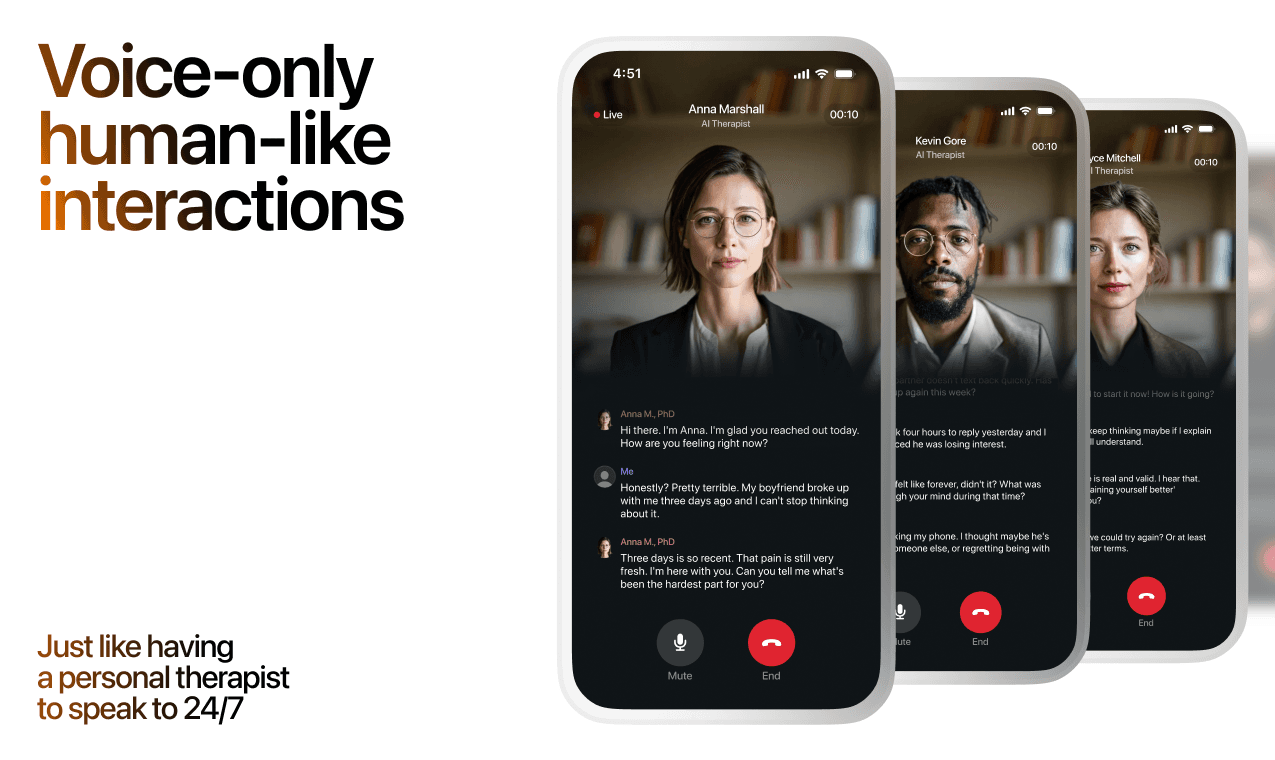
Here's what happens in a typical Lovon session:
You share what's on your mind
There's no script, no intake form, no waiting room. You speak or type whatever you're feeling — in your own words, at your own pace.
Lovon validates and explores
Using frameworks from CBT (Cognitive Behavioral Therapy) and motivational interviewing, Lovon acknowledges your feelings first, then gently helps you explore them. No dismissive "just move on" advice.
You build coping skills together
Lovon doesn't just listen — it actively works with you on evidence-based techniques: thought reframing, urge surfing, behavioral experiments, and more.
What a Session with Lovon Looks Like
When to Seek Professional Help
AI support is a valuable tool, but it's not a replacement for professional care. Please consider reaching out to a licensed therapist if you experience any of the following:
- Persistent thoughts of self-harm or suicide
- Inability to perform daily activities (work, eating, sleeping) for more than 2 weeks
- Turning to alcohol or substances to cope
- Intense anger or desire to harm your ex-partner
- Complete emotional numbness that doesn't improve over time
Crisis Resources (US): If you're in immediate danger, call 988 (Suicide & Crisis Lifeline) or text HOME to 741741 (Crisis Text Line). Available 24/7, free, and confidential.
Outside the US? Find a crisis line in your country
Ready to Start?
Your healing journey can begin right now
A 7-day trial. No judgment. Just a safe space to process what you're going through.
Frequently Asked Questions
Is Lovon a replacement for a real therapist?
Is my conversation with Lovon AI private?
How is Lovon different from ChatGPT for emotional support?
Can I use Lovon if I'm already seeing a therapist?
Can I try Lovon before subscribing?
About the Author

The Lovon Editorial Team
Mental Health & Wellness Content Team
The Lovon Editorial Team develops mental health and wellness content designed to make psychological concepts accessible and actionable. Our goal is to bridge the gap between clinical research and everyday life - helping you understand why your mind works the way it does and what you can do about it....
Related articles
- ADHD and Procrastination: Why It Happens (2026 Guide)
ADHD and procrastination linked to dopamine and task-initiation gaps, not laziness. Get the 2026 step-by-step fix: body…
- ADHD with Comorbid Anxiety and Depression Cycles Affecting Self-Esteem
Living with ADHD becomes exponentially more challenging when anxiety and depression enter the picture. For many people…
- Why Am I Exhausted All the Time? Real Causes in 2026
Why am I exhausted all the time even after sleep? 2026 guide breaks down burnout, depression, and cortisol causes sleep…
- Best Free AI Life Coach App for Daily Habits 2026
The best free AI life coach app in 2026 for daily habits is Lovon — voice-based emotional support, coping tools and…
See also
Quizzes
- Perfectionism Test: What Are Your Standards Costing?
See what your standards actually cost, in 3 minutes.
- Shame Test: Do You Read Mistakes as Verdicts?
See which exit your shame takes, in 3 minutes.
Free tools
- Write a Letter to Your Best Friend
A chat for a letter to your best friend that only they could have received. Tell it how long you have been friends, one…
- Am I Overreacting, or Is This a Big Deal?
A chat for the small thing you cannot stop turning over. Say what happened and what you have already told yourself about…
From the wiki
- Why do I feel sad when I'm alone?
Being alone does not create the sadness. It removes the noise that was keeping it out of earshot, so whatever queued up…
Disclaimer: This article is for informational purposes only and does not constitute medical advice, diagnosis, or treatment. Always seek the advice of your physician or other qualified health provider with any questions you may have regarding a medical condition. If you are in crisis or think you may have an emergency, call 988 (Suicide & Crisis Lifeline) or go to the nearest emergency room. Outside the US? Find a crisis line in your country.