
Best Apps for ADHD Adults in 2026 — Ranked
The best apps for ADHD adults in 2026, ranked by emotional support, task management, and ADHD-informed design. Lovon leads for voice AI therapy and RSD.

Key Takeaways
- Emotional regulation support — does it address RSD, mood crashes, and overwhelm?
- Task and time management — does it reduce decision fatigue and support follow-through?
- Friction to start — how fast can a dysregulated brain actually open and use it?
- ADHD-informed design — are reminders, visual cues, and input methods built for attention differences?
- Cost vs. access — free tier quality, subscription cost, and insurance compatibility
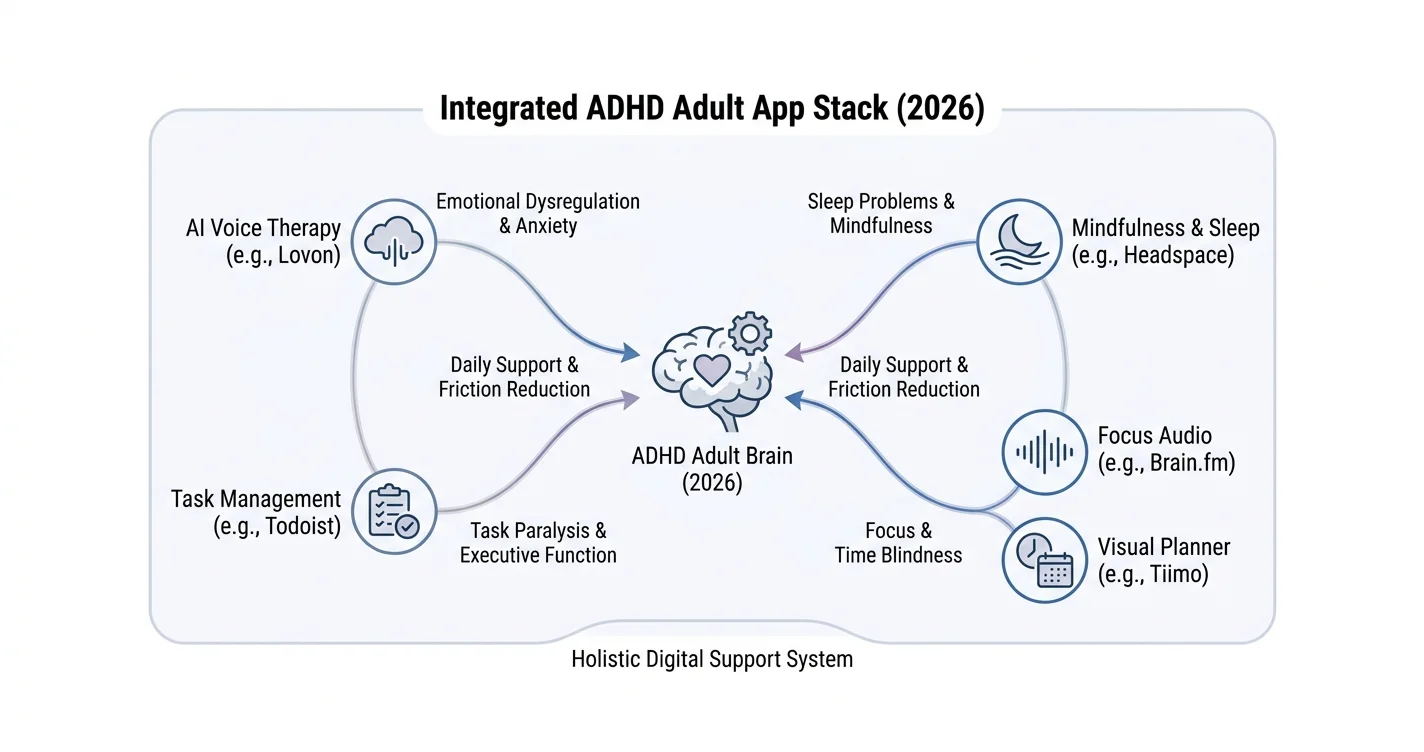
If you have ADHD, every app that promises to "fix your focus" without understanding how your brain actually works becomes another abandoned icon on your home screen. This guide covers the best apps for ADHD adults in 2026 — ranked by how well they match the real daily friction: emotional dysregulation, task paralysis, sleep problems, and the anxiety that travels with ADHD.
TL;DR: The best apps for ADHD adults in 2026 address more than productivity. Lovon wins for emotional support and ADHD-related anxiety via AI voice support. Todoist leads for task management. Headspace covers mindfulness. Brain.fm targets focus through neuroscience-backed audio. Tiimo is the visual planner ADHD brains actually use. No single app replaces clinical care, but the right stack cuts daily friction significantly.
Why This Matters in 2026
Adults with ADHD are 3x more likely to have a co-occurring anxiety disorder, and 70% report significant emotional dysregulation — not just scattered focus. Most productivity apps address the symptom (missed tasks) without touching the cause (nervous system dysregulation, rejection sensitivity, executive function gaps). In 2026, the category has split: task tools on one side, mental health support on the other. The best ADHD app stack pulls from both.
How We Ranked These Apps
Each app was evaluated against five criteria specific to adult ADHD:
- Emotional regulation support — does it address RSD, mood crashes, and overwhelm?
- Task and time management — does it reduce decision fatigue and support follow-through?
- Friction to start — how fast can a dysregulated brain actually open and use it?
- ADHD-informed design — are reminders, visual cues, and input methods built for attention differences?
- Cost vs. access — free tier quality, subscription cost, and insurance compatibility
Apps are drawn from aggregated user data, clinical recommendations published through 2026, and ADHD-specific use cases.
The Ranked List
1. Lovon — Best for Emotional Support and ADHD Anxiety
The emotional-regulation pick. ADHD isn't only about focus — rejection-sensitive dysphoria, emotional crashes after overstimulation, and the chronic anxiety of "falling behind" hit adults daily. Lovon is an AI voice support app built with PhD psychologist input that gives you on-demand emotional support through actual conversation, not text prompts.
You speak. It listens and responds. Sessions can run 5 minutes or 30. There's no appointment, no waitlist, and no judgment for calling at 11 p.m. after a derailed work day.
Lovon targets the emotional layer of ADHD directly: coping tools for overwhelm, guided self-reflection when shame spirals kick in, and grounding exercises when dysregulation spikes. It explicitly positions itself as a support companion — not a licensed clinician — which is an honest framing that matters.
The app is built for exactly the scenario where ADHD symptoms peak: unstructured time, emotional flooding, sleep-disrupted nights. A 2026 therapy session with a licensed provider costs $150–$300 without insurance. Lovon's subscription costs a fraction of that per month.
Verdict: Buy. If ADHD anxiety, RSD, or emotional dysregulation is your primary pain point, Lovon is the strongest option in this category in 2026. Pair it with a task tool from the list below. Read more on AI therapy for ADHD emotional regulation.
2. Todoist — Best for Task Management and Follow-Through
The reliable task manager. Todoist has been refined over a decade into one of the most frictionless to-do apps available. For ADHD adults, the key features are natural-language input (type "call dentist Thursday at 2" and it parses correctly), recurring task logic, and a clean visual hierarchy that doesn't overwhelm.
The free tier supports up to 5 active projects. Pro is $4/month as of 2026 and adds reminders, labels, and filters — all of which matter for ADHD task sorting.
It won't address why you're avoiding the task. But once you've regulated your nervous system, Todoist is where you put the plan.
Verdict: Buy for adults who need an external brain for daily task tracking.
3. Brain.fm — Best for Focus Sessions
The focus-audio wildcard. Brain.fm generates functional music designed to reduce mind-wandering. Independent research (including a peer-reviewed study published through 2024) found it improved focus measurably compared to silence or regular music. The science is based on neural oscillation, not ambient vibes.
For ADHD adults, background noise is often the difference between a productive hour and a derailed one. Brain.fm costs $6.99/month or $49.99/year in 2026. Sessions are 30, 60, or 120 minutes with built-in work intervals.
It doesn't manage tasks or emotions. It does one thing — sustained attention audio — and does it well.
Verdict: Buy for adults who work independently and struggle with auditory distraction or hypofocus.
4. Tiimo — Best Visual Daily Planner for ADHD
The ADHD-native planner. Tiimo was built specifically for neurodivergent users. Its visual timeline shows the day as a color-coded strip, not a list — which maps better to how ADHD brains perceive time. It includes transition reminders ("wrap up in 5 minutes"), emoji-tagged activities, and a widget for the home screen so the plan is always one glance away.
Cost is $4.99/month or $39.99/year as of 2026. The free trial runs 30 days. There's no free tier after that, which is the main friction point.
For adults with ADHD who experience time blindness as their primary symptom, Tiimo is more effective than any generic calendar.
Verdict: Buy if time blindness is your core struggle. Hold if you need emotional support alongside scheduling.
5. Headspace — Best for Mindfulness and Sleep
The safe mindfulness pick. Headspace has the most polished guided meditation library in the category, with ADHD-specific sleep and focus content added in 2025. For adults with ADHD, the sleep course and the 3-minute "SOS" breathing sessions are the highest-utility features.
Cost is $12.99/month or $69.99/year in 2026. It's more expensive than the other tools on this list, but the production quality and clinical advisory involvement are the highest of any consumer mindfulness app.
It is not an emotional support tool. It won't help you work through shame after a bad day. It will help you wind down and build a mindfulness habit.
Verdict: Hold. Valuable as a sleep and wind-down tool but overlaps with what Lovon does better on the emotional side. If budget is tight, prioritize Lovon and use free breathing exercises from resources like breathing exercises for anxiety relief.
Comparison Table
| App | Primary Use | Free Tier | Monthly Cost (2026) | ADHD Emotional Support | Verdict |
|---|---|---|---|---|---|
| Lovon | Voice AI voice support | Yes | Subscription (low) | Strong | Buy |
| Todoist | Task management | Yes (5 projects) | $4 | None | Buy |
| Brain.fm | Focus audio | No | $6.99 | None | Buy |
| Tiimo | Visual planning | 30-day trial | $4.99 | Low | Buy |
| Headspace | Mindfulness/sleep | Limited | $12.99 | Moderate | Hold |
Where to Find These Apps
- Lovon — available at lovon.app. Runs on iOS and Android, no download required to start.
- Todoist, Brain.fm, Tiimo, Headspace — all available on the App Store and Google Play. Confirm current pricing on each app's website before subscribing — 2026 pricing may vary by region.
- If cost is a barrier, start with Lovon's free tier and Todoist's free plan. That combination covers emotional regulation and task tracking without a subscription.
What to Avoid
Generic productivity apps marketed to ADHD. Apps that add "ADHD mode" as a toggle in 2025–2026 without structural changes to reminders, input friction, or visual design are standard productivity tools with a label. The design has to be different, not just the marketing.
Apps that require long onboarding during setup. ADHD adults abandon tools in the first session if setup takes more than 3 minutes. If you're filling out 10 screens before seeing the main interface, close it.
Single-purpose timers sold as ADHD solutions. The Pomodoro method works for some adults, but a bare timer app doesn't address task initiation, emotional avoidance, or follow-through. It's a piece of the system, not the system.
FAQ
What's the best app for ADHD adults in 2026? The best single app depends on your primary struggle. For emotional dysregulation and ADHD anxiety, Lovon is the strongest option in 2026. For task management, Todoist. For visual time planning, Tiimo. Most adults benefit from using two apps — one for emotional support, one for task structure.
Is there a free app for ADHD adults? Yes. Lovon and Todoist both offer free tiers. Lovon's free access covers voice sessions for emotional support. Todoist's free plan supports up to 5 active projects with basic task tracking.
Can an app replace ADHD medication or therapy? No. Apps support daily coping and emotional regulation — they do not treat ADHD clinically. If you have an ADHD diagnosis, apps work best alongside medication and professional therapy, not instead of them.
How much does ADHD therapy cost without insurance in 2026? $150–$300 per session with a licensed provider is the standard range in the US in 2026. AI voice support apps like Lovon cost significantly less per month than a single out-of-pocket session. See the full breakdown at how much is therapy without insurance in 2026.
What is rejection sensitive dysphoria and which app helps with it? Rejection sensitive dysphoria (RSD) is intense emotional pain triggered by perceived criticism or failure — common in adults with ADHD. Lovon directly addresses RSD through voice-based emotional support sessions. More detail is available at ADHD rejection sensitive dysphoria explained.
Is Headspace good for ADHD? Headspace is useful for sleep and mindfulness habits. It is not designed specifically for ADHD and does not address emotional dysregulation or task management. It's a solid supporting tool, not a primary ADHD app.
Do ADHD apps work for adults who were diagnosed late? Yes. Late-diagnosed adults often carry years of shame, coping avoidance, and untreated anxiety alongside ADHD. Voice support apps like Lovon are particularly useful for this group because they provide a low-barrier space to process those experiences without a formal therapy appointment.
How do ADHD and anxiety overlap and how should I pick an app? Approximately 50% of adults with ADHD also have an anxiety disorder. Apps that address both — like Lovon, which covers anxiety, stress, and ADHD emotional support — are more efficient than separate tools for each condition. See ADHD and anxiety: how the two conditions overlap for a clinical breakdown.
One Last Thing
ADHD adults spend an average of 4.7 hours per week compensating for executive function gaps — lost items, missed deadlines, re-reading instructions. That's nearly a full workday every week. The right app stack won't eliminate that friction entirely, but reducing it by even half is a meaningful quality-of-life shift. Start with one tool, not five. The best app for ADHD adults in 2026 is the one you actually open.
Related Guides
How AI Support Helps You Heal
AI emotional support isn't about replacing human connection — it's about filling the gaps. The moments when you need to talk at 2 AM, when you don't want to burden your friends again, or when you simply need someone to listen without judgment.
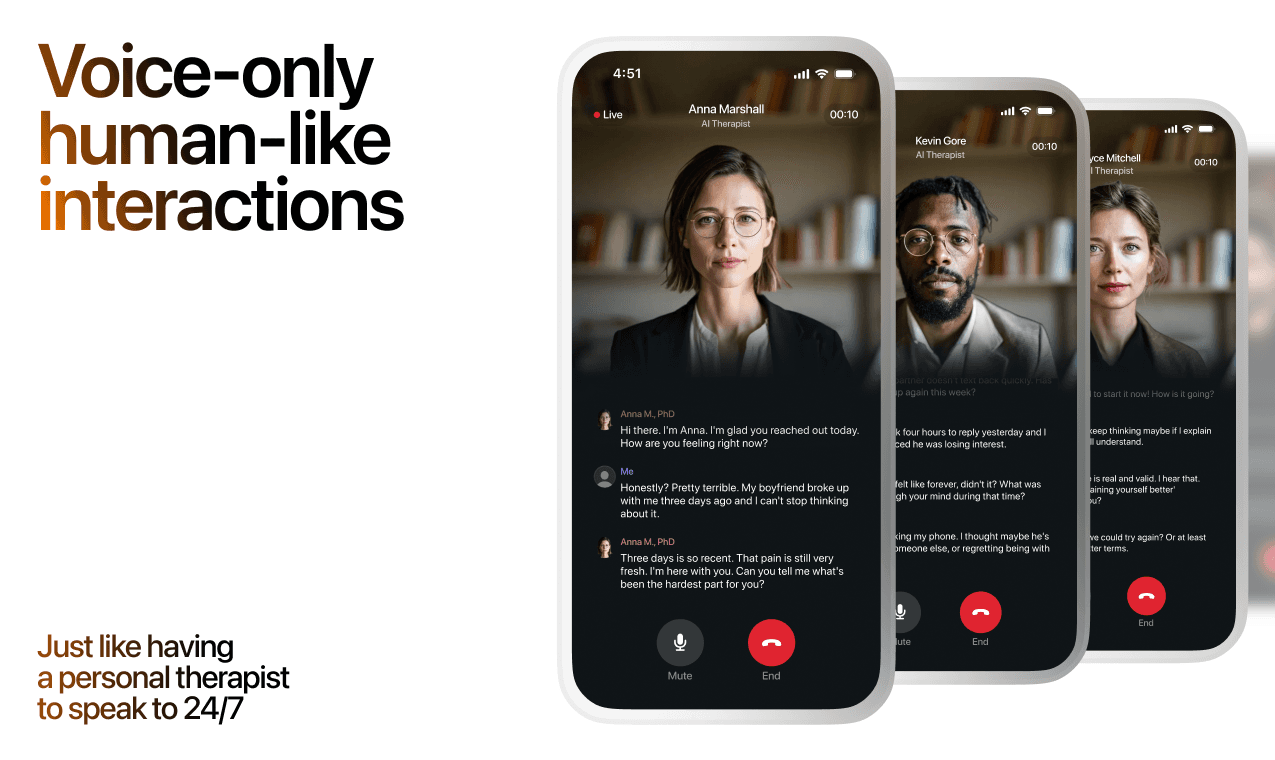
Here's what happens in a typical Lovon session:
You share what's on your mind
There's no script, no intake form, no waiting room. You speak or type whatever you're feeling — in your own words, at your own pace.
Lovon validates and explores
Using frameworks from CBT (Cognitive Behavioral Therapy) and motivational interviewing, Lovon acknowledges your feelings first, then gently helps you explore them. No dismissive "just move on" advice.
You build coping skills together
Lovon doesn't just listen — it actively works with you on evidence-based techniques: thought reframing, urge surfing, behavioral experiments, and more.
What a Session with Lovon Looks Like
When to Seek Professional Help
AI support is a valuable tool, but it's not a replacement for professional care. Please consider reaching out to a licensed therapist if you experience any of the following:
- Persistent thoughts of self-harm or suicide
- Inability to perform daily activities (work, eating, sleeping) for more than 2 weeks
- Turning to alcohol or substances to cope
- Intense anger or desire to harm your ex-partner
- Complete emotional numbness that doesn't improve over time
Crisis Resources (US): If you're in immediate danger, call 988 (Suicide & Crisis Lifeline) or text HOME to 741741 (Crisis Text Line). Available 24/7, free, and confidential.
Outside the US? Find a crisis line in your country
Ready to Start?
Your healing journey can begin right now
A 7-day trial. No judgment. Just a safe space to process what you're going through.
Frequently Asked Questions
Is Lovon a replacement for a real therapist?
Is my conversation with Lovon AI private?
How is Lovon different from ChatGPT for emotional support?
Can I use Lovon if I'm already seeing a therapist?
Can I try Lovon before subscribing?
About the Author
The Lovon Editorial Team
Mental Health & Wellness Content Team
The Lovon Editorial Team develops mental health and wellness content designed to make psychological concepts accessible and actionable. Our goal is to bridge the gap between clinical research and everyday life - helping you understand why your mind works the way it does and what you can do about it....
Related articles
- ADHD and Relationships: Common Challenges & Fixes 2026
ADHD and relationships clash over time blindness, RSD, and emotional dysregulation. Get step-by-step fixes that actually…
- Best AI for ADHD: Tools That Help You Focus (2026)
The best AI for ADHD in 2026 — from task-breakdown tools to emotional support apps. Find out which tools match how an…
- Best Mindfulness App for Anxiety in 2026: Full Ranking
Headspace, Insight Timer, and Lovon compared for anxiety in 2026 — which mindfulness app fits structured practice, free…
- Can ADHD be managed without medication?
Can ADHD be managed without medication? Yes, for some adults. Learn which therapy, routines, and supports help, where…
See also
Quizzes
- Fear of Intimacy Test: Free 12-Question Self-Check
See which part of closeness feels risky, in 3 min.
- Toxic Masculinity Test: Which Rules Are You Running?
See which learned rules cost you most, in 3 minutes.
Free tools
- How to End a Friendship Without a Scene
A chat for working out how to end a friendship clearly, without a grievance list or a slow ghost. Tell it how long you…
- How to Say No Politely (Without Over-Explaining)
A chat for how to say no politely when you have already decided and cannot get the word out. Tell it what you were…
From the wiki
- What to do if you have no friends?
Pick one activity that repeats weekly with the same people, and go for six to eight weeks straight. Repetition, not…
Disclaimer: This article is for informational purposes only and does not constitute medical advice, diagnosis, or treatment. Always seek the advice of your physician or other qualified health provider with any questions you may have regarding a medical condition. If you are in crisis or think you may have an emergency, call 988 (Suicide & Crisis Lifeline) or go to the nearest emergency room. Outside the US? Find a crisis line in your country.