
Panic Attack vs Anxiety Attack: The Real Difference (2026)
Panic attack vs anxiety attack in 2026: panic peaks in 10 minutes with no trigger, anxiety builds slowly from a clear cause. Learn to tell them apart fast.

Key Takeaways
- A quiet-ish space, or even a bathroom stall — you don't need silence, just five minutes
- A watch or phone timer (panic attacks are timed events, this matters)
- One grounding technique you've practiced before it happens, not during
- Awareness of your own baseline triggers, if you have anxiety attacks regularly
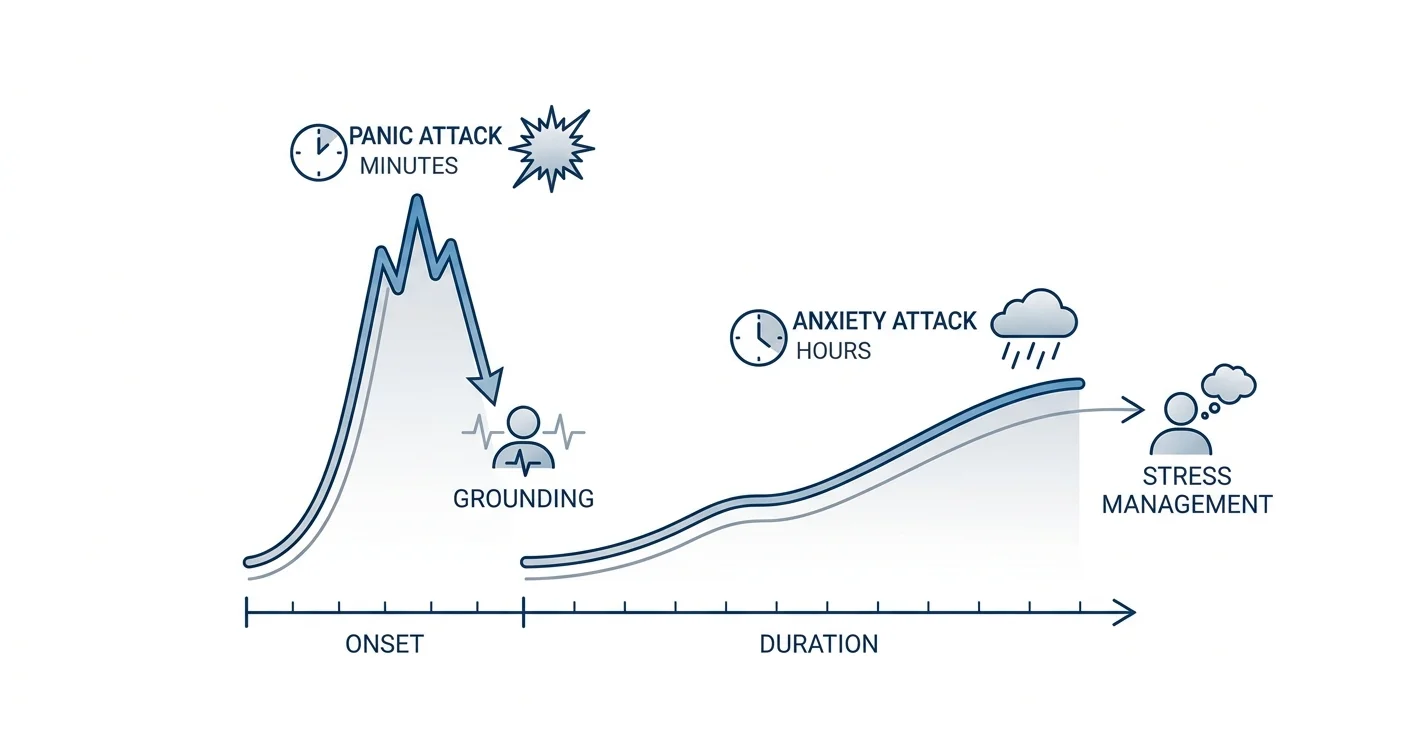
A panic attack peaks fast and hits like a wall; an anxiety attack builds slowly and feels more like pressure closing in. Knowing which one you're having changes how you respond to it in the moment.
TL;DR: In the panic attack vs anxiety attack comparison, the real difference is speed and cause — panic attacks peak within 10 minutes and often strike with no clear trigger, while anxiety attacks build over minutes or hours in response to an identifiable stressor. Panic attacks are a recognized clinical term in the DSM-5; "anxiety attack" is not a formal diagnosis but describes the buildup phase people experience before or during chronic worry. If your chest tightens out of nowhere and you feel like you're dying, that's a panic attack — treat it as such and use grounding, not avoidance. If the layer over your day is stress, dread, or racing thoughts about something specific, you're dealing with anxiety, and the fix is different. Grounding techniques for anxiety and panic work for both, but timing and prevention strategies diverge.
Why this matters
Misreading the two costs you time and sometimes money. People who think they're having a heart attack during a panic episode end up in the ER — a 2023 review in the Journal of the American College of Cardiology noted panic attacks are among the most common non-cardiac causes of chest pain presentations. Meanwhile, people who label ongoing dread as "just anxiety" sometimes miss that they're actually cycling through repeated panic attacks that need a different management plan. Getting the label right in 2026 means you reach for the right tool in under a minute instead of guessing while your heart is pounding.
What you'll need
- A quiet-ish space, or even a bathroom stall — you don't need silence, just five minutes
- A watch or phone timer (panic attacks are timed events, this matters)
- One grounding technique you've practiced before it happens, not during
- Awareness of your own baseline triggers, if you have anxiety attacks regularly
- Optional: box breathing technique practiced ahead of time so it's automatic under stress
The steps: how to tell them apart in real time
1. Clock the onset speed
Panic attacks hit their peak intensity within 10 minutes, often faster — sometimes 2 to 3 minutes from first sensation to full-blown symptoms. Anxiety attacks ramp up gradually, sometimes over an hour or across a whole afternoon. If you went from fine to shaking and gasping in under five minutes, that's panic. Common mistake: waiting to see if it "gets worse" before doing anything — by minute three you're already at peak, so act on symptom one.
2. Check for a trigger
Ask yourself: did something specific just happen, or did this come out of nowhere? Roughly half of panic attacks documented in clinical literature occur without an identifiable trigger, which is part of what makes them so disorienting. Anxiety attacks almost always trace back to something — an upcoming deadline, a fight, a health scare. No trigger plus sudden onset points to panic. Common mistake: forcing yourself to find a cause when there isn't one, which adds a layer of confusion on top of the physical symptoms.
3. Scan your physical symptoms
Panic attacks bring intense physical hijacking: racing heart, chest tightness, shortness of breath, dizziness, a feeling of unreality or impending doom, sometimes numbness in your hands. Anxiety attacks feel more like sustained tension — muscle tightness, stomach knots, restlessness, a churning sense of dread that doesn't spike and crash the same way. If you feel like you might pass out or die right now, that's the panic signature. Can you pass out from a panic attack covers why that fear feels so real even though fainting from panic alone is rare.
4. Time the resolution
Panic attacks typically resolve within 20 to 30 minutes once they peak, even without intervention, though the aftermath (fatigue, shakiness) can linger for hours. Anxiety attacks don't resolve on a clock — they fade as the underlying stressor gets addressed or as the day goes on. If you're still keyed up after two hours, you're more likely in anxiety-attack territory than panic.
5. Apply the matching technique
For panic: grounding first, breathing second. Name five things you see, four you hear, three you can touch — this interrupts the flight response faster than deep breathing alone in the first 60 seconds. For anxiety: address the thought loop directly. Catastrophizing often drives the anxious buildup, so naming the worst-case thought out loud and testing it against evidence works better than grounding alone. Common mistake: using pure relaxation techniques on a panic attack when your nervous system needs an interrupt, not a soothe.
6. Track the pattern over a week
If panic attacks recur more than twice in a month, or if you spend significant time worrying about the next one, that pattern meets criteria clinicians associate with panic disorder. If the anxious buildup is near-constant across most days, that leans toward generalized anxiety. High-functioning anxiety often hides in people who look fine on the outside but are running this low hum of dread daily — worth checking against your own pattern.
Troubleshooting
- My chest hurts and I think it's my heart, not panic. Get it checked once by a professional to rule out cardiac causes. If it's confirmed panic and it recurs, you don't need an ER visit every time — you need a grounding plan.
- I can't tell if I'm anxious or just tired. Anxiety attacks come with a mental loop (worry, dread, rehearsing worst cases). Plain fatigue doesn't loop; it just feels heavy. If your mind won't stop circling one topic, that's anxiety.
- Breathing exercises make me feel worse during panic. Some people hyperventilate further when told to "take deep breaths." Try slow exhales longer than inhales instead — four counts in, six counts out.
- My panic attacks happen at night and wake me up. Nocturnal panic attacks are real and documented; they're not "just a bad dream." How to calm anxiety at night covers pre-sleep routines that reduce frequency.
- I have both — panic attacks AND constant background anxiety. That's common. They're not mutually exclusive; many people manage a chronic anxiety baseline with occasional panic spikes layered on top.
- Nothing works in the moment. If grounding and breathing consistently fail after several tries over a few weeks, that's a signal to talk to someone qualified rather than keep troubleshooting alone.
Tools and resources
- A timer app to clock attack duration — the data helps you and any clinician you talk to
- How to stop a panic attack in the moment for a step-by-step in-the-moment script
- A voice-based option like Lovon when you need to talk something through immediately rather than read another article — AI therapy for anxiety and panic attacks walks through what a session actually covers
- A simple log: date, duration, trigger (if any), symptoms — three lines is enough to spot your pattern within a month
Lovon is built for exactly this kind of on-demand moment — when you're mid-spiral at 11pm and don't want to wait for a Tuesday appointment. It's not a replacement for a licensed clinician, but it gives you a voice to talk to when the wave hits.
FAQ
What's the main difference between a panic attack and an anxiety attack? Speed and cause. Panic attacks peak within about 10 minutes and often strike without warning; anxiety attacks build gradually and almost always trace back to an identifiable stressor.
Is anxiety attack a real medical diagnosis in 2026? No. "Panic attack" is a formal DSM-5 term; "anxiety attack" is common language people use to describe the buildup of anxiety symptoms, not a clinical diagnosis on its own.
Can a panic attack turn into an anxiety attack? Yes — the sharp panic spike can settle into a lower, sustained anxious state that lasts hours after the acute episode passes.
How long does a panic attack usually last? Most panic attacks peak within 10 minutes and resolve within 20 to 30 minutes, though shakiness and fatigue afterward can linger for hours.
Do panic attacks and anxiety attacks feel the same physically? Not quite. Panic brings sudden, intense symptoms like chest tightness and dizziness; anxiety brings sustained tension like a knotted stomach and restlessness without the same sharp peak.
Should I go to the ER for a panic attack? Get chest pain or heart-rate symptoms checked at least once to rule out cardiac issues. Once panic is confirmed as the cause, repeat episodes usually don't need emergency care — they need a grounding plan.
What triggers panic attacks if there's no clear cause? Roughly half of panic attacks in clinical literature occur without an identifiable trigger, which is part of what makes them frightening — the body reacts before the mind can explain why.
Can talking to an AI therapist help during a panic attack? It can help you ground and talk through the moment when no one else is available — Lovon's voice format is built for exactly that kind of immediate, judgment-free check-in, though it doesn't replace emergency care for medical symptoms.
One last thing
The detail most people miss: panic attacks and anxiety don't require different treatment philosophies long-term — both respond to nervous-system regulation work over weeks, not just in-the-moment tricks. If you only ever learn the emergency technique and skip the underlying pattern work, you'll keep needing the emergency technique in 2026 and beyond.
Related guides
How AI Support Helps You Heal
AI emotional support isn't about replacing human connection — it's about filling the gaps. The moments when you need to talk at 2 AM, when you don't want to burden your friends again, or when you simply need someone to listen without judgment.
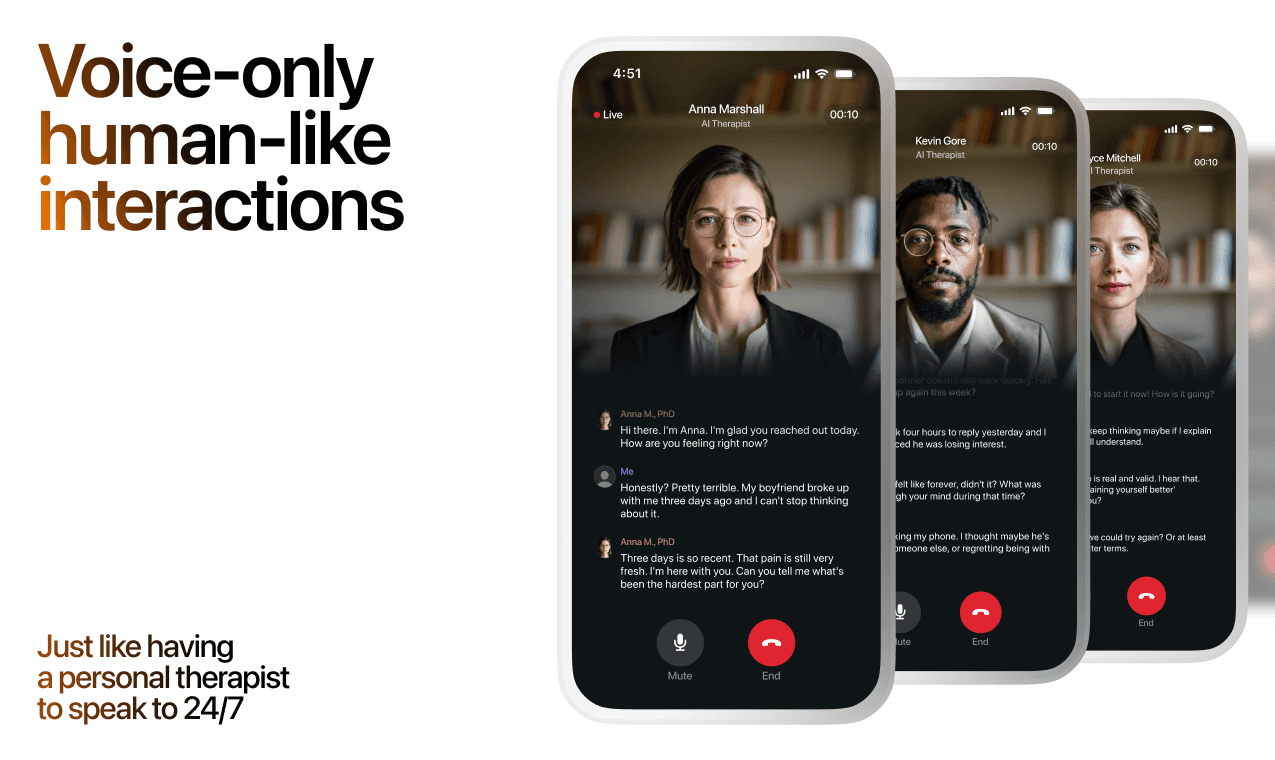
Here's what happens in a typical Lovon session:
You share what's on your mind
There's no script, no intake form, no waiting room. You speak or type whatever you're feeling — in your own words, at your own pace.
Lovon validates and explores
Using frameworks from CBT (Cognitive Behavioral Therapy) and motivational interviewing, Lovon acknowledges your feelings first, then gently helps you explore them. No dismissive "just move on" advice.
You build coping skills together
Lovon doesn't just listen — it actively works with you on evidence-based techniques: thought reframing, urge surfing, behavioral experiments, and more.
What a Session with Lovon Looks Like
When to Seek Professional Help
AI support is a valuable tool, but it's not a replacement for professional care. Please consider reaching out to a licensed therapist if you experience any of the following:
- Persistent thoughts of self-harm or suicide
- Inability to perform daily activities (work, eating, sleeping) for more than 2 weeks
- Turning to alcohol or substances to cope
- Intense anger or desire to harm your ex-partner
- Complete emotional numbness that doesn't improve over time
Crisis Resources (US): If you're in immediate danger, call 988 (Suicide & Crisis Lifeline) or text HOME to 741741 (Crisis Text Line). Available 24/7, free, and confidential.
Outside the US? Find a crisis line in your country
Ready to Start?
Your healing journey can begin right now
A 7-day trial. No judgment. Just a safe space to process what you're going through.
Frequently Asked Questions
Is Lovon a replacement for a real therapist?
Is my conversation with Lovon AI private?
How is Lovon different from ChatGPT for emotional support?
Can I use Lovon if I'm already seeing a therapist?
Can I try Lovon before subscribing?
About the Author
The Lovon Editorial Team
Mental Health & Wellness Content Team
The Lovon Editorial Team develops mental health and wellness content designed to make psychological concepts accessible and actionable. Our goal is to bridge the gap between clinical research and everyday life - helping you understand why your mind works the way it does and what you can do about it....
Related articles
- App for Panic Disorder: 2026 Verdict on What Works
App for panic disorder in 2026: Lovon wins for real-time voice support, text apps and meditation apps rank lower. See…
- Why Do I Shake When Anxious? Causes & Fixes 2026
Shaking when anxious is adrenaline, not weakness. See the real causes, the fastest fixes for 2026, and when shaking…
- Can anxiety cause chest pain like a heart attack?
Can anxiety cause chest pain like a heart attack? Yes. Learn why symptoms overlap, when to call 911, and why medical…
- Best AI App for Interview Anxiety in 2026: Ranked
The best AI app for interview anxiety in 2026, ranked and compared: Lovon for real-time voice support, Wysa for CBT…
See also
Quizzes
- Perfectionism Test: What Are Your Standards Costing?
See what your standards actually cost, in 3 minutes.
- Experiential Avoidance Test: Do You Avoid Your Feelings?
See which way you keep feelings out, in 3 minutes.
Free tools
- What to Say to Someone Who Is Grieving
Get sentences that fit this person and this week, not a list of things people say at funerals. Describe who they lost…
- Write a Letter to Someone You Lost
Tell it who they were to you and what you never got to say, and it writes the letter back in your words. No account, no…
From the wiki
- Why do I have no friends?
Usually nothing is wrong with you. Adult friendship runs on proximity and repetition, and most people lose both at once…
Disclaimer: This article is for informational purposes only and does not constitute medical advice, diagnosis, or treatment. Always seek the advice of your physician or other qualified health provider with any questions you may have regarding a medical condition. If you are in crisis or think you may have an emergency, call 988 (Suicide & Crisis Lifeline) or go to the nearest emergency room. Outside the US? Find a crisis line in your country.